
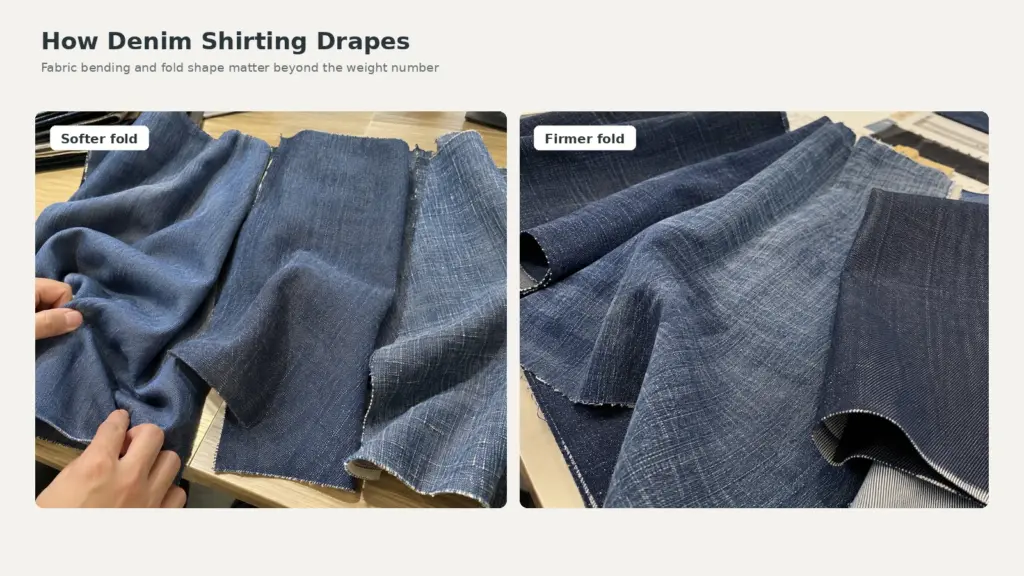
Two denim fabrics are both marked 6oz. One makes a soft, easy-moving shirt. The other feels stiff around the collar, pulls across the shoulders and looks heavier than the designer intended.
The fabric weights match. The finished shirts do not.
What changed? Not the number on the label. The difference can come from yarn size, weave density, fiber composition, finishing and the wash applied to the garment.
For a denim shirt, the fabric has to do more than look like denim. It must bend at the elbow, sit comfortably under a collar, form clean seams and keep its appearance after washing.
Here is how to choose denim fabric for shirts by finished garment performance—not weight alone.
Start With the Type of Shirt
“Denim shirt” describes several products with different fabric needs. Decide which one you are making before picking a weight.
- Soft everyday button-up: needs drape, manageable seams and comfortable sleeve movement.
- Relaxed western shirt: may tolerate a slightly firmer hand and pronounced twill or indigo character.
- Women’s blouse or shirt dress: often benefits from a more fluid hand and softer folds.
- Overshirt: is designed to act as an outer layer and may need extra body.
- Shirt jacket: can use substantially heavier construction, but should not be compared with an ordinary shirting fabric.
A fabric that works beautifully for an unlined overshirt may be uncomfortable or bulky in a fitted button-up shirt.
The first decision is therefore the intended silhouette, not whether a supplier calls a roll “lightweight denim.”
What Denim Weight Works Best for Shirts?
Denim weight is expressed in ounces per square yard (oz/yd²) or grams per square meter (GSM). 1 oz/yd² is approximately 33.9 GSM.
| Fabric Weight | Approx. GSM | Shirt Direction | What to Check |
|---|---|---|---|
| 4.5–5.5 oz | 153–186 | Very light shirts, blouses, shirt dresses | Opacity, seam stability, drape |
| 5.5–6.5 oz | 186–220 | Soft button-ups and casual denim shirts | Hand feel, shrinkage, sleeve movement |
| 6.5–8 oz | 220–271 | Western shirts and relaxed overshirts | Collar, placket and cuff bulk |
| 8–10 oz | 271–339 | Structured overshirts and shirt jackets | Layering room, seam bulk, garment weight |
These are sampling directions, not universal standards. Construction can matter as much as the ounce figure. A soft 7oz lyocell blend may drape differently from a compact 6oz cotton denim.
For a broader comparison, see Lightweight Denim Fabric: 6oz vs 8oz vs 10oz.
Is 6oz Denim Good for Shirts?
Often, yes. About 6oz is a sensible first range for many casual denim shirts, especially if you want visible denim twill without excessive garment weight.
But do not approve a 6oz fabric without checking how it bends, how the seams sit, and whether it provides enough coverage for the design.
Can an 8oz Denim Work for a Shirt?
Yes, especially for a relaxed western shirt or overshirt. It may look deliberately substantial, but designers should check whether the collar, double-folded placket and cuffs become too bulky.
For a conventional soft shirt, 8oz may be more rigid than intended. For a shirt jacket, the same fabric could be appropriate.
Why Hand Feel Can Matter More Than One Ounce
A garment’s hand feel is not a single technical value. Buyers often use terms such as soft, dry, crisp, compact, fluid or brushed to describe a complex combination of surface touch and bending behavior.
Three things influence it strongly.
Yarn and Weave
Yarn count, yarn twist, weave type and thread density change how readily a fabric bends. Different 2/1 or 3/1 twills can achieve different hands depending on the complete construction; one weave name does not automatically guarantee softness.
CottonWorks’ Denim Construction guide provides background on yarn and woven structures.
Fiber Composition
Cotton offers the familiar denim appearance and can be finished to a soft hand. Lyocell-containing denim is also worth comparing when a collection needs a fluid silhouette, though performance depends on blend ratio and yarn construction.
If an exact branded lyocell fiber is required, ask for proof; generic lyocell and the TENCEL™ trademark are not interchangeable.
Elastane is not mandatory for a comfortable shirt. A generous pattern and flexible lightweight woven construction may provide enough freedom of movement. When stretch is used, evaluate growth and recovery rather than relying on elastane percentage alone.
Finishing
Desizing, washing and mechanical or chemical softening may change a denim fabric dramatically. A stiff loom-state sample can soften after processing, while an overly aggressive finish might reduce the structure needed at collars and plackets.
The right comparison is between fabrics at the finish stage at which the garment will actually be sold.
Denim vs Chambray: Are They Interchangeable for Shirts?
Not exactly. A conventional denim is woven in a twill structure, often with a colored warp and lighter weft. Traditional chambray is typically a plain-weave fabric that may also use a colored warp and lighter weft.
Both can make blue shirts, but their surface pattern, texture and garment behavior may differ.
- Choose denim twill when diagonal texture and a more recognizably denim surface are important.
- Sample chambray when the target is a lighter-looking plain-weave shirt with a different surface character.
Neither is automatically softer or more breathable; weight, density, yarn and finish still need comparison. If a supplier offers a “denim-look” fabric, ask for the weave specification rather than relying on the label.
The Shirt Details That Expose a Bad Fabric Choice
A fabric may look promising as a folded swatch and still fail in the most visible parts of a shirt.
Collar and Collar Stand
The collar has multiple fabric layers and often interfacing. A fabric with too much thickness or stiffness can make the neckline feel rigid. A very fluid fabric may need a different interlining to hold the desired collar shape.
Front Placket and Buttonholes
Check folded edges, buttonhole quality and whether the placket twists or puckers after washing. Buttons and snaps may need reinforcement appropriate to the fabric weight and construction.
Cuffs and Sleeve Movement
A shirt must bend naturally at the elbow. Test sleeve movement with the correct pattern and check the cuff seams for uncomfortable bulk.
Yoke and Side Seams
Lightweight or loose constructions should be reviewed for seam slippage, puckering and distortion. These are construction-specific risks, not flaws inherent to every soft denim.
Opacity and Coverage
A very light denim may reveal underwear or seam allowances more than expected, particularly after washing. Assess the garment under realistic lighting, not only against a dark table.
This is why an attractive swatch does not replace a shirt prototype.
How Washing Changes a Lightweight Denim Shirt
Many denim shirts receive rinsing, enzyme washing, softening or a more developed garment wash. The result can change color, drape and garment size.
Check the following before approving bulk production:
- Warp and weft shrinkage: measure the actual dimensional change under the planned process.
- Collar, cuff and placket shape: confirm that repeated layers stay controlled rather than curling or distorting.
- Shade and color transfer: dark indigo or black shirts may transfer color to lighter garments or skin-contact layers; request relevant rubbing and laundering fastness tests.
- Seam puckering and twisting: inspect the finished shirt, including side seams and yoke.
- Surface character: aggressive abrasion or enzyme treatments may produce a different effect from the approved original swatch.
A fabric may feel delightfully soft after one wash but fail the intended look if the placket becomes wavy or the shade fades too far.
For weight-related wash considerations, the Denim Fabric Weight Guide provides useful context.
Rigid, Stretch and Lyocell: Which Direction Suits Your Shirt?
The best choice follows the cut and intended hand, not a simple hierarchy of fiber types.
| Shirt Style | Fabric Direction Worth Sampling | Priority |
|---|---|---|
| Soft regular button-up | 5–7oz cotton or suitable blend | Comfortable drape and clean seams |
| Fluid shirt dress | Lightweight cotton/lyocell or comparable soft construction | Movement, opacity, seam stability |
| Western denim shirt | 6–8oz cotton denim | Defined twill texture and collar handling |
| Relaxed overshirt | 7–9oz rigid or low-stretch denim | Layering and silhouette |
| Structured shirt jacket | 8–10oz or heavier, as design requires | Bulk, movement and durability |
These are only initial choices. Both rigid and stretch denim can produce good shirts, but the fit pattern must match the fabric behavior.
If the shirt must move closely with the body, review actual extension and recovery. The Stretch Denim Fabric Guide explains how to compare those properties.
For a lighter catalog option listed for shirts and dresses, compare C634 4.5oz cotton denim. Its weight is below the common sampling ranges above, so assess opacity, hand feel and the finished shirt rather than treating it as a 6oz substitute.
How to Test Denim Shirt Fabric Before Ordering
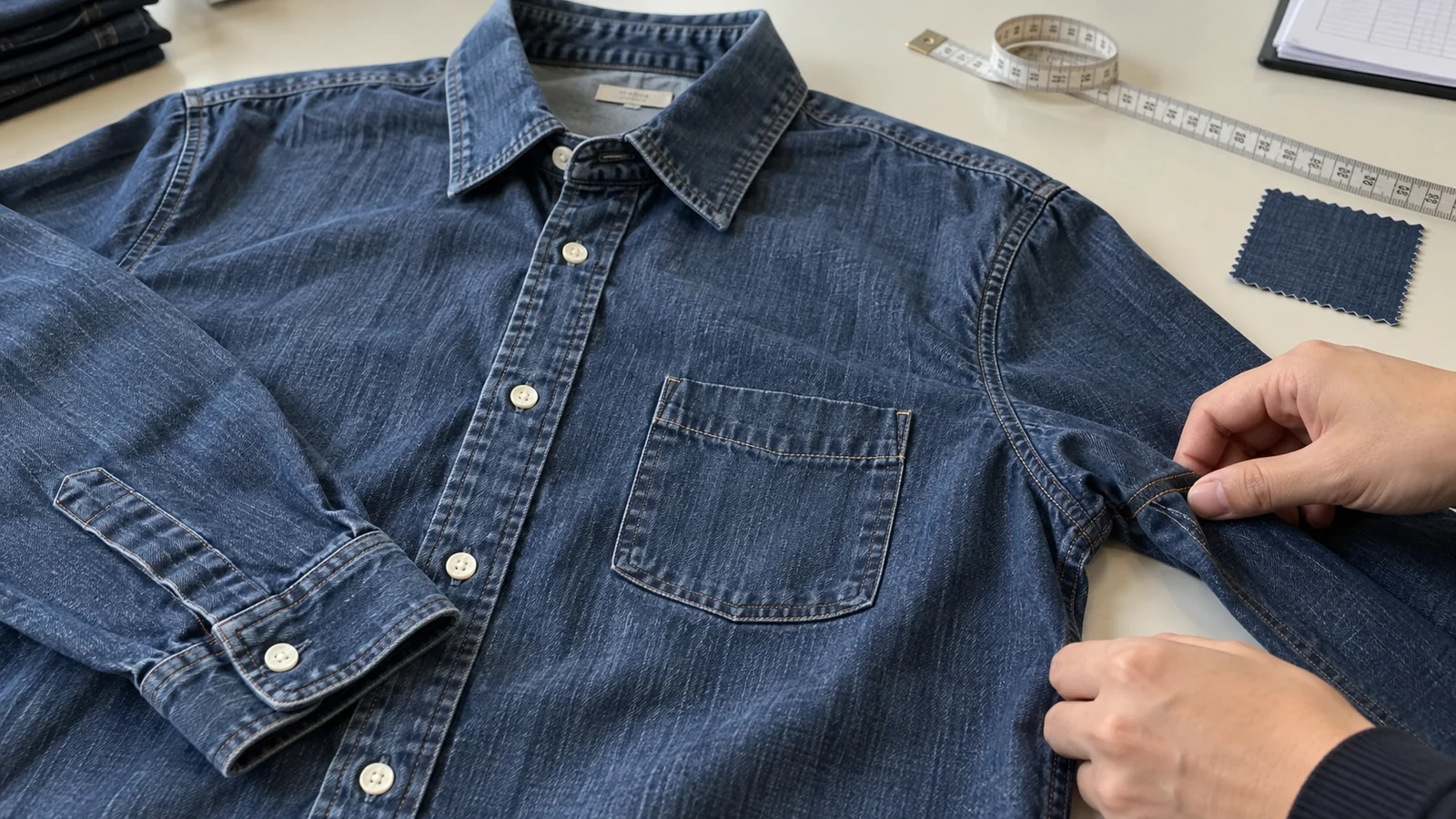
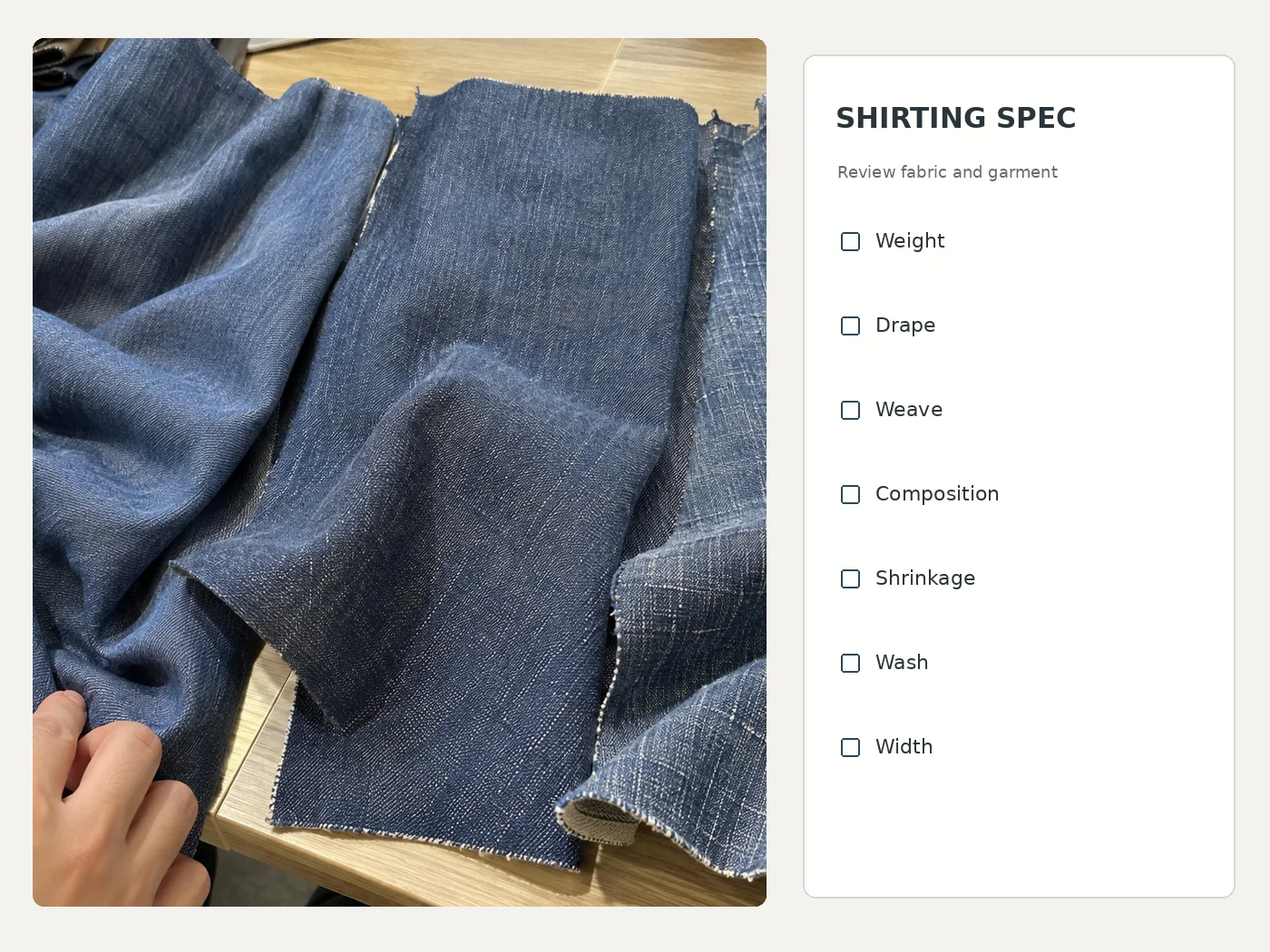
Ask for enough sample material to make at least one representative shirt if garment development is underway. A small swatch is useful for texture and shade but cannot fully show collar behavior or arm movement.
A practical evaluation sequence:
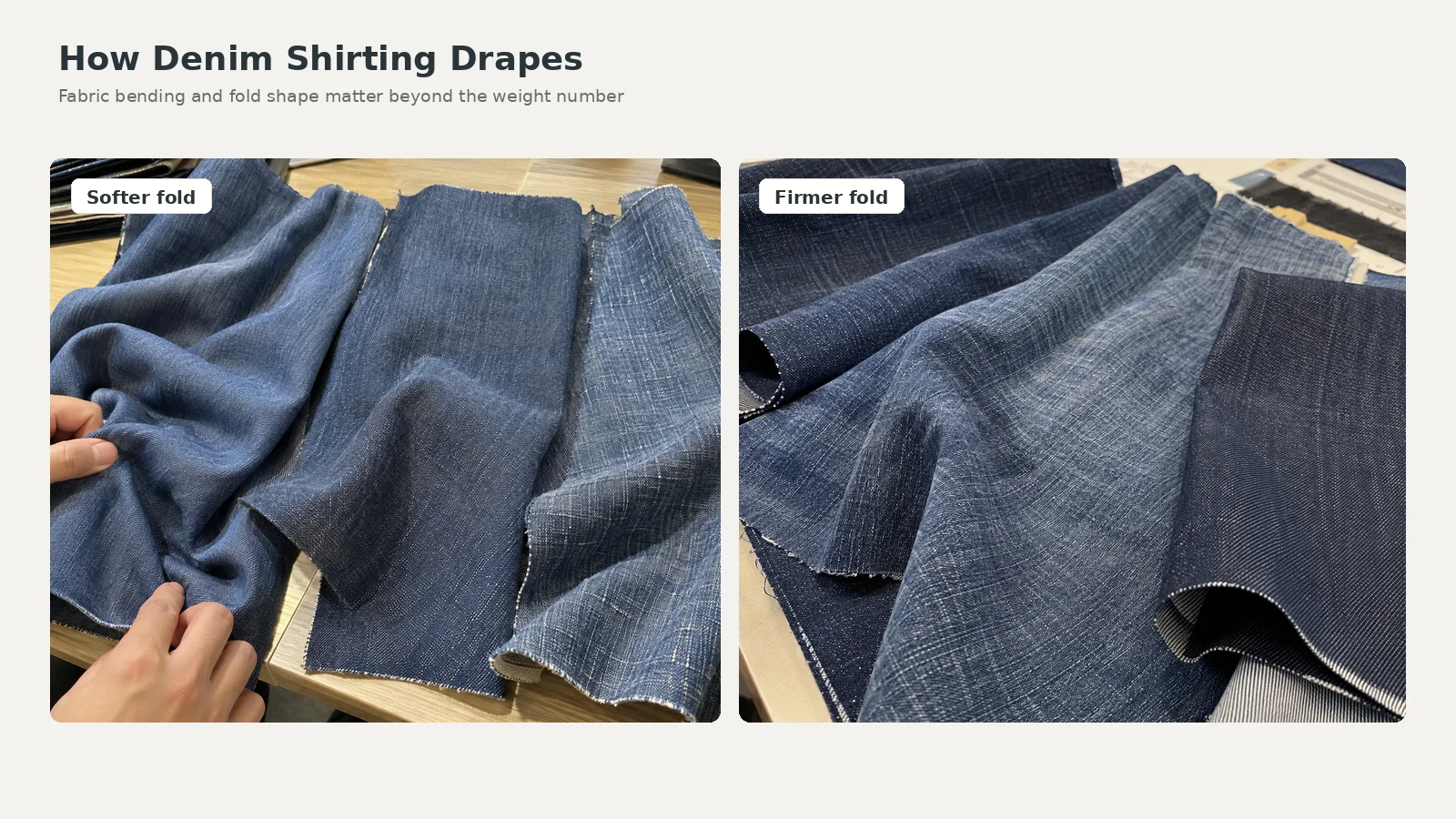
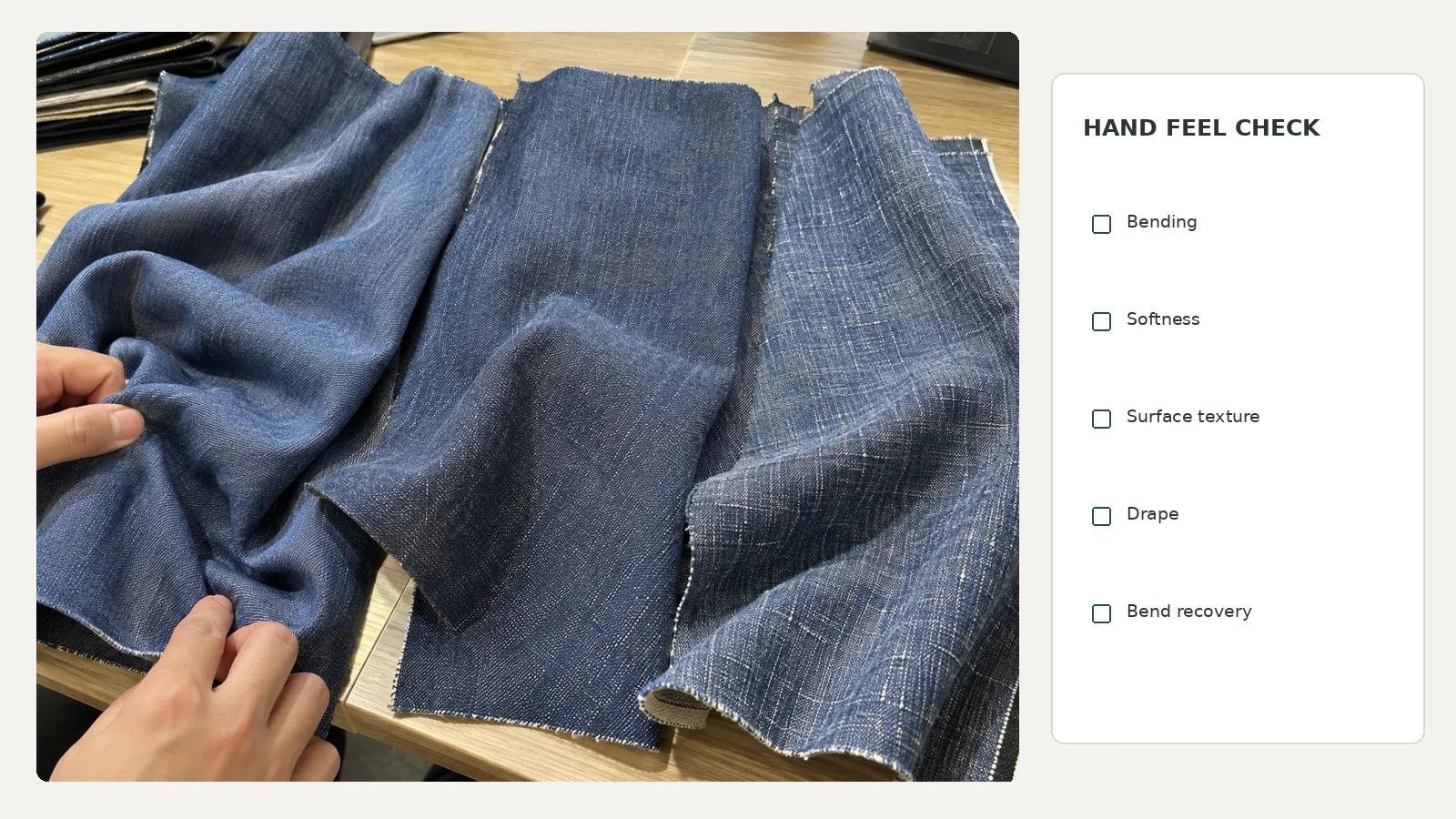
First, handle and drape. Fold the fabric at different angles, bend it across the bias and compare its hand with the intended shirt.
Next, sew key details. Make a collar, placket, cuff and a representative side seam using the intended stitching and interfacing.
Then, wash the sample. Follow the actual planned process. Measure dimensional change and evaluate color, softness, seam shape and puckering.
Finally, fit a whole garment. Check shoulders, sleeve movement, collar comfort, drape and opacity on a body or fit form.
When evaluating suppliers, request exact fiber composition, finished weight, usable width, intended wash, current lot and available test data for the selected fabric. Do not assume a listed weight guarantees repeatability or current stock.
What to Send a Supplier for Denim Shirt Fabric
The more precisely you describe your finished shirt, the more useful the sample shortlist becomes.
Example: Soft Casual Denim Shirt
We are developing a men’s casual button-up denim shirt. We want approximately 5.5–6.5oz dark-indigo denim with a medium-soft hand, natural drape and no required elastane. The garment will receive a gentle rinse or softening wash. Please suggest suitable options and provide composition, usable width, shrinkage information, current sampling availability and any relevant colorfastness test results.
Example: Structured Overshirt
We need an 8–9oz denim for a relaxed overshirt with a firm collar and two chest pockets. We prefer a clear twill texture and enough body to wear as a light outer layer. Please provide fabric options and confirm the construction, usable width, hand finish and wash behavior.
ZLDENIM can help compare available stock and supplier-network options, subject to actual quantities and specifications. See Denim Swatches & Sample Yardage to begin a fabric trial.
Common Mistakes When Choosing Denim for Shirts
Treating Every 6oz Fabric as Equivalent
Weight does not guarantee identical drape, density or hand feel. Request actual samples.
Choosing a Soft Fabric Without Sewing a Collar
A fabric can feel comfortable in the hand but behave poorly when folded into a collar stand or placket.
Ignoring Color Transfer
A dark shirt may be worn against a white undershirt or over a pale T-shirt. Appropriate dry and wet rubbing fastness testing can matter as much as the shade itself.
Selecting a Jeans Fabric for a Shirt Without Re-Evaluation
A denim built for five-pocket jeans may be unnecessarily heavy or firm for everyday shirting even when marketed as lightweight.
Approving Only the Unwashed Sample
Garment washing changes color, size, hand and construction details. Approve the result that will be delivered to the customer.
FAQ: Denim Fabric for Shirts
What is the best weight denim for a shirt?
Approximately 5–7oz is a useful place to start for many soft casual denim shirts, with lighter or heavier choices depending on design and hand feel.
Is 6oz denim suitable for button-up shirts?
Often yes. It can balance a recognizable denim surface with modest garment weight. Evaluate collar thickness, drape and wash shrinkage before approval.
Can I use 8oz denim for shirts?
Yes, particularly for western-style shirts, structured overshirts and shirt jackets. For a flowing shirt, a lighter construction may be preferable.
Is a lyocell blend better than cotton for denim shirts?
Not necessarily. Lyocell blends can be worth sampling for fluid drape, but the full yarn and weave construction determines the result. Cotton can also be finished to a soft hand.
Does a denim shirt need stretch?
No. Many relaxed shirts work with rigid lightweight denim. Stretch may help selected fitted patterns, but recovery and growth should be checked when applicable.
What tests matter for a lightweight denim shirt?
Depending on the garment and brand requirements, consider shrinkage, colorfastness, seam stability, strength, opacity, surface appearance and wash durability.
Is denim the same as chambray?
No. Traditional denim uses a twill construction, while traditional chambray uses a plain weave. Surface appearance and performance depend on the specific fabric.
Final Thoughts: Choose for the Shirt After Washing
Go back to the two 6oz fabrics in the opening example. They weigh the same, yet one works in a comfortable button-up and the other does not.
The difference is rarely solved by chasing an even lower number on the specification sheet. The right fabric has to suit the collar, sleeve, silhouette and intended wash together.
Begin with the shirt type. Select an approximate weight range. Compare yarn, weave, hand feel and composition. Then sew and wash a representative sample before committing to bulk fabric.
If you are sourcing denim fabric for shirts from China, send ZLDENIM your target garment, weight range, color, composition preference, desired hand, quantity and planned wash. We can help narrow relevant fabrics from available stock and our sourcing network, subject to current availability and sample approval. Contact ZLDENIM with your brief.