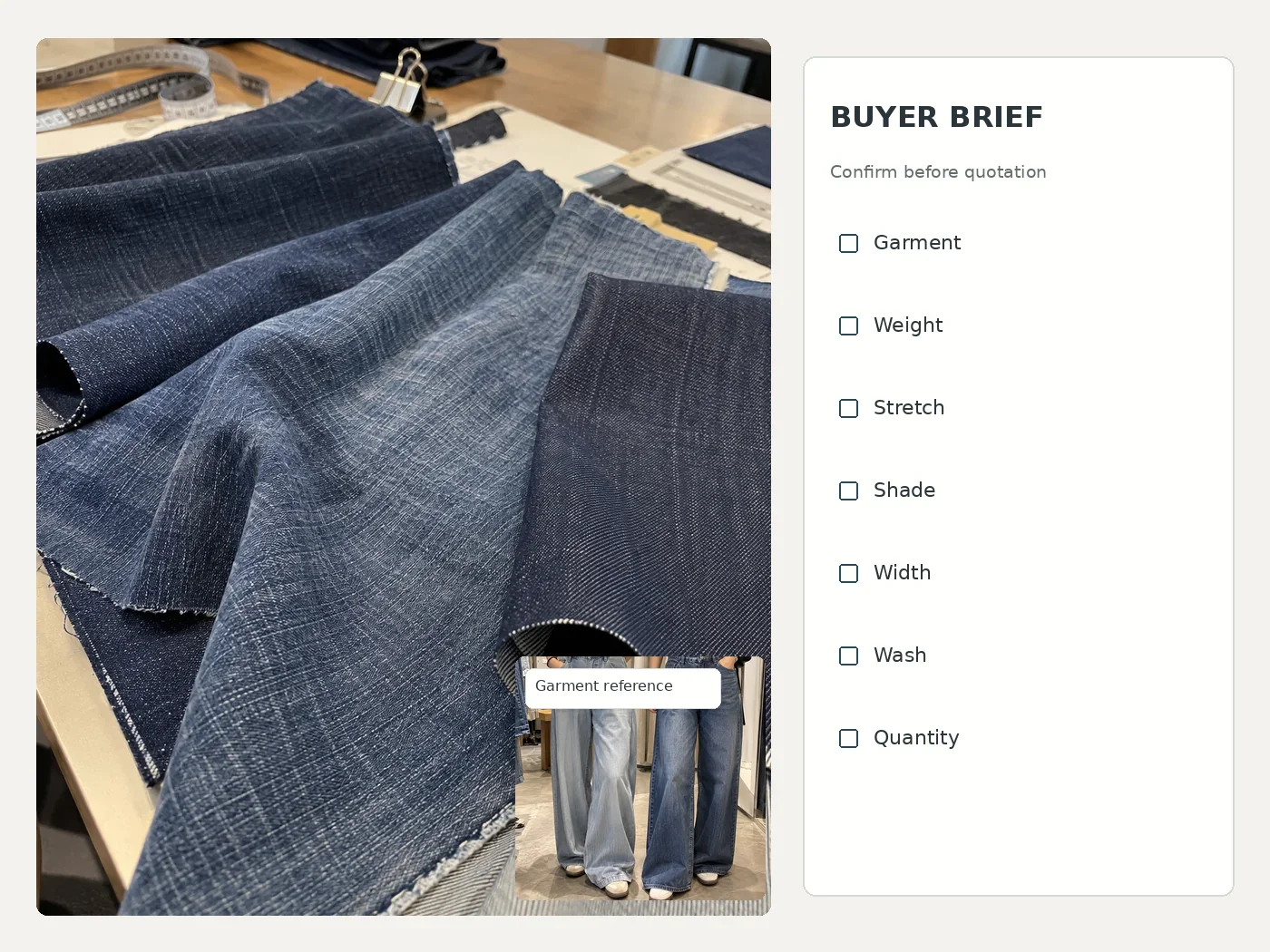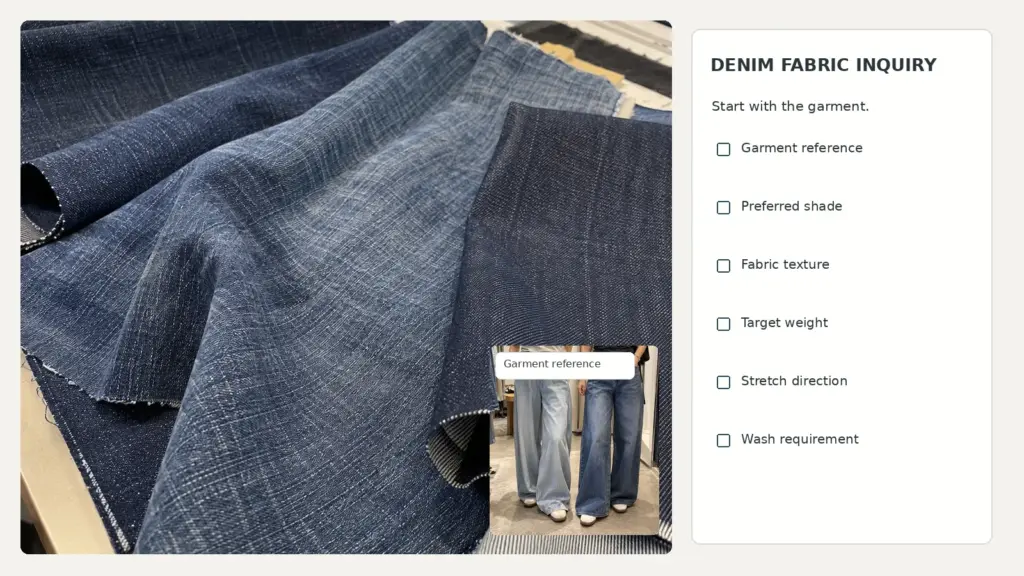
A buyer sends three suppliers the same message: “Do you have 11oz blue denim?”
One sends a rigid cotton swatch. Another quotes stretch denim. The third proposes a fabric with a wider usable width—but a different shade and finishing process.
All three suppliers answered the question. None necessarily quoted the same product.
That is the hidden cost of an incomplete denim inquiry. The problem is not always that suppliers reply slowly; sometimes the request leaves too many decisions to the supplier.
You do not need a complete laboratory specification to start sourcing. But a few well-chosen details can turn a vague request into a shortlist of fabrics you can actually compare.
This guide explains what to send a denim fabric supplier, what to ask back, and how to build a practical inquiry for samples or bulk orders.
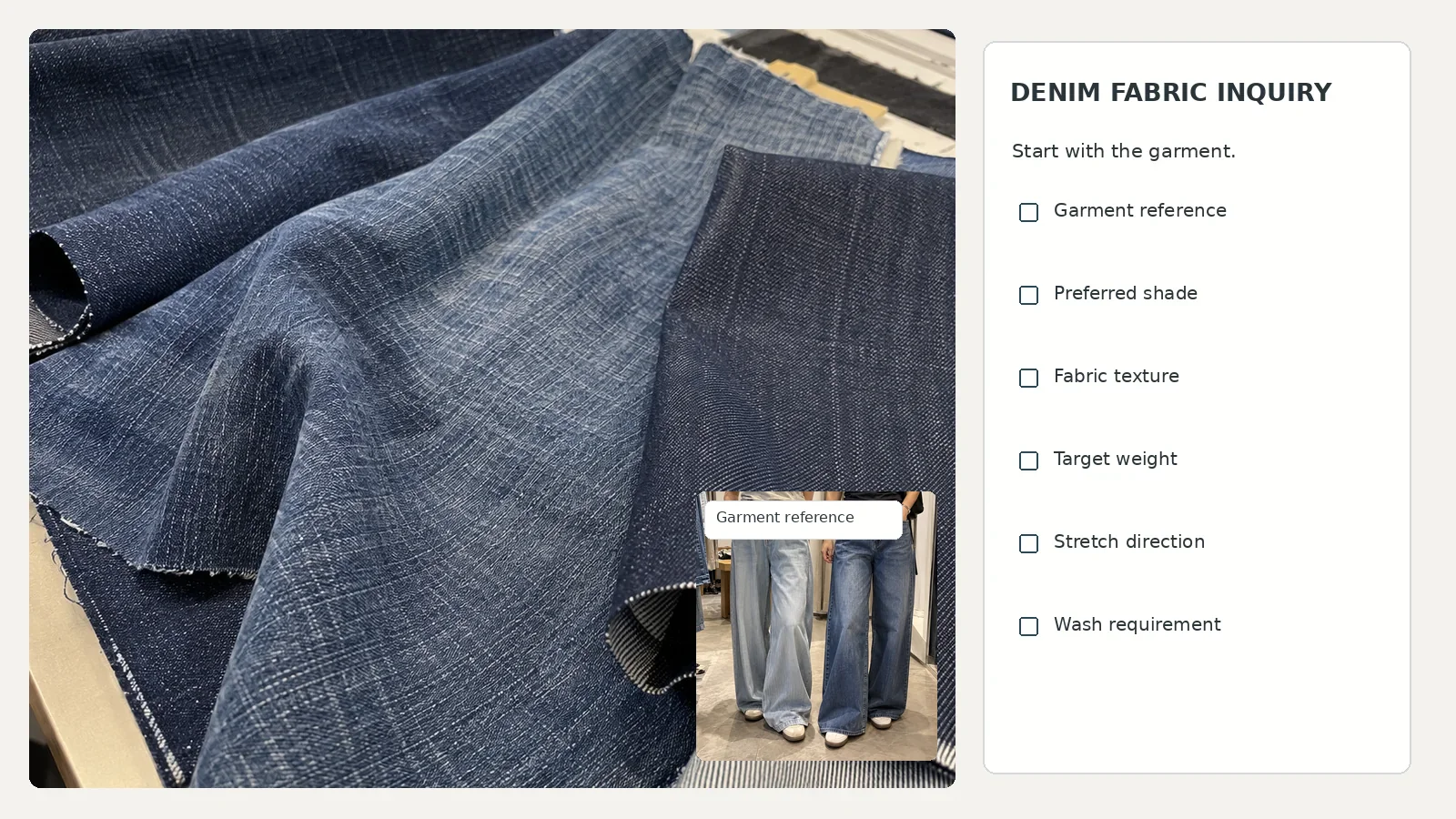
Start With the Garment, Not the Fabric Code
Before listing technical numbers, explain what you want to make. A lightweight overshirt, a fitted pair of jeans, and a rigid workwear jacket may all use blue denim, but they need different fabric behavior.
Tell the supplier:
- garment type and intended fit (straight, skinny, relaxed or wide-leg);
- men’s, women’s or children’s collection where relevant;
- intended season and approximate target market;
- whether the garment will be rinsed, enzyme washed, abraded or heavily finished;
- a reference garment, photograph or swatch if you have one.
The supplier can then judge whether a proposed fabric is appropriate for the finished garment, not just similar in color.
For jeans programs, specify the target silhouette and preferred fabric behavior instead of using a broad label such as “suitable for jeans.”
The 10 Details That Make a Denim Inquiry Useful
Some details are essential for an accurate match. Others can be described as a target range until the development team has tested fabric samples.
| Information to Send | Helpful Example | Why It Matters |
|---|---|---|
| Garment and fit | Men’s relaxed straight jeans | Sets structure and movement requirements |
| Weight | Target 10–12 oz/yd² | Narrows fabric mass and likely application |
| Composition | 100% cotton preferred; blends acceptable | Defines fiber and stretch options |
| Stretch | Rigid or 15–20% tested extension | Avoids confusing elastane content with actual fabric stretch |
| Color and appearance | Dark indigo, clean face, white back | Guides dye shade and visual character |
| Weave or texture | 3/1 twill, subtle slub | Helps match surface and construction |
| Hand feel | Medium-firm, not board-stiff | Describes the desired fabric touch |
| Width | At least 150 cm usable width if required | Affects garment marker and consumption |
| Wash and performance | Vintage wash; shrinkage data requested | Reveals wash-dependent approval risks |
| Quantity, destination and timing | 800 m estimate; shipping to Italy; target month | Separates stock inquiries from production planning |
Treat examples as illustrations, not default specifications. Do not insert an invented quantity, MOQ or testing grade in a real order.
1. Weight: Use a Range When Possible
Denim weight is usually expressed as ounces per square yard (oz/yd²) or grams per square meter (GSM). Approximately 1 oz/yd² equals 33.9 GSM.
Instead of insisting on exactly 11.0oz, a buyer might start with 10–12oz if the finished garment can accommodate more than one construction. A narrow tolerance can be added after sampling.
Weight changes drape, seam bulk and structure, but it cannot tell you the complete hand feel. Two 11oz fabrics can still behave differently.
See the Denim Fabric Weight Guide for garment-oriented weight ranges.
2. Composition: State What Is Required and What Is Flexible
Examples include 100% cotton, cotton/elastane, cotton/polyester/elastane or cotton/lyocell blends. If a branded fiber or exact ratio is mandatory, say so and request supporting documents where appropriate.
Do not claim certification simply because a supplier mentions a fiber name. The composition of the exact proposed fabric needs to be checked.
3. Stretch: Ask for Performance, Not Just Fiber Percentage
A fabric marked 98% cotton / 2% elastane does not mean it stretches by 2%. Buyers developing fitted jeans should ask for the actual stretch percentage, measurement direction, growth and recovery, where available.
Read the Stretch Denim Fabric Guide to understand the difference between extension and shape retention.
4. Shade, Surface and Back Color
“Blue” or “black” is rarely enough. Distinguish dark indigo from medium blue, and deep clean black from washed charcoal. If the lighter weft or fabric back will be visible in cuffs or seams, describe it too.
A physical standard is preferable for critical matching. Phone photographs can be helpful for discovery but cannot establish an exact color match under controlled lighting.
5. Width and Unit of Sale
Ask whether the quoted width is finished width or usable cutting width. Also confirm whether quantity and price are expressed per meter or yard; those are different units.
A lower meter price can be misleading if the usable width produces less efficient garment markers.
6. Washing and Performance Requirements
The final garment may differ from the supplied roll after washing. Specify the intended finish and ask which results are available for shrinkage, skew, colorfastness, tensile or tear strength and seam behavior where relevant.
Do not assume every supplier can provide every test. State which tests are mandatory for your buyer or market, and confirm methods and acceptance levels before approval.
Three Realistic Inquiry Scenarios
Different sourcing stages need different levels of detail. Asking for a full production quotation before you know the fabric specification can create false precision.
Scenario A: You Only Have a Garment Photo
Write: “We are developing women’s relaxed jeans similar to this photo. We prefer a soft medium-blue denim around 9–11oz, with low or moderate stretch. Please show comparable constructions and tell us which properties still need confirmation.”
This is a discovery request, not a promise that an exact photo match exists. The supplier should separate verified specifications from visual estimates.
Scenario B: You Need Swatches and Sample Yardage
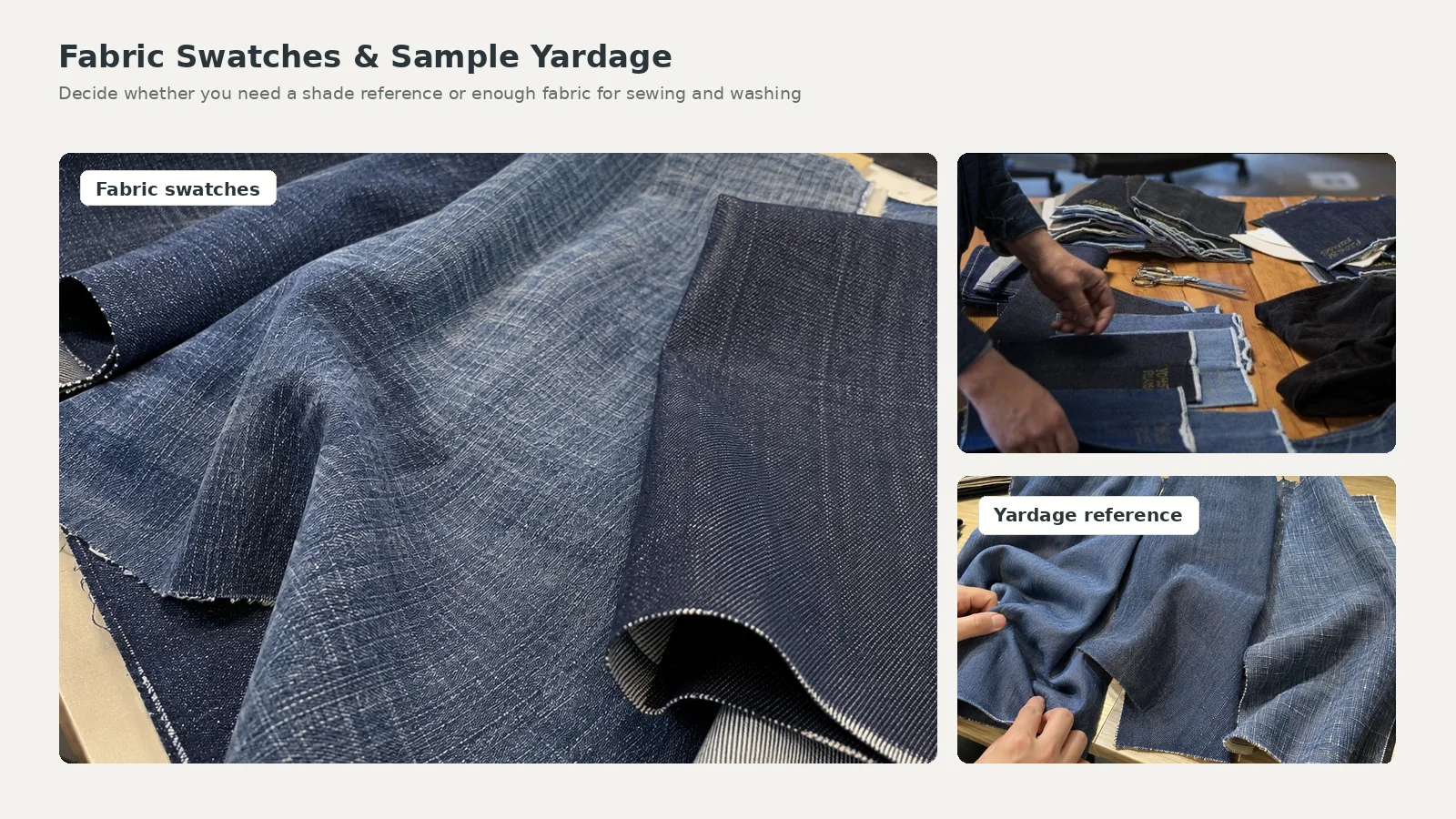
Write: “Please suggest 2–3 dark-indigo 100% cotton denims around 11–13oz for straight-leg jeans. We need initial swatches and, if suitable, enough yardage for a fit sample and garment wash. Please confirm swatch availability, minimum cut length, sample price and shipping terms.”
Swatches help judge hand and shade. Sample yardage allows cutting, sewing and washing evaluation. ZLDENIM’s sampling page describes how these options are confirmed fabric by fabric.
Scenario C: You Are Preparing a Bulk Order
Write: “We have approved a 10.5oz stretch denim sample for women’s slim jeans. Please quote the approved style and dye lot for approximately 1,200 meters, subject to final size breakdown and marker. Confirm available usable width, quantity, lot consistency, test information, packing, price basis and realistic dispatch timing.”
For a repeat or production program, include the approved fabric code and reference swatch. New production and available stock may have different minimums and lead times; neither should be assumed without confirmation.
A Copy-Ready Denim Fabric Inquiry Template
Subject: Denim Fabric Inquiry — [Garment / Target Weight / Color]
Hello, we are developing [garment and fit] for [market or season].
We are looking for [weight range], [fiber preference], [rigid or tested stretch requirement], and [shade / surface character]. The intended garment wash is [wash process or “not decided”].
Our target quantity is [estimated meters or yards], with delivery to [country/city] around [target period]. We need [swatches / sample yardage / bulk quotation].
Please share available fabric options, composition, weight, usable width, relevant test results and the current lot/quantity. Please also confirm sample availability, quotation basis and lead time. We can send a fabric or garment reference if necessary.
Do not fill gaps with guesses. Mark unknowns as “open for supplier recommendation.” This makes it easier to compare proposals honestly.
How to Compare Supplier Replies Without Mixing Specifications
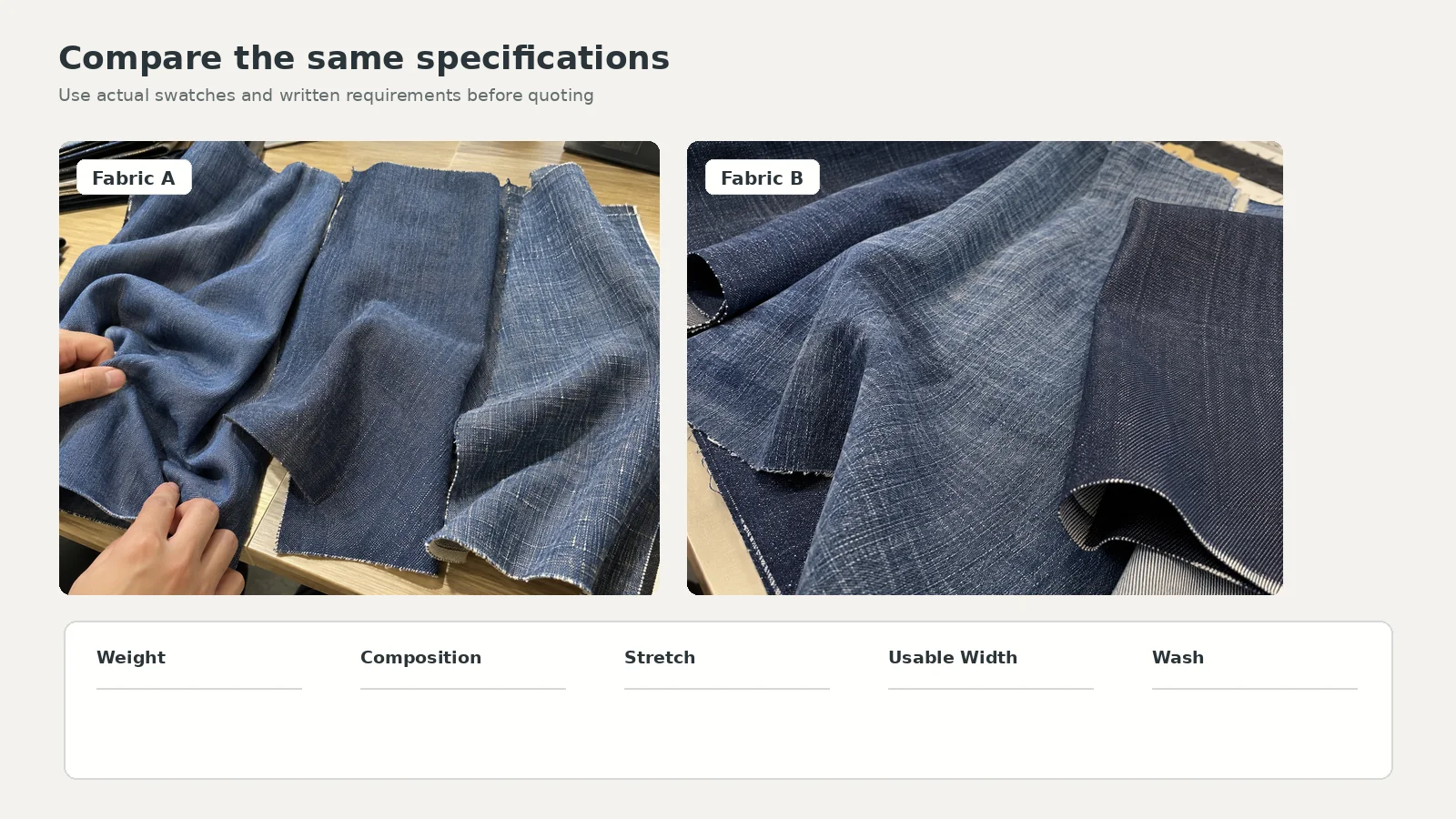
A fast quote is not necessarily a comparable quote. Once responses arrive, build a simple comparison using the same fields.
| Checkpoint | Supplier A | Supplier B | Decision Rule |
|---|---|---|---|
| Fabric weight | 11 oz | 11 oz | Equal weight is only a starting point |
| Stretch | Rigid | Comfort stretch | Different garment fit behavior |
| Usable width | Confirmed | Not provided | Request missing width before costing |
| Shrinkage | Tested under stated wash | Not provided | Do not treat results as equivalent |
| Price basis | Per meter | Per yard | Convert units before comparison |
| Lot / available quantity | Verified now | Estimated | Reconfirm before payment or cutting |
Ask the supplier to distinguish measured, estimated and not available. This matters for fabric weight, stretch, shrinkage and remaining stock.
If you receive a very low price, check whether it includes the same width, construction, shade approval, roll selection and packing basis.
Four Questions to Ask Before Paying for Fabric
- Is the offered fabric actual stock, partner stock or new production? Stock is not permanent inventory; quantities and lots can change.
- Can you identify the proposed fabric and current dye lot? A sample from a different lot may not represent the final supply perfectly.
- Which specifications are supported by tests or original records? Ask for methods and samples where necessary, rather than accepting unsupported adjectives.
- What happens if the approved fabric is no longer available? A similar replacement may require fresh approval, especially for color, stretch and washing.
A reliable sourcing process is built around verification rather than blanket promises. ZLDENIM’s sourcing FAQ explains the distinction between owned stock, partner stock and wider sourcing options.
Common Mistakes That Delay Denim Sourcing
Asking for “the Best Denim”
There is no universal best construction. Give the supplier a garment objective and a target price or performance constraint if one exists.
Treating a Reference Photo as a Test Report
A photograph cannot prove weight, composition, usable width, stretch percentage or shrinkage. Ask for actual values before approving a fabric.
Omitting the Garment Wash
The wash can change shade, size, hand feel and sometimes elastic behavior. A fabric approved on the roll is not necessarily approved as a finished garment.
Asking for an Exact Match Without Any Tolerance
If exact replication is mandatory, provide a physical reference and define measurable accept/reject criteria. If a close alternative is acceptable, indicate which requirements can vary.
Comparing Only Price per Meter
Usable width, garment consumption, quality requirements, available quantity and testing can change the actual cost of a satisfactory garment.
FAQ: What to Send a Denim Fabric Supplier
What details are essential for a first inquiry?
At minimum, share garment type, approximate weight, color, rigid/stretch preference, estimated quantity and your intended sampling or buying stage. Add composition, wash and width when known.
Can I ask for samples without knowing the exact fabric construction?
Yes. Describe the garment, fit, color, desired hand and approximate weight. The supplier can propose candidates, but their specifications must still be verified.
Should I send an image or a physical swatch?
Images are useful for initial discovery. A physical swatch or an approved garment is better for precise shade, texture and hand comparison. Neither replaces technical testing.
What is a typical MOQ for denim fabric?
There is no single MOQ that applies to all stock, suppliers and production routes. Confirm the actual minimum, whether cuts or rolls are available, and the terms for the particular fabric.
How many meters should I request for sampling?
That depends on the garment, number of samples and whether you need wash or sewing trials. Ask the supplier to confirm suitable sample quantities and availability.
What if my buyer requires a certification?
State the specific document or standard before sampling. Ask whether it applies to the exact proposed fabric, lot and chain of custody; do not assume all fabrics carry the same certifications.
Final Checklist: Make Every Reply Comparable
A useful denim inquiry does not have to be long. It has to prevent the most expensive misunderstandings.
Start with the garment. Add the weight range, composition, stretch, color, usable width and wash direction. Clarify what remains flexible. Then request samples and evidence for the specifications that matter.
That way, different suppliers can recommend different fabrics without leaving you uncertain about what they actually offered.
If you need a denim fabric sourcing comparison, send ZLDENIM your garment brief, target weight, stretch requirement, color, approximate quantity and any reference image or sample. We can help narrow suitable fabrics from available stock and sourcing partners, with current quantity and commercial terms confirmed for the specific option. You can contact ZLDENIM here.