
One of the first specifications you will see when sourcing denim fabric is a number such as 8 oz, 10 oz, 12 oz or 14 oz.
That number matters, but it does not tell you everything about the fabric.
Denim weight affects the structure, drape, comfort and overall feel of a garment. A lightweight denim may work well for a soft summer shirt, while the same fabric may feel too loose for a structured pair of jeans. A heavier denim can give jeans more body, but it may also create more bulk at seams and feel less suitable for warm climates.
For clothing brands, garment factories and sourcing teams, the practical question is therefore not:
“Which denim weight is best?”
It is:
“Which denim weight is suitable for this garment, fit, season and wash?”
This guide explains how to make that decision.
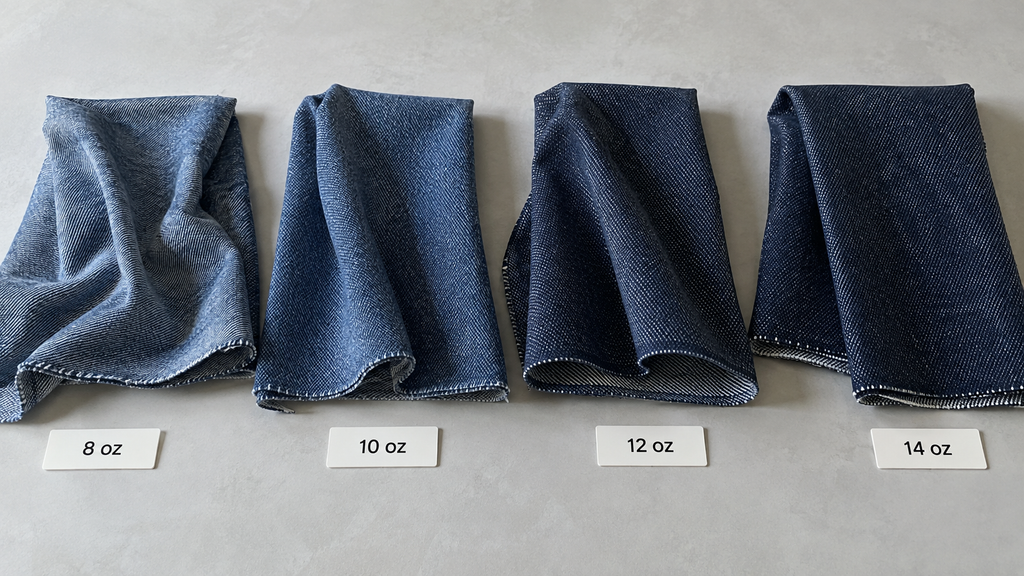
What Does Denim Fabric Weight Mean?
Denim weight is normally expressed in ounces per square yard, written as oz/yd² and usually shortened to “oz.”
For example:
- 8 oz denim weighs approximately 8 ounces per square yard
- 12 oz denim weighs approximately 12 ounces per square yard
- 14 oz denim weighs approximately 14 ounces per square yard
This is the weight of the fabric per unit area, not the total weight of a finished pair of jeans.
A higher oz number means more mass per square yard of fabric. In practice, heavier denim will often feel more substantial and structured, although weight alone does not determine thickness, stiffness or durability.
Yarn size, weave construction, density, fiber composition and finishing all affect how the fabric actually behaves.
Denim Oz vs GSM: What Is the Difference?
International buyers may receive denim specifications in either oz/yd² or GSM, meaning grams per square meter.
The approximate conversion is:
1 oz/yd² ≈ 33.9 GSM
Here is a quick reference:
| Denim Weight | Approx. GSM |
|---|---|
| 6 oz | 203 GSM |
| 8 oz | 271 GSM |
| 9 oz | 305 GSM |
| 10 oz | 339 GSM |
| 11 oz | 373 GSM |
| 12 oz | 407 GSM |
| 13 oz | 441 GSM |
| 14 oz | 475 GSM |
| 16 oz | 542 GSM |
These values are useful when a clothing brand specifies fabric in ounces while a mill, supplier or testing report works in GSM.
For sourcing, it is often useful to include both oz and GSM on the fabric specification sheet to reduce misunderstandings.
A Practical Denim Weight Guide by Garment Type
There is no single universal classification for lightweight, medium-weight and heavyweight denim. Different mills, brands and denim markets may use slightly different ranges.
For sourcing purposes, however, the following ranges are a useful starting point.
5–8 oz Denim: Lightweight and Drapey
Denim below approximately 8 oz is at the lighter end of the market.
It is commonly considered for garments where softness, movement and lower fabric weight are more important than a traditional heavy denim feel.
Typical applications include:
- denim shirts
- blouses
- dresses
- lightweight skirts
- summer garments
- relaxed overshirts
- some children’s garments
Lightweight denim can drape more easily around the body and is usually more suitable for warm-weather products.
However, buyers should check opacity, dimensional stability and garment structure carefully. A fabric that works for a loose shirt may not provide enough body for a structured five-pocket jean.
8–10 oz Denim: Light Bottom Weight
Around 8–10 oz is a useful range for brands that want denim character without a particularly heavy hand feel.
Possible applications include:
- lightweight jeans
- women’s fashion jeans
- shorts
- skirts
- casual pants
- lightweight jackets
- warm-weather denim programs
Stretch constructions are also common in this weight area because they can provide comfortable movement while keeping the garment relatively light.
For very fitted jeans, the stretch percentage and recovery performance may be as important as the ounce weight itself.
10–12 oz Denim: Versatile Everyday Denim
For many commercial denim programs, the 10–12 oz area is a practical place to begin sampling.
It can work for:
- everyday jeans
- straight-leg jeans
- relaxed jeans
- stretch jeans
- denim skirts
- casual workwear
- some denim jackets
This range can provide enough structure for many bottoms without moving immediately into a heavy or very rigid construction.
But two 11 oz fabrics can still feel completely different.
One may be soft, stretchy and heavily finished. Another may be rigid, dry and compact.
The number should therefore be used to narrow the selection, not to approve the fabric.
12–14 oz Denim: Classic Structured Jeans
The 12–14 oz range is strongly associated with traditional jeans and more structured denim garments.
Common applications include:
- classic five-pocket jeans
- rigid jeans
- straight and relaxed fits
- trucker-style jackets
- workwear-inspired garments
- vintage-style denim
These fabrics generally provide more body and a substantial denim hand.
If the garment will receive enzyme washing, stone washing or another strong finishing treatment, buyers should test how the selected fabric looks and feels after the intended wash, rather than judging only the original fabric roll.
14 oz and Above: Heavyweight Denim
Above approximately 14 oz, denim begins moving into heavier constructions.
Possible uses include:
- heavyweight jeans
- rigid denim
- heritage-inspired products
- heavy jackets
- workwear
- specialty raw denim programs
Heavy fabric can provide a strong, structured silhouette, but more weight does not automatically mean a better garment.
It may increase seam bulk, require appropriate sewing equipment and make a garment less comfortable for customers in hot climates.
Very heavyweight denim therefore tends to be a deliberate product choice rather than the default option for every jeans program.
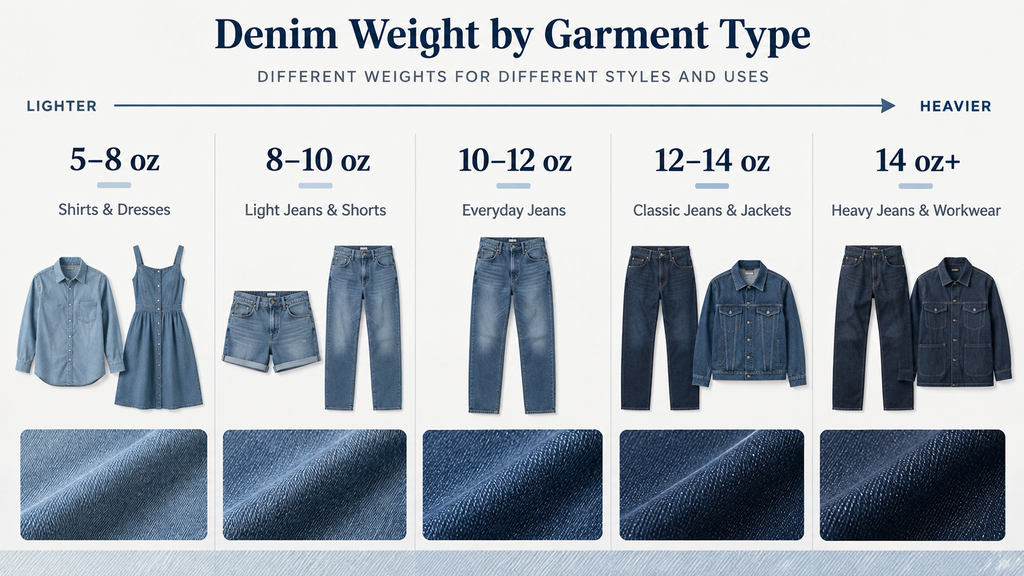
Quick Denim Weight Selection Table
| Weight Range | General Character | Common Garment Direction |
|---|---|---|
| 5–8 oz | Lightweight, softer drape | Shirts, dresses, light summer garments |
| 8–10 oz | Light bottom weight | Light jeans, skirts, shorts |
| 10–12 oz | Balanced and versatile | Everyday jeans, pants, casual denim |
| 12–14 oz | More structured | Classic jeans, jackets, rigid styles |
| 14 oz+ | Heavy and substantial | Heavy jeans, workwear, heritage styles |
This table should be treated as a starting point for sampling, not as a fixed industry rule.
Why Two 12 oz Denim Fabrics Can Feel Completely Different
This is one of the most important points for denim buyers.
If two suppliers both offer a 12 oz denim fabric, the fabrics are not automatically interchangeable.
Several other specifications can change the result.
1. Rigid vs Stretch
A 12 oz 100% cotton rigid denim may feel firm and structured.
A 12 oz cotton-stretch denim may feel softer and allow significantly more body movement.
For stretch denim, ask about:
- fiber composition
- stretch percentage
- stretch direction
- recovery
- finished width
Do not select stretch denim based on weight alone.
2. Yarn and Fabric Construction
Yarn count, yarn type, warp and weft density, and twill construction can all influence the character of a denim.
The same weight can be produced using different constructions.
That changes the appearance, surface texture, flexibility and hand feel of the finished cloth.
3. Finishing
Finishing can make denim feel:
- softer
- drier
- smoother
- fuller
- more compact
- more flexible
That is why touching or testing an actual fabric sample remains important even when the technical specification looks correct.
4. Garment Washing
Denim rarely ends its life looking exactly as it did on the fabric roll.
Garment washing may change:
- color
- hand feel
- surface character
- dimensions
- drape
- appearance of slub or texture
If your brand already knows the intended wash, evaluate the fabric together with that wash direction.
A beautiful raw fabric is not automatically the right fabric after washing.
Does Heavier Denim Mean Better Quality?
No.
Fabric weight and fabric quality are different questions.
A 14 oz denim is not automatically better than a 10 oz denim. It is simply heavier per unit area.
For a summer dress, a well-developed 7 oz denim may be much more suitable than a 14 oz fabric.
For structured rigid jeans, the opposite may be true.
Quality should be evaluated according to the intended product, including factors such as:
- fabric construction
- consistency
- color
- shrinkage
- dimensional stability
- stretch and recovery where required
- surface defects
- wash performance
- suitability for the garment
The goal is not to buy the heaviest fabric.
The goal is to buy the fabric that produces the right garment.
How Denim Weight Affects Garment Design
Drape and Silhouette
Light denim generally moves more easily and can create a softer silhouette.
Heavier denim tends to hold its shape more strongly.
This matters particularly for wide-leg jeans, skirts, dresses and oversized jackets.
A designer may want a wide-leg jean to fall cleanly rather than stand away from the body. In that case, weight and hand feel need to be considered together.
Comfort and Climate
Climate is another practical consideration.
A fabric developed for a northern European winter program may not be suitable for a hot Southeast Asian summer collection.
If the target market is warm, buyers may want to explore lighter constructions instead of automatically choosing traditional heavyweight denim.
Sewing and Seam Bulk
As denim gets heavier, folded areas such as:
- waistbands
- belt loops
- pocket corners
- hems
- felled seams
can become bulkier.
Garment factories should therefore know the fabric weight before production planning.
The problem is not simply whether a sewing machine can stitch the fabric. Multiple layers at seam intersections can behave very differently from one flat layer.
How Washing Can Affect Your Weight Decision
The intended garment wash should be discussed before the fabric is finally approved.
Imagine two projects:
Project A: dark rinse jeans with a clean, structured appearance.
Project B: heavily washed vintage jeans with a softer hand.
Even if both designs begin in a similar weight range, the most suitable base fabric may not be identical.
The wash process can change the hand, surface and overall character of denim.
For sourcing teams, this means the most useful question is often:
“How should this garment look and feel after washing?”
Then work backward to the fabric.
How to Choose Denim Weight: A Buyer’s Checklist
Before requesting denim samples, prepare the following information.
Garment Type
Specify whether you are making:
- jeans
- jackets
- shirts
- skirts
- shorts
- dresses
- workwear
Target Weight
If you already have a reference garment, provide the approximate oz or GSM.
If you do not know the exact number, describe whether you want the fabric to feel light, medium, structured or heavy.
Rigid or Stretch
State whether you need:
- 100% cotton rigid denim
- comfort stretch
- higher-stretch denim
- another fiber composition
Target Hand Feel
Useful descriptions include:
- soft
- dry
- crisp
- firm
- flexible
- compact
- vintage
A physical reference sample is even better.
Intended Wash
If known, explain whether the garment will use:
- rinse wash
- enzyme wash
- stone wash
- bleach effect
- vintage wash
- another finishing process
Shrinkage Requirements
Ask for shrinkage information and test the fabric under conditions relevant to the intended production process.
Do not assume that two fabrics with the same weight will shrink in the same way.
【配图建议4】
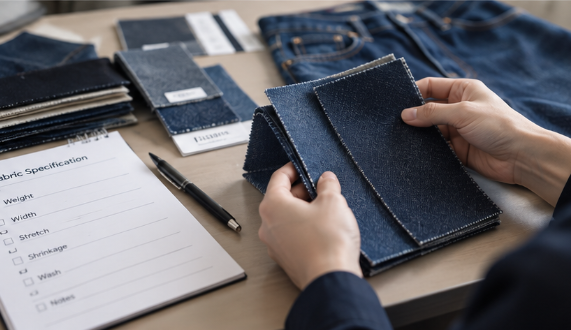
A Better Way to Request Denim Samples
Instead of sending a supplier a message such as:
“Please send me 12 oz denim.”
give more context.
For example:
We are developing men’s straight-leg jeans for an all-season collection. We are looking for approximately 11–12 oz blue denim, preferably rigid or low-stretch, with a medium-firm hand. The garment will receive a vintage wash.
That information gives the supplier a much better chance of selecting relevant fabrics.
If you have a reference garment or fabric swatch, sharing photos and technical information can narrow the selection further.
Common Mistakes When Choosing Denim Fabric Weight
Choosing Only by the Oz Number
Weight is useful for filtering fabrics, but it should not replace physical sample review.
Assuming Heavier Means More Durable
Durability depends on more than mass per square yard. Yarn, weave, construction, finishing, garment fit and sewing quality can all affect wear performance.
Ignoring the Final Wash
A denim fabric should ideally be evaluated with the intended garment finish in mind.
Ignoring Stretch and Recovery
For fitted jeans, stretch behavior may have a larger impact on comfort and fit than a small difference in ounce weight.
Approving Fabric Without Testing Shrinkage
Fabric width, garment dimensions and wash shrinkage can directly affect production.
Weight alone cannot predict them.
FAQ About Denim Fabric Weight
What weight denim is normally used for jeans?
Many jeans fall somewhere around the medium-weight area, often approximately 10–14 oz, but there is no single required weight.
Light fashion jeans may use lighter fabrics, while rigid, workwear or heritage jeans may use heavier constructions.
Is 12 oz denim heavy?
A 12 oz denim would generally be considered a versatile medium-weight denim rather than an extreme heavyweight fabric.
It is commonly suitable for jeans and some jackets, depending on the construction and finish.
Is 10 oz denim good for jeans?
Yes. Around 10 oz can work well for lightweight or comfortable jeans, especially where a brand wants less bulk or a product suitable for warmer conditions.
The final choice should also consider stretch, hand feel, fit and wash.
What GSM is 12 oz denim?
12 oz/yd² is approximately 407 GSM.
What GSM is 10 oz denim?
10 oz/yd² is approximately 339 GSM.
What GSM is 14 oz denim?
14 oz/yd² is approximately 475 GSM.
What denim weight is suitable for shirts?
Lightweight denim is normally more appropriate. Approximately 5–8 oz can be a useful starting range, depending on the desired drape and structure.
What denim weight is suitable for jackets?
There is a wide range.
Lighter overshirts may use fabric below 10 oz, while traditional denim jackets often use medium or heavier denim. The correct weight depends on whether the garment should feel soft and relaxed or rigid and structured.
Final Thought: Start With the Garment, Not the Number
Denim weight is one of the easiest specifications to compare, which is why buyers often focus on it first.
But it should be treated as a filter, not a complete fabric specification.
Start with the garment you want to make.
Then consider:
- weight
- construction
- rigid or stretch
- hand feel
- shrinkage
- washing
- target season
- finished silhouette
Once those factors are clear, comparing denim samples becomes much easier.
If you are looking for denim fabric for a new garment program, send ZLDENIM your target weight, garment type, stretch requirement, color, wash direction or reference image.
We can use that information to help narrow down suitable denim options from available fabrics and our supplier network.