
Stretch denim can make jeans easier to move in, improve comfort and allow designers to create closer-fitting silhouettes.
But choosing stretch denim is not as simple as asking:
“Does this fabric contain 1% or 2% elastane?”
Two denim fabrics can both contain 2% elastane and behave very differently.
One may offer only gentle comfort stretch. Another may extend much further. One may return close to its original shape after wear, while another may start bagging at the knees and seat.
For buyers, the more useful questions are:
- How much does the fabric actually stretch?
- In which direction does it stretch?
- How well does it recover?
- How much growth remains after stretching?
- What fit and garment is the fabric intended for?
This guide explains how clothing brands, garment factories and sourcing teams can evaluate stretch denim more effectively.
What Is Stretch Denim Fabric?
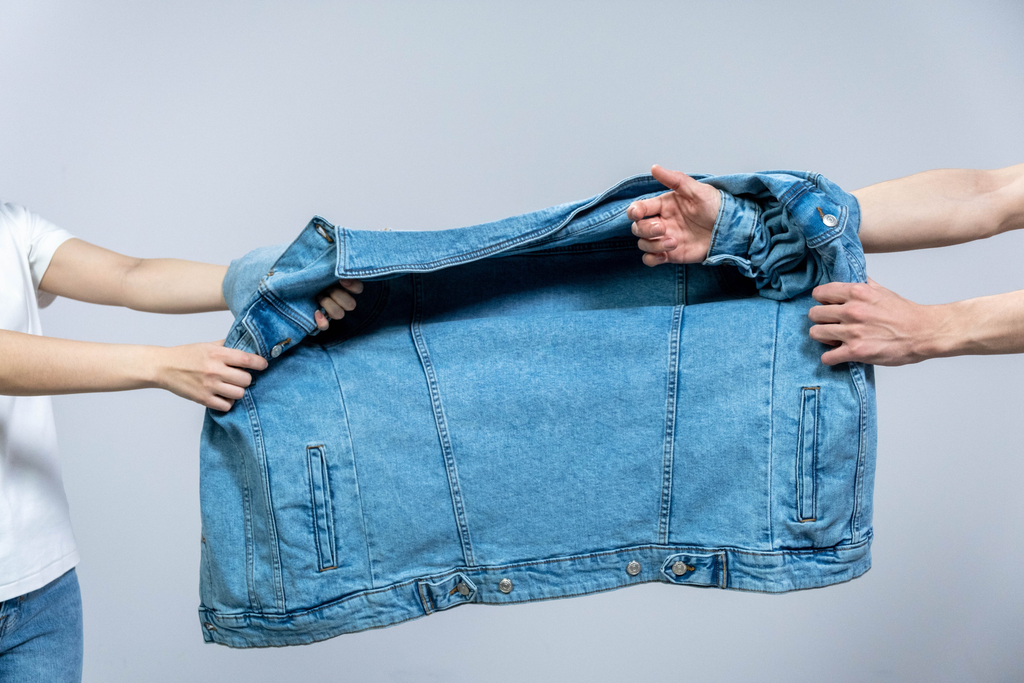
Stretch denim is woven denim designed to extend when force is applied and then recover toward its original dimensions when the force is removed.
Many stretch denim fabrics use cotton together with a small amount of elastane, also called spandex. In denim production, elastic yarn may be placed inside a cotton-covered core-spun yarn, commonly in the weft direction. CottonWorks describes core-spun denim yarns as cotton fibers wrapped around a spandex core to create elastic yarn for stretch constructions.
However, elastane is not the only way to create flexibility.
Mechanical stretch constructions can also produce movement without elastane. Cotton Incorporated, for example, reports typical fill-direction stretch of approximately 10–18% for its 100% cotton mechanical-stretch construction, depending on fabric weight and weave.
This is why buyers should separate two different specifications:
fiber composition
and
actual fabric stretch performance
They are related, but they are not the same thing.
Elastane Percentage Is Not the Same as Stretch Percentage
This is probably the most common misunderstanding when sourcing stretch denim.
Suppose a fabric specification says:
98% Cotton / 2% Elastane
The 2% tells you the amount of elastane fiber in the fabric.
It does not mean the fabric stretches only 2%.
Actual fabric extension depends on several factors:
- elastane yarn specification
- yarn construction
- amount of elastic yarn used
- fabric density
- weave structure
- finishing
- heat setting
- fabric weight
- direction of stretch
Even a relatively small amount of elastane can significantly change fabric movement. Spandex itself is an elastomeric fiber capable of very high elongation, while the final stretch of denim is controlled by the complete fabric construction rather than the raw fiber percentage alone.
For buying purposes, therefore, asking only for “2% spandex denim” is not enough.
Ask for the fabric’s tested stretch percentage as well.
What Does 20%, 30% or 50% Stretch Mean?
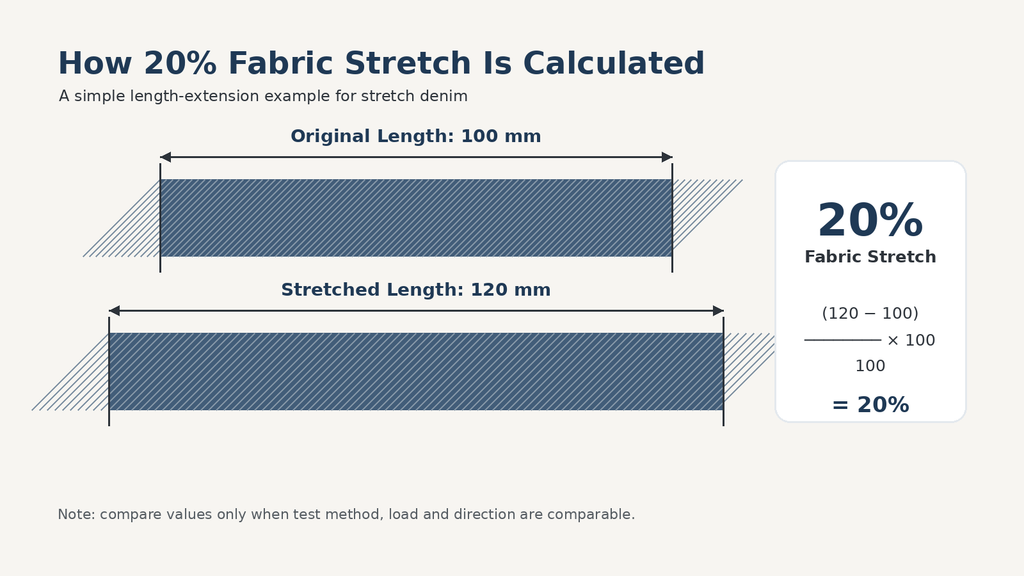
Stretch percentage describes how far a fabric can extend compared with its original dimension under a defined test condition.
A simplified example:
If a 100 mm section of fabric extends to 120 mm during testing, the extension is approximately:
(120 − 100) ÷ 100 × 100 = 20% stretch
A fabric with 40% stretch would extend considerably further than a 20% stretch fabric under the same test conditions.
There is an important qualification:
stretch values are only useful when the test method, load and direction are comparable.
A supplier’s “30% stretch” measured under one method should not automatically be treated as identical to another supplier’s 30% result measured differently.
ASTM D3107-26, the current ASTM standard for woven stretch fabrics, covers measurements including fabric stretch, growth and recovery after specified tension and extension. ASTM also notes that some stretch woven fabrics contain stretch yarn only in the filling direction, so only that direction may require testing.
When comparing suppliers, ask:
“What test method and direction were used for this stretch value?”
A Practical Guide to Stretch Denim Levels
There is no single universal industry rule defining where “comfort stretch” ends and “high stretch” begins.
Brands, mills and suppliers may use these terms differently.
For example, one current commercial guide describes approximately 5–25% as comfort stretch, 26–35% as dynamic stretch and higher values as performance-oriented stretch, while mechanical cotton stretch can already reach around 10–18% without elastane.
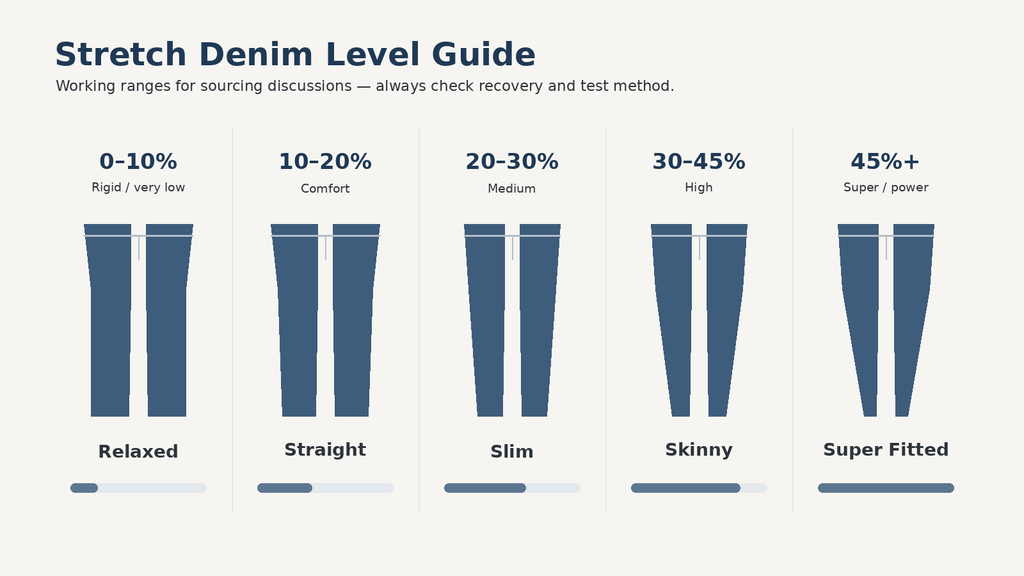
For sourcing discussions, the following ranges can be used as a working guide, not as a mandatory industry classification.
| Approx. Stretch | Practical Description | Typical Direction |
|---|---|---|
| 0–10% | Rigid to very low stretch | Classic structure |
| 10–20% | Low / comfort stretch | Easy movement |
| 20–30% | Medium stretch | Slim and everyday fitted jeans |
| 30–45% | High stretch | Close-fitting fashion jeans |
| 45%+ | Super / power stretch | Very fitted or highly flexible styles |
The exact number should always be considered together with recovery, growth, weight and garment fit.
0–10%: Rigid or Very Low Stretch
This range is closest to traditional rigid denim behavior.
It may suit:
- straight-leg jeans
- relaxed jeans
- workwear-inspired products
- vintage-style denim
- jackets
- loose silhouettes
Some fabrics in this range may have no elastane at all.
They can feel firmer and provide stronger garment structure, although comfort depends heavily on weight, finishing and fit.
10–20%: Comfort Stretch
This level provides noticeable ease of movement while retaining much of the traditional denim character.
It can work well for:
- straight jeans
- slim-straight jeans
- men’s casual jeans
- relaxed women’s jeans
- everyday trousers
- garments where flexibility is useful but a very elastic feel is not wanted
For many general jeans programs, this can be a useful starting point.
20–30%: Medium Stretch
As stretch increases, the fabric can accommodate a closer fit while still maintaining a recognizable woven-denim feel.
Possible applications include:
- slim jeans
- fitted straight-leg jeans
- women’s fashion jeans
- tapered jeans
- comfortable travel jeans
At this level, recovery becomes increasingly important.
If the fabric stretches comfortably but remains permanently extended after sitting or bending, the garment may lose its original silhouette.
30–45%: High Stretch
High-stretch denim is often suitable for garments designed to follow the body more closely.
Typical applications may include:
- skinny jeans
- fitted women’s jeans
- narrow tapered styles
- close-fitting children’s jeans
- highly flexible fashion denim
High extension can improve mobility, but buyers should not assume that higher stretch automatically means higher quality.
The fabric still needs enough recovery to control the garment.
45% and Above: Super Stretch or Power Stretch
At very high extension levels, denim can begin to behave much more like a performance fabric while still retaining a denim appearance.
Possible uses include:
- very close-fitting skinny jeans
- body-contouring styles
- highly flexible travel garments
- fashion products designed around maximum mobility
For these garments, stretch alone is not the main performance target.
Recovery and growth control become critical.
Stretch Is Only Half the Story: What Is Fabric Recovery?
A denim fabric may stretch very well and still perform badly in a garment.
Why?
Because it also needs to return toward its original dimensions.
This is where recovery becomes important.
Imagine someone wearing fitted jeans and sitting for several hours.
The fabric around the:
- knees
- hips
- seat
- thighs
remains under repeated or prolonged stress.
After the wearer stands up, a good stretch denim should recover enough to maintain the intended silhouette.
If recovery is poor, the jeans may begin to look loose or baggy.
ASTM D3107 specifically evaluates stretch, growth and recovery because all three help predict how stretch woven fabrics may behave during use.
For buyers, this means:
Do not approve a fabric just because it feels very stretchy in your hand.
What Is Fabric Growth?
Growth is closely related to recovery, but it is worth discussing separately.
Fabric growth describes the dimensional change that remains after the fabric has been stretched and the force is removed.
In practical garment terms, excessive growth may appear as:
- baggy knees
- a loose seat
- waistband relaxation
- loss of shape after several hours
- a garment becoming larger during wear
Consider two fabrics:
Fabric A: 35% stretch with good recovery
Fabric B: 45% stretch but poor recovery
Fabric B has the larger stretch number.
That does not automatically make it the better fabric.
For a fitted jean, Fabric A may maintain its shape much better.
This is why professional fabric evaluation should look at stretch + growth + recovery, rather than stretch percentage alone.
2-Way Stretch vs 4-Way Stretch Denim
Another question buyers should ask is:
Which direction stretches?
Weft Stretch / 2-Way Stretch Denim
Traditional stretch denim commonly places elastic performance in the weft, or crosswise direction.
This lets the fabric stretch around the body.
That is useful for:
- waist and hip movement
- thighs
- sitting
- walking
- bending
This type of construction remains common because horizontal movement provides much of the comfort needed in ordinary jeans.
Bi-Stretch / 4-Way Stretch Denim
Some fabrics are engineered to stretch in both the width and length directions.
They may be described commercially as:
- bi-stretch
- dual-core stretch
- 4-way stretch
- multi-directional stretch
These constructions can offer greater freedom of movement and may suit very fitted or performance-oriented garments.
However, greater directional stretch also increases the importance of dimensional stability.
Warp and weft behavior should both be considered during garment testing.
Why Stretch Denim Can Cause Size Problems
Stretch affects more than comfort.
It can affect garment measurements during:
- cutting
- sewing
- washing
- finishing
- wearing
Highly elastic fabrics may relax after being rolled, spread or cut.
If fabric tension changes during cutting, garment panels can also behave differently after relaxation.
Washing can further change the dimensions.
That means a garment factory should not assume that a pattern developed for rigid denim can simply be used unchanged for a high-stretch fabric.
The more elastic the fabric becomes, the more important it is to evaluate:
- finished fabric width
- relaxation
- shrinkage
- stretch
- growth
- recovery
- pattern ease
- finished garment measurements
Does More Elastane Mean More Stretch?
Not necessarily.
A buyer may see:
99% Cotton / 1% Elastane
and
98% Cotton / 2% Elastane
and assume the second fabric must provide twice as much stretch.
Fabric engineering does not work that simply.
Core-spun yarn design, yarn tension, weave density and finishing can all influence how much of the elastic fiber’s potential is expressed in the final fabric. CottonWorks also notes that stretch fabric manufacturing involves considerations such as elastic yarn assembly, weaving, wet processing and heat setting.
Therefore:
Elastane percentage is a composition specification.
Stretch percentage is a performance specification.
Buyers need both.
How Fabric Weight Changes the Stretch Experience
Stretch percentage should also be viewed together with denim weight.
For example:
A 9 oz high-stretch denim may feel soft, light and flexible.
A 13 oz fabric with the same measured stretch percentage may feel much more substantial.
The numerical extension can be similar while the wearing experience is completely different.
Weight affects:
- body
- drape
- perceived compression
- thickness
- warmth
- garment structure
For this reason, buyers should compare fabrics with the complete specification rather than selecting only by stretch percentage.
A useful sourcing description might be:
“11 oz blue denim, approximately 25% weft stretch, medium-soft hand, for women’s slim straight jeans.”
That is much more useful than:
“We need stretch denim.”
How Garment Fit Changes the Stretch Requirement
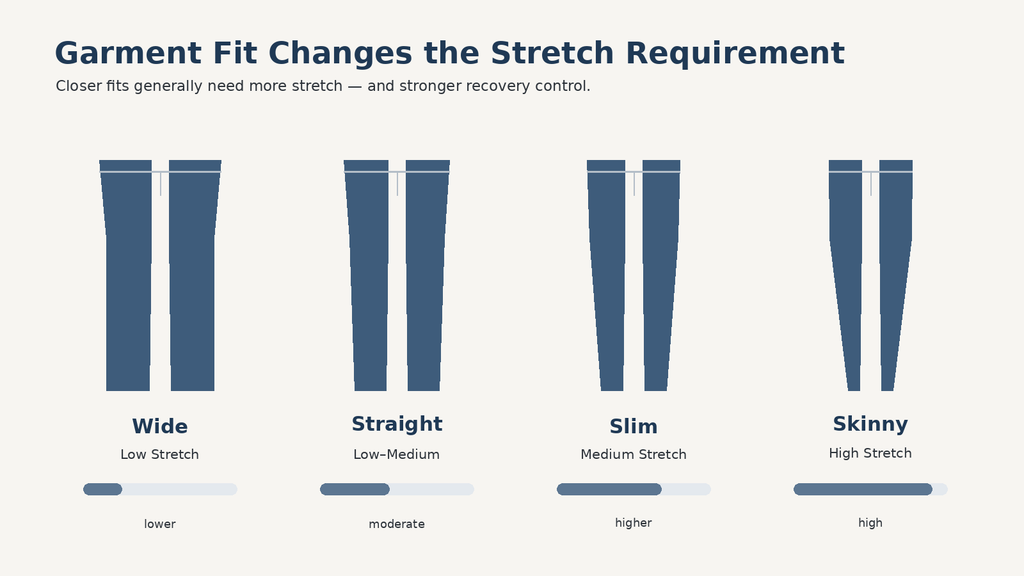
The correct stretch level depends heavily on the intended silhouette.
Relaxed and Wide-Leg Jeans
These garments usually do not need very high stretch because the pattern already provides movement.
Too much elasticity may even change the intended drape.
The priorities may instead be:
- hand feel
- weight
- drape
- wash effect
- structure
Straight-Leg Jeans
Low or comfort stretch can provide easier movement while preserving a traditional denim appearance.
Slim Jeans
Moderate stretch can help the garment follow the body without making movement uncomfortable.
Recovery becomes more important as the fit gets closer.
Skinny Jeans
High stretch is often useful because the pattern contains less physical ease.
The fabric must stretch with the body and then recover well enough to maintain the silhouette.
Very Fitted Fashion Denim
Super-stretch fabrics may be appropriate, but the entire garment should be developed around that performance.
Pattern, waistband construction, sewing and washing all need to work with the fabric.
Stretch Denim for Men’s and Women’s Jeans
There is no technical rule saying that men’s denim must use low stretch and women’s denim must use high stretch.
The decision should be based on fit.
A relaxed women’s jean may need less stretch than a fitted men’s skinny jean.
That said, different product categories often create different commercial requirements.
Men’s Jeans
Common priorities may include:
- traditional denim hand
- moderate comfort
- structure
- resistance to bagging
- low to medium stretch for slim fits
Women’s Jeans
Depending on the style, buyers may prioritize:
- easier hip movement
- closer fit
- softer hand
- higher stretch
- stronger recovery
- body-contouring performance
The fit block should determine the fabric rather than gender labels alone.
How Washing Affects Stretch Denim
Garment washing should be part of the fabric approval process.
Stretch denim may go through processes such as:
- desizing
- enzyme washing
- stone washing
- bleaching
- softening
- tinting
- drying
These processes can change:
- dimensions
- hand feel
- fabric tension
- elastic behavior
- finished garment fit
Heat setting and wet processing are particularly relevant to stretch fabrics because incorrect processing conditions can affect dimensional control and elastic performance.
A fabric that performs well before washing should therefore still be tested after the intended garment wash.
A Practical Stretch Denim Buying Checklist
Before requesting samples, prepare the following information.
1. Garment Type
For example:
- men’s jeans
- women’s jeans
- children’s jeans
- denim shorts
- denim skirt
- jacket
2. Fit
Specify:
- wide
- relaxed
- straight
- slim
- skinny
- body fit
3. Target Fabric Weight
Give oz or GSM where possible.
For example:
10–11 oz finished weight
4. Stretch Direction
Specify whether you need:
- weft stretch
- bi-stretch
- 4-way stretch
5. Target Stretch Percentage
If known, give a range.
For example:
20–25% weft stretch
6. Recovery or Growth Requirement
If the garment needs to remain fitted throughout the day, ask for performance data instead of evaluating stretch by hand only.
7. Fiber Composition
Examples may include:
- cotton/elastane
- cotton/polyester/elastane
- cotton/viscose/elastane
- cotton/lyocell/elastane
Different blends can change softness, drape, weight and garment behavior.
8. Wash Direction
Explain the target finish:
- dark rinse
- medium wash
- vintage wash
- light wash
- black wash
- heavy abrasion
9. Reference Sample
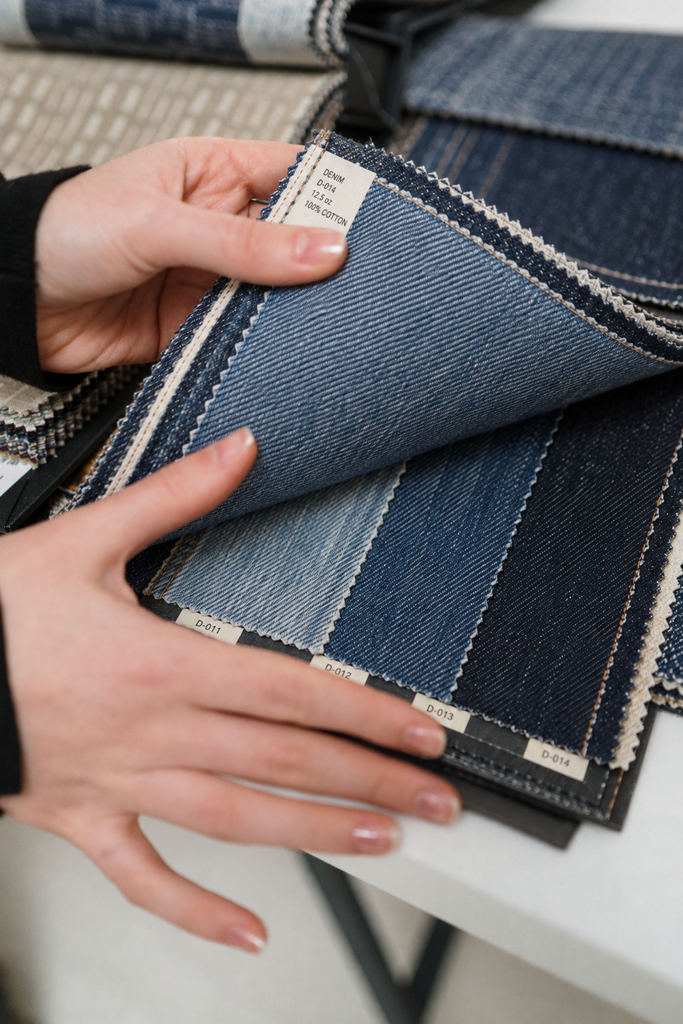
If possible, send:
- an existing fabric swatch
- a reference jean
- garment photos
- technical specification
- desired hand feel
This reduces the chance of receiving samples that technically qualify as “stretch denim” but do not match the product.
A Better Way to Ask a Supplier for Stretch Denim
A request such as:
“I need 2% spandex denim.”
leaves too many variables open.
A better enquiry might be:
We are developing women’s slim-straight jeans. We are looking for approximately 10–11 oz blue denim with 20–25% weft stretch, good shape recovery and a medium-soft hand. The garment will receive a medium vintage wash. Please suggest suitable fabrics and provide available stretch, shrinkage and width information.
For a skinny-jean program, the request may look different:
We need 9.5–11 oz high-stretch denim for fitted women’s jeans. Target weft stretch is around 35–45%, with good recovery after wear. Please recommend suitable constructions for garment wash testing.
The more accurately the garment is described, the easier it is for a supplier to narrow down relevant fabrics.
Common Mistakes When Sourcing Stretch Denim
Mistake 1: Choosing by Elastane Content Alone
A composition such as 98/2 does not tell you the actual fabric extension.
Ask for measured stretch.
Mistake 2: Choosing the Highest Stretch Number
More movement is not always necessary.
A relaxed jean does not need to perform like leggings.
Mistake 3: Ignoring Recovery
A highly elastic fabric that bags out after wear can create more problems than a lower-stretch fabric with better shape retention.
Mistake 4: Ignoring Stretch Direction
25% weft stretch and a fabric that stretches significantly in both directions are not the same product.
Mistake 5: Testing Only Raw Fabric
Stretch, shrinkage and hand feel should also be evaluated after the intended wash.
Mistake 6: Using the Same Pattern for Different Stretch Levels
Changing from rigid denim to high-stretch denim can change garment fit significantly.
Pattern development should reflect the fabric.
FAQ About Stretch Denim Fabric
What percentage of elastane is normally used in stretch denim?
Many commercial stretch denims contain only a small percentage of elastane, often around 1–3%, but composition alone does not determine actual fabric stretch. One current commercial guide, for example, notes that 1–3% elastane can produce noticeably different extension depending on how the fabric is engineered.
Is 1% elastane enough for jeans?
It can be.
A small amount of elastane may provide comfort stretch while keeping a relatively traditional denim feel.
The actual result depends on construction and finishing.
Is 2% elastane high stretch?
Not necessarily.
A 2% elastane fabric may be comfort stretch, medium stretch or potentially higher stretch depending on the yarn and fabric construction.
Check the measured stretch percentage.
What is comfort stretch denim?
Comfort stretch generally refers to denim that provides enough extension for easier movement without feeling extremely elastic.
The exact percentage varies by supplier, so the term should always be supported by actual test data.
What is super stretch denim?
Super stretch is a commercial term normally used for denim with very high extension, often designed for close-fitting garments.
There is no universal percentage that every supplier uses.
Is stretch denim always made with spandex?
No.
Mechanical constructions can create measurable stretch even in 100% cotton fabrics. Cotton Incorporated reports approximately 10–18% fill-direction stretch in one such mechanical-stretch system.
What is the difference between stretch and recovery?
Stretch measures how far the fabric can extend.
Recovery describes its ability to return toward its original dimension after the stretching force is removed.
Both matter in fitted garments.
What causes stretch jeans to become baggy?
One common cause is excessive residual growth after the fabric remains under stress.
Garment pattern, fabric construction, recovery performance and washing can all influence the final result.
What stretch level is best for skinny jeans?
Skinny jeans usually require more stretch than straight or relaxed jeans because there is less garment ease.
A moderate-to-high stretch fabric may be appropriate, but the final decision should be based on fit trials, recovery and wash testing rather than a single universal percentage.
Final Thought: Choose Stretch for the Garment, Not for the Specification Sheet
Stretch denim should not be selected by asking which fabric contains the most elastane or which one has the highest stretch percentage.
Start with the garment.
Define:
- silhouette
- target weight
- desired comfort
- stretch direction
- stretch percentage
- recovery
- shrinkage
- hand feel
- intended wash
Then compare fabrics.
For everyday straight or slim jeans, moderate comfort stretch may be enough.
For a very fitted skinny jean, higher stretch and stronger recovery may become much more important.
The objective is not maximum elasticity.
It is the right balance between movement, fit and shape retention for the finished garment.
If you are sourcing stretch denim fabric, send ZLDENIM your garment type, target weight, fit, stretch requirement, color, wash direction or reference sample.
We can use those details to help narrow down suitable denim options from available fabrics and our supplier network.