
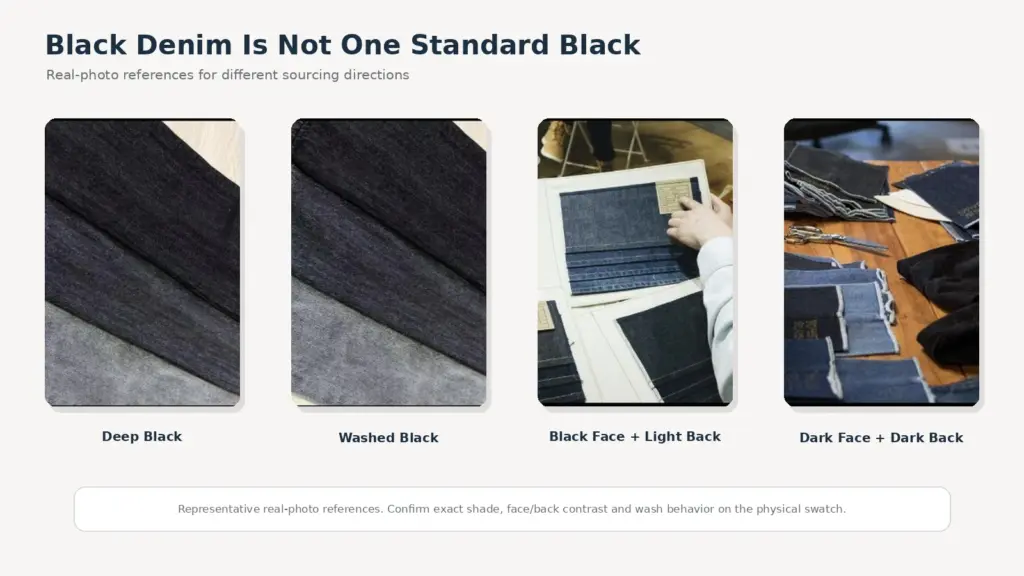
Black denim sounds like a simple specification.
It is not.
Two suppliers may both describe a fabric as black denim, while the actual fabrics differ in:
- depth of black
- color cast
- face and back color
- wash-down behavior
- rubbing fastness
- fabric weight
- stretch
- shrinkage
- hand feel
One fabric may be designed to stay dark after washing. Another may be selected specifically because it develops a faded grey or vintage black appearance.
For clothing brands, garment factories and sourcing teams, the safest approach is therefore not to order simply by saying:
We need black denim.
The better approach is to define what the finished garment should look and feel like.
This guide explains the main points buyers should check before ordering black denim fabric.
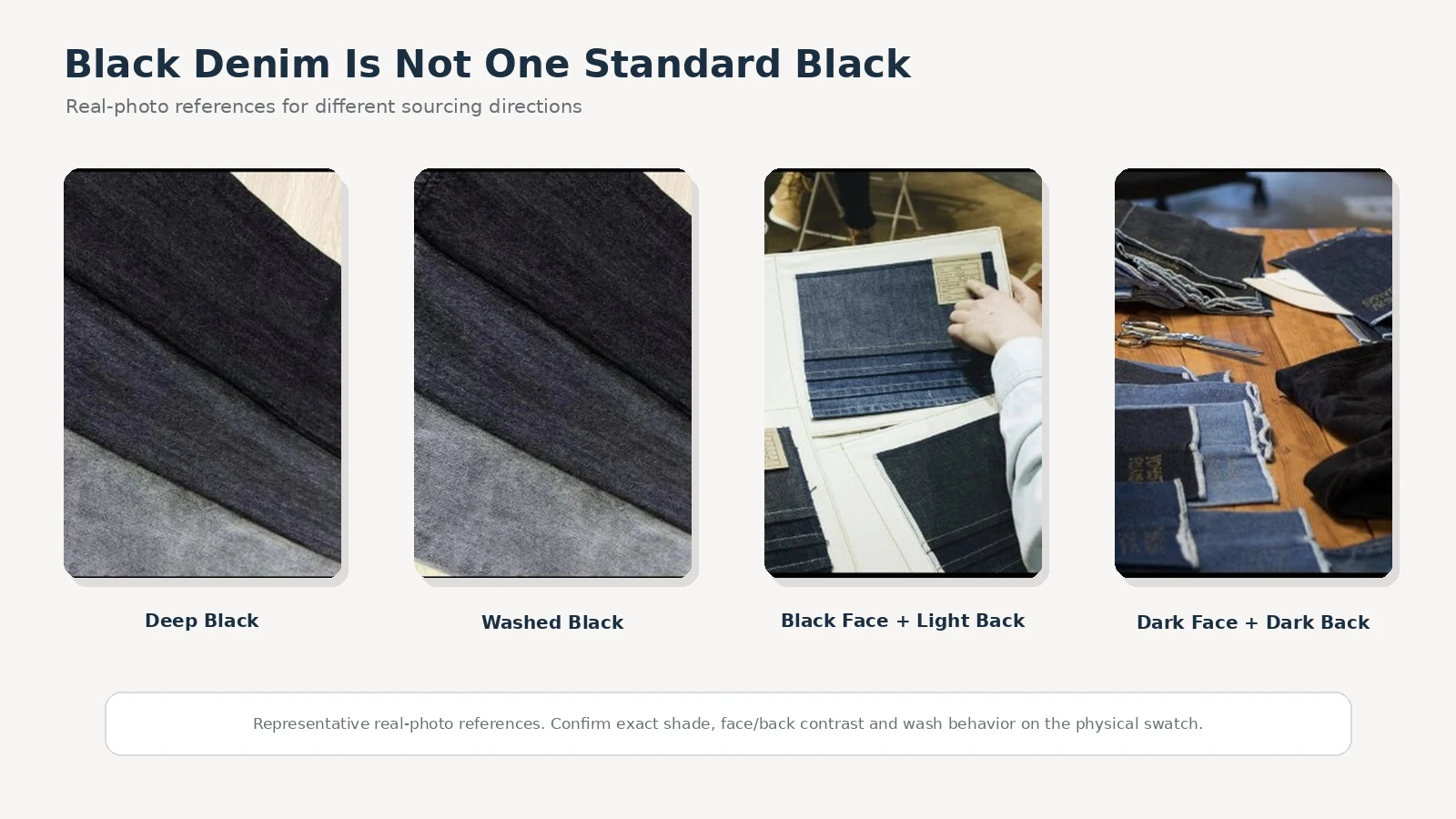
1. First Define What “Black” You Actually Want
Before discussing weight or price, define the target appearance.
Useful descriptions may include:
- deep black
- clean black
- soft black
- washed black
- charcoal black
- vintage black
- black with a visible denim twill
- black face with a lighter back
- dark appearance on both sides
Do not rely on names alone.
Words such as deep black, jet black or vintage black can mean different things to different suppliers.
Whenever possible, provide:
- a physical fabric swatch
- an existing garment
- a reference photo
- an approved color standard
For important programs, a physical reference is usually more reliable than a screen image because screens, lighting and cameras can all change the appearance of black.
Check the Undertone Too
Not all black shades look identical under different lighting or after washing.
Some may appear more neutral. Others may show a slightly different cast after abrasion or repeated washing.
If the brand has a very specific black target, compare samples under consistent lighting and evaluate them again after the intended garment wash.
2. Ask How the Black Color Is Produced
The dye system matters because it affects both appearance and performance.
Sulfur dyes are widely used for deep black cotton shades. CottonWorks describes sulfur dyes as an industry-standard option for black and notes that rubbing fastness and sensitivity to chlorine need attention.
Black denim can also be produced using other dyeing and finishing approaches.
Depending on the construction, a supplier may use:
- sulfur dyes
- reactive dyes
- other cotton dye systems
- piece dyeing
- garment overdyeing
- combinations of denim dyeing and finishing processes
These methods should not automatically be treated as interchangeable.
They can produce different:
- black depth
- surface appearance
- washing behavior
- colorfastness
- fading character
A useful buyer question is:
What dye system is used, and how is this black expected to behave after garment washing?
Sulfur Black in Denim
Sulfur black is especially relevant to denim because sulfur dyes can be used alone for black shades or together with indigo processes for darker denim effects.
CottonWorks describes sulfur bottom and sulfur top processes used with indigo yarn dyeing, with sulfur applied before or after indigo to change the resulting shade and wash behavior.
For a pure black denim program, the important point is not that buyers need to become dye chemists.
They simply need to know that different black dye systems can produce different final garments.
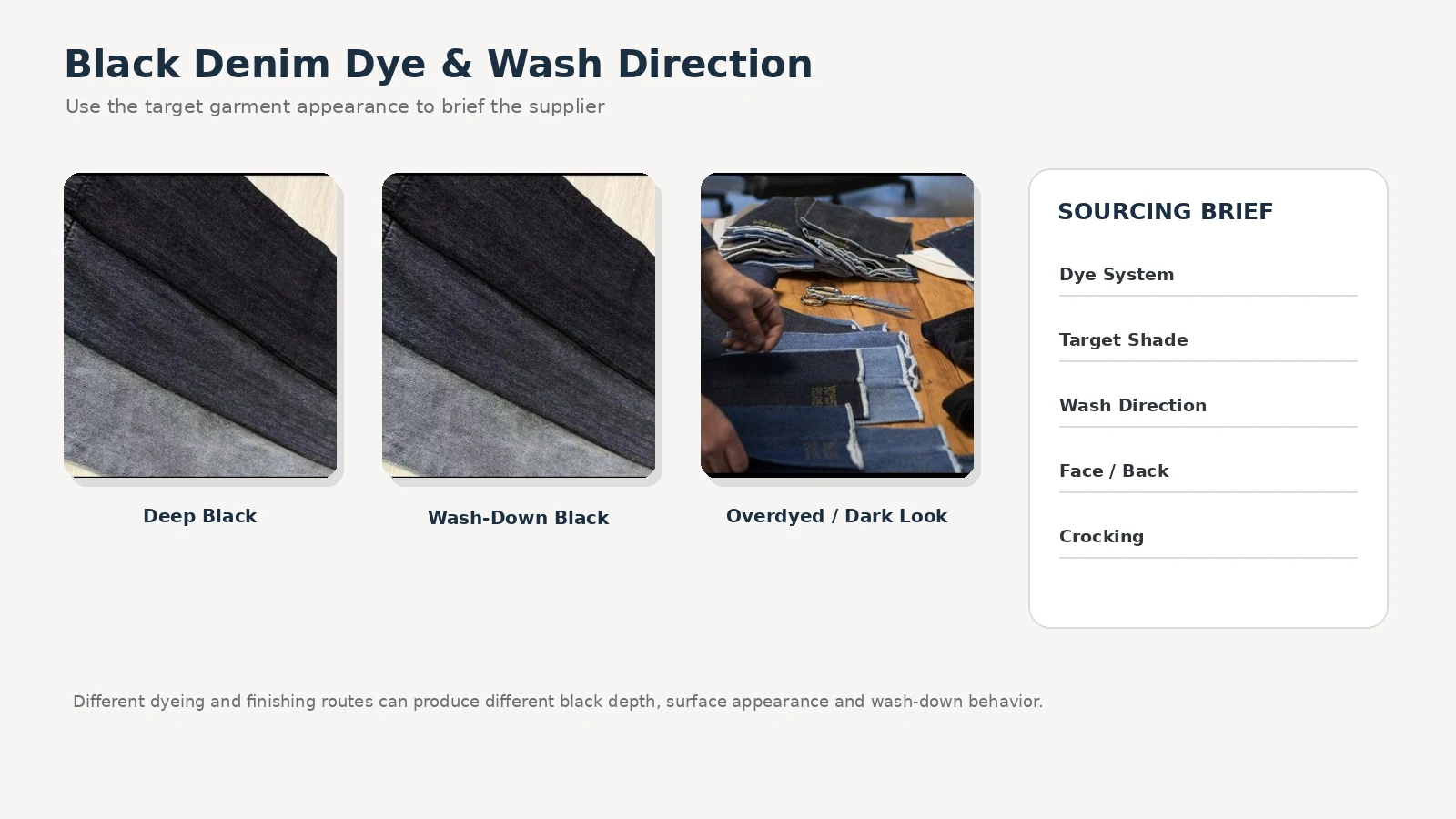
3. Check the Face, Back and Weft Color
Do not inspect only the front of the fabric.
Turn the swatch over.
Some black denim keeps the traditional denim contrast between a dark face and a lighter back. Other constructions create a much darker overall appearance.
This difference becomes important for garments where the inside may be visible, such as:
- rolled cuffs
- raw hems
- jackets
- overshirts
- distressed jeans
- garments with turned-up details
It also changes the visual result after abrasion.
If the design needs a specific face-to-back contrast, include that requirement when requesting samples.
A supplier should not have to guess whether you want a traditional denim contrast or a more uniformly black garment.
4. Check Dry and Wet Rubbing Fastness
For dark denim, rubbing fastness is one of the most important practical checks.
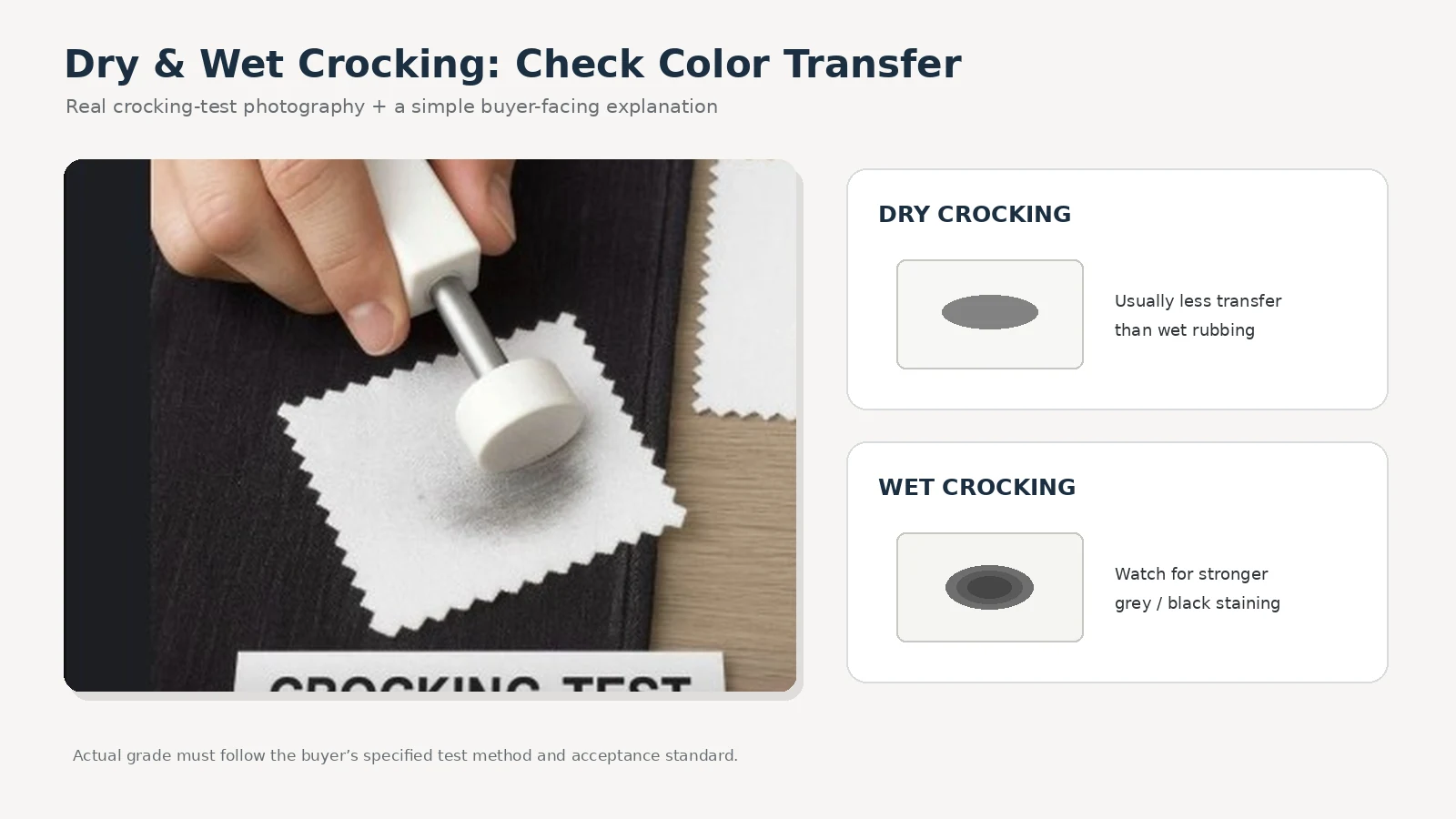
Crocking refers to color transferring from the textile surface to another material through rubbing.
AATCC TM8 evaluates color transfer by rubbing colored fabric with standardized white test cloth under dry and wet conditions.
Poor rubbing fastness can create complaints such as black color transferring onto:
- white shirts
- shoes
- bags
- furniture
- car seats
- light-colored garment components
This is particularly important with deep shades.
CottonWorks notes that sulfur dyes can have relatively poor crockfastness and that unfixed surface color can contribute to color-transfer problems.
Ask for Both Dry and Wet Results
A fabric may perform differently when dry and when wet.
Do not ask only:
Is the colorfastness good?
A better question is:
What are the dry and wet crocking results, and which test method was used?
The required grade should follow your brand’s own testing standard or target market requirements rather than an arbitrary number copied from another buyer.
5. Test the Fabric After the Intended Garment Wash
Do not approve black denim only in its original fabric form.
The garment wash can completely change the result.
Depending on the process, washing may change:
- black depth
- color cast
- surface contrast
- softness
- shrinkage
- seam appearance
- abrasion marks
A dark fabric that looks perfect on the roll may become much lighter after aggressive washing. Another fabric may remain relatively dark.
Neither is automatically better. They are simply suited to different design directions.
Stay Black vs Wash-Down Black
This distinction should be discussed early.
If the brand wants a clean dark jean that remains black-looking, the fabric and wash process need to support that direction.
If the goal is:
- faded black
- vintage grey
- worn edges
- strong abrasion
- washed-out character
then controlled color loss may actually be desirable.
CottonWorks notes that denim finishing processes can intentionally remove color through abrasion, chemical treatment and ozone, and that sulfur and indigo dyes can also be affected by ozone exposure.
So instead of asking:
Does this black fade?
ask:
How does this black develop under our intended wash?
6. Watch for Shade Change During Washing and Storage
Color loss is not the only issue.
The tone of the black can also change.
For important programs, compare:
- original fabric
- first wash sample
- approved garment wash
- production garment
Do not evaluate only whether the sample became lighter.
Check whether it still looks like the black shade you approved.
Ozone Exposure
Ozone can oxidize textile dyes.
CottonWorks notes that indigo and sulfur dyes can be prone to ozone fading, which may be relevant during shipment or storage as well as intentional ozone finishing.
This does not mean every black denim order will have an ozone problem.
It means buyers working with sensitive dark shades should consider the complete production, finishing, shipping and storage environment if shade stability is critical.
Chlorine Exposure
Sulfur dyes are also known to be sensitive to chlorine.
If chlorine-containing processes or care conditions are relevant to the product, discuss this with the supplier and washing factory before bulk production.
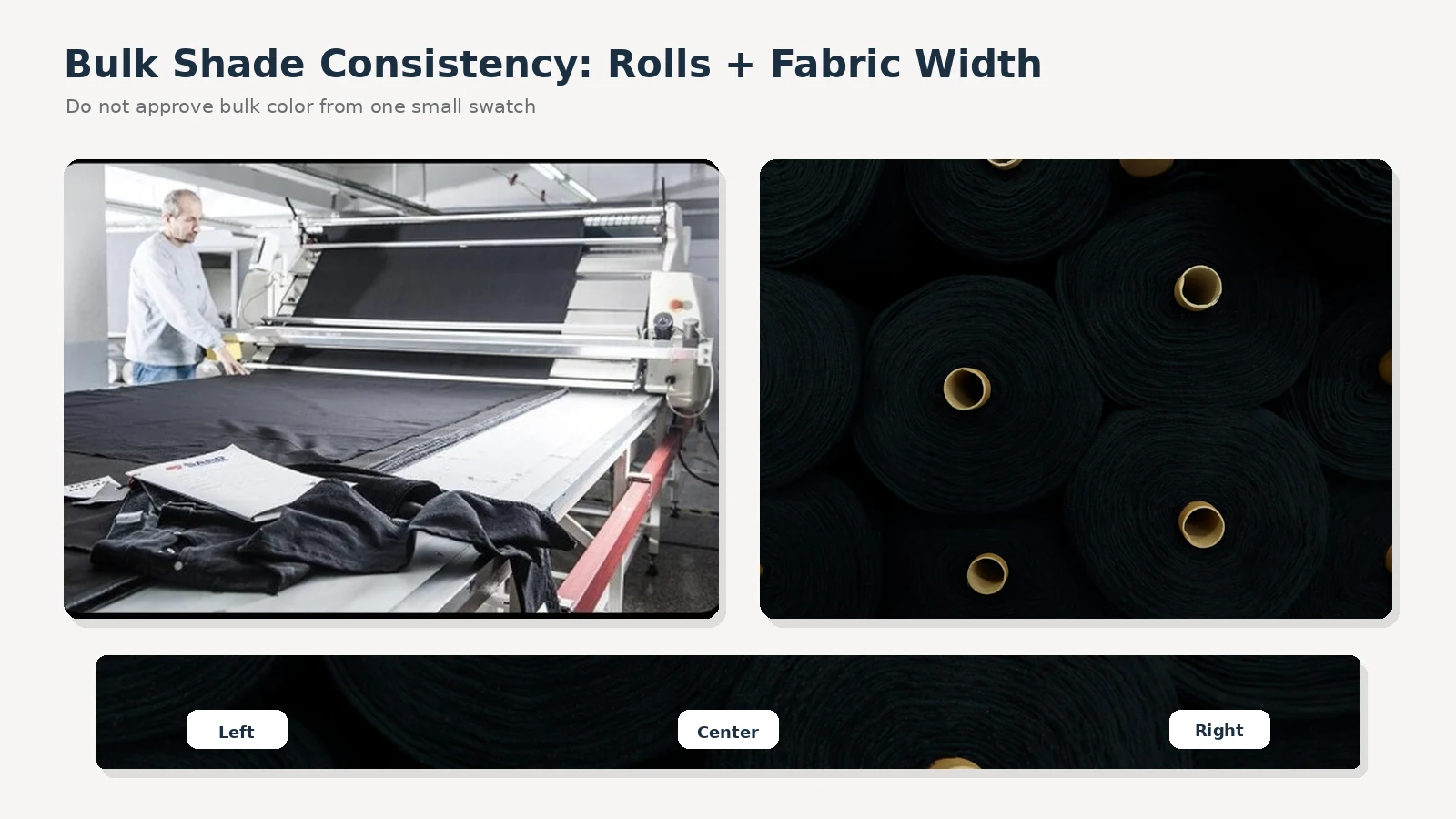
7. Check Roll-to-Roll and Lot-to-Lot Shade Consistency
A small swatch can look perfect while bulk production still creates shade problems.
For larger orders, buyers should ask how shade consistency is controlled between:
- rolls
- dye lots
- production batches
This becomes especially important when multiple garment panels may be cut from different rolls.
Small differences in dark fabric can become more obvious after garment washing.
Do Not Check Only the Center of the Fabric
For critical programs, inspect fabric across the usable width.
Compare:
- left side
- center
- right side
The goal is to catch any meaningful edge-to-center color difference before cutting.
If the final garment will receive a heavy wash, it can also be useful to test representative sections after washing because some differences become easier to see after color has been removed.
8. Confirm Fabric Weight
Black color does not tell you whether a fabric is suitable for jeans.
A black denim may be:
- lightweight
- medium weight
- heavyweight
A 7oz black denim and a 13oz black denim are completely different products even if their shade looks similar.
Weight affects:
- garment structure
- drape
- warmth
- seam bulk
- silhouette
- perceived durability
Lightweight Black Denim
Can work for:
- shirts
- dresses
- lightweight trousers
- skirts
- overshirts
Medium-Weight Black Denim
Often suitable for:
- everyday jeans
- shorts
- straight-leg jeans
- casual jackets
Heavier Black Denim
May work for:
- rigid jeans
- structured jackets
- workwear
- heritage-inspired garments
Always request the actual oz or GSM, not simply “light,” “medium” or “heavy.”
For a fuller breakdown by garment type, see our Denim Fabric Weight Guide: How to Choose the Right Oz.
9. Decide Between 100% Cotton and Stretch Black Denim
Black denim is available in both rigid and stretch constructions.
The correct choice depends on the garment.
100% Cotton Black Denim
A good direction for:
- relaxed jeans
- straight-leg jeans
- wide-leg jeans
- workwear
- rigid styles
- structured jackets
It can provide a more traditional denim character.
Stretch Black Denim
Often better for:
- slim jeans
- skinny jeans
- fitted women’s jeans
- children’s fitted styles
- garments requiring easier movement
Do not choose only by fiber composition.
For stretch black denim, ask for:
- actual stretch percentage
- stretch direction
- growth
- recovery
For a broader comparison, see 100% Cotton Denim vs Stretch Denim: Which Should Buyers Choose?
For detailed stretch selection, see Stretch Denim Fabric: How to Choose the Right Stretch Level.
10. Do Not Ignore Recovery in Stretch Black Denim
A black stretch denim may look excellent when new but lose its silhouette after several hours of wear if recovery is poor.
Potential problems include:
- baggy knees
- loose seat
- waistband relaxation
- loss of fitted shape
This is especially visible in black skinny or slim jeans because the design depends on a clean silhouette.
A very high stretch number does not automatically mean better performance.
Buyers should evaluate stretch + growth + recovery together.
If possible, approve the fabric after both laboratory evaluation and actual garment fitting.
11. Confirm Shrinkage Before Bulk Cutting
Black denim still needs normal dimensional testing.
Ask for:
- warp shrinkage
- weft shrinkage
- finished width
- usable width
- stretch where applicable
Then test the fabric under conditions that reflect the intended garment process.
Garment washing, drying and finishing can all affect final dimensions.
If the wash recipe changes, the final garment measurements may change too.
Do not assume that a fabric is safe simply because another black denim with similar weight performed well. Construction matters.
12. Compare Fabric Before and After Washing
A useful black denim approval process is:
Fabric roll → Lab wash → Garment sample → Bulk approval
At each stage, check:
| Item | Before Wash | After Wash |
|---|---|---|
| Shade | Check | Check again |
| Color cast | Check | Check again |
| Hand feel | Check | Check again |
| Weight/structure | Check | Evaluate garment result |
| Shrinkage | Baseline | Measure |
| Stretch | Baseline | Recheck if required |
| Recovery | Baseline | Recheck if required |
| Rubbing fastness | Check | Retest if specification requires |
This prevents the buying team from approving one product while the consumer ultimately receives something very different.
13. Ask Whether the Fabric Is Intended to Fade or Stay Dark
This single question can prevent a surprising number of misunderstandings.
A buyer may say:
I want good black denim.
But one designer means:
Deep black jeans that remain dark.
Another means:
Black jeans that wash down beautifully into grey.
Those are different fabric-development targets.
Tell the supplier which result you expect.
Useful descriptions include:
- stay black
- minimal wash-down
- moderate wash-down
- vintage black
- charcoal after wash
- strong abrasion contrast
If possible, send a reference garment showing the final washed result, not only the raw fabric color.
14. Check the Hand Feel
Two black denims with the same weight and composition can still feel different.
One may be:
- dry
- crisp
- compact
Another may be:
- soft
- smooth
- flexible
Finishing has a major effect on this.
When requesting samples, describe the target hand.
For example:
11oz black denim, 100% cotton, medium-firm hand for relaxed jeans.
is more useful than:
11oz black denim.
Likewise:
9.5oz stretch black denim, soft hand, good recovery for women’s slim jeans.
gives the supplier a clearer target.
15. If Sulfur Dye Is Used, Understand Its Specific Risks
Sulfur black is widely used because it can produce rich dark shades effectively.
AATCC maintains TM26, Ageing of Sulfur-Dyed Textiles: Accelerated, specifically for evaluating ageing behavior of sulfur-dyed materials.
Not every buyer needs to request this test.
But for programs with strict durability requirements, long storage periods or specific brand standards, it may be worth discussing the appropriate sulfur-dye testing requirements with the supplier or laboratory.
The important principle is:
know what dye system you are buying before deciding which performance tests matter.
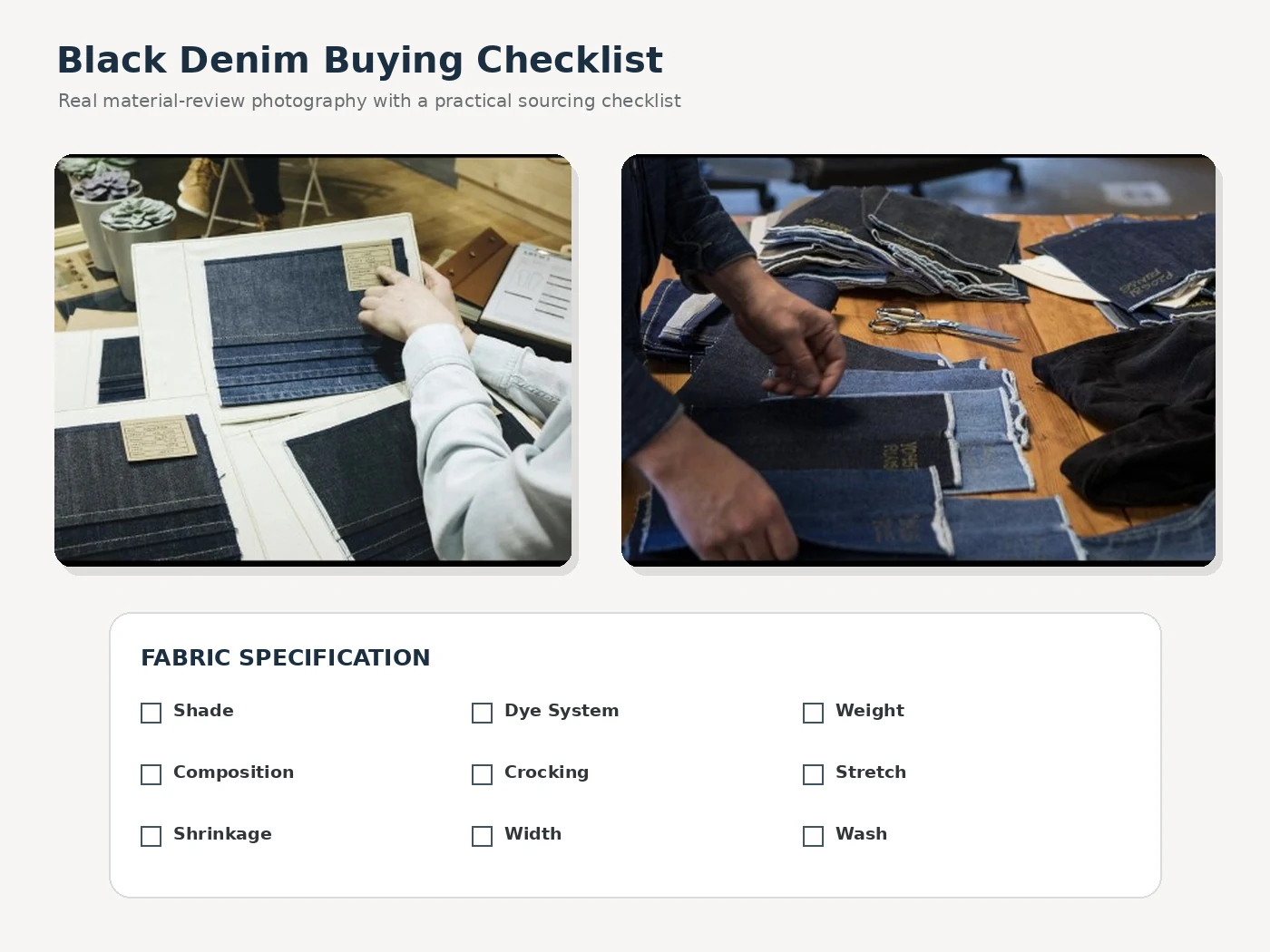
Black Denim Buying Checklist
Color
- target black shade
- color cast
- face color
- back color
- reference standard
Dyeing
- dye system
- expected wash-down behavior
- stay-black or fading direction
Colorfastness
- dry crocking
- wet crocking
- laundering requirements
- other brand-specific tests
Fabric
- weight in oz or GSM
- composition
- weave/construction
- finished width
- usable width
- hand feel
Stretch
If applicable:
- stretch %
- stretch direction
- growth
- recovery
Dimensional Performance
- warp shrinkage
- weft shrinkage
- result after intended garment wash
Bulk Consistency
- roll-to-roll shade
- lot-to-lot shade
- edge-to-center appearance
Garment Development
- intended garment
- fit
- washing process
- target final black appearance
A Better Way to Request Black Denim Samples
Instead of sending:
Please send black denim.
send something closer to:
We are developing men’s relaxed jeans. We need approximately 11–12oz black denim, preferably 100% cotton, with a medium-firm hand. We want a clean dark black with moderate wash-down after garment washing. Please provide finished width, shrinkage and available colorfastness information.
For a stretch program:
We are developing women’s slim jeans. We are looking for approximately 9.5–10.5oz stretch black denim with a soft hand, good recovery and a deep clean black shade. Please provide composition, stretch %, growth/recovery information if available, shrinkage, finished width and rubbing fastness results.
These requests help the supplier narrow the sample selection before shipping.
That saves time for both sides.
Common Mistakes When Buying Black Denim
Mistake 1: Ordering by “Black” Alone
Black is a color family, not a complete fabric specification.
Mistake 2: Approving Only the Raw Fabric
The final wash may completely change the shade and hand feel.
Mistake 3: Ignoring Wet Crocking
Dark fabrics may behave differently under wet rubbing conditions.
Mistake 4: Checking Only One Small Swatch
It tells you very little about bulk shade consistency.
Mistake 5: Choosing Stretch Fabric Only by Elastane Content
Actual stretch and recovery matter more than the fiber percentage alone.
Mistake 6: Ignoring the Fabric Back
The inside color can affect cuffs, hems, distressing and the overall design.
Mistake 7: Assuming Darker Is Always Better
A very deep black may be wrong for a product designed to develop a vintage grey appearance.
FAQ About Black Denim Fabric
What is black denim fabric?
Black denim is a denim construction colored to produce a black or very dark appearance rather than traditional indigo blue.
The exact construction, dyeing method and face/back appearance can vary.
Is black denim usually sulfur dyed?
Sulfur dyes are widely used for deep black cotton shades and are considered a standard black dye option in woven bottomweights. However, buyers should confirm the actual dye system used for the specific fabric rather than assume all black denim is produced in the same way.
Does black denim fade?
It can.
The amount and character of fading depend on the dye system, fabric construction, washing process, abrasion and care conditions.
Some fabrics are selected to remain dark, while others are intentionally developed to wash down.
Why does black denim transfer color?
Surface color can transfer through rubbing, particularly when colorfastness to crocking is limited.
Testing under both dry and wet conditions helps buyers evaluate this risk.
What is the difference between black denim and black-on-black denim?
In sourcing conversations, “black-on-black” often describes denim with a dark overall appearance rather than the strong dark-face/light-back contrast associated with some traditional denim constructions.
Because suppliers may use the term differently, buyers should inspect both sides of the actual sample and specify the required face and back color.
Is 100% cotton or stretch better for black jeans?
It depends on the fit.
100% cotton is often suitable for rigid, relaxed and straight styles.
Stretch denim is usually more practical for slim and skinny fits.
What weight is best for black jeans?
There is no single best weight.
Lightweight fabrics can suit softer fashion garments, while approximately medium-weight constructions are common starting points for everyday jeans.
The final choice depends on silhouette, season, stretch and desired structure.
What should I test before ordering black denim in bulk?
At minimum, buyers should consider:
- approved shade
- dry and wet rubbing fastness
- wash behavior
- shrinkage
- width
- weight
- composition
- stretch/recovery if applicable
- bulk shade consistency
The exact testing program should follow the buyer’s own product and market requirements.
Final Thought: Approve the Finished Result, Not Just a Black Swatch
Black denim is easy to describe badly.
A request such as:
10oz black stretch denim
still leaves many questions unanswered.
What shade?
How dark should the back be?
Should it stay black or wash down?
How much stretch?
How well should it recover?
What is the intended wash?
What rubbing-fastness requirement applies?
What shrinkage is acceptable?
The more precisely these questions are answered before sampling, the easier it becomes to compare fabrics correctly.
For black denim sourcing, the best approach is:
define the garment → define the final black appearance → confirm the technical specifications → wash and test the sample → approve bulk
If you are sourcing black denim fabric, send ZLDENIM your garment type, target weight, composition, stretch requirement, desired black shade, wash direction or reference sample.
We can use those details to help narrow down suitable black denim options from available fabrics and our supplier network.