
When a buyer asks for lightweight denim fabric, one of the first questions should be:
How light?
A 6oz denim and a 10oz denim may both be described as lighter alternatives to traditional heavy jeans fabric, but they behave very differently.
A 6oz fabric may drape easily enough for a shirt or dress.
An 8oz denim can provide more body while remaining relatively light.
A 10oz denim begins to offer enough structure for many everyday jeans.
That difference matters because denim weight influences:
- garment structure
- drape
- comfort
- seam bulk
- seasonal use
- wash appearance
- suitability for different silhouettes
This guide compares 6oz vs 8oz vs 10oz denim from a practical sourcing perspective.

What Counts as Lightweight Denim Fabric?
There is no single universal weight boundary that every denim mill or supplier uses.
Some suppliers classify denim below 8 or 9 oz as lightweight, while others include fabrics around 10 oz in their lightweight or light-to-medium categories. This is why the word “lightweight” should not replace an actual oz or GSM specification when sourcing fabric.
For practical garment development, it is more useful to think of the three weights this way:
| Denim Weight | Approx. GSM | Practical Character |
|---|---|---|
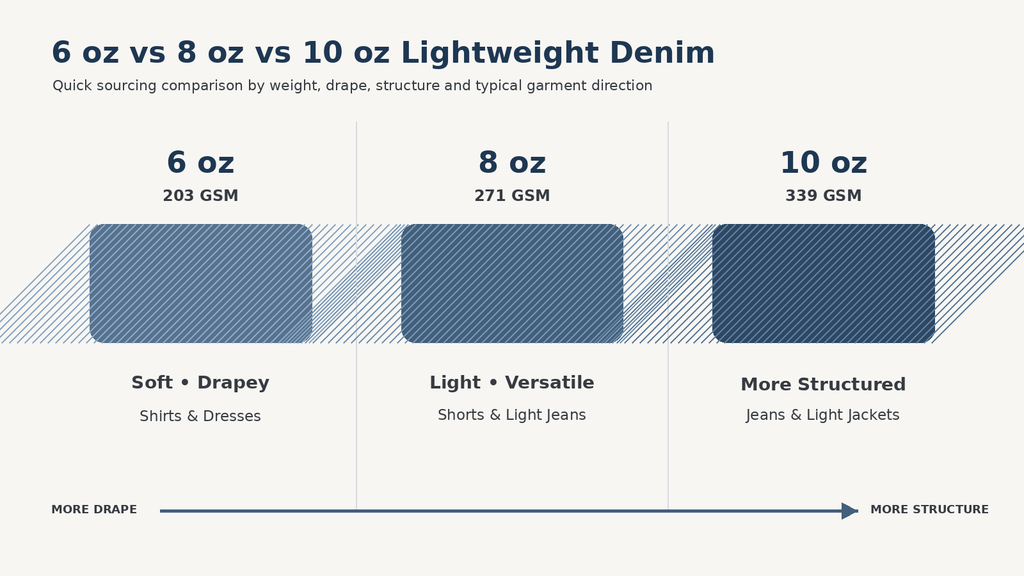
| 6 oz | 203 GSM | Very light, soft and drapey |
| 8 oz | 271 GSM | Lightweight with more body |
| 10 oz | 339 GSM | Light-to-medium, more suitable for jeans |
The approximate conversion is:
1 oz/yd² ≈ 33.9 GSM
So:
- 6 oz ≈ 203 GSM
- 8 oz ≈ 271 GSM
- 10 oz ≈ 339 GSM
The difference between 6oz and 10oz is therefore significant. A 10oz fabric contains roughly two-thirds more fabric mass per unit area than a 6oz fabric.
But weight still does not tell you everything about how the denim will feel.
6oz Denim Fabric: Best for Soft, Drapey Garments
At approximately 203 GSM, 6oz denim is at the light end of denim construction.
Instead of behaving like a classic pair of rigid jeans, it can behave much more like a shirting or lightweight fashion fabric.
What Does 6oz Denim Feel Like?
Depending on yarn, weave and finishing, 6oz denim can feel:
- light
- flexible
- soft
- easy to fold
- relatively fluid
- less bulky around seams
It normally provides less structure than traditional jeans denim.
That makes it useful when the designer wants denim appearance without heavy denim weight.
What Is 6oz Denim Used For?
Typical directions include:
- denim shirts
- shirt dresses
- lightweight dresses
- blouses
- summer skirts
- loose overshirts
- children’s garments
- lightweight fashion pieces
Commercial fabric guides also commonly place approximately 6–8oz denim toward shirting, dress and other lighter garment applications.
Is 6oz Good for Jeans?
It can be used for certain fashion pants or very lightweight denim styles, but buyers should be careful.
For traditional five-pocket jeans, a very light fabric may not provide the expected:
- body
- shape retention
- pocket support
- seam structure
- classic denim hand
If the target garment is loose, soft and designed specifically around lightweight fabric, 6oz may work.
If the customer expects a conventional pair of jeans, it may feel too light.
What Should Buyers Check?
With very lightweight denim, pay particular attention to:
- opacity
- seam appearance
- fabric stability
- shrinkage
- strength around pockets and seams
- fabric distortion after washing
Do not approve the fabric by hand feel alone.
A beautiful soft sample still needs to work in the final garment.
8oz Denim Fabric: A Balance Between Drape and Structure
At approximately 271 GSM, 8oz denim sits in a useful middle area.
It still feels noticeably lighter than traditional medium-weight jeans denim, but it can provide substantially more structure than 6oz.
This makes 8oz one of the more versatile lightweight denim options.
What Does 8oz Denim Feel Like?
Compared with 6oz, an 8oz denim will generally feel:
- fuller
- more structured
- more substantial
- less fluid
- closer to a traditional denim hand
It can still remain comfortable for warm-weather garments, especially if the construction and finishing are relatively soft.
What Is 8oz Denim Used For?
Possible applications include:
- lightweight jeans
- women’s fashion jeans
- shorts
- denim skirts
- casual trousers
- overshirts
- light jackets
- dresses requiring more structure
The advantage of 8oz is that it can move between top-weight and light bottom-weight applications, depending on construction.
A soft 8oz denim may work well for an overshirt.
A firmer 8oz stretch denim may be better suited to lightweight jeans.

Alt text(英文): 8 oz lightweight denim fabric for jeans, shorts, skirts and overshirts
10oz Denim Fabric: Where Lightweight Denim Starts to Feel Like Jeans
At approximately 339 GSM, 10oz denim is approaching the traditional medium-weight denim category.
Some suppliers call it lightweight denim. Others classify it as medium-weight.
For buyers, the category name matters less than the actual performance.
The important point is that 10oz usually provides considerably more structure than 6oz or 8oz.
What Does 10oz Denim Feel Like?
Depending on construction, 10oz denim can offer:
- clear denim body
- better shape retention
- moderate structure
- enough weight for many five-pocket jeans
- less bulk than classic 12–14oz denim
This makes it useful for buyers who want jeans to still feel like jeans, but do not want a heavy garment.
What Is 10oz Denim Used For?
Common directions include:
- lightweight everyday jeans
- slim jeans
- women’s jeans
- stretch jeans
- straight-leg jeans
- casual trousers
- structured skirts
- shorts
- lighter denim jackets
It can be particularly useful for warm-climate or spring/summer denim programs where a brand still wants proper jeans construction.
Is 10oz Denim Too Heavy for Summer?
Not necessarily.
Weight influences comfort, but it is not the only factor.
A 10oz fabric with:
- a softer construction
- appropriate yarn density
- comfortable stretch
- a lighter hand finish
may feel more suitable for warm weather than a dense, rigid fabric of similar weight.
Climate decisions should therefore be based on weight plus construction and hand feel, rather than oz alone.
6oz vs 8oz vs 10oz: Quick Comparison
| Feature | 6oz Denim | 8oz Denim | 10oz Denim |
|---|---|---|---|
| Approx. GSM | 203 | 271 | 339 |
| General Feel | Very light | Light | Light-to-medium |
| Drape | High | Medium-high | Medium |
| Structure | Low | Moderate | Moderate-high |
| Typical Tops | Excellent | Good | Possible |
| Dresses | Excellent | Good | More structured |
| Lightweight Jeans | Limited / style-dependent | Good | Very good |
| Classic Jeans Feel | Low | Moderate | Stronger |
| Shorts & Skirts | Light styles | Very suitable | Structured styles |
| Warm-Weather Use | Strong | Strong | Depends on construction |
| Seam Bulk | Low | Low-moderate | Moderate |
This table should be used as a sampling guide rather than a fixed rule.
Which Weight Is Best for Shirts?
If the garment is a classic lightweight denim shirt, 6oz is usually the most natural starting point among these three options.
Why?
Because shirts normally need:
- easier drape
- lower seam bulk
- comfortable arm movement
- less body stiffness
An 8oz fabric can also work, particularly for:
- overshirts
- shirt jackets
- heavier workwear-style shirts
- structured casual shirts
A 10oz fabric may feel too substantial for a conventional shirt, although it can work for intentionally heavy overshirts or shirt-jacket designs.
Which Weight Is Best for Dresses?
For soft dresses and shirt dresses, 6oz is often easier to work with because the fabric can fall more naturally.
An 8oz denim can suit dresses that require:
- more shape
- an A-line silhouette
- structured panels
- stronger pocket construction
A 10oz fabric creates a much more structured garment and should normally be chosen deliberately rather than simply because it is called “light denim.”
Which Weight Is Best for Lightweight Jeans?
For most buyers choosing between these three options, 8oz and 10oz are more natural starting points for jeans than 6oz.
Choose approximately 8oz when the goal is:
- very light summer jeans
- soft fashion jeans
- children’s jeans
- relaxed lightweight bottoms
- high-comfort styles
Choose approximately 10oz when the goal is:
- conventional five-pocket construction
- more structure
- stronger denim character
- straight or slim fits
- an all-season lightweight jean
The correct answer still depends on stretch, wash and silhouette.
Rigid vs Stretch Changes the Comparison
A major mistake is comparing weight without looking at stretch construction.
Consider two fabrics:
Fabric A:
8oz, 100% cotton rigid denim
Fabric B:
8oz cotton-elastane stretch denim
They have the same nominal weight but may behave very differently.
The stretch fabric may:
- follow the body more closely
- feel easier to move in
- work better for slim styles
- require more attention to recovery
The rigid fabric may:
- feel more traditional
- hold a looser silhouette differently
- create a drier or more structured denim character
So if the garment is jeans, weight should always be evaluated together with stretch percentage and recovery.
For a deeper comparison, see our guide to Stretch Denim Fabric: How to Choose the Right Stretch Level.
Why Two 8oz Denim Fabrics Can Feel Completely Different
Weight measures mass per unit area.
It does not directly tell you:
- yarn thickness
- weave density
- weave structure
- fiber composition
- softness
- stiffness
- stretch
- surface texture
That is why two fabrics marked “8oz denim” can look and feel surprisingly different.
Yarn and Construction
Different yarn counts and warp/weft densities can create very different surfaces.
One 8oz denim may feel compact and firm.
Another may feel loose, soft and flexible.
Weave
Lightweight denim may use different twill structures depending on the target appearance and performance.
A construction designed for a soft shirt does not need to behave like one designed for lightweight jeans.
Fiber Composition
Possible constructions include:
- 100% cotton
- cotton/elastane
- cotton/polyester/elastane
- cotton/lyocell blends
- other cellulosic blends
Fiber composition can significantly change:
- softness
- drape
- stretch
- recovery
- moisture feel
Finishing
Finishing can make lightweight denim feel:
- softer
- smoother
- drier
- fuller
- flatter
- more flexible
This is another reason buyers should request physical samples rather than approve a fabric only from its oz specification.
Wash Results Matter More in Lightweight Denim Than Buyers Expect
Denim is often judged before washing, but the garment is sold after washing.
That distinction matters.
Garment washing can change:
- shade
- shrinkage
- hand feel
- drape
- surface texture
- apparent structure
A soft 8oz fabric may become even more relaxed after washing.
A 10oz fabric that initially feels slightly firm may become much more comfortable after enzyme or garment washing.
If possible, evaluate:
raw fabric → washed sample → finished garment
instead of approving only the original fabric roll.
Watch Shrinkage and Width Carefully
Lightweight fabrics should still be treated as technical fabrics.
When developing a garment, buyers should confirm:
- finished width
- usable width
- warp shrinkage
- weft shrinkage
- stretch where applicable
- finished weight
- fabric stability after washing
This is particularly important when the garment uses a loose silhouette or multiple panels.
Even a small percentage change in fabric dimensions can affect:
- garment length
- waist
- leg opening
- sleeve length
- panel matching
Ask Whether the Quoted Weight Is Before or After Finishing
When comparing fabrics from different suppliers, ask exactly what the stated weight refers to.
For example:
Is the 8oz value measured on the finished fabric being supplied?
Finishing, moisture condition and dimensional changes can alter measured fabric weight.
For production communication, the safest approach is to confirm the finished fabric specification, not rely only on a construction name or an old greige-fabric value.
This also makes supplier comparisons more meaningful.
How to Choose Between 6oz, 8oz and 10oz
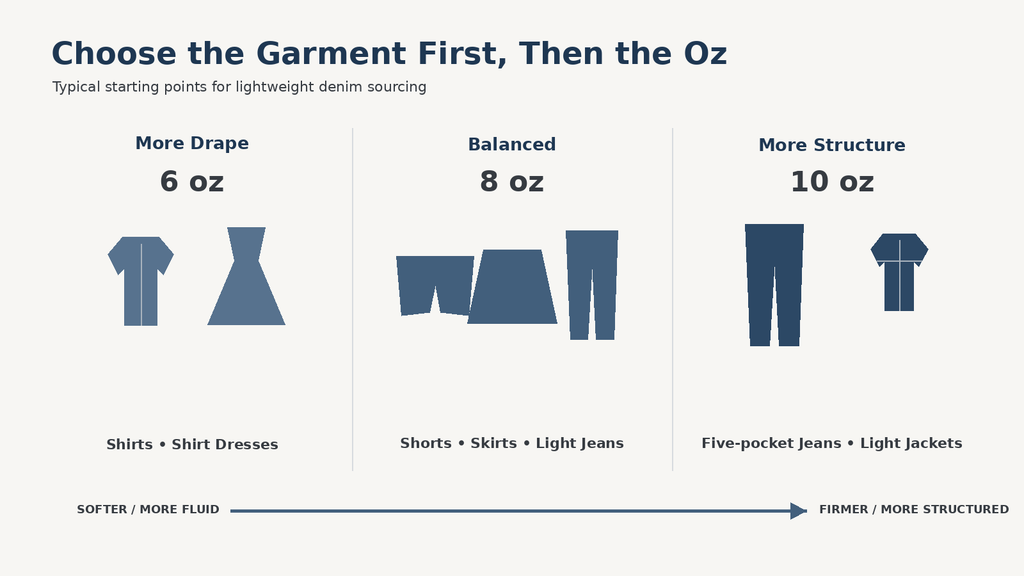
Start with the finished garment rather than the number.
Choose 6oz if you need:
- soft drape
- shirts
- dresses
- lightweight skirts
- loose summer garments
- minimal fabric bulk
Choose 8oz if you need:
- lightweight but visible denim structure
- shorts
- skirts
- overshirts
- lightweight fashion jeans
- a balance between softness and body
Choose 10oz if you need:
- lightweight jeans with more structure
- traditional five-pocket construction
- straight or slim jeans
- stronger shape retention
- a more substantial denim hand
- lightweight jackets
A Better Way to Request Lightweight Denim Samples
Instead of asking:
“Please send lightweight denim.”
give the supplier enough information to understand the garment.
For example:
We are developing a women’s summer shirt dress. We want approximately 6–7oz blue denim with a soft hand and good drape. The garment will receive a light wash. Please suggest suitable options and provide finished width and shrinkage information.
Or:
We need lightweight denim for men’s straight-leg jeans. Target weight is around 9–10oz, with moderate structure and a softer hand than traditional 12oz rigid denim. Please suggest rigid and comfort-stretch options.
These requests are much easier for a supplier to work with because they define the garment first and the fabric second.
Lightweight Denim Buying Checklist
Before approving a 6oz, 8oz or 10oz fabric, check:
- garment type
- target oz or GSM
- finished fabric weight
- rigid or stretch
- stretch percentage if applicable
- fiber composition
- finished width
- shrinkage
- hand feel
- intended garment wash
- required structure
- target season or climate
- reference garment or fabric sample
If several of these variables are unknown, request a small group of different samples rather than trying to choose from weight alone.
Common Mistakes When Buying Lightweight Denim
Mistake 1: Assuming All Lightweight Denim Feels Soft
A lighter fabric can still feel compact or firm depending on construction and finishing.
Mistake 2: Using 6oz for Jeans Because It Is More Comfortable
Comfort alone does not determine suitability.
A five-pocket jean may need more structure around the waistband, pockets, seat and knees.
Mistake 3: Assuming 10oz Is Too Heavy for Summer
Some 10oz fabrics can work well for warm-weather jeans.
Evaluate construction, hand feel and garment fit.
Mistake 4: Ignoring Stretch
An 8oz rigid denim and an 8oz high-stretch denim are not interchangeable.
Mistake 5: Approving the Fabric Before Washing
The final garment may feel and fit differently after wash processing.
Mistake 6: Comparing Supplier Samples by Oz Only
Weight should be compared together with composition, width, stretch, shrinkage and hand feel.
FAQ About Lightweight Denim Fabric
Is 6oz denim lightweight?
Yes. Around 6oz, or approximately 203 GSM, is generally considered very lightweight denim and is commonly suited to shirts, dresses and other soft garments.
Is 8oz denim good for jeans?
Yes, depending on the style.
8oz denim can work well for lightweight fashion jeans, summer jeans and softer casual bottoms.
For more traditional jeans structure, buyers may prefer approximately 10oz or heavier.
Is 10oz denim lightweight?
It depends on the supplier’s classification.
10oz sits near the transition between lightweight and medium-weight denim. For jeans, it can feel relatively light compared with classic 12–14oz fabrics.
What GSM is 6oz denim?
6oz denim is approximately 203 GSM.
What GSM is 8oz denim?
8oz denim is approximately 271 GSM.
What GSM is 10oz denim?
10oz denim is approximately 339 GSM.
What is the best denim weight for summer?
There is no single best weight.
Approximately 6–8oz works well for many shirts, dresses and lightweight garments.
For summer jeans, approximately 8–10oz can be a practical starting range.
Construction, stretch, fit and finishing should also be considered.
What is the best lightweight denim for shirts?
Around 6oz is a useful starting point for soft denim shirts.
An 8oz fabric may be better for overshirts or styles that require more structure.
Which is better for jeans: 8oz or 10oz denim?
Choose 8oz when you want a lighter, softer jean.
Choose 10oz when you want more body and a more traditional jeans feel.
Neither is automatically better. The correct choice depends on the garment.
Final Thought: Choose the Garment First, Then the Oz
The difference between 6oz, 8oz and 10oz denim is not simply three numbers on a specification sheet.
Each weight moves the garment toward a different result.
6oz prioritizes drape and lightness.
8oz creates a useful balance between softness and structure.
10oz moves closer to a traditional jeans fabric while remaining lighter than many classic denim constructions.
But weight is still only the starting point.
Before choosing lightweight denim fabric, consider:
- garment type
- fit
- stretch
- composition
- hand feel
- shrinkage
- wash
- season
- finished appearance
If you are sourcing lightweight denim fabric, send ZLDENIM your target weight, garment type, composition, stretch requirement, color, wash direction or reference image.
We can use those details to help narrow down suitable denim options from available fabrics and our supplier network.