
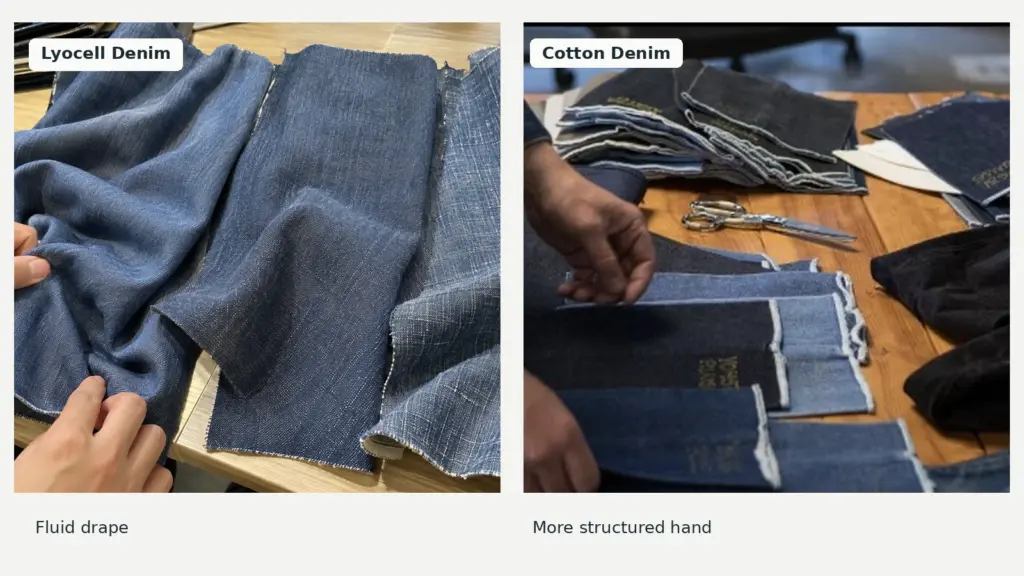
Two denim fabrics arrive on your desk.
Both weigh 9oz. Both have a similar indigo shade. Both seem suitable for a new jeans collection.
But when you pick them up, the difference is obvious.
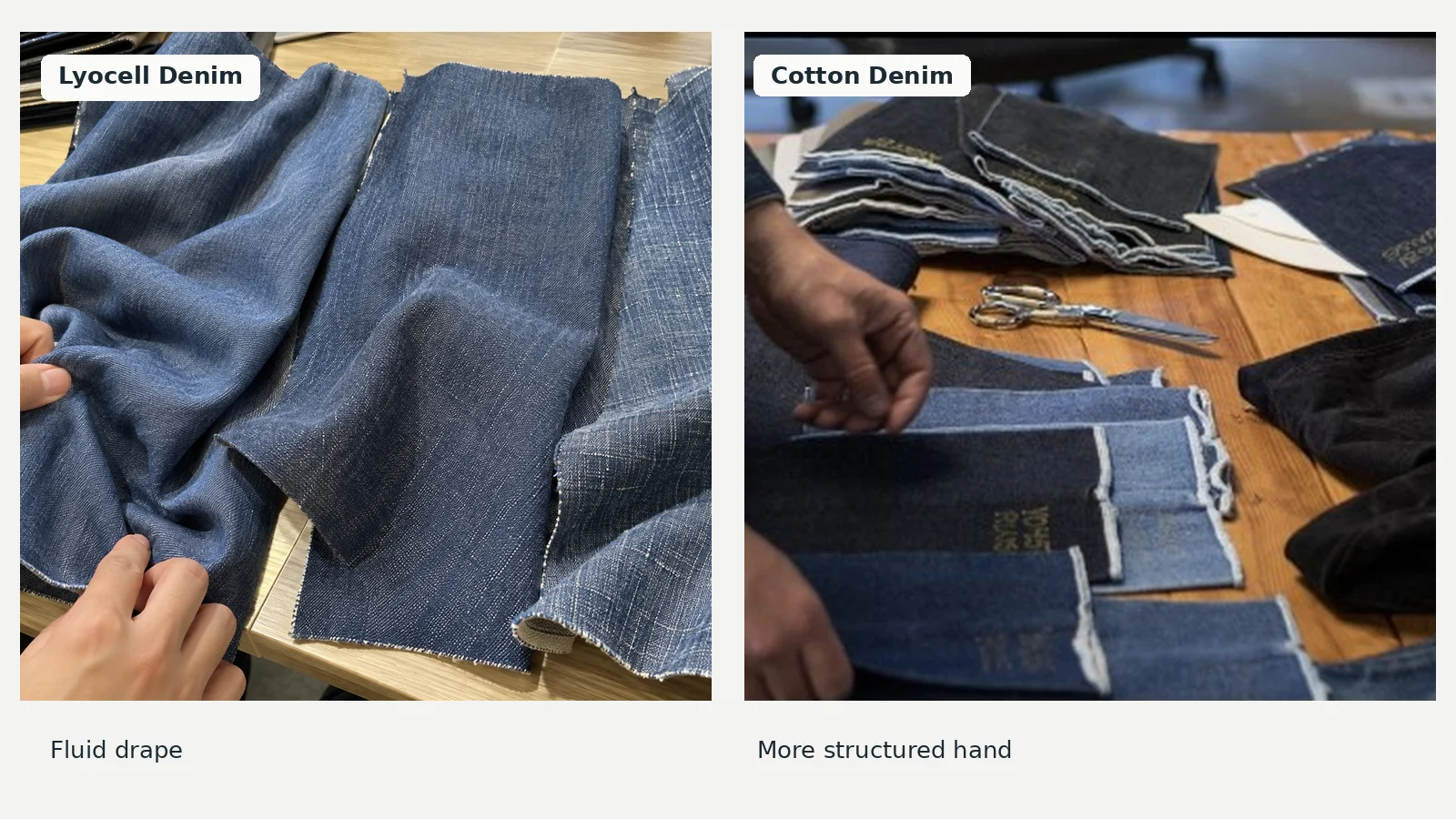
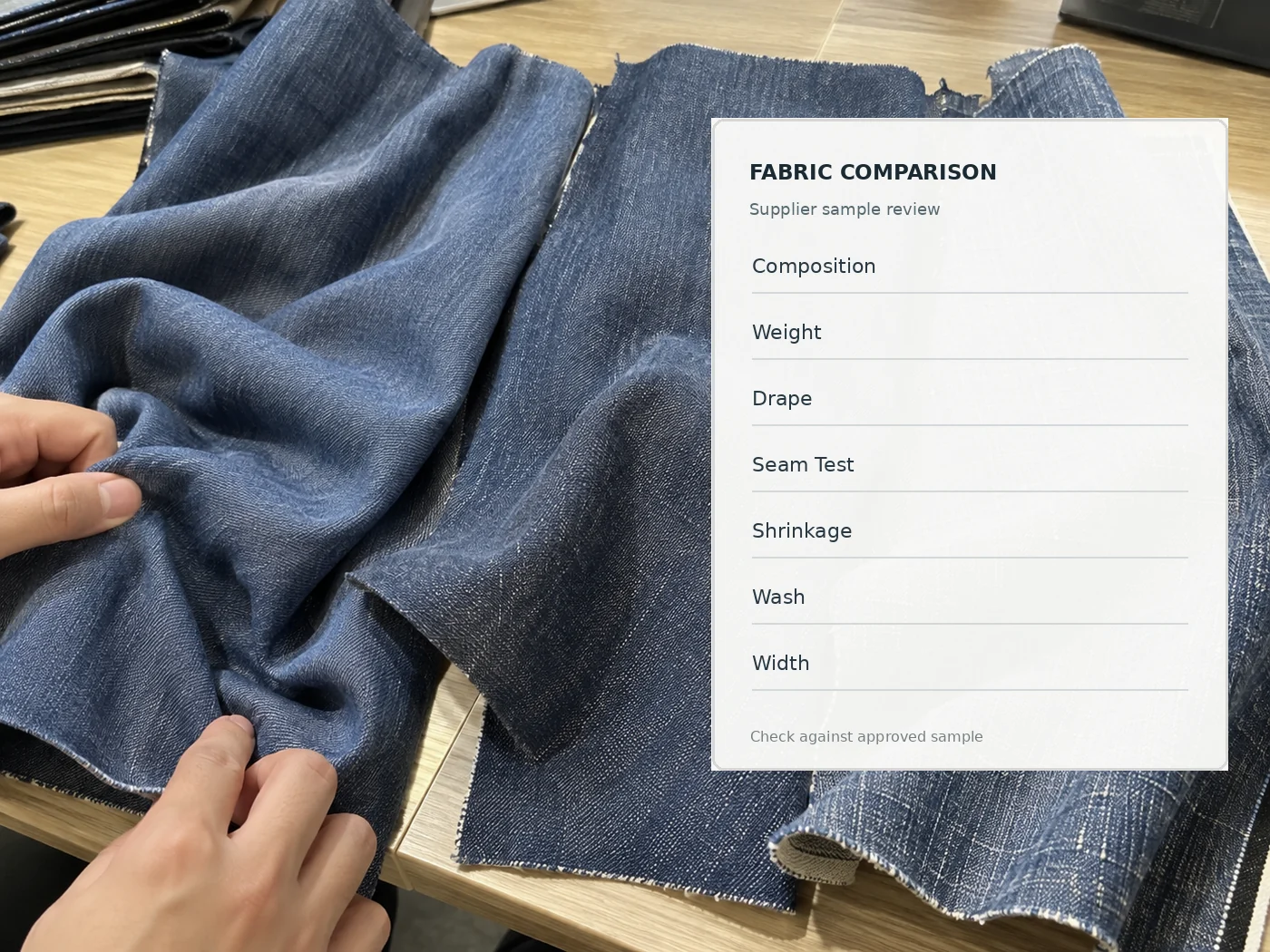
One feels soft and falls naturally over your hand. The other feels firmer and holds its shape.
The softer fabric seems like the better choice.
But what if that softness creates a problem after the jeans are sewn and washed?
Not because lyocell is necessarily weak. It isn’t.
The real issue is that softness, drape, fabric strength and seam stability are different properties.
A fabric may look excellent as a swatch but behave differently when it becomes a garment.
That is why choosing between lyocell denim and cotton denim requires more than comparing which one feels better.
For clothing brands, garment factories and sourcing teams, the decision depends on five things:
- the intended garment silhouette
- fabric weight and construction
- softness and drape
- seam and washing performance
- the final appearance after garment finishing
Let’s start with the difference buyers usually notice first.
1. What Is the Difference Between Lyocell Denim and Cotton Denim?
Both materials can be used to produce woven denim.
The main difference is the fiber.
Cotton Denim
Cotton is a natural cellulosic fiber obtained from the cotton plant.
Traditional denim is commonly made with cotton yarns, often using indigo-dyed warp yarns and lighter-colored weft yarns.
Depending on construction, cotton denim can be:
- lightweight or heavyweight
- rigid or mechanically flexible
- smooth or heavily textured
- firm or soft after finishing
- suitable for jeans, jackets, skirts and shirts
A 100% cotton denim fabric does not automatically have to feel stiff.
Its yarns, weave, density and finishing determine much of the final character.
Lyocell Denim
Lyocell is a regenerated cellulosic fiber, commonly made using wood-derived cellulose through a solvent-spinning process.
Lyocell-containing denim can offer a smoother hand and more fluid drape than certain comparable cotton constructions.
It may be used in:
- 100% lyocell denim
- cotton/lyocell blends
- lyocell/cotton/elastane blends
- other multi-fiber denim constructions
Lyocell is also known for its moisture absorption and high fiber tenacity.
Lenzing describes these properties in its TENCEL™ Lyocell technical overview.
However, the fiber name alone does not tell buyers how a finished denim will perform.
For a detailed explanation of the fiber itself, see What Is Lyocell? A Guide for Denim Fabric Buyers.
2. Quick Comparison: Lyocell Denim vs Cotton Denim
| Feature | Lyocell Denim | Cotton Denim |
|---|---|---|
| Fiber type | Regenerated cellulose | Natural cotton fiber |
| Typical hand feel | Often smooth and soft | Ranges from soft to firm |
| Drape | Can be more fluid | Can provide a more structured appearance |
| Traditional rigid denim character | Possible, depending on construction | Common choice |
| Lightweight fashion garments | Often a good option | Also suitable |
| Structured classic jeans | Requires careful construction selection | Common choice |
| Moisture behavior | High moisture uptake | Also moisture absorbent |
| Seam stability | Must be evaluated for each construction | Must be evaluated for each construction |
| Wet abrasion and fibrillation | Important consideration for lyocell | Different surface-fuzz and abrasion behavior |
| Shrinkage | Testing required | Testing required |
| Garment washing | Process and surface response need approval | Process and surface response need approval |
| Stretch | Depends on yarn and construction | Depends on yarn and construction |
| Cost | Depends on blend, supply and finishing | Depends on quality and construction |
This table describes general sourcing tendencies rather than guaranteed performance.
A tightly constructed lyocell denim may be more stable than a loosely constructed cotton denim.
Likewise, a lightweight cotton denim with appropriate finishing may feel softer than a heavier lyocell blend.
The better question is not which fiber is always superior. It is which finished fabric performs better for the garment you are developing.
And that brings us to the biggest practical difference: how the garment hangs on the body.
3. Drape and Structure: Which Fabric Creates the Better Silhouette?
Imagine developing two products.
The first is a relaxed summer trouser that should move naturally when the wearer walks.
The second is a traditional straight-leg jean that should keep a defined leg shape.
Both can use denim, but they do not need the same fabric behavior.
When Lyocell Denim Makes More Sense
Lyocell-containing denim is worth sampling when the target garment needs:
- softer movement
- fluid drape
- less rigid visual structure
- a smooth hand
- a relaxed or flowing silhouette
Possible applications include:
Wide-Leg Fashion Jeans
A softer denim may allow the legs to fall closer to the intended silhouette rather than standing away from the body.
Relaxed Summer Pants
Lyocell denim may work when a brand wants a denim appearance with a lighter, softer wearing experience.
Denim Shirts and Dresses
Soft hand feel and drape can be especially valuable in garments with larger areas of fabric movement.
When Cotton Denim Makes More Sense
Cotton denim is often a useful starting point when the garment needs:
- a traditional denim hand
- defined folds and creases
- firmer structure
- a classic jeans appearance
- a more substantial workwear character
Typical applications include straight-leg jeans, rigid jeans, structured jackets and workwear-inspired garments.
But the right choice still depends on the weight and finish.
A soft 8oz cotton denim and a firm 13oz cotton denim can behave very differently.
Does Lyocell Always Drape Better?
No.
A study examining different denim weft yarns, twill directions and washing methods found that fabric hand and drape depended on the combination of materials, construction and processing. Some lyocell-containing samples showed greater drapability, but that finding should not be applied indiscriminately to every lyocell denim.
This distinction matters because fiber composition is only one part of the fabric engineering process.
So if the silhouette is important, request enough fabric for a real drape or garment test rather than approving the material by touch alone.
4. Does Fabric Weight Change the Comparison?
Yes, significantly.
A common mistake is comparing a lightweight lyocell denim with a much heavier cotton denim and attributing every difference to the fiber.
Consider the following hypothetical samples:
Sample A: 8oz 100% lyocell denim.
Sample B: 12oz 100% cotton denim.
Sample A may feel lighter and more fluid.
But some of that difference comes from the 4oz weight gap, not just the fiber type.
A fairer comparison would match:
- approximate fabric weight
- similar weave
- similar finishing
- comparable garment application
Then evaluate the actual difference in hand feel and drape.
Practical Weight Directions
For lightweight shirts, dresses and fluid trousers, approximately 6–9oz denim may be worth exploring.
For everyday jeans, approximately 9–12oz offers a broad range of possible constructions.
For structured jeans and jackets, heavier fabrics may be appropriate depending on the intended design.
These are sampling directions, not strict requirements for either fiber.
For more information, see Denim Fabric Weight Guide: How to Choose the Right Oz for Garments.
But even after matching fabric weight, there is another variable that can completely change the wearing experience: construction.
5. Why Cotton/Lyocell Blended Denim Can Be a Practical Middle Ground
A buyer does not always need to choose between 100% cotton and 100% lyocell.
Blended denim allows the fabric developer to combine different fiber characteristics.
For example, a cotton/lyocell blend may be developed to balance:
- traditional denim appearance
- softness
- fluid drape
- garment structure
- fiber and yarn performance
However, the blend percentage alone does not determine how successful that balance will be.
What Does More Lyocell Mean?
Increasing the lyocell percentage may change the hand feel and drape.
But the result also depends on:
- which yarn contains the lyocell
- whether it is a fiber blend or separate warp/weft yarn system
- yarn count and twist
- weave construction
- fabric density
- finishing
For instance, cotton warp with lyocell-containing weft yarns is not necessarily equivalent to a fabric using intimately blended cotton/lyocell yarns throughout.
Both may carry similar overall composition percentages while behaving differently.
What About Cotton/Lyocell/Elastane Denim?
Some garments need both softness and functional stretch.
In these cases, a construction containing lyocell, cotton and elastane may be considered.
But buyers must evaluate the same performance factors required for other stretch denims:
- actual stretch percentage
- stretch direction
- growth
- recovery
- performance after garment washing
A soft lyocell blend is not automatically a high-stretch fabric.
Likewise, a garment containing elastane is not automatically protected against baggy knees or poor recovery.
For a closer look at stretch performance, see Stretch Denim Fabric: How to Choose the Right Stretch Level.
6. The Risk Buyers Should Not Ignore: Seam Slippage
Here is where the comparison moves beyond how the fabric feels.
A fabric sample can look beautiful on a table.
But jeans are not worn as flat pieces of cloth.
They contain seams that experience repeated stress around the:
- seat
- hips
- thighs
- crotch
- pockets
A suitable jeans fabric must perform in those areas.
What Is Seam Slippage?
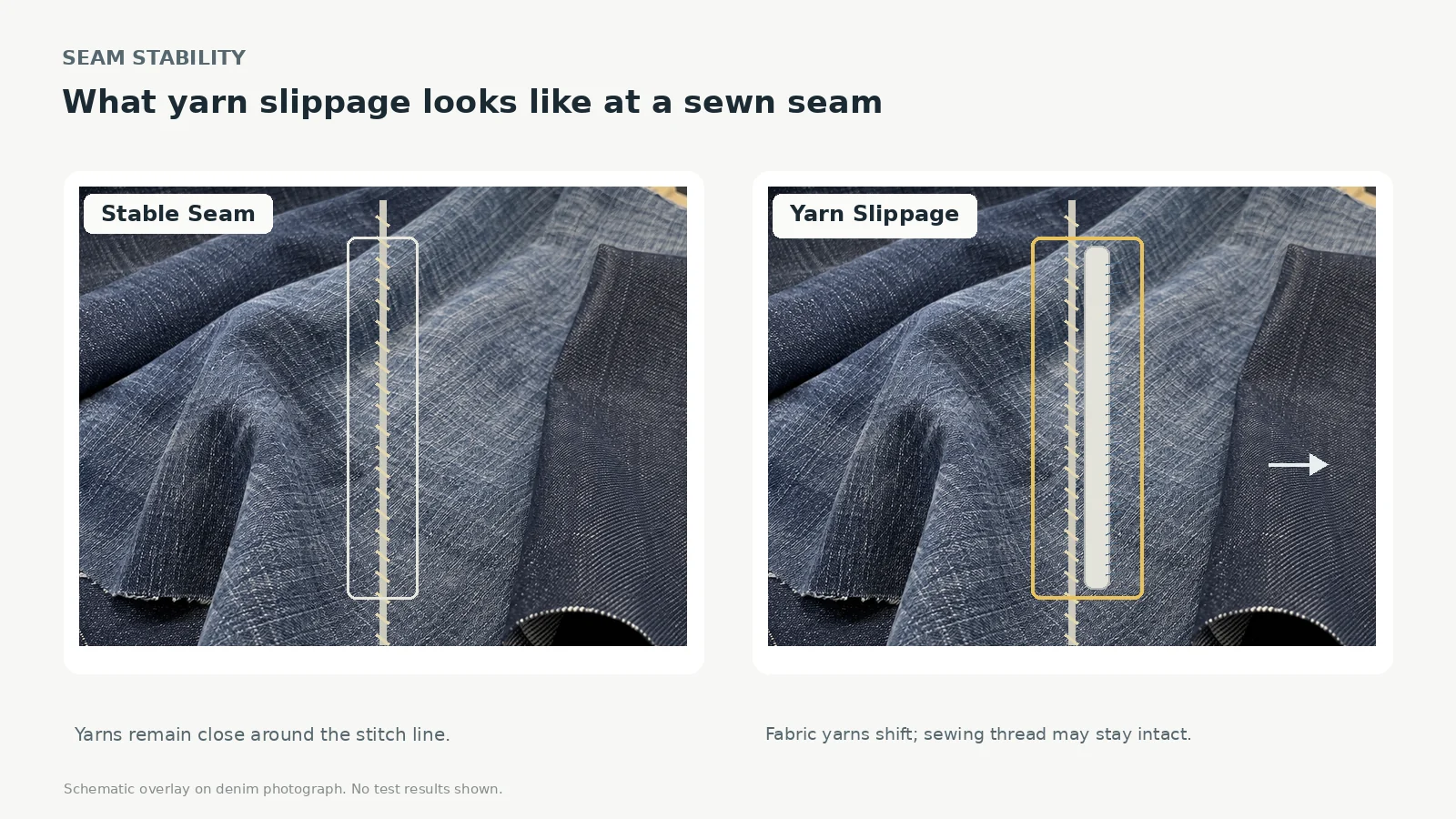
Seam slippage occurs when yarns move or separate around a sewn seam under tension.
In a garment, this may appear as:
- visible gaps along a seam
- yarn displacement
- seam opening
- reduced seam integrity
In serious cases, seam failure may occur.
This is particularly important when developing lightweight or fluid fabrics for fitted garments.
Is Lyocell Denim More Likely to Slip at the Seams?
Not automatically.
Seam slippage is not determined by the word “lyocell.”
It depends on the actual fabric and sewing system, including yarn characteristics, weave density, seam construction and stitching.
A lightweight, loosely constructed cotton fabric can also have poor seam stability.
The concern for buyers is that selecting a fabric only because it feels exceptionally soft may cause them to overlook its suitability for a stressed seam.
What Should Buyers Test?
For jeans development, consider evaluating sewn seams made with the intended production construction.
ASTM D1683/D1683M-22 covers failure in sewn seams of woven fabrics, including seam strength and yarn displacement under test conditions.
The appropriate acceptance requirement should be based on the customer’s specification and intended garment.
Testing is especially useful when:
- the fabric is lightweight
- the garment is fitted
- the construction is relatively open
- the wash process is demanding
- the seam area will experience repeated strain
A fabric that feels excellent as a swatch still needs to prove it works as a sewn garment.
7. Washing Performance: Why Lyocell Denim Needs a Separate Check
Seam stability is one consideration.
The next challenge may only become visible after washing.
Denim garments commonly undergo treatments such as:
- desizing
- enzyme washing
- abrasion
- softening
- rinsing
- drying
These processes can change appearance, hand feel, dimensions and surface structure.
Both cotton and lyocell denim require wash approval.
However, lyocell has a particular surface behavior worth understanding.
What Is Lyocell Fibrillation?
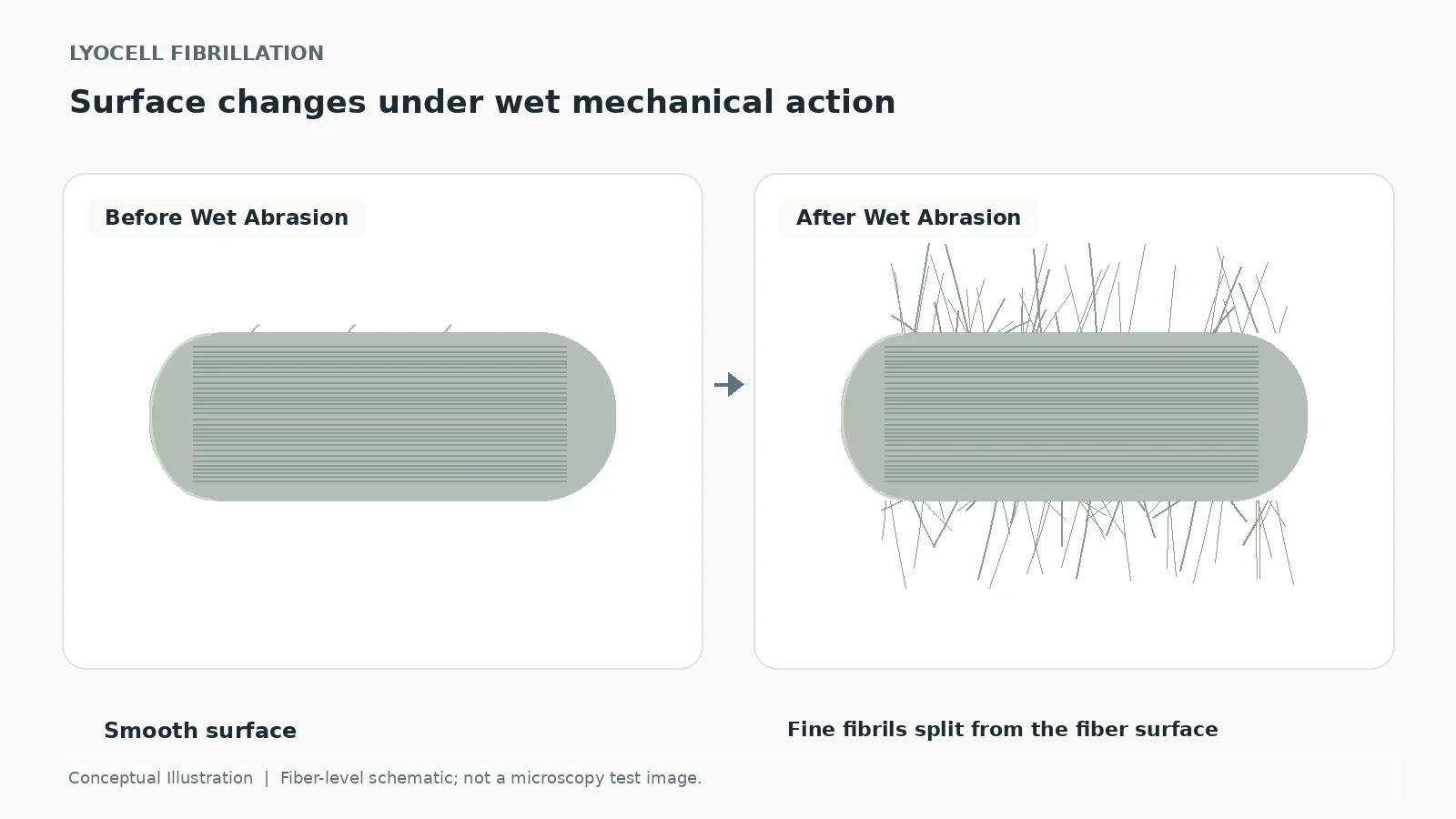
Fibrillation is the splitting of fine fibrils from the surface of a fiber.
In lyocell textiles, this can be encouraged by mechanical action under wet conditions.
Depending on the degree and finishing, the result may include:
- surface fuzz
- a different texture
- changes in fabric appearance
- a peach-skin effect
- unwanted surface irregularity
A 2025 review in Carbohydrate Polymers examines lyocell fibrillation, its causes and possible ways of controlling it.
This does not mean every lyocell denim fabric will develop an unacceptable surface.
Some constructions and finishes are specifically designed to control fibrillation.
In some products, controlled fibrillation may even contribute to the intended surface character.
Why the Wash Recipe Matters
Suppose a brand chooses a smooth lyocell denim for a clean, minimal-looking trouser.
If the garment receives an aggressive wash without suitable development, the final surface may no longer match the original design intention.
The opposite situation is also possible.
A carefully developed finishing process may produce the exact soft, washed appearance the designer wants.
The key is to test the intended process on the actual fabric.
What About Cotton Denim?
Cotton denim can also experience surface abrasion, fuzzing, color loss and strength changes during washing.
The mechanisms and visual results may differ, but cotton is not immune to finishing problems.
The practical distinction is not that one fabric requires testing and the other does not.
It is that the two materials may need different process settings to achieve the same finished-garment target.
For fabric development, ask the washing factory to evaluate:
- surface appearance after washing
- dimensional changes
- color and shade changes
- hand feel
- strength or seam stability where relevant
- repeatability of the wash result
8. Shrinkage and Dimensional Stability: Neither Fabric Gets a Free Pass
A fabric may pass the hand-feel evaluation and still create garment measurement problems.
Both lyocell and cotton are cellulosic materials, and both can show dimensional changes during washing.
The amount depends on:
- yarn and fabric construction
- finishing and preshrinking
- washing temperature
- mechanical action
- drying conditions
Therefore, buyers should not assume that lyocell automatically shrinks less than cotton or that cotton always has better dimensional stability.
Check Warp and Weft Shrinkage Separately
Request measured values for:
- warp shrinkage
- weft shrinkage
- finished fabric width
- usable fabric width
- garment measurements after the intended wash
For home-launderable fabrics, AATCC TM135 is one recognized method for evaluating dimensional changes after home laundering.
For industrially washed denim garments, the development team should also evaluate the actual planned wash process.
Why Finished Width Matters
Two fabrics may have similar prices per meter but different usable widths.
This can affect garment consumption and cutting efficiency.
A narrower usable width may require more fabric for the same garment quantity.
Buyers comparing lyocell and cotton options should therefore review usable width and estimated garment consumption, not only the quoted meter price.
9. Is Lyocell Denim Less Durable Than Cotton Denim?
This question needs a careful answer.
Lyocell fiber itself is not inherently a weak fiber.
Lenzing reports high tenacity as one of the characteristics of its TENCEL™ Lyocell fibers.
However, fiber strength and finished garment durability are not identical.
A denim garment must perform as a complete construction.
That includes:
- yarn strength
- woven fabric strength
- tear resistance
- abrasion resistance
- seam integrity
- washing durability
A strong fiber can still be used in a fabric with unsuitable seam performance.
Likewise, a traditional cotton denim is not automatically durable simply because it contains 100% cotton.
How Should Buyers Compare Durability?
Avoid asking:
Which fiber is stronger?
Instead, ask:
Which fabric meets the strength and durability requirements for this particular garment?
For lightweight relaxed pants, the testing requirements may differ from those for heavy workwear-inspired jeans.
For a fitted jean with stressed seams, seam strength and garment construction deserve particular attention.
For a premium lightweight shirt, surface appearance after repeated laundering may be just as important.
The right assessment depends on the final product.
10. Which Fabric Is More Comfortable in Warm Weather?
Lyocell-containing denim is often considered for warm-weather collections because it can provide a softer hand and fluid drape.
Lyocell fibers also have high moisture uptake.
However, this does not automatically mean every lyocell denim fabric is cooler, more breathable or faster drying than every cotton denim fabric.
Garment comfort depends on multiple factors:
- fabric weight
- fabric thickness
- air permeability
- moisture handling
- garment fit
- finishing
- wearing conditions
For example, a lightweight cotton denim with an open construction may feel more comfortable in certain conditions than a heavier, denser lyocell denim.
Buyers should evaluate the actual fabric.
A useful practical test is to make comparable garment samples and assess fit, drape and comfort under conditions close to the intended end use.
11. Is Lyocell Denim More Sustainable Than Cotton Denim?
Lyocell is often discussed in relation to resource-efficient fiber production.
But broad sustainability claims require evidence.
Lyocell Production
Lyocell is commonly produced through a solvent-spinning process.
Lenzing states that its TENCEL™ Lyocell production recovers more than 99.8% of the solvent used in its closed-loop process.
That is a specific claim about Lenzing’s technology.
It should not automatically be applied to every lyocell producer or finished denim fabric.
Cotton Production
Cotton’s environmental impact also varies depending on agricultural practices, location, processing and supply-chain characteristics.
Fiber selection is only one part of the complete textile impact.
Dyeing, washing, finishing, transportation and garment life also matter.
What Should Buyers Ask For?
If environmental claims are important, request documentation that supports the specific material and claim.
Depending on the product, this may involve:
- fiber-origin documentation
- material certification where applicable
- chain-of-custody evidence
- traceability information
- relevant environmental data
Do not describe a finished fabric as certified, organic, recycled or environmentally superior unless the claim is supported by appropriate evidence.
Is Every Lyocell Denim Fabric TENCEL™ Denim?
No.
Lyocell is the generic fiber category. TENCEL™ is a trademark of Lenzing.
A fabric should only be marketed as containing genuine TENCEL™ Lyocell when the branded fiber claim can be supported.
Lenzing also has specific certification and licensing requirements for commercial trademark use.
See Lenzing’s official brand and licensing information.
If documentation is unavailable, the generic term lyocell is the appropriate description for a verified lyocell composition.
12. Which Is More Cost-Effective for Clothing Brands?
There is no universal answer.
The price difference between lyocell and cotton denim depends on the specific fabric.
Factors include:
- fiber composition
- yarn type
- fabric weight
- construction
- finishing
- supplier availability
- order quantity
- branded-fiber requirements
A lyocell-containing fabric may have a higher quoted price than a particular cotton alternative.
But it would be misleading to assume that every lyocell denim is always more expensive.
Compare Garment Cost, Not Only Fabric Price
Suppose two fabrics are being considered for the same garment.
One costs more per meter but offers a different usable width.
Another has a lower price but requires additional garment-washing development.
The relevant commercial question is not simply the price per meter.
It is the estimated cost of producing an approved garment.
A useful comparison should include:
Fabric cost + fabric consumption + processing cost + relevant quality risks
This is especially important when sampling a new construction or unfamiliar blend.
13. Which Should Buyers Choose for Different Garments?
Here is a practical starting point.
| Garment Type | Fabric Direction to Consider | Main Buying Priority |
|---|---|---|
| Fluid wide-leg jeans | Lyocell or cotton/lyocell blend | Drape and seam stability |
| Traditional straight jeans | Cotton denim | Structure and wash character |
| Lightweight summer trousers | Lightweight lyocell or cotton denim | Comfort, opacity and drape |
| Denim shirts | Lightweight lyocell or cotton | Hand feel and wash performance |
| Structured denim jackets | Medium/heavier cotton denim | Shape and seam bulk |
| Soft denim dresses | Lyocell or cotton/lyocell blend | Drape and surface appearance |
| Slim fitted jeans | Appropriate stretch blend | Recovery and fit |
| Heritage-style rigid jeans | Rigid cotton denim | Traditional construction and character |
These are recommendations for initial sampling, not rules.
For example, a wide-leg jean can work very well in cotton denim, while certain lyocell blends can be engineered with substantial structure.
In every case, the final choice should be based on an approved fabric and garment sample.
For a specific 8.5oz fabric intended for wide-leg pants, review HW1210 100% lyocell denim. This is a lyocell product example, not evidence of a branded-fiber claim.
14. A Better Way to Compare Samples Before Ordering
For overseas clothing brands and sourcing teams, the most efficient process is to compare samples against the same product requirements.
Step 1: Define the Garment
Specify:
- jeans, trousers, shirt, jacket or dress
- target silhouette
- season
- desired drape
- intended wash
Step 2: Narrow the Weight Range
Choose a realistic sampling range rather than selecting by fiber alone.
For example, lightweight relaxed trousers might begin with several samples within a similar weight range.
Step 3: Compare Actual Construction
Request:
- complete fiber percentages
- yarn and weave information where available
- finished weight
- usable width
- stretch performance if applicable
Step 4: Check Sewing Performance
For jeans and fitted trousers, evaluate seam stability using the intended seam construction.
For light, flowing materials, pay attention to areas under repeated stress.
Step 5: Make a Wash Trial
Compare the samples after the planned treatment.
Check:
- color
- hand feel
- surface appearance
- shrinkage
- twisting or distortion
- strength and seam performance where appropriate
Step 6: Compare the Finished Garments
Evaluate the real silhouette rather than only the fabric swatches.
A fabric that looks best on a table may not produce the best finished garment.
Step 7: Confirm Commercial Details
Before ordering, confirm:
- current fabric availability
- quantity and dye lot
- price and usable width
- available testing information
- sampling options
- lead time and repeatability
The final decision should be based on garment performance, not the fiber name alone.
15. How to Request Lyocell or Cotton Denim Samples
A request such as:
We need soft denim.
may lead to samples that feel good but do not match the final garment.
A better request would be:
Example A: Lyocell Denim for Relaxed Trousers
We are developing lightweight wide-leg trousers with a soft, fluid denim appearance. We are considering lyocell or cotton/lyocell blended denim around 8–10oz. Please recommend suitable options and provide composition, usable width, shrinkage, available seam-performance information and the recommended wash direction.
Example B: Cotton Denim for Classic Jeans
We are developing men’s straight-leg jeans with a traditional denim structure. We are looking for approximately 11–13oz cotton-rich or 100% cotton denim with a medium-firm hand. Please provide composition, finished and usable width, shrinkage information and suitable options for a dark rinse or vintage wash.
Both requests describe the intended product.
That is far more useful than selecting a fabric only by fiber type.
Frequently Asked Questions
Is lyocell denim better than cotton denim?
Not universally. Lyocell-containing denim may offer a softer hand and more fluid drape, while cotton denim is often selected for traditional structure. The right choice depends on the garment and tested fabric performance.
Is lyocell denim suitable for jeans?
Yes. It can be suitable for jeans, especially relaxed or fashion-oriented designs. However, buyers should evaluate the actual construction, seam performance, shrinkage and intended wash.
Is lyocell denim weaker than cotton denim?
Not inherently. Lyocell fibers can have high tenacity. Finished fabric and garment durability depend on yarn, construction, finishing and sewing performance.
Does lyocell denim shrink?
It can. Shrinkage should be tested for the specific fabric and intended washing conditions. Fiber composition alone cannot establish the shrinkage result.
What is cotton/lyocell blended denim?
It is denim containing both cotton and lyocell fibers. The blend may be developed to balance traditional denim character with softness or drape, depending on how the yarns and fabric are constructed.
Does lyocell denim stretch?
Not necessarily. Lyocell is not an elastane fiber. Functional stretch depends on the complete construction, including whether elastic yarns are used.
Is lyocell denim the same as TENCEL™ denim?
No. Lyocell is a generic fiber category. TENCEL™ is a protected Lenzing brand that applies only to qualifying branded fibers.
What is the main washing risk with lyocell denim?
One relevant consideration is fibrillation during wet mechanical processing, which may change surface appearance. Buyers should also check shrinkage, color, strength and seam performance.
Which fabric is better for wide-leg jeans?
Both can work. Lyocell-containing denim may be preferable when a soft, fluid silhouette is the goal, while cotton denim may be selected for a more structured leg shape.
Final Thoughts: Choose the Garment, Not Just the Fiber
Remember the two 9oz denim samples from the beginning?
One felt soft and fluid.
The other felt more structured.
Neither was automatically the better fabric.
If the product is a flowing wide-leg trouser, the softer lyocell option may be worth developing.
If the product is a traditional straight-leg jean, the cotton option may offer the desired character.
But whichever fabric you select, the real approval comes after:
construction check → sewing test → wash trial → finished garment evaluation
Lyocell denim and cotton denim are not simply two competing materials.
They are different tools for creating different garments.
The best choice is the fabric that delivers the required silhouette, comfort, appearance and production performance.
If you are sourcing lyocell denim, cotton denim or cotton/lyocell blends from China, send ZLDENIM your garment type, target weight, composition, color, stretch requirement, wash direction or reference sample.
We can help compare suitable options from available fabrics and our supplier network, with quantities and specifications confirmed during the sourcing process.