
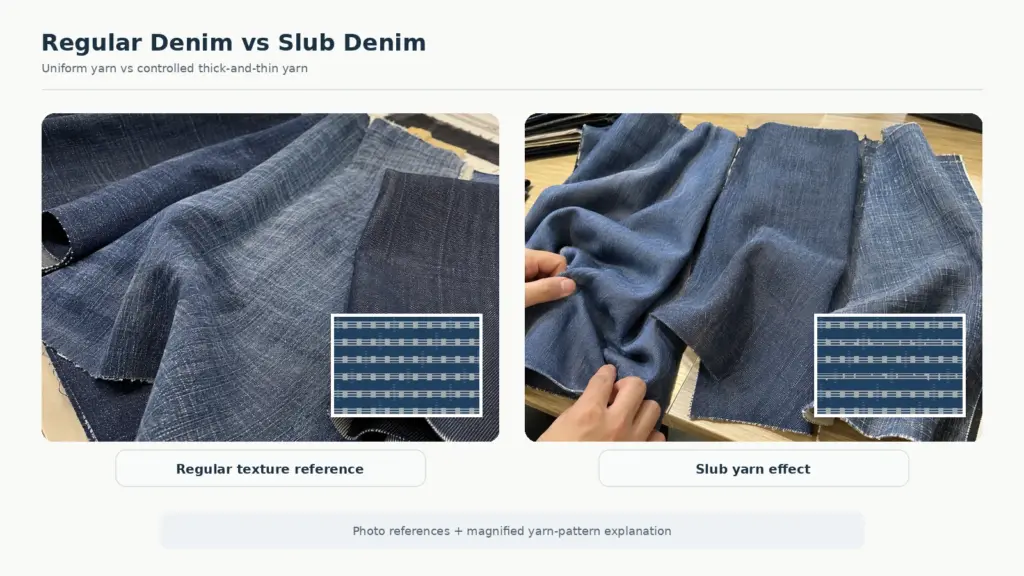
Two denim fabrics look almost identical when they arrive at your office.
Both are 11oz. Both are dark indigo. Both have a visible slub texture.
You send them for the same garment wash.
But the results are surprisingly different.
One develops a beautiful, irregular texture with natural-looking contrast.
The other looks uneven in the wrong places. Some areas are too prominent, while others appear almost flat.
If both fabrics are slub denim, why do they look so different after washing?
The answer starts long before the washing process.
It starts with the yarn.
Slub denim is not simply ordinary denim with a rough surface. Its appearance is influenced by intentional yarn irregularity, slub placement, weave construction, dyeing and finishing.
And for clothing brands, garment factories and sourcing teams, understanding these differences can prevent expensive sample revisions and disappointing bulk production.
Let’s start with what actually creates the texture.
1. What Is Slub Denim Fabric?
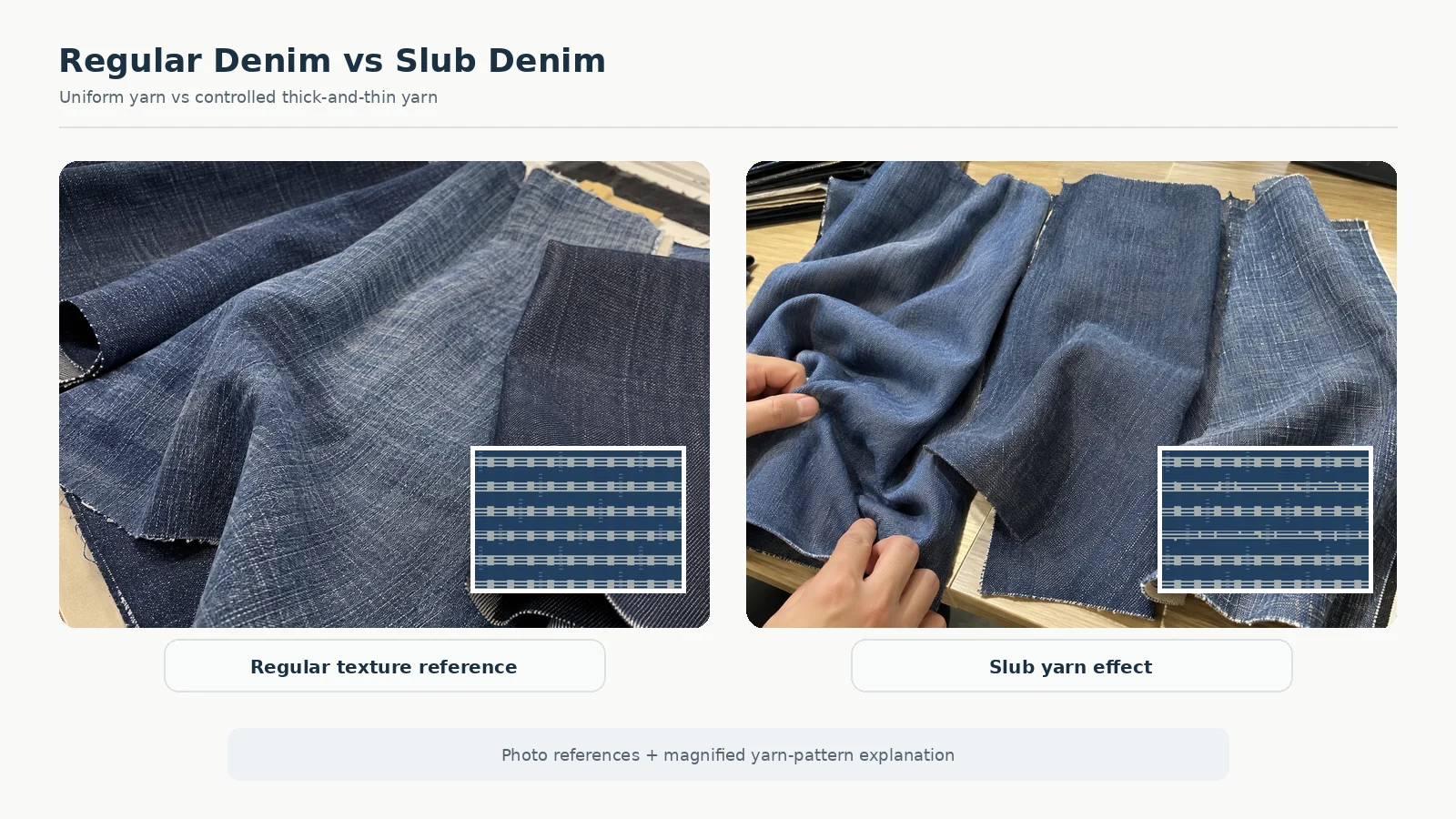
Slub denim is denim made using yarns with deliberate variations in thickness.
Instead of maintaining the same diameter along the entire yarn, a slub yarn contains sections that are thicker than the surrounding yarn.
These thicker sections create irregular surface effects when the yarn is woven into fabric.
Depending on the yarn design and placement, the finished denim may show:
- subtle thick-and-thin texture
- pronounced raised slubs
- irregular vertical streaks
- crosshatched surface effects
- a vintage-inspired appearance
- additional contrast after washing
The effect can be very subtle or highly visible.
Is Slub Denim a Fabric Defect?
Not when the effect is intentional and falls within the approved specification.
In ordinary yarn production, unexpected thick or thin places may be considered irregularities or defects.
In slub denim, selected irregularities are deliberately created to achieve a specific appearance.
However, this does not mean every visible irregularity should be accepted.
A fabric can contain an approved slub design and still have unacceptable weaving defects, excessive thin places or inconsistent yarn effects.
The difference is whether the irregularity matches the intended fabric construction and approved appearance.
This distinction becomes especially important during bulk fabric inspection.
2. How Is Slub Yarn Made?
To understand slub denim, it helps to look at the spinning process.
A conventional yarn is normally produced with a target linear density, meaning its thickness is intended to remain relatively consistent.
Slub yarn is produced with controlled variations in that density.
Controlled Thick-and-Thin Sections
In slub yarn production, the spinning system can be adjusted to create selected thicker sections along the yarn.
The design may control:
- slub length
- slub thickness
- spacing between slubs
- frequency of slubs
- variation in the underlying yarn count
These variables influence how the texture appears in the finished fabric.
For example, short and frequent slubs may create a different visual rhythm from long, widely spaced slubs.
A fabric designer can therefore develop different surface effects without changing the basic denim color.
Ring-Spun vs Open-End Slub Yarn
Slub effects can be produced using suitable ring-spinning or open-end spinning systems.
This is an important sourcing distinction.
Slub denim is not automatically ring-spun denim.
Modern spinning equipment can be programmed to introduce slub effects with different lengths, intervals and thicknesses.
CottonWorks explains these spinning techniques in its Denim Construction guide.
For buyers, the practical question is:
What slub yarn construction is used, and what surface effect is it designed to produce?
It is usually more useful to ask this than to assume that one spinning method always produces the desired appearance.
Does a Bigger Slub Mean Better Denim?
No.
Large slubs can create strong texture, but they are not automatically more attractive or more suitable for jeans.
Very prominent slubs may be appropriate for a vintage-inspired collection.
A clean commercial jeans program may require a more restrained effect.
The ideal slub size and frequency depend on the fabric’s intended appearance, construction and garment application.
So far, we know how the irregularity gets into the yarn. But where that yarn is placed in the weave can change the entire look of the fabric.
3. Warp Slub, Weft Slub and Crosshatch Denim
This is one of the most useful technical distinctions for denim buyers.
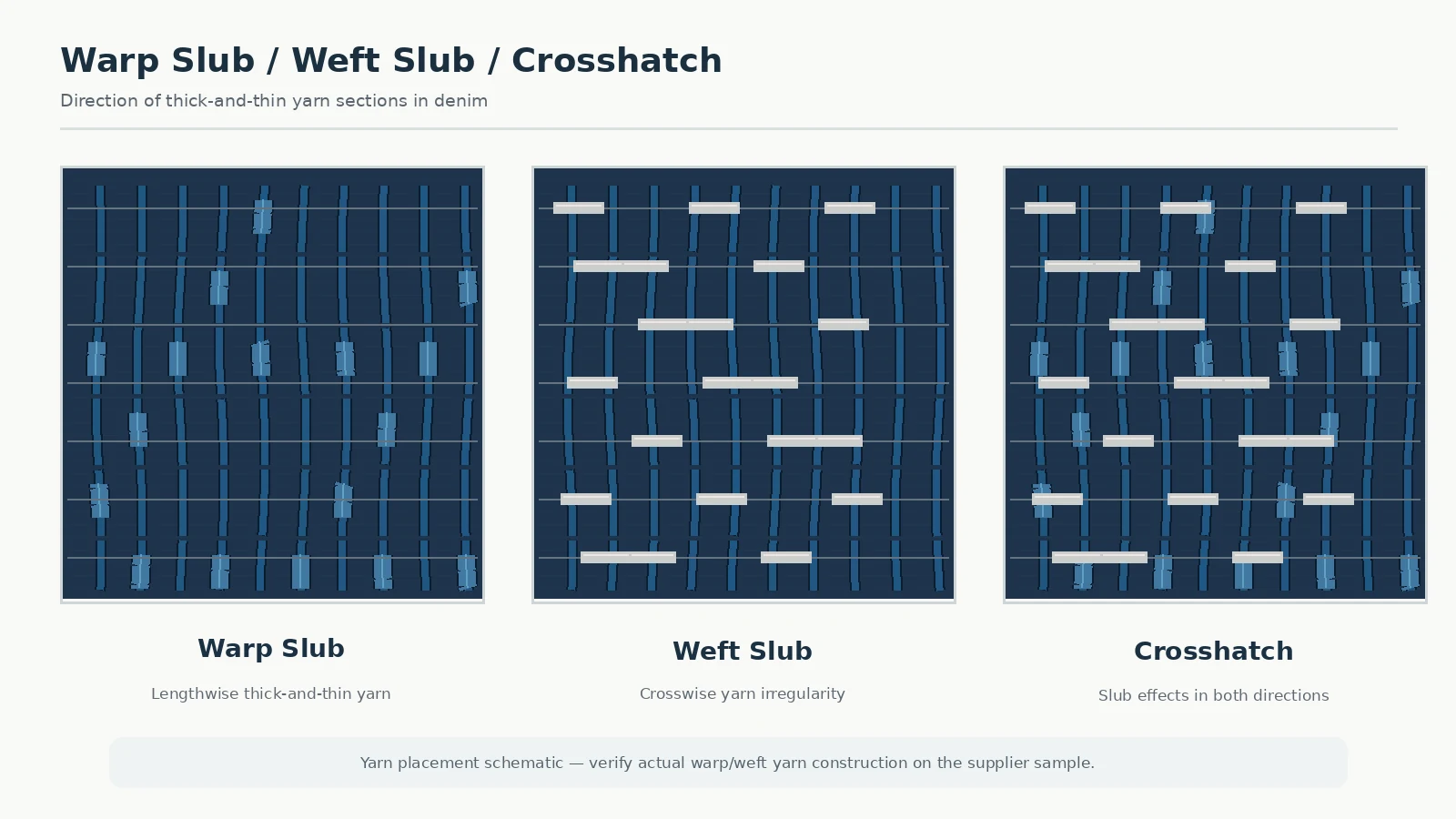
Slub yarns can be used in the warp, the weft or both directions.
Each arrangement produces a different visual effect.
Warp Slub Denim
Warp yarns run lengthwise along the fabric.
In traditional warp-faced indigo denim, these yarns dominate the visible face of the fabric.
When slub yarns are used in the warp, the surface can develop irregular lengthwise texture.
Depending on the construction and garment wash, this may produce a vertical streaking effect associated with vintage denim.
Warp slub is often considered when a designer wants:
- visible vertical texture
- irregular indigo contrast
- vintage-style fading
- a distinctive rigid-denim appearance
However, the exact appearance depends on yarn design, warp density, indigo dyeing and finishing.
Weft Slub Denim
Weft yarns, also called filling yarns, run across the width of the fabric.
Using slub yarns in the weft can introduce irregularity in that direction.
How strongly the effect appears on the fabric face depends on the weave and the relationship between warp and weft yarns.
In a warp-faced twill, some weft effects may be less visible than similarly prominent warp slubs.
A buyer should therefore inspect the actual woven sample rather than judge the design from the yarn alone.
Crosshatch Denim
When irregular yarn effects are introduced in both warp and weft, the resulting surface may have a crosshatched appearance.
This can produce a more complex, irregular texture.
Crosshatch denim is useful when the design calls for pronounced surface character.
But not all fabrics described commercially as “crosshatch” have identical yarn constructions.
Ask to see the face, back and enlarged surface texture.
Comparison of Slub Constructions
| Construction | Typical Visual Direction | Buyer Consideration |
|---|---|---|
| Warp slub | Lengthwise irregularity and possible vertical fading | Slub prominence and wash contrast |
| Weft slub | Filling-direction texture, visibility depending on weave | Face appearance and hand feel |
| Warp and weft slub | Irregular texture in both directions | Pattern balance and consistency |
| Regular non-slub yarn | More uniform fabric surface | Clean appearance and predictable visual texture |
These are general descriptions, not fixed appearance guarantees.
4. Slub Denim vs Regular Denim: What Is the Real Difference?
Both fabrics can use the same basic denim weave.
Both can be made from cotton.
Both can be rigid or stretch.
The main difference is the intentional variation in yarn thickness and the resulting surface character.
Regular Denim
Denim made with relatively even yarns generally produces a more uniform texture.
Depending on finishing, it can create a clean surface and a comparatively even wash-down appearance.
Slub Denim
Slub denim introduces deliberate irregularity.
That irregularity can influence:
- surface texture
- visual depth
- how light reflects from the fabric
- local abrasion during washing
- the appearance of faded areas
CottonWorks notes that uneven yarn thickness can create variations in shade during abrasion finishing, with thicker areas potentially abrading differently from thinner sections.
This explains why slub can become more noticeable after washing.
But the result is not identical for every construction.
The slub yarn design, dye penetration, abrasion intensity and fabric structure all affect the final appearance.
Is Slub Denim Stronger Than Regular Denim?
Not necessarily.
Slub is primarily a yarn appearance feature, not a strength rating.
The finished fabric’s performance depends on multiple factors, including:
- yarn strength
- thin-section characteristics
- yarn count
- weave density
- fiber composition
- finishing
- fabric weight
A well-engineered slub denim can be suitable for everyday jeans.
But buyers should not assume that a textured fabric is automatically stronger, or that intentional yarn irregularity excuses weak fabric performance.
If durability is important, compare actual test results.
5. Why Indigo Slub Denim Can Look Different After Washing
Now we can return to the two 11oz samples from the beginning.
Both were described as slub denim.
Yet after washing, one developed attractive contrast while the other looked inconsistent.
Why?
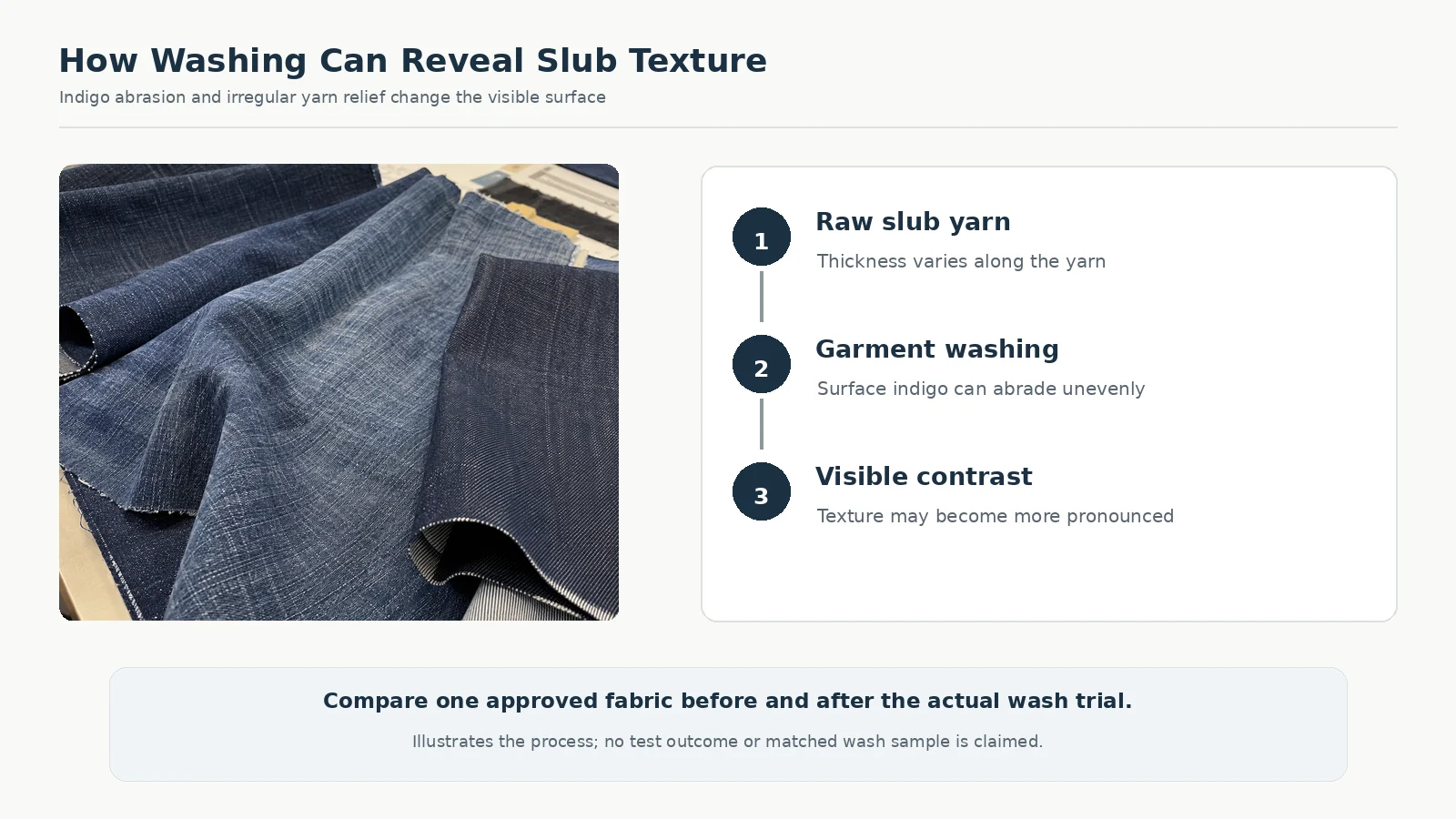
Because slub texture and garment washing interact.
In conventional indigo denim, dye is concentrated primarily toward the outside of the yarn, while the inner core may remain much lighter.
During washing and abrasion, surface dye can be removed.
This allows lighter areas and surface texture to become more visible.
Slub Thickness Changes Surface Contact
A slub yarn contains thicker and thinner sections.
In some fabric constructions, thicker sections may protrude more from the surface.
These areas can experience different contact and abrasion during washing or wear.
As a result, certain slub patterns may become more pronounced.
However, the exact fading pattern also depends on:
- which yarn direction contains the slubs
- dyeing conditions
- yarn twist
- weave structure
- abrasion method
- wash duration and intensity
It would be inaccurate to assume that all slub denim fades faster or produces the same vintage effect.
The Same Slub Fabric Can Produce Different Results
Consider three possible finishing directions.
Dark Rinse
A relatively gentle rinse may preserve much of the original dark indigo appearance.
The slub texture may remain visible mainly through surface relief and light reflection.
Enzyme or Vintage Wash
A process designed to remove some indigo and soften the garment may make slub effects more apparent.
More Intensive Abrasion
Stronger abrasion may create pronounced surface contrast.
But it may also produce an appearance that is too aggressive for a clean commercial collection.
The correct result depends on what the designer wants.
Why Buyers Should Approve the Washed Sample
An unwashed slub fabric may look subtle.
After washing, the same texture may become much more prominent.
For commercial development, buyers should therefore compare:
- original fabric appearance
- small-scale wash sample
- finished garment wash
- bulk production result
A fabric that looks attractive on a hanger may not produce the same effect after garment finishing.
For more technical background, see the CottonWorks Denim Finishing guide.
6. How Fabric Weight Changes Slub Denim Applications
Slub yarn is not limited to heavyweight denim.
A lightweight fabric can contain slub yarns, just as a heavyweight denim can.
Fabric weight and surface texture should be considered separately.
Lightweight Slub Denim: Approximately 6–9oz
Lightweight slub denim may be worth sampling for:
- denim shirts
- shirt dresses
- skirts
- lightweight overshirts
- relaxed summer trousers
For these garments, the main priorities are often hand feel, drape and the intended surface appearance.
If the slubs are very prominent, inspect whether the resulting texture is suitable for a lighter garment.
Medium-Weight Slub Denim: Approximately 9–12oz
This range may be appropriate for:
- everyday fashion jeans
- straight-leg jeans
- relaxed jeans
- shorts
- casual jackets
A medium-weight slub denim can combine visible denim texture with a relatively versatile weight.
However, the final garment structure still depends on fiber composition, yarn size, density and finishing.
Heavier Slub Denim: Approximately 12–16oz and Above
Heavier slub constructions can be considered for:
- traditional rigid jeans
- vintage-inspired denim
- heavyweight straight-leg jeans
- structured jackets
- heritage-style products
In these garments, pronounced texture may form an important part of the design.
But heavier weight also increases sewing bulk and requires careful evaluation of finishing and garment comfort.
These ranges are practical starting points, not technical definitions of slub denim.
For a broader weight comparison, see Denim Fabric Weight Guide: How to Choose the Right Oz for Garments.
7. Is Slub Denim Always Rigid or 100% Cotton?
No.
This is a common misunderstanding.
The word slub describes yarn texture.
It does not, by itself, define fiber composition or stretch performance.
Possible fabric constructions include:
- 100% cotton rigid slub denim
- cotton/elastane stretch slub denim
- cotton/polyester/elastane slub denim
- cotton-rich blended slub denim
The exact options depend on the supplier and construction.
Rigid Slub Denim
Rigid slub denim is often used when the design calls for a traditional denim appearance.
It may work for:
- straight-leg jeans
- relaxed jeans
- loose-fit jeans
- structured jackets
A rigid slub fabric can have a distinctive appearance without requiring elastane.
Stretch Slub Denim
Slub effects can also be produced in suitable stretch constructions.
A stretch fabric may contain special effect yarns together with elastic yarns, depending on its design.
This makes it possible to combine textured denim appearance with greater flexibility.
However, buyers should still request:
- actual stretch percentage
- stretch direction
- growth
- recovery
Slub texture does not guarantee good stretch performance.
For a detailed explanation, see Stretch Denim Fabric: How to Choose the Right Stretch Level.
Slub Denim Is Not the Same as Selvedge Denim
Selvedge refers to a self-finished woven fabric edge.
Slub refers to irregular yarn thickness.
These describe different characteristics.
A fabric can be slubby without being selvedge, or selvedge without having a pronounced slub texture.
Do not use these terms interchangeably when sourcing fabric.
8. Slub Denim vs Nep Denim: Do Not Confuse the Two
Slub and nep are both associated with textured denim.
But they are not the same thing.
Slub
Slub generally refers to thicker sections along the yarn length.
The visual result may include elongated or irregular thick-and-thin effects.
Nep
Nep refers to small entangled fiber knots or compact fiber irregularities.
In fabric, neps may appear as small specks or raised points.
Some fabrics contain both slub and nep effects.
For buyers, the distinction matters because the intended surface appearance may be completely different.
A garment designer asking for visible vertical slubs may not be satisfied with denim dominated by small nep-like dots.
When requesting samples, include a close-up reference photo whenever possible.
9. How to Tell Intentional Slub From a Fabric Defect
A heavily textured fabric can create a particular inspection challenge.
Some irregularities are part of the approved design.
Others may be unacceptable production defects.
The answer is not to reject everything uneven.
It is to define the approved texture.
What Should Be Approved?
Before bulk production, buyers should agree on:
- intended slub prominence
- general frequency and spacing
- acceptable visual variation
- face and back appearance
- target wash effect
- representative approved sample
These should be assessed on a sufficiently large piece of fabric.
A tiny swatch may not show the full repeating or irregular character.
What Still Counts as a Potential Problem?
Even in slub denim, buyers should inspect for:
- unintended holes
- broken yarns
- visible weaving faults
- abnormal repeated bars or streaks
- unacceptable thick or thin areas
- contamination
- excessive variation between rolls
The existence of a slub design does not mean every defect becomes acceptable.
The Difference Between Character and Inconsistency
Imagine approving a denim with noticeable but well-distributed thick-and-thin yarn effects.
The bulk fabric then arrives with one section showing very heavy slubs and another section appearing almost flat.
Whether this is acceptable depends on the approved reference and agreed tolerance.
The issue is not that the fabric is irregular.
The issue is that its irregularity may no longer match the product the buyer approved.
This is why slub denim requires both technical specifications and visual approval.
10. Check Bulk Consistency Before Cutting
One of the risks with textured denim is assuming that a small approved sample represents the entire production lot.
For important programs, compare:
- roll to roll
- beginning and end of rolls
- left, center and right across the width
- different dye or production lots
- washed results from representative samples
Slub placement may intentionally appear irregular within the design.
But the overall character should still remain within the agreed approval standard.
Why Shade Consistency Matters
Indigo denim can show shade variation between production lots.
When a strong slub pattern is added, differences in dyeing and surface abrasion may become more noticeable after washing.
This can cause problems when different garment panels are cut from fabric with mismatched appearances.
For larger jeans programs, it is useful to compare representative swatches after the intended garment wash.
Why Finished Width Matters
Slub denim still needs to be evaluated for usable width.
A fabric may have the target appearance but a different usable width from the original sourcing brief.
That affects marker layout and fabric consumption.
The buyer should confirm both the finished width and usable cutting width before finalizing the garment cost.
11. Does Slub Denim Require Special Strength Testing?
Not necessarily a completely different test system.
But its intended construction should be evaluated against the garment’s normal performance requirements.
Slub yarn introduces deliberate variation in yarn thickness.
The impact on fabric properties depends on the yarn design and complete woven construction.
For jeans, relevant performance checks may include:
- tensile strength
- tear strength
- seam strength
- dimensional stability
- abrasion performance
- rubbing colorfastness
- stretch and recovery, if applicable
Not every project requires every test.
The appropriate testing program depends on the garment, customer specification and market.
Pay Attention to Thin Areas
A slub yarn may contain thinner sections between its thicker effects.
For a particular construction, these sections may be relevant to yarn strength and production performance.
However, their existence does not automatically mean the fabric is unsuitable.
The actual fabric should be tested.
A supplier should not use “vintage slub character” as a substitute for meeting an agreed strength requirement.
12. Best Applications for Slub Denim Fabric
The best use depends on how visible the slub effect is and how the fabric behaves after washing.
| Garment Type | Slub Direction to Consider | Main Buying Priority |
|---|---|---|
| Classic straight-leg jeans | Medium-weight warp slub | Texture and silhouette |
| Relaxed jeans | Subtle or medium slub | Drape and washed appearance |
| Vintage-inspired jeans | More pronounced slub | Indigo contrast and wash development |
| Heavyweight rigid jeans | Medium or prominent slub | Fabric strength and structure |
| Denim jackets | Subtle to medium slub | Surface appearance and seam bulk |
| Denim shorts | Lightweight or medium slub | Hand feel and intended wash |
| Shirts and overshirts | Lightweight, controlled slub | Comfort and texture |
| Fashion skirts | Lightweight or medium slub | Drape and garment appearance |
These are sampling directions, not fixed product specifications.
A subtle slub can work very well in premium minimalist denim.
A pronounced slub may be more suitable for a collection centered on vintage texture.
Neither is inherently better.
The correct choice should support the garment’s design and intended selling point.
One relevant 14oz catalog example is HW7370# dark-indigo warp-slub rigid denim, with a stated composition of 90% cotton and 10% polyester; it should not be treated as 100% cotton denim.
13. How to Compare Slub Denim Samples From Different Suppliers
When comparing samples, avoid treating the word “slub” as a complete fabric specification.
Use a structured selection process.
Step 1: Define the Target Texture
Decide whether you want:
- subtle irregularity
- short, frequent slubs
- long, visible slubs
- vertical texture
- crosshatched appearance
A reference swatch is usually more useful than a description such as “heavy slub.”
Step 2: Match Fabric Weight
Compare fabrics in the same approximate weight range when possible.
An 8oz slub denim and a 14oz slub denim may have completely different hand and garment applications.
Step 3: Confirm Composition and Stretch
Check whether the fabric is:
- rigid
- low stretch
- comfort stretch
- higher stretch
Do not infer stretch behavior from the texture.
Step 4: Compare Construction
Ask for available information about:
- warp and weft yarn
- slub direction
- weave
- finished weight
- fabric density
- finished and usable width
Step 5: Test the Intended Wash
This is especially important for visible slub effects.
Compare the actual washed appearance, not just the original fabric surface.
Step 6: Check Performance and Consistency
Depending on the product, confirm:
- shrinkage
- skew or leg twist
- strength
- rubbing fastness
- stretch recovery where applicable
- lot consistency
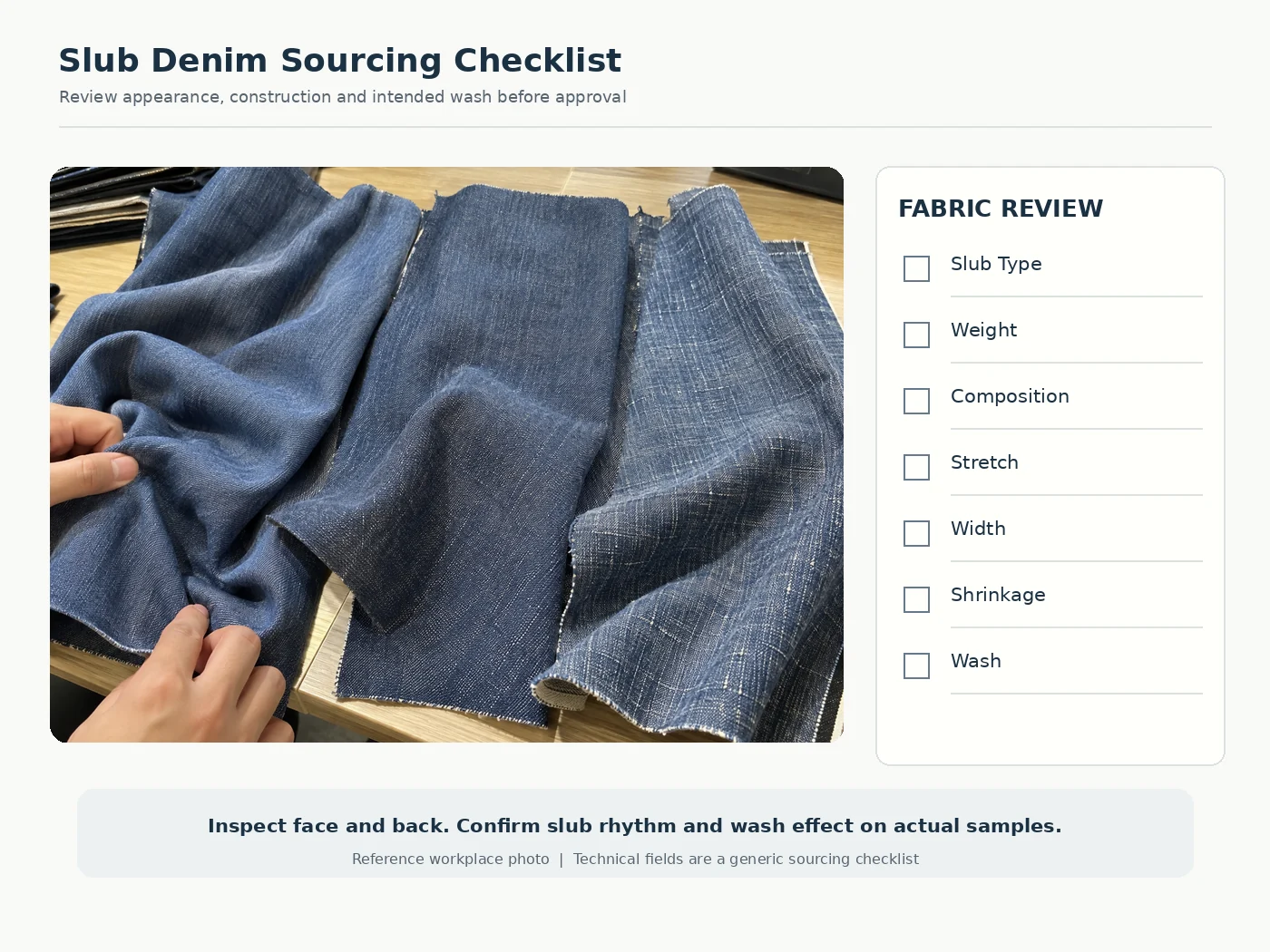
Step 7: Approve the Fabric for the Final Garment
Use the fabric in a real garment sample.
Check the texture at the scale of the whole garment.
An attractive slub pattern in a small swatch may appear too strong or too irregular when spread across an entire pair of jeans.
The objective is not to select the most textured sample. It is to select the texture that makes the finished garment look right.
14. How to Request Slub Denim Samples From a Supplier
A message such as:
Please send slub denim fabric.
does not provide enough information to identify the right fabric.
The supplier still needs to know how prominent the slubs should be, what garment you are making and what wash effect you expect.
Example A: Rigid Slub Denim for Straight-Leg Jeans
We are developing men’s straight-leg jeans with a vintage indigo appearance. We are looking for approximately 11–13oz rigid slub denim, preferably 100% cotton, with visible but balanced warp slubs. The garment will receive a medium vintage wash. Please recommend suitable options and provide composition, finished width, shrinkage and available construction details.
Example B: Lightweight Slub Denim for Fashion Garments
We need approximately 7–9oz indigo slub denim for lightweight overshirts and relaxed trousers. The target is a soft hand with subtle, irregular texture rather than heavy slubs. Please provide available fabric options, composition, usable width, shrinkage and sample information.
Example C: Stretch Slub Denim for Jeans
We are developing women’s casual jeans and want a visible slub texture with comfortable stretch. We are considering approximately 9–11oz denim. Please provide composition, actual stretch percentage, growth and recovery information if available, shrinkage and suitable wash directions.
These requests allow the supplier to narrow the options based on fabric behavior and appearance.
Frequently Asked Questions
What is slub denim fabric?
Slub denim is denim made with yarns containing deliberate thick-and-thin variations. These yarn effects create an irregular fabric texture that can become more noticeable after washing.
Is slub denim better than regular denim?
Not necessarily. Slub denim offers a different visual character. Regular denim may be more appropriate for garments requiring a clean, uniform surface.
Is slub denim always 100% cotton?
No. Slub denim can be produced in cotton and certain blended constructions. Fiber composition should be confirmed for the specific fabric.
Is slub denim stretchable?
It can be. Slub describes yarn texture rather than stretch behavior. Rigid and stretch slub constructions are both possible.
What is the difference between warp slub and weft slub?
Warp slubs occur in lengthwise yarns, while weft slubs occur in crosswise yarns. Their visibility depends on the weave and fabric construction.
Why does slub denim fade differently?
Intentional differences in yarn thickness can affect surface contact, indigo removal and the way the texture becomes visible during abrasion. The final result also depends on dyeing and washing conditions.
Is slub denim a defect?
Intentional, approved slub effects are design characteristics. Unintended weaving faults, excessive yarn irregularities or unacceptable bulk variation may still be defects.
What is the difference between slub denim and nep denim?
Slubs are thicker sections along yarn length. Neps are small entangled fiber knots. Both may create texture, but the visual effects are different.
Is slub denim suitable for jeans?
Yes. Slub denim is used for various jeans styles, including rigid, relaxed, straight-leg and certain stretch constructions. The right choice depends on weight, texture, durability and wash performance.
What should buyers check before ordering slub denim?
Confirm the slub appearance, weight, composition, warp or weft placement, width, shrinkage, stretch where applicable, wash result and bulk consistency.
Final Thoughts: The Best Slub Denim Is Not Always the Most Irregular
Remember the two 11oz slub denim samples from the beginning?
They had similar specifications but produced different results after washing.
That difference was not necessarily a matter of one fabric being good and the other being bad.
Their yarn design, slub placement, construction and finishing may simply have produced different effects.
For clothing brands and buyers, the important question is:
Does the fabric develop the texture you want after it becomes a finished garment?
Start by defining the visual target.
Then compare:
- slub size and distribution
- warp and weft construction
- weight and composition
- hand feel
- intended wash behavior
- strength and dimensional stability
- bulk consistency
The best slub denim is not the fabric with the largest irregularities.
It is the fabric whose texture supports the finished product.
If you are sourcing slub denim fabric from China, send ZLDENIM your garment type, target weight, composition, preferred slub texture, stretch requirement, color, intended wash or reference swatch.
We can help narrow suitable options from available fabrics and our supplier network, with actual specifications and availability confirmed during the sourcing process.