
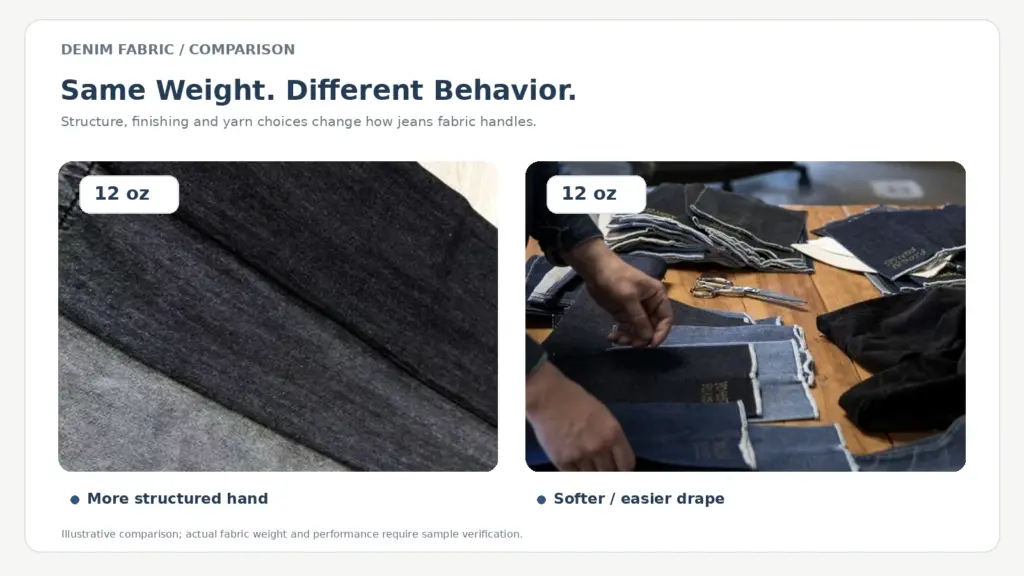
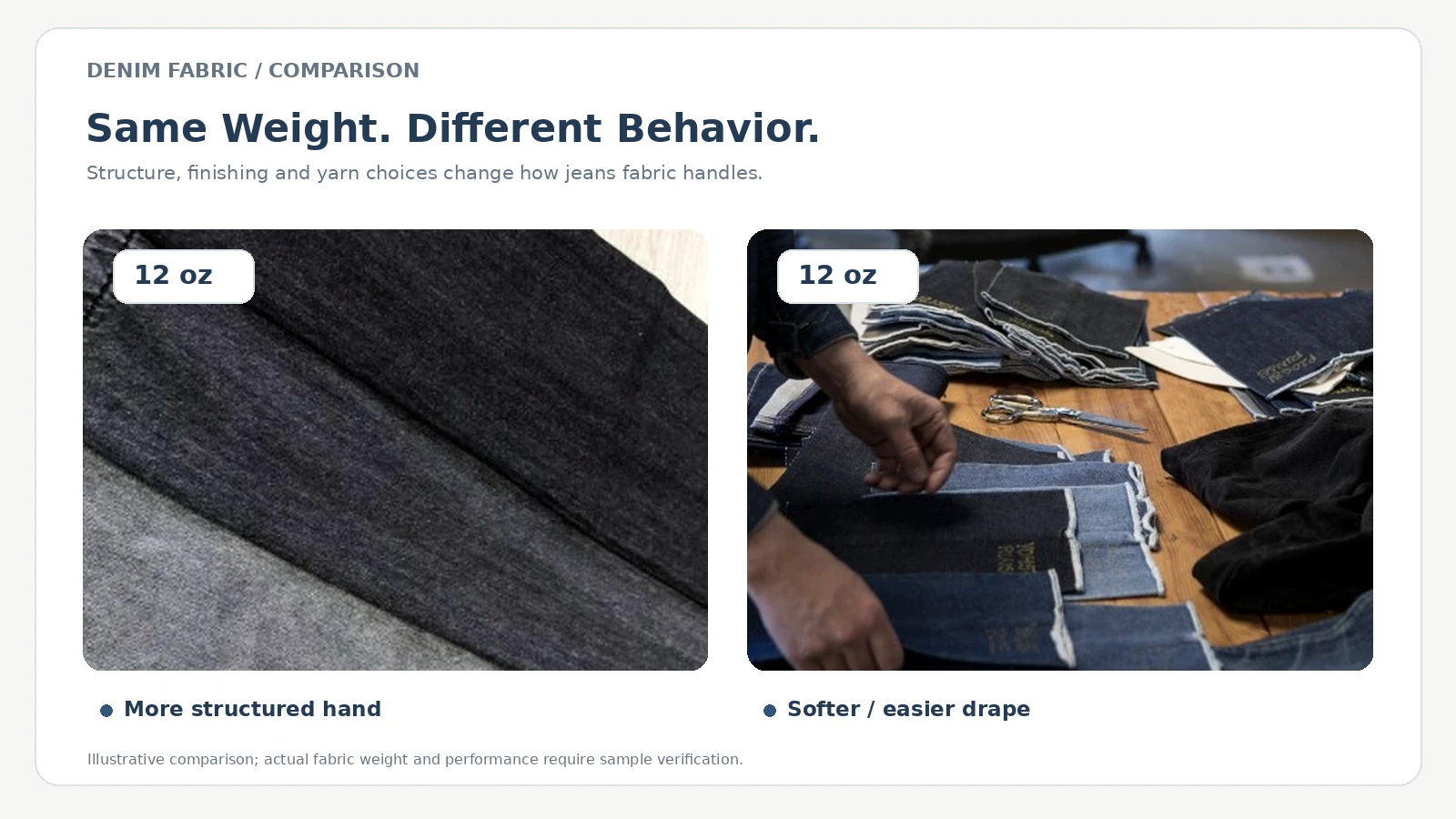
Imagine receiving two denim samples from different suppliers.
Both are labeled 12oz denim fabric. Both have a similar indigo shade. Both look suitable for your next jeans collection.
You choose one.
But after garment washing, the finished jeans feel stiffer than expected, the leg shape looks different, and the measurements need adjustment.
What went wrong?
The weight was correct. The color was close. Even the fabric composition looked acceptable.
The problem is that 12oz tells you how much the fabric weighs—not how the finished jeans will behave.
This is one of the most important distinctions when sourcing denim fabric for jeans.
Fabric weight matters, but so do stretch, yarn construction, weave density, finishing and shrinkage.
For clothing brands, garment factories and fabric buyers, choosing the right denim starts with understanding how these factors work together.
Here is a practical way to make that decision.
1. Start With the Jeans You Want to Make
Before asking a supplier for denim fabric, define the garment.
A pair of relaxed straight-leg jeans and a pair of skinny jeans may have completely different fabric requirements.
The first usually needs enough structure to maintain its silhouette.
The second needs sufficient flexibility to move with the body.
Similarly, lightweight summer jeans and heavyweight heritage jeans should not be developed around the same assumptions.
Start with four questions:
- What is the target fit?
- How should the jeans feel when worn?
- What is the intended garment wash?
- What season or market is the collection designed for?
These answers help narrow the fabric selection before weight or stretch specifications are discussed.
Match the Fabric to the Fit
| Jeans Style | Recommended Starting Direction | Key Consideration |
|---|---|---|
| Wide-leg jeans | Rigid or low-stretch denim | Drape and structure |
| Relaxed jeans | Rigid or comfort stretch | Shape and movement |
| Straight-leg jeans | Rigid or comfort stretch | Balanced hand and body |
| Slim jeans | Comfort or medium stretch | Fit and recovery |
| Skinny jeans | Medium to high stretch | Extension and shape retention |
| Heritage jeans | Often rigid denim | Traditional character |
| Lightweight summer jeans | Lighter rigid or stretch denim | Weight, comfort and drape |
These are starting points, not fixed technical requirements.
A well-designed pair of wide-leg jeans can use stretch denim, and a slim-fitting garment can sometimes use rigid denim if the pattern is developed accordingly.
The key is to choose fabric and pattern together.
But once the fit is decided, the next question becomes harder: how heavy should the fabric actually be?
2. Choose the Right Denim Fabric Weight
Denim weight is normally measured in ounces per square yard, written as oz/yd², or in grams per square meter (GSM).
The approximate conversion is:
1 oz/yd² = 33.9 GSM
Common weight references include:
| Denim Weight | Approx. GSM | Typical Jeans Application |
|---|---|---|
| 8 oz | 271 | Very lightweight fashion jeans |
| 9 oz | 305 | Lightweight casual jeans |
| 10 oz | 339 | Lightweight everyday jeans |
| 11 oz | 373 | Everyday jeans |
| 12 oz | 407 | Classic jeans |
| 13 oz | 441 | Structured jeans |
| 14 oz | 475 | Traditional rigid jeans |
| 16 oz | 542 | Heavyweight jeans |
The appropriate weight depends on the garment, construction and finish.
8–10oz: Lightweight Jeans
This range is worth considering when a brand wants jeans that feel lighter and less bulky.
Possible applications include:
- lightweight summer jeans
- relaxed women’s jeans
- fashion denim
- children’s jeans
- soft casual jeans
However, a very lightweight fabric may not provide the structure expected from conventional five-pocket jeans.
Check waistband stability, pocket support and finished garment drape.
For a more detailed comparison, see Lightweight Denim Fabric: 6oz vs 8oz vs 10oz.
10–12oz: Versatile Everyday Jeans
For many commercial jeans programs, approximately 10–12oz is a useful starting range.
It can offer a balance between fabric body and wearing comfort.
This range may work for:
- straight-leg jeans
- relaxed jeans
- slim jeans
- everyday fashion denim
But the same weight can feel very different depending on whether the fabric is rigid, comfort stretch or high stretch.
12–14oz: Classic Structured Denim
For traditional jeans, approximately 12–14oz remains a common direction.
These fabrics can provide a substantial denim hand and more structure for straight, relaxed and workwear-inspired silhouettes.
They are also worth considering when a brand wants visible folds, creases and a more traditional rigid-denim character.
14oz and Above: Heavyweight Jeans
Heavyweight denim is commonly associated with more substantial jeans and heritage-inspired products.
It can create a strong, structured appearance.
But heavier fabric also increases seam bulk around:
- waistbands
- belt loops
- pockets
- hems
The sewing factory should confirm whether its production process is suitable for the chosen construction.
Heavier denim does not automatically mean better quality.
For a detailed explanation of weight selection, see Denim Fabric Weight Guide: How to Choose the Right Oz for Garments.
Why Weight Alone Is Not Enough
Return to the two 12oz denim samples from the introduction.
They have the same weight per unit area.
Yet one may use coarser yarns and a different weave density. The other may include elastic yarns and a softer finish.
Their weight is the same, but their drape, hand feel and movement can differ.
That brings us to the second major decision.
Should the jeans use rigid denim or stretch denim?
3. Rigid vs Stretch Denim: Choose Based on Movement and Fit
A jeans fabric can look traditional while behaving very differently when worn.
Rigid Denim: Structure and Traditional Character
Rigid denim usually contains no added elastane and has limited functional stretch.
It is often selected for:
- relaxed jeans
- straight-leg jeans
- wide-leg jeans
- traditional five-pocket styles
- heritage-inspired denim
Rigid denim can help maintain the intended garment structure.
However, rigid does not necessarily mean uncomfortable.
A lighter rigid fabric or one with a softer finish may feel comfortable, especially when the garment pattern provides sufficient room.
Stretch Denim: More Flexibility for Closer Fits
Stretch denim is engineered to extend when the wearer moves.
It commonly contains cotton combined with elastane, also called spandex.
Stretch constructions are often useful for:
- slim jeans
- skinny jeans
- fitted women’s jeans
- everyday jeans requiring greater movement
But buyers should not select stretch denim based only on elastane content.
For example:
98% cotton / 2% elastane
describes the fiber composition.
It does not mean the fabric stretches by only 2%.
Actual stretch depends on the yarn, weaving construction and finishing process.
How Much Stretch Should You Choose?
There is no universal industry classification used by every supplier.
As a practical starting point, buyers may consider the following approximate performance ranges:
| Fabric Stretch | General Direction | Possible Jeans Application |
|---|---|---|
| Below 10% | Rigid to low stretch | Relaxed, structured styles |
| 10–20% | Comfort stretch | Straight and casual jeans |
| 20–35% | Medium stretch | Slim and fitted jeans |
| Above 35% | High stretch | Skinny and close-fitting jeans |
These ranges are indicative only. Stretch values should be compared using the same test direction, load and method.
The Hidden Problem: Recovery
Here is where stretch denim selection becomes more complicated.
Imagine two fabrics:
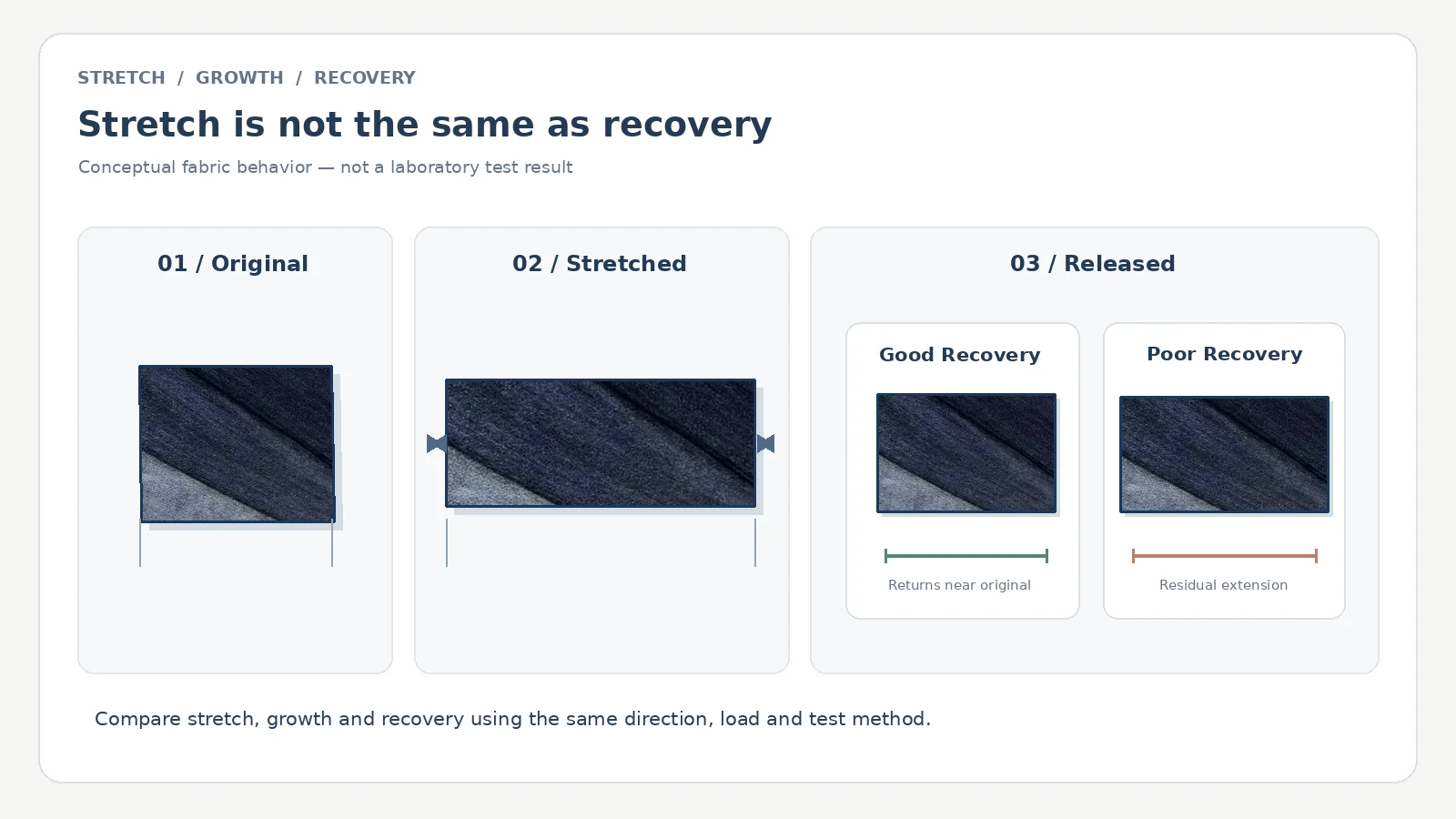
Fabric A: 25% stretch with good recovery.
Fabric B: 40% stretch with poor recovery.
Fabric B extends further.
But that does not automatically make it more suitable for jeans.
If the fabric does not return sufficiently toward its original dimensions, the finished garment may develop:
- baggy knees
- loose seat
- waistband relaxation
- loss of fitted shape
For stretch denim, buyers should evaluate three separate measurements:
Stretch: How far the fabric extends.
Growth: How much residual extension remains after stretching.
Recovery: How effectively the fabric returns toward its original dimensions.
ASTM D3107-26 addresses the measurement of stretch, growth and recovery in woven stretch fabrics.
The standard also notes limitations when comparing results between laboratories, so buyers should confirm how results were obtained.
For more details, see Stretch Denim Fabric: How to Choose the Right Stretch Level.
4. Denim Fabric Construction: Why Two Similar Fabrics Behave Differently
So far, we have covered weight and stretch.
But even after matching both specifications, two fabric samples may still feel different.
The next explanation is in the fabric construction.
Denim is a woven fabric, and its properties depend on yarn characteristics, weave structure and density.
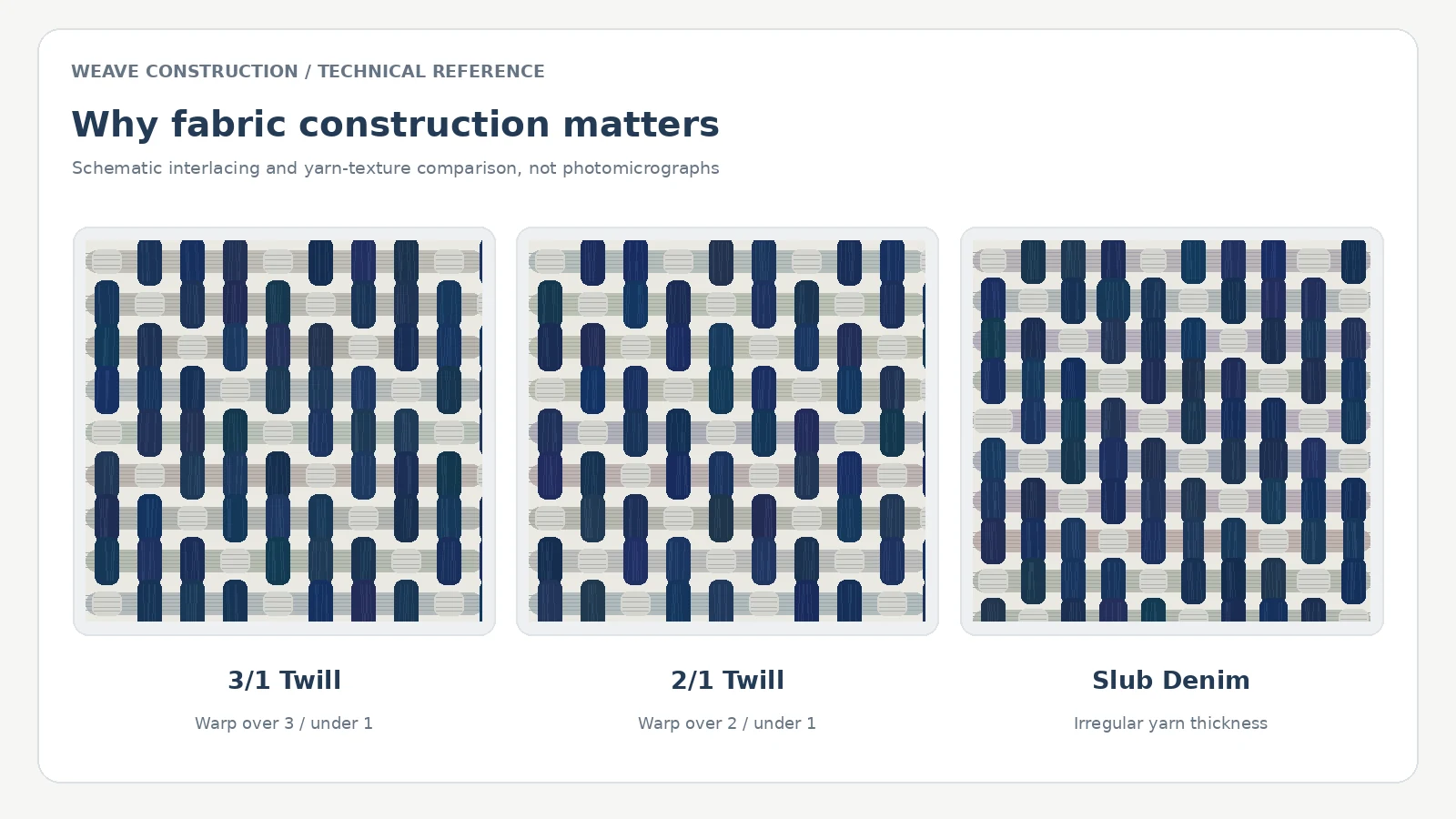
3/1 Twill vs 2/1 Twill
Traditional denim is often woven using a twill construction.
Two common types are:
3/1 Twill
The warp yarn passes over three weft yarns and under one in the repeating weave structure.
This construction is strongly associated with traditional jeans denim.
2/1 Twill
The warp yarn passes over two weft yarns and under one.
It is another common denim construction and can be used for different weight and hand-feel targets.
Neither is automatically superior.
The actual fabric depends on the complete construction, including yarn size and density.
Right-Hand, Left-Hand and Broken Twill
Denim may also be described by its twill direction or pattern.
Right-hand twill is widely associated with classic denim.
Left-hand twill uses the opposite diagonal direction and can produce a different surface and hand, depending on yarn characteristics.
Broken twill changes the regular diagonal pattern, often to reduce the tendency toward directional distortion.
However, the weave name alone does not guarantee a particular softness or twist performance.
Buyers should still evaluate the actual sample.
Yarn Count and Density
Fabric construction also involves:
- warp yarn count
- weft yarn count
- ends per inch
- picks per inch
- yarn twist
- yarn irregularity
These details affect fabric mass, surface appearance, compactness and behavior during washing.
CottonWorks explains these relationships in its Denim Construction guide.
For sourcing teams, the practical lesson is simple:
Do not assume that two fabrics with the same weight and composition are interchangeable.
Slub and Surface Texture
Some denim fabrics have a clean, uniform surface.
Others use slub yarns or irregular constructions to create a more textured appearance.
This can affect the final wash result.
For a vintage collection, visible yarn irregularity may be desirable.
For a clean, uniform jeans program, a more consistent surface may be preferable.
The correct choice depends on the product design.
5. Fiber Composition: Is 100% Cotton Always Better for Jeans?
Not necessarily.
100% cotton denim is often preferred when a brand wants a traditional denim character.
But different blends can serve different product requirements.
Common options include:
| Fiber Composition | Possible Characteristics | Buying Considerations |
|---|---|---|
| 100% cotton | Traditional denim hand and structure | Weight, shrinkage, finishing |
| Cotton/elastane | Improved flexibility | Stretch, growth, recovery |
| Cotton/polyester/elastane | Engineered blend with stretch | Hand feel, recovery, care performance |
| Cotton/lyocell | Potential for softer, more fluid drape | Construction, shrinkage, wash behavior |
| Cotton/lyocell/elastane | Softness combined with stretch | Fit, recovery, dimensional stability |
Fiber content alone does not guarantee the final properties.
For example, a cotton/lyocell denim may feel softer than a conventional rigid cotton fabric, but the result depends on how the yarn and fabric are constructed and finished.
The same applies to cotton/polyester/elastane blends.
For current catalog references, compare HWC1115 100% cotton rigid denim with HW1006 10oz medium-stretch Sirospun denim, then confirm current-lot performance for the intended wash.
Buyers should request composition information and evaluate actual fabric performance rather than assume a particular blend always behaves the same way.
100% Cotton Denim vs Stretch Denim: Which Should Buyers Choose?
6. The Factor That Can Change Everything: Garment Washing
At this point, a buyer might have selected:
- the right weight
- the right stretch
- the right construction
- the preferred fiber composition
It sounds like the job is finished.
But the most important fabric approval may still be ahead.
Denim is often sold as a washed garment.
And the fabric coming off the roll may look and feel very different after washing.
What Can Change During Washing?
Depending on the wash process, denim may experience changes in:
- color
- hand feel
- dimensions
- surface texture
- drape
- stretch behavior
- appearance of yarn irregularities
Processes such as desizing, enzyme washing, abrasion and softening can influence the finished result.
CottonWorks provides technical background in its Denim Finishing guide.
The Same Fabric Can Produce Different Jeans
Consider one 12oz rigid denim used in two different development directions.
Option A: Dark Rinse Jeans
The target is a clean indigo shade with a relatively structured appearance.
Option B: Vintage Washed Jeans
The target is a softer hand, visible abrasion and a worn appearance.
The original fabric might be identical.
But the finished jeans can feel and look considerably different.
That is why buyers should describe the intended final wash when requesting fabric samples.
Check Shrinkage Before Bulk Production
Shrinkage affects:
- inseam length
- waistband measurements
- hip and thigh dimensions
- leg opening
- garment fit
Ask for warp and weft shrinkage information under relevant test conditions.
If the garment will receive a specific industrial wash, evaluate its dimensional changes using that process.
CottonWorks’ Shrinkage & Skewing guide explains how construction and finishing can influence dimensional stability.
Do Not Ignore Leg Twist
Twill denim can develop skew-related distortion.
In finished jeans, this may appear as a side seam twisting away from its expected position.
Buyers should evaluate skew control and the finished garment after washing, particularly for styles where seam alignment is important.
The lesson is that the final wash is not merely a finishing detail. It is part of the fabric selection process.
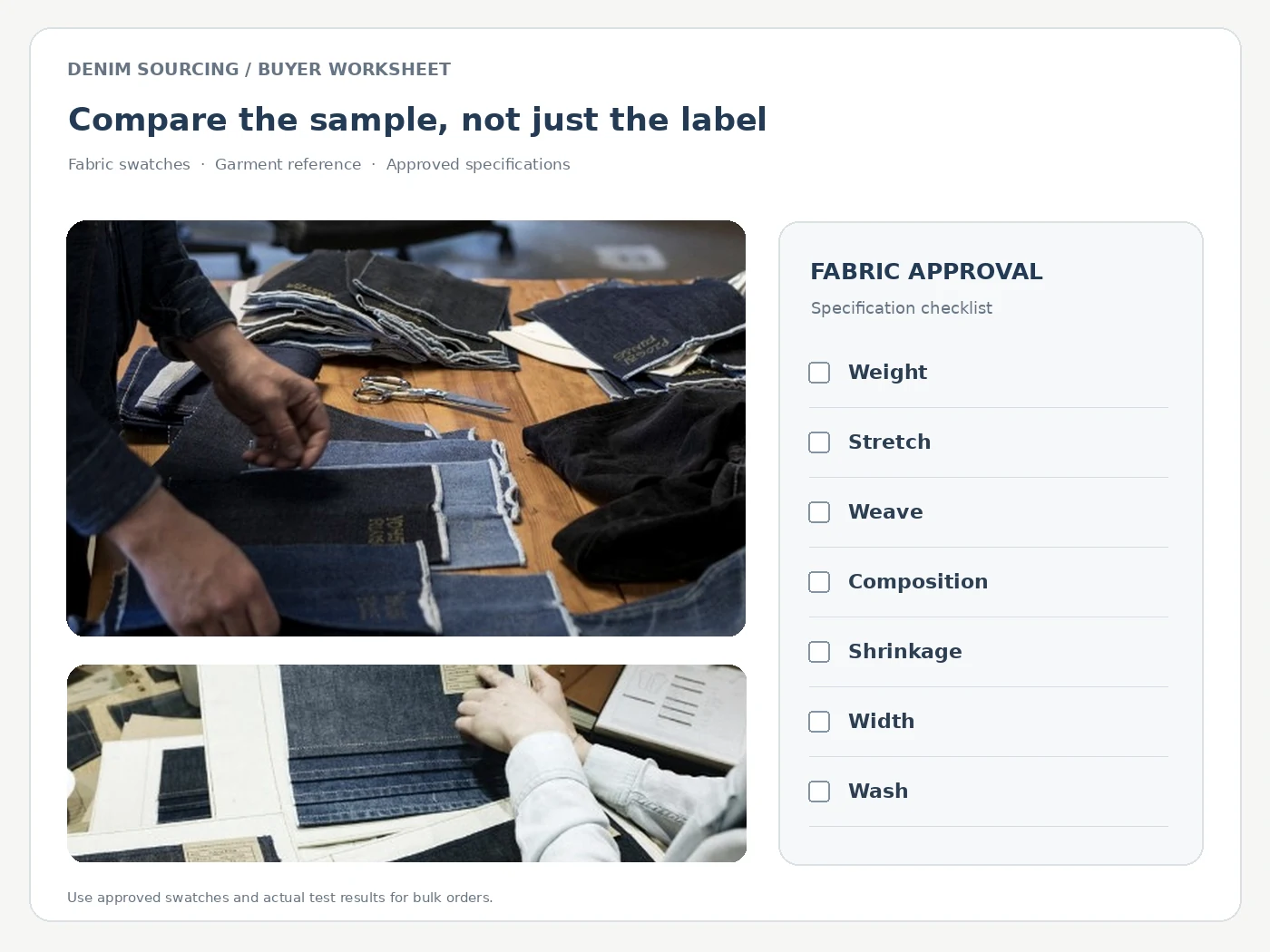
7. How to Compare Denim Fabric Samples Before Ordering
The right selection process should move from specifications to actual garment performance.
Here is a practical sequence.
Step 1: Define the Garment
Start with:
- men’s or women’s jeans
- relaxed, straight, slim or skinny fit
- target season
- final wash direction
Step 2: Select a Weight Range
For example:
10–12oz for everyday straight-leg jeans.
Do not require an exact weight too early if several nearby constructions may work.
Step 3: Confirm Stretch Requirements
Decide whether the garment needs:
- rigid denim
- comfort stretch
- higher stretch
If stretch is required, ask about recovery and growth.
Step 4: Compare Construction and Hand Feel
Look at:
- surface texture
- weave
- yarn character
- compactness
- flexibility
- desired drape
A fabric can meet the technical weight requirement while still feeling wrong for the collection.
Step 5: Test the Intended Wash
Make a wash trial or garment sample using the planned process.
Check:
- shade
- shrinkage
- hand feel
- fit
- dimensional stability
- stretch performance, if applicable
Step 6: Confirm Bulk Specifications
Before ordering, confirm:
- finished fabric weight
- fiber composition
- finished width and usable width
- relevant test results
- approved shade
- lot consistency
- delivery and stock availability
Where appropriate, also establish requirements for tensile or tear strength, abrasion, colorfastness and other brand-specific quality standards.
Do not assume that passing one test guarantees overall fabric suitability.
8. Denim Fabric Selection Examples by Jeans Style
Let’s bring the three main variables together: weight, stretch and construction.
The following examples are starting points for sampling, not fixed production specifications.
Example A: Men’s Relaxed Straight-Leg Jeans
Target: Classic everyday jeans with a traditional appearance.
Possible fabric direction:
- 11–13oz
- 100% cotton rigid denim
- traditional twill construction
- medium-firm hand
- dark rinse or vintage wash
The priority is sufficient structure without excessive stiffness.
Example B: Women’s Slim Jeans
Target: Comfortable, closer-fitting everyday jeans.
Possible fabric direction:
- 9–11oz
- cotton/elastane denim
- comfort to medium stretch
- good growth control and recovery
- soft to medium hand
Here, stretch performance may matter more than a small difference in weight.
Example C: Wide-Leg Fashion Jeans
Target: A relaxed silhouette with controlled drape.
Possible fabric direction:
- 9–12oz
- rigid or low-stretch denim
- softer or medium-firm hand
- suitable drape after washing
A very heavy construction may create more structure than the designer wants.
Example D: Heritage-Inspired Jeans
Target: Traditional rigid appearance and substantial denim character.
Possible fabric direction:
- 13–16oz
- 100% cotton rigid denim
- twill construction suited to the desired surface
- firmer hand
- rinse or vintage wash direction
Here, weight and traditional appearance are part of the product concept.
For all four examples, the final decision should follow garment sampling and testing.
9. Common Mistakes When Sourcing Denim Fabric for Jeans
Mistake 1: Choosing Only by Oz
Two fabrics of the same weight can perform differently because of construction, finishing and stretch.
Mistake 2: Assuming More Stretch Means Better Comfort
More stretch may improve movement in fitted jeans, but excessive growth can cause bagging.
Mistake 3: Treating 100% Cotton as a Quality Grade
100% cotton describes composition, not overall quality.
Mistake 4: Ignoring the Intended Wash
A fabric approved before washing may behave differently after the planned finishing process.
Mistake 5: Choosing Fabric Without Considering the Pattern
A rigid denim and a high-stretch denim may require different pattern dimensions and fit development.
Mistake 6: Comparing Suppliers Using Incomplete Specifications
A quotation for "12oz blue stretch denim" may refer to fabrics with different construction, usable width, recovery and wash performance.
A more complete specification makes quotations and samples easier to compare.
10. What Information Should You Send a Denim Fabric Supplier?
Instead of asking:
Do you have denim fabric for jeans?
provide the supplier with a clearer brief.
For example:
We are developing men’s straight-leg jeans for an everyday collection. We are looking for approximately 11–12oz indigo denim, preferably rigid or low stretch, with a medium-firm hand. The garment will receive a vintage wash. Please recommend suitable fabrics and provide finished width, composition and shrinkage information.
For a stretch-denim program:
We need approximately 10–11oz stretch denim for women’s slim jeans. The fabric should have comfortable movement, good recovery and a medium-soft hand. Please provide actual stretch percentage, growth/recovery information if available, shrinkage, composition and finished width.
A physical reference sample or existing garment can make the request even clearer.
The more accurately you describe the finished jeans, the easier it is to identify relevant fabric options.
FAQ: Choosing Denim Fabric for Jeans
What is the best denim fabric for jeans?
There is no single best fabric.
The right denim depends on garment fit, target weight, stretch requirement, construction, wash and desired wearing experience.
What denim weight is best for everyday jeans?
Approximately 10–13oz is a useful starting range for many everyday jeans.
Lighter or heavier constructions can also work depending on the style.
Is 12oz denim good for jeans?
Yes. 12oz is a common weight for traditional jeans and can work in both rigid and stretch constructions.
However, weight alone does not determine the final hand, drape or fit.
Is rigid or stretch denim better for jeans?
Rigid denim is often preferred for traditional, relaxed and structured silhouettes.
Stretch denim is generally more suitable when the jeans need to fit closely while allowing easier movement.
Is 100% cotton denim good for jeans?
Yes. 100% cotton is widely used for jeans, particularly rigid and traditional styles.
But composition alone does not guarantee durability or comfort.
What is the difference between 3/1 and 2/1 denim?
These describe different twill weaving patterns.
3/1 and 2/1 constructions have different warp and weft interlacing arrangements, but their actual performance also depends on yarn size, density and finishing.
What should I check before ordering denim fabric in bulk?
Confirm the approved fabric specification, including weight, composition, stretch where applicable, construction, width, shrinkage, shade, intended wash performance and relevant quality requirements.
Final Thoughts: Choose the Finished Jeans, Not Just the Fabric Specification
Remember the two 12oz denim samples from the beginning?
The number on the specification sheet was the same.
But that number could not tell you how the jeans would drape, stretch, recover or fit after washing.
A good denim selection is not about finding the highest weight, the most stretch or the most complicated construction.
It is about finding the fabric that works for the garment.
Start with the intended jeans style.
Then narrow your options by:
- weight
- stretch and recovery
- yarn and weave construction
- fiber composition
- shrinkage
- wash performance
- final hand feel
Once those factors are clear, fabric sampling becomes more focused and supplier comparisons become more meaningful.
If you are sourcing denim fabric for jeans from China, send ZLDENIM your target weight, garment fit, stretch requirement, composition, color, intended wash or reference sample.
We can help identify suitable denim options from available stock fabrics and our supplier network, based on your actual garment requirements.