
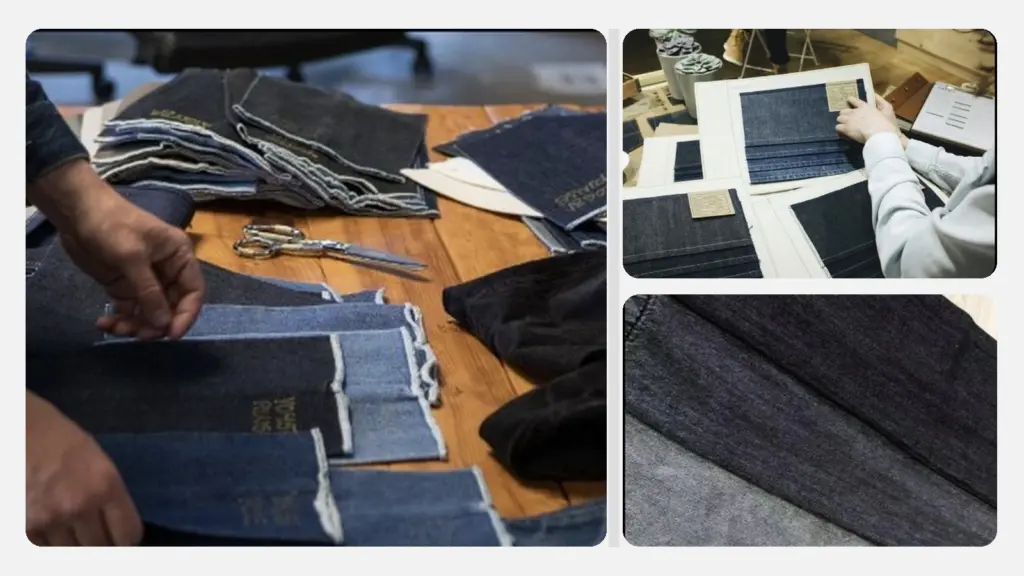
Rigid denim fabric is often associated with traditional jeans: firm, structured and made without elastane.
But not all rigid denim feels the same.
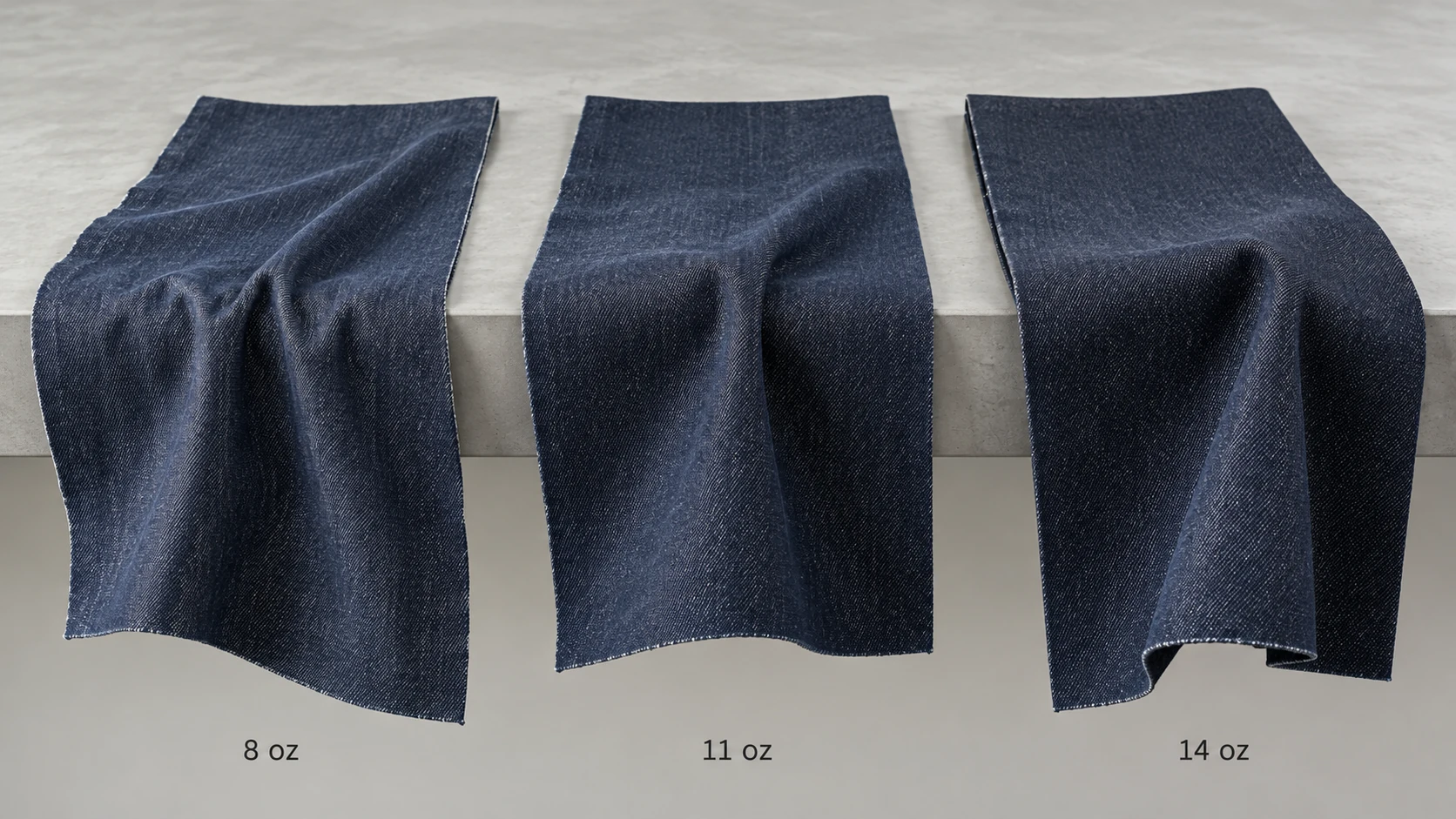
An 8oz rigid denim may be suitable for a lightweight jacket or relaxed summer garment. A 12oz construction can provide the body needed for everyday straight-leg jeans. A 15oz fabric may create a much heavier, more substantial garment.
All three can be classified as rigid denim.
For clothing brands and fabric buyers, the important question is not simply whether the denim stretches.
It is how the fabric’s weight, construction and finishing will affect the garment.
This guide explains how to evaluate rigid denim fabric and choose the right option for jeans, jackets, workwear and other garments.
What Is Rigid Denim Fabric?
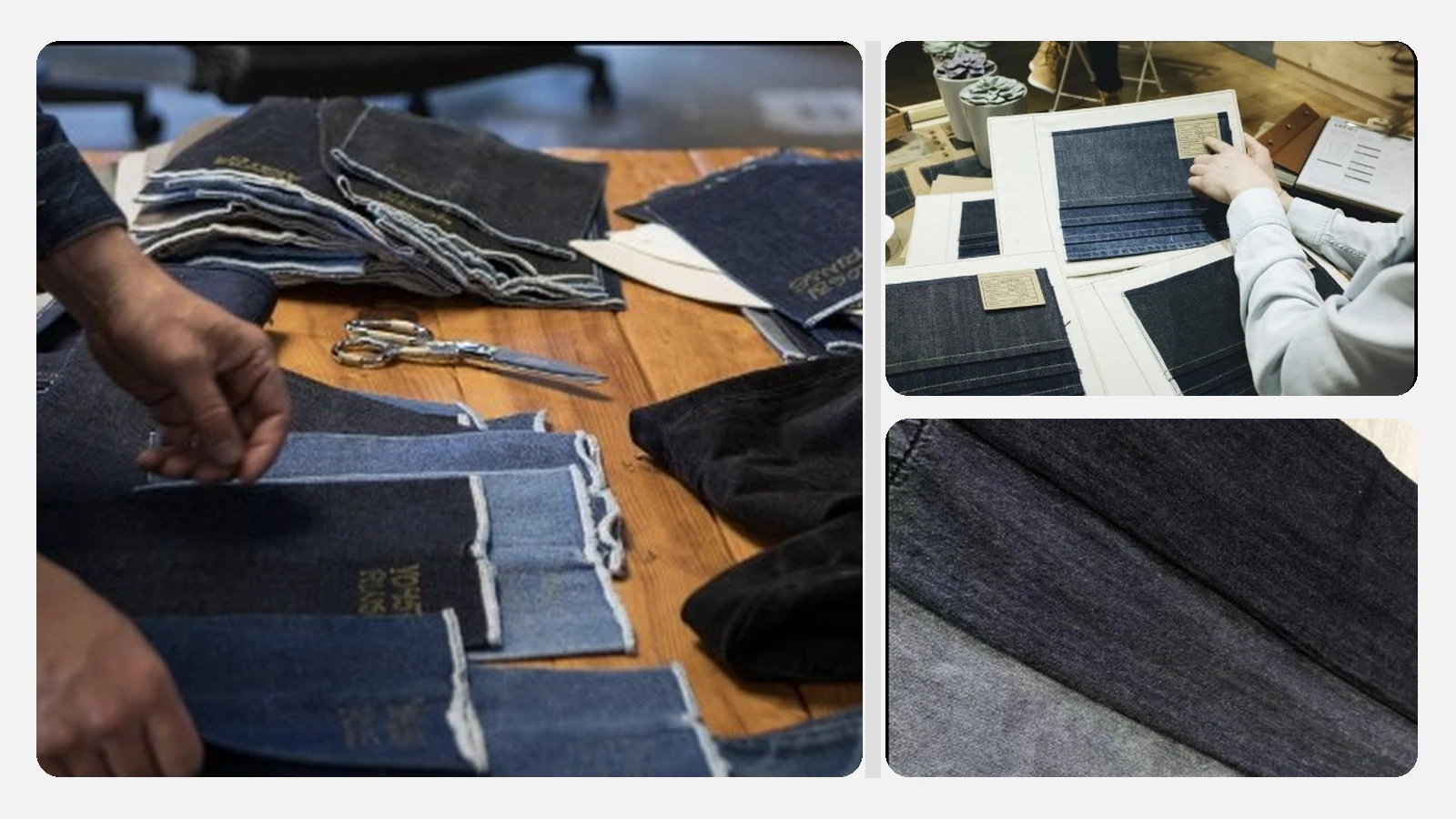
Rigid denim is woven denim with little or no functional stretch. It is commonly made from 100% cotton without added elastane or spandex.
In sourcing conversations, it may also be called:
- non-stretch denim
- rigid cotton denim
- 100% cotton rigid denim
- traditional denim
- zero-stretch denim
These descriptions often refer to similar products, but they should not replace technical specifications.
For example, 100% cotton does not automatically mean zero fabric extension.
Specially engineered cotton constructions can provide mechanical stretch without elastane. Cotton Incorporated’s NATURAL STRETCH technology demonstrates this distinction.
Therefore, buyers who specifically require rigid denim should confirm both fiber composition and actual fabric behavior.
Does Rigid Mean Hard or Uncomfortable?
Not necessarily.
Rigid describes the absence of significant stretch, not a fixed level of stiffness.
A rigid fabric can feel:
- firm and dry
- compact and structured
- soft and flexible when handled
- lightweight or heavyweight
The final hand depends on yarn construction, density, weight and finishing.
A 100% cotton fabric can become much softer after washing while remaining non-stretch.
How Is Rigid Denim Constructed?
Rigid denim gets its character from the woven structure rather than elastic yarns.
Several construction details matter.
1. Twill Weave
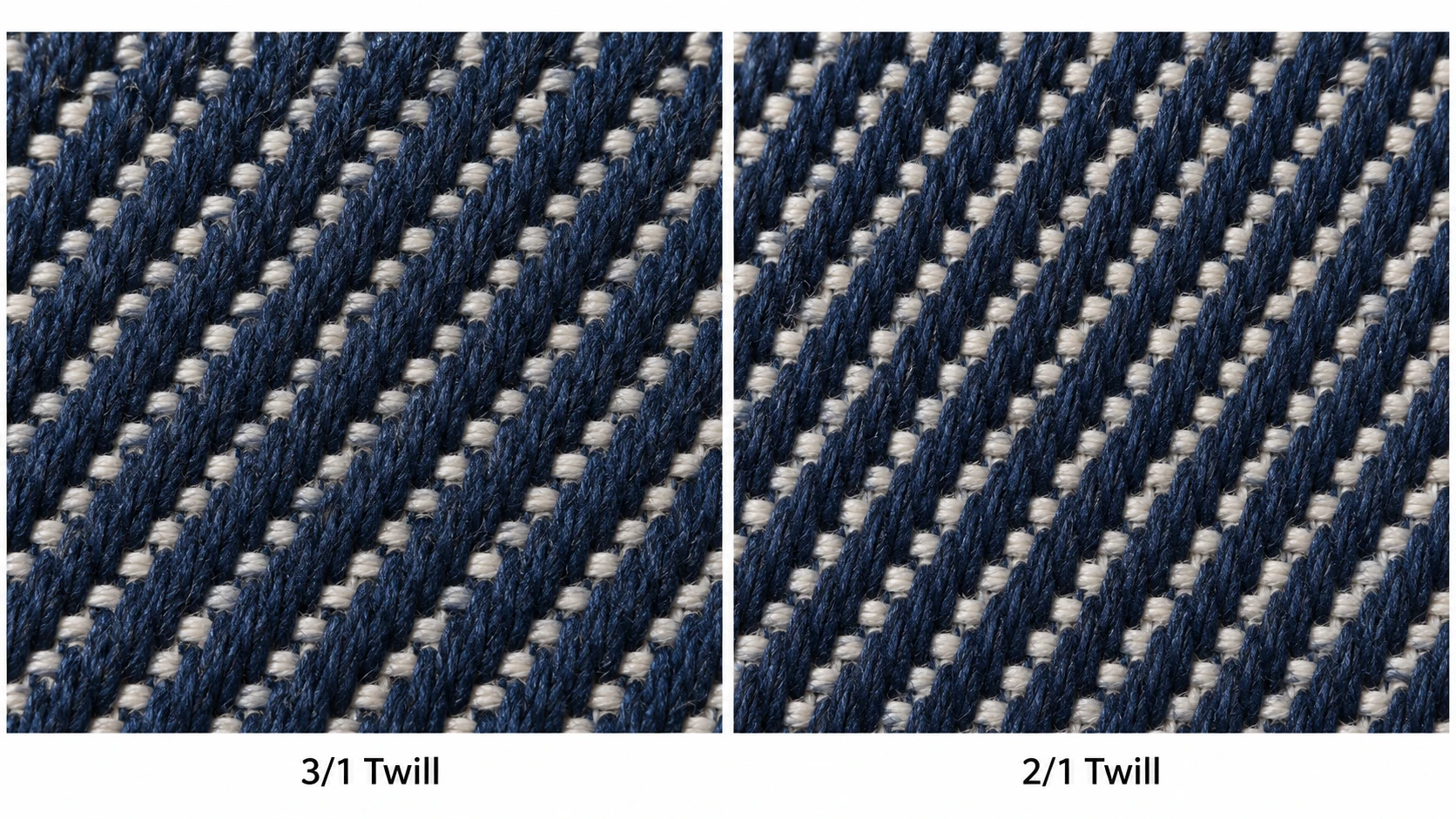
Traditional denim commonly uses a twill weave, which produces diagonal lines on the fabric surface.
Two familiar constructions are:
3/1 Twill
In a typical 3/1 warp-faced twill, each warp yarn passes over three weft yarns and under one in a repeating pattern.
This structure is strongly associated with traditional jeans denim.
2/1 Twill
A 2/1 twill uses a different interlacing pattern and is also found in lighter or medium-weight denim constructions.
Other variations include left-hand twill, right-hand twill and broken twill.
These weaves can produce different appearances and fabric characteristics.
However, a 3/1 twill is not automatically heavier or better than a 2/1 twill. Yarn size and fabric density also matter.
CottonWorks provides additional technical explanations in its Denim Basics guide.
2. Yarn Count
Yarn count influences fabric appearance, thickness and hand feel.
Depending on the construction, different yarn sizes can create:
- finer, smoother surfaces
- coarser denim textures
- compact fabrics
- pronounced slub effects
A buyer who wants a clean, uniform fabric should not select the same construction as a designer looking for a highly textured vintage appearance without reviewing actual samples.
3. Warp and Weft Density
The number of warp and weft yarns per unit length also affects the fabric.
Two denims with identical weights can have different yarn sizes and densities.
As a result, they may differ in:
- compactness
- drape
- hand feel
- appearance
- flexibility
- wash behavior
Fabric weight alone cannot fully describe rigid denim construction.
Rigid Denim Weight Guide: Which Oz Should Buyers Choose?
Rigid denim can be manufactured in many weights.
Fabric weight is normally measured in ounces per square yard (oz/yd²) or grams per square meter (GSM).
1 oz/yd² ≈ 33.9 GSM
The following ranges provide a practical starting point for garment development.
| Fabric Weight | Approx. GSM | Common Applications |
|---|---|---|
| 6–8 oz | 203–271 | Shirts, dresses, lightweight overshirts |
| 8–10 oz | 271–339 | Light jackets, shorts, relaxed summer pants |
| 10–12 oz | 339–407 | Everyday straight and relaxed jeans |
| 12–14 oz | 407–475 | Classic rigid jeans, denim jackets |
| 14–16 oz | 475–542 | Heavy jeans, structured workwear |
| 16 oz+ | 542+ | Specialty heavyweight denim |
These are suggested application ranges, not universal industry standards.
Lightweight Rigid Denim: 6–10 oz
Lightweight rigid denim can provide denim appearance without the weight of traditional heavy jeans.
It may suit:
- denim shirts
- dresses
- lightweight jackets
- shorts
- relaxed trousers
For structured five-pocket jeans, buyers should check whether the fabric provides enough body around the waistband, pockets and seat.
If the garment needs a softer appearance or easy drape, lighter rigid denim may be preferable.
For more on garment applications, compare 6oz, 8oz and 10oz lightweight denim.
Medium-Weight Rigid Denim: 10–14 oz
For many classic jeans programs, approximately 10–14oz is a practical sampling range.
These weights can work for:
- straight-leg jeans
- relaxed jeans
- wide-leg jeans
- regular-fit jeans
- denim jackets
- casual workwear
A 10–11oz construction may provide a lighter feel, while 13–14oz denim generally offers a more substantial hand.
The final result still depends on finishing and fabric structure.
Heavyweight Rigid Denim: 14 oz and Above
Heavier rigid denim is often selected for products where substantial fabric weight is part of the design.
Possible applications include:
- heavyweight jeans
- heritage-inspired denim
- workwear-style garments
- structured jackets
- specialty raw denim
However, heavyweight fabric creates additional considerations.
Multiple layers at waistbands, belt loops, pockets and hems can become bulky.
Garment factories should confirm that cutting, sewing and washing processes are suitable for the selected construction.
A heavier fabric is not automatically better quality.
The right weight is the weight that works for the finished garment.
For a broader comparison, see the Denim Fabric Weight Guide.
What Are the Best Uses for Rigid Denim Fabric?
Rigid denim is useful when a garment needs structure rather than significant elastic movement.
Straight-Leg Jeans
Straight-leg jeans are one of the most common applications for rigid denim.
The pattern provides sufficient room around the thighs and knees, while the fabric helps maintain the intended leg shape.
For an everyday jeans program, buyers may begin by sampling approximately 10–13oz rigid denim.
Relaxed and Wide-Leg Jeans
Rigid denim also works well for relaxed and wide silhouettes.
These garments do not necessarily require high fabric stretch because movement comes largely from the pattern.
Depending on the design, a medium-weight rigid denim can create a clear silhouette without excessive bulk.
However, a very heavy fabric may make a wide-leg garment stand away from the body more than intended.
For these products, drape should be evaluated alongside weight.
Denim Jackets
Rigid denim is widely used for traditional denim jackets.
The absence of elastic stretch helps create a more structured appearance.
But buyers should consider:
- shoulder comfort
- sleeve movement
- layering space
- seam thickness
- intended wash
A rigid jacket that fits too closely may restrict movement even if the fabric itself is suitable.
Workwear-Inspired Garments
Rigid denim is a common material choice for workwear styling, including overshirts, utility pants and structured jackets.
It can provide a substantial appearance, especially with heavier constructions.
However, rigid denim should not automatically be assumed to meet industrial protective-workwear standards.
Specific durability or protective performance requirements need appropriate testing.
Skirts, Shorts and Dresses
Rigid denim is not limited to jeans.
Light and medium-weight constructions may work for:
- A-line skirts
- denim shorts
- structured dresses
- overshirts
- casual fashion garments
The fabric should be selected according to the desired drape and garment structure.
A catalog example for structured jeans is HWC1115 100% cotton rigid denim, displayed as 12oz with a recorded weight of 11.79oz. Compare the actual sample and intended garment wash before selection.
Rigid Denim vs Stretch Denim: What Is the Difference?
The main practical distinction is how the fabric behaves when the wearer moves.
| Feature | Rigid Denim | Stretch Denim |
|---|---|---|
| Elastane | Usually none | Commonly included |
| Fabric extension | Limited | Designed for greater extension |
| Traditional structure | Common | Depends on construction |
| Straight and relaxed fits | Very suitable | Also suitable |
| Skinny and fitted jeans | More restrictive | Usually more suitable |
| Initial movement comfort | Depends strongly on fit | Usually easier in close fits |
| Recovery testing | Less central | Particularly important |
| Shrinkage testing | Required | Required |
Both can be suitable for quality garments.
For a relaxed pair of jeans, rigid denim may provide the desired structure without needing stretch.
For skinny jeans, stretch denim may offer a better balance between close fit and movement.
See our 100% Cotton Denim vs Stretch Denim comparison for a garment-focused discussion.
Buyers developing fitted garments can also review our Stretch Denim Fabric Guide.
Is Rigid Denim the Same as Raw Denim?
No. These terms describe different characteristics.
Rigid denim refers to fabric with little or no functional stretch.
Raw denim generally refers to denim that has not undergone the usual garment washing or distressing treatments.
Selvedge denim refers to fabric produced with a self-finished woven edge, commonly associated with shuttle looms.
A denim fabric may be:
- rigid and raw
- rigid and garment-washed
- rigid and selvedge
- rigid and non-selvedge
These descriptions are not interchangeable.
A washed 100% cotton jean can still be rigid denim even if it feels soft.
Similarly, a rigid fabric does not need a selvedge edge to be suitable for classic jeans.
This distinction helps buyers avoid paying for a construction feature that the garment does not require.
What Should Buyers Check Before Ordering Rigid Denim?
Rigid denim may appear simpler than stretch denim, but several technical specifications still matter.
1. Fabric Shrinkage
Cotton denim can change dimensions during washing.
Buyers should check:
- warp shrinkage
- weft shrinkage
- expected garment wash shrinkage
- dimensional consistency between lots
Fabric shrinkage directly affects garment length, waist measurements and cutting allowances.
Sanforized vs Unsanforized Denim
Sanforization is a mechanical finishing process intended to reduce residual shrinkage.
Unsanforized denim has not undergone that specific preshrinking process and may show substantially greater dimensional change during its first wash.
However, neither term guarantees an exact shrinkage percentage for every construction.
Buyers should request measured results for the specific fabric and intended treatment.
For further technical context, see the CottonWorks guide to shrinkage and skewing.
ZLDENIM also has an existing article about handling shrinkage in denim garment sizes.
2. Skew and Leg Twist
Twill constructions may develop twisting or dimensional distortion after washing.
This can become visible in jeans when the side seam moves away from its intended position.
Ask whether the fabric has been appropriately controlled for skew and evaluate the result after the intended garment wash.
Do not approve a rigid denim only from its unwashed appearance.
3. Finished Width
Confirm both the finished width and usable cutting width.
Width affects fabric consumption.
For two otherwise comparable fabrics, a wider usable width may reduce the number of meters needed per garment, depending on the marker layout.
4. Shade and Color Consistency
When selecting rigid denim, check:
- target indigo or black shade
- face and back appearance
- roll-to-roll shade differences
- lot-to-lot consistency
- appearance after washing
If the project requires a specific washed shade, approving only the original fabric color is insufficient.
5. Surface and Hand Feel
Not all rigid denim has the same surface.
Some buyers want:
- clean and smooth denim
- compact twill
- dry vintage hand
- irregular slub texture
- pronounced diagonal lines
These characteristics should be communicated before sampling.
How Washing Changes Rigid Denim
Rigid denim can change significantly during garment washing.
A fabric that initially feels stiff may soften after desizing, enzyme washing or other finishing processes.
The intended wash may also change:
- shade
- shrinkage
- surface texture
- seam appearance
- drape
- final hand feel
CottonWorks explains several of these processes in its Denim Finishing guide.
Example: Two Garments Using the Same Rigid Denim
Consider two development directions using the same base fabric.
Garment A: Dark Rinse Jeans
The target is a clean, structured appearance with relatively limited surface abrasion.
Garment B: Vintage Washed Jeans
The target is a softer hand, visible abrasion and a more worn appearance.
The base fabric may be identical, but the finished garments can look and feel very different.
That is why buyers should evaluate:
fabric sample → wash trial → finished garment
For related topics, browse the ZLDENIM Denim Guide, which includes washing and finishing resources.
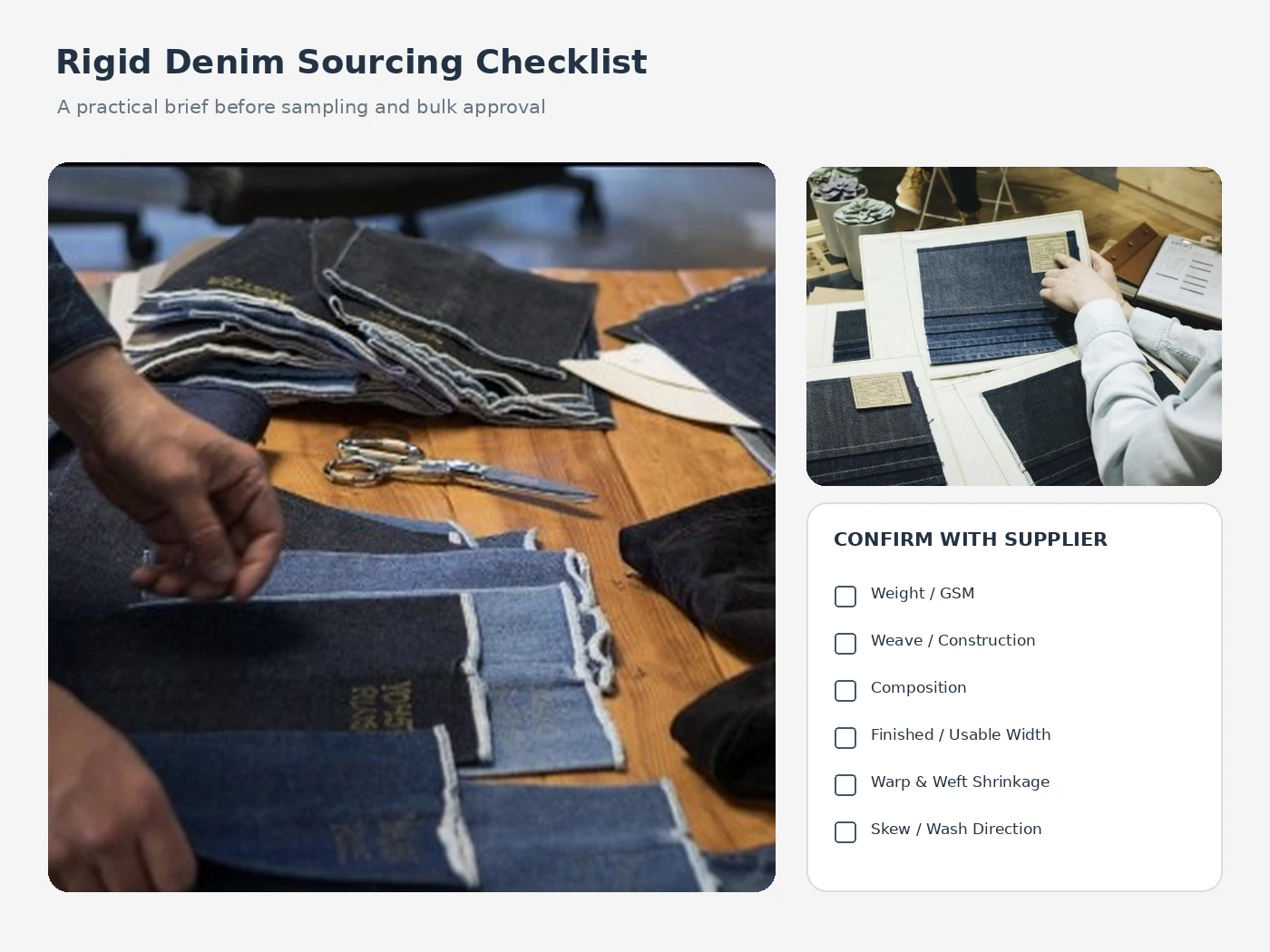
Rigid Denim Fabric Sourcing Checklist
Before ordering, prepare the following information.
| Specification | What Buyers Should Confirm |
|---|---|
| Composition | 100% cotton or another specified non-stretch construction |
| Weight | Target oz or GSM, measured on finished fabric |
| Weave | 3/1, 2/1 or another specified construction |
| Appearance | Clean twill, slub, vintage or other target |
| Color | Indigo, black or approved shade |
| Hand feel | Soft, medium-firm, dry or crisp |
| Width | Finished and usable width |
| Shrinkage | Warp and weft results |
| Skew | Dimensional behavior after washing |
| Finishing | Sanforized or other specified treatment |
| Garment | Jeans, jacket, shirt, skirt or workwear |
| Wash direction | Dark rinse, vintage, enzyme or another process |
Not every buyer needs to specify every construction detail from the beginning.
But providing the target garment and finished appearance can substantially improve sample selection.
How to Request Rigid Denim Samples from a Supplier
A request such as:
Please send 12oz rigid denim.
is a starting point, but it does not tell the supplier enough about the garment.
A more useful enquiry would be:
We are developing men’s relaxed straight-leg jeans. We are looking for approximately 12–13oz rigid denim, preferably 100% cotton, with a medium-firm hand and a classic indigo shade. The garment will receive a vintage wash. Please suggest suitable fabrics and provide finished width, shrinkage and available construction information.
For a lighter garment:
We need approximately 8–9oz non-stretch denim for lightweight overshirts. The target is a soft hand with visible denim twill and enough structure to maintain the garment shape.
These descriptions help the supplier understand the intended use rather than selecting samples based on weight alone.
Common Mistakes When Buying Rigid Denim
Mistake 1: Assuming All Rigid Denim Is Heavy
Rigid denim can be lightweight or heavyweight.
The word “rigid” does not specify fabric mass.
Mistake 2: Assuming 100% Cotton Always Means Zero Stretch
Cotton constructions may have some mechanical extension.
Confirm the actual performance if a strict non-stretch requirement matters.
Mistake 3: Choosing Fabric Based Only on Weight
Two 12oz rigid denims can have different textures, densities and finishing characteristics.
Mistake 4: Ignoring Shrinkage
A fabric that looks suitable before washing may produce unacceptable garment measurements afterward.
Mistake 5: Confusing Rigid, Raw and Selvedge
These terms describe different fabric attributes.
Mistake 6: Selecting Heavy Rigid Denim for Every Jeans Style
Very heavy denim may be appropriate for a specialty product but unsuitable for a lightweight everyday collection.
Frequently Asked Questions
What is rigid denim fabric?
Rigid denim is denim with little or no functional stretch, commonly woven from 100% cotton without elastane.
Is rigid denim always 100% cotton?
No. Although 100% cotton is common, a non-stretch denim may contain other non-elastic fibers. Buyers should verify the composition rather than assume it.
Is rigid denim uncomfortable?
Not necessarily. Comfort depends on fabric weight, finishing and garment fit. A well-developed relaxed jean made from rigid denim can provide comfortable movement without elastic yarns.
What weight is best for rigid denim jeans?
Approximately 10–14oz is a useful starting range for many everyday rigid-jeans programs. Lighter or heavier constructions may be appropriate depending on the design.
Does rigid denim stretch with wear?
Rigid denim can relax and change shape through wear, particularly in areas under repeated tension. However, it does not provide the same engineered extension and recovery as elastane-based stretch denim.
Does rigid denim shrink?
It can. Shrinkage depends on construction, finishing and washing conditions. Buyers should request test results for the specific fabric.
Can rigid denim be soft?
Yes. Lightweight constructions, soft finishing and garment washing can produce a softer hand without adding elastane.
Is rigid denim better than stretch denim?
Neither is universally better. Rigid denim is often well suited to structured, straight and relaxed garments. Stretch denim is generally more practical for closer-fitting garments that need greater movement.
Final Thoughts: Choose Rigid Denim for the Garment You Want to Make
Rigid denim remains a useful choice for clothing brands that want traditional denim character, structure and a defined garment silhouette.
But the label alone is not enough.
An 8oz lightweight rigid denim and a 15oz heavyweight rigid denim can produce completely different garments.
Before choosing, consider:
- fabric weight
- yarn and weave construction
- finished hand feel
- shrinkage and skew
- width
- intended wash
- garment fit
The goal is not to find the stiffest or heaviest fabric.
It is to find a rigid denim construction that produces the intended garment after washing and finishing.
If you are sourcing rigid denim fabric from China, send ZLDENIM your target weight, composition, weave, color, garment type, wash direction or reference sample.
We can help narrow down suitable rigid denim options from available fabrics and our supplier network.