
One of the most common decisions when sourcing denim fabric is whether to choose 100% cotton denim or stretch denim.
At first, the difference seems simple:
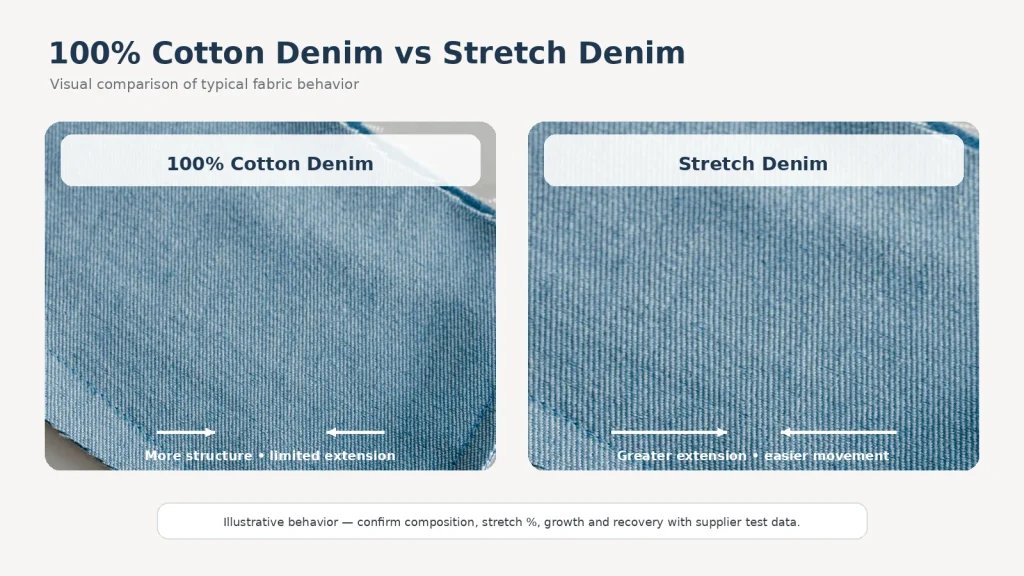
100% cotton denim gives a more traditional, structured denim feel.
Stretch denim adds flexibility and makes closer-fitting garments easier to wear.
But for clothing brands and garment factories, the decision involves more than comfort.
The right fabric also depends on:
- garment fit
- fabric weight
- desired silhouette
- wash effect
- stretch recovery
- shrinkage
- target customer
- expected wearing experience
A relaxed straight-leg jean and a fitted skinny jean should not automatically use the same fabric.
This guide compares 100% cotton and stretch denim from a practical sourcing perspective.
What Is 100% Cotton Denim?
100% cotton denim is denim woven entirely from cotton fibers, without elastane or other fibers added to the fabric composition.
Traditional denim commonly uses indigo-dyed cotton yarn in the warp and undyed cotton yarn in the weft.
Depending on yarn, weight, weave and finishing, 100% cotton denim can feel:
- firm
- dry
- soft
- compact
- heavy
- lightweight
- highly structured
- relatively flexible
This is important because 100% cotton does not describe the hand feel by itself.
A soft 8oz cotton denim and a rigid 14oz cotton denim are both 100% cotton, but they can produce very different garments.
Denim construction also varies considerably. CottonWorks notes that finished denim can use constructions such as 3×1, 2×1 and broken twills, while yarn size, fabric tightness and construction all influence finished weight and character.
What Is Stretch Denim?
Stretch denim is denim designed to provide greater extension when the wearer moves.
A common construction combines cotton with elastane, also known as spandex.
For example:
- 99% cotton / 1% elastane
- 98% cotton / 2% elastane
- cotton / polyester / elastane
- cotton / lyocell / elastane
In many denim constructions, elastic yarn is introduced in the weft direction.
CottonWorks explains that core-spun stretch yarn can be made by wrapping cotton fibers around a spandex core, creating an elastic yarn suitable for stretch denim constructions.
The result can provide:
- easier movement
- improved comfort in fitted garments
- greater range of motion
- closer body fit
However, the percentage of elastane in the composition does not tell buyers exactly how far the finished fabric stretches.
Actual fabric stretch depends on the complete yarn, weaving and finishing system.
Quick Comparison: 100% Cotton Denim vs Stretch Denim
| Feature | 100% Cotton Denim | Stretch Denim |
|---|---|---|
| Traditional denim feel | Strong | Varies |
| Natural structure | Usually higher | Usually softer/more flexible |
| Body movement | More limited | Easier |
| Close-fitting garments | Less forgiving | Very suitable |
| Relaxed fits | Very suitable | Also suitable |
| Shape retention | Depends on construction | Depends heavily on recovery |
| Bagging risk | Different wear behavior | Important to check growth/recovery |
| Vintage character | Strong choice | Possible, but feel differs |
| Pattern flexibility | Less dependent on stretch | Fit must account for stretch |
| Elastane | None | Often present |
| Wash development | Classic rigid character possible | Must consider elastic performance |
This is a general comparison only.
Fabric weight, finishing and construction can sometimes create bigger differences than fiber composition alone.
If stretch performance is important for your garment, see our [Stretch Denim Fabric: How to Choose the Right Stretch Level] for a more detailed explanation of stretch percentage, recovery and growth.
Which Feels More Like Traditional Denim?
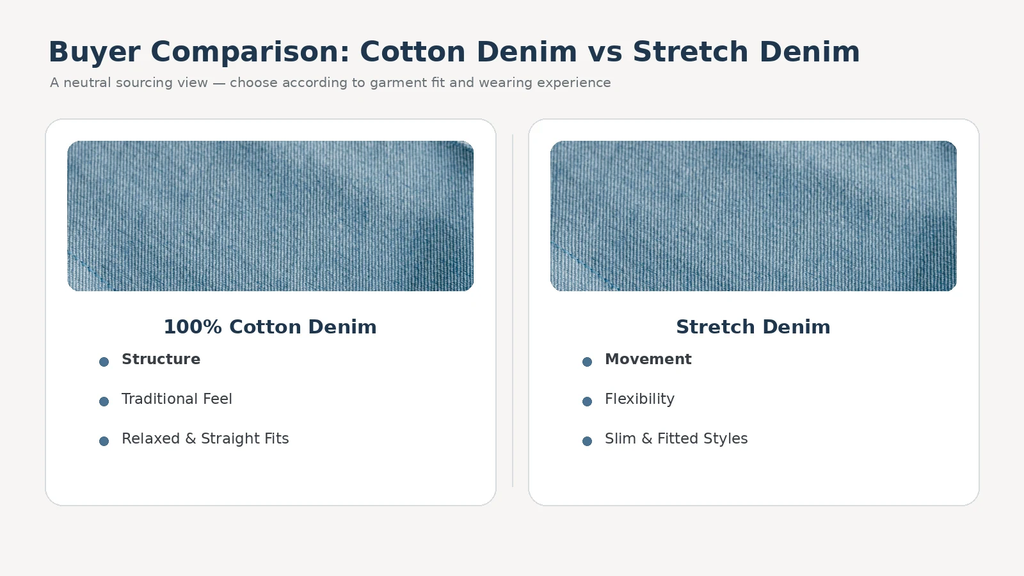
If the goal is a traditional rigid-jeans experience, 100% cotton denim is usually the more natural starting point.
It can provide:
- stronger structure
- a firmer hand
- more noticeable break-in
- traditional creasing
- a classic rigid silhouette
This is one reason 100% cotton remains common in:
- rigid jeans
- relaxed jeans
- straight-leg jeans
- heritage-inspired denim
- workwear
- denim jackets
Stretch denim can still look very traditional from the surface.
The difference often becomes more obvious when the wearer moves or pulls the fabric.
For brands selling denim based on authenticity, stiffness or a break-in experience, 100% cotton may therefore fit the product concept better.
Which Is More Comfortable?
If comfort means easy movement immediately after putting on the garment, stretch denim normally has an advantage.
This becomes particularly noticeable around:
- hips
- thighs
- knees
- seat
- waist
when the wearer is:
- sitting
- bending
- walking
- climbing stairs
A garment can therefore be cut closer to the body while still allowing movement.
But comfort should not be reduced to stretch alone.
A lightweight or softly finished 100% cotton denim can also feel comfortable, especially in relaxed garments where the pattern provides enough physical ease.
A loose 100% cotton jean may feel more comfortable than a very tight stretch jean.
The correct comparison is therefore:
fabric + pattern + finished garment
rather than fiber composition alone.
Which Is Better for Relaxed and Wide-Leg Jeans?
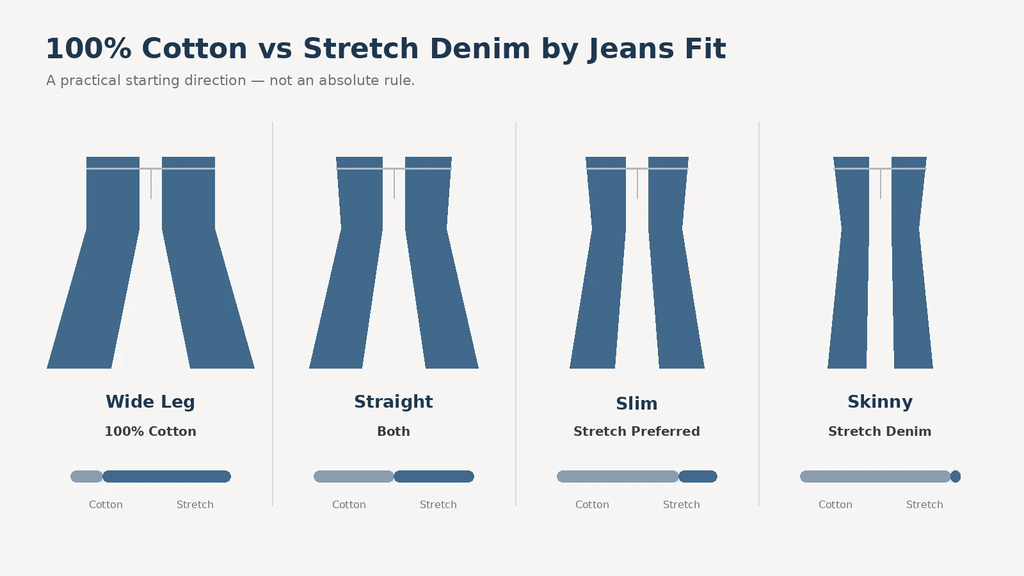
For relaxed, loose and wide-leg silhouettes, 100% cotton denim is often a strong choice.
These garments already contain enough room for movement, so high fabric stretch may not be necessary.
A cotton rigid construction can help create:
- clean leg shape
- visible structure
- stronger denim character
- intentional folds and creases
Stretch denim can still be used, particularly when the brand wants a softer or more relaxed hand.
But adding significant stretch to a very loose garment may provide little practical advantage.
For these styles, buyers may get more value from focusing on:
- weight
- drape
- hand feel
- wash
- shrinkage
rather than maximum stretch.
Which Is Better for Straight-Leg Jeans?
Both can work.
The choice depends on the intended experience.
Choose 100% cotton when you want:
- a classic rigid feel
- clearer structure
- vintage styling
- stronger break-in character
Choose comfort stretch denim when you want:
- easier sitting and bending
- softer everyday wear
- slightly closer fit
- less restriction
This is one category where buyers should often sample both options.
The silhouette may look similar on a product page, but the wearing experience can be very different.
Which Is Better for Slim and Skinny Jeans?
Stretch denim is normally the more practical choice as the garment gets closer to the body.
A slim or skinny pattern provides less physical room around the:
- seat
- thigh
- knee
- calf
Fabric extension helps compensate for that reduced ease.
For skinny or highly fitted jeans, buyers should evaluate not only how much the fabric stretches, but also how well it returns to shape.
ASTM D3107-26 evaluates stretch woven fabrics in terms of stretch, growth and recovery because these properties help describe how the garment may behave during use.
This becomes especially important in fitted jeans.
A fabric that stretches easily but does not recover well may begin to lose shape around the knees and seat.
Stretch Percentage Is Not the Same as Elastane Percentage
This distinction is important when comparing suppliers.
If a denim specification says:
98% Cotton / 2% Elastane
the 2% refers to fiber composition.
It does not mean:
2% fabric stretch.
A fabric containing a small amount of elastane may produce much greater extension.
Actual fabric stretch depends on:
- elastic yarn specification
- yarn construction
- weave density
- fabric weight
- finishing
- heat setting
- test method
That means two 98/2 cotton-elastane denims can perform differently.
When sourcing fitted jeans, ask for:
- fiber composition
- fabric stretch %
- direction of stretch
- growth
- recovery
rather than composition alone.
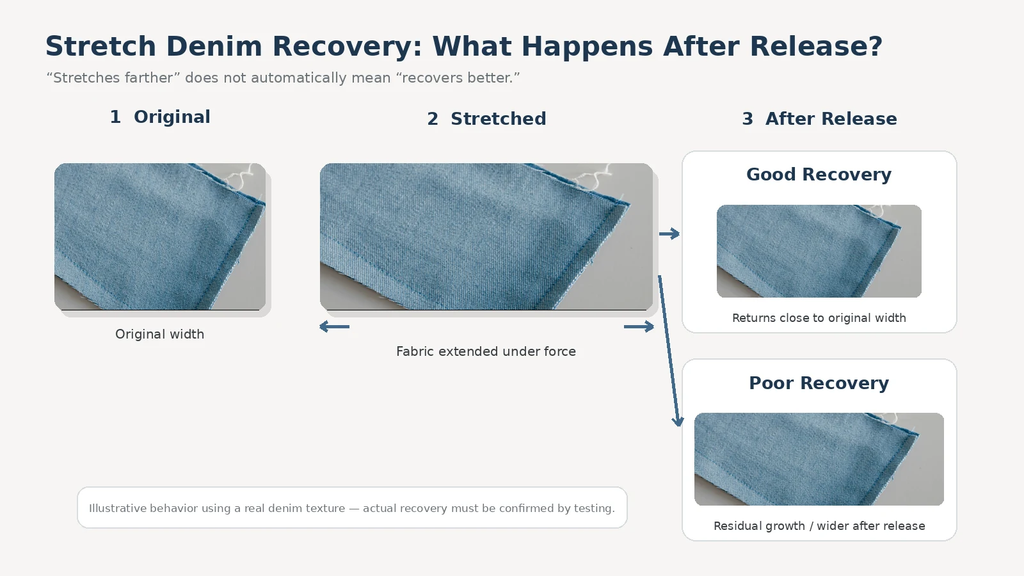
Recovery May Matter More Than Maximum Stretch
Buyers often pull a fabric sample by hand and immediately judge:
“This one is stretchier, so it must be better.”
That can be misleading.
Consider:
Fabric A: 25% stretch with strong recovery
Fabric B: 40% stretch with poor recovery
Fabric B stretches more.
But after several hours of wear, it may remain more distorted.
For fitted garments, this can appear as:
- baggy knees
- loose seat
- waistband relaxation
- loss of body shape
This is why stretch, growth and recovery should be considered together rather than selecting the largest extension number.
ASTM’s current D3107-26 standard specifically separates these measurements when evaluating woven stretch fabrics.
Does 100% Cotton Denim Have Zero Stretch?
Not always.
Traditional rigid 100% cotton denim normally has much less extension than elastane-based stretch denim.
However, fiber composition and fabric performance are not exactly the same thing.
Mechanical construction can create some flexibility even without elastane.
Cotton Incorporated’s current NATURAL STRETCH system, for example, uses a 100% cotton construction engineered to provide approximately 10–18% fill-direction stretch, depending on fabric weight and weave.
This does not mean every 100% cotton denim stretches 10–18%.
It means buyers should avoid assuming:
100% cotton = absolutely zero fabric extension
without testing the actual fabric.
If flexibility matters but the buyer wants a 100% cotton composition, mechanically engineered stretch denim may be worth discussing with suppliers.
How Fabric Weight Changes the Decision
Composition should never be considered without weight.
For example:
8oz 100% cotton denim
may feel light and relatively flexible.
14oz 100% cotton denim
may feel much firmer and more substantial.
Similarly:
9oz stretch denim
may feel soft and highly flexible.
13oz comfort-stretch denim
may still feel substantial and structured.
This means buyers should avoid requests such as:
“I want soft 100% cotton denim.”
or:
“I want comfortable stretch denim.”
without adding weight.
A better request might be:
11–12oz 100% cotton denim with a medium-soft hand for relaxed men’s jeans.
or:
10–11oz comfort-stretch denim for women’s slim-straight jeans.
For a deeper explanation of weight, see our Denim Fabric Weight Guide.
How Washing Changes Both Fabrics
The fabric roll is only the beginning.
Denim garments may go through:
- desizing
- enzyme washing
- stone washing
- bleaching
- softening
- tinting
- drying
- other finishing processes
These processes can change the garment’s:
- color
- hand feel
- dimensions
- drape
- surface character
CottonWorks notes that denim garment finishing can include desizing, enzyme or stone washing, softening and additional chemical or mechanical treatments.
For 100% Cotton Denim
Washing can significantly soften a rigid cotton fabric.
A sample that feels stiff before garment washing may become much more comfortable after processing.
The wash can also create the creases, abrasion and surface contrast associated with classic denim.
For Stretch Denim
The buyer must also consider how processing affects elastic performance.
Stretch constructions can be sensitive to processing conditions, and CottonWorks notes that heat-setting conditions can influence shrinkage, recovery and growth in spandex-containing denim.
For this reason, stretch fabric should ideally be tested using the actual intended garment wash rather than approved only in raw or finished-fabric form.
Which Fabric Gives Better Vintage Wash Effects?
For traditional rigid, heritage or vintage-style products, 100% cotton denim is often a strong starting point.
Its structured hand and traditional denim construction can work well with:
- whiskers
- creases
- abrasion
- stonewashed effects
- faded knees
- vintage texture
This does not mean stretch denim cannot create vintage effects.
It can.
But the garment may retain a softer, more flexible wearing character even when the visual appearance is vintage-inspired.
The correct choice therefore depends on whether the brand wants only a vintage look or also a traditional rigid wearing experience.
Which Fabric Holds Its Shape Better?
There is no universal answer.
A well-developed stretch denim with strong recovery can maintain a fitted silhouette very effectively.
A poor stretch construction may bag after wear.
A 100% cotton denim does not depend on elastane recovery, but it may still relax and change shape through wear and washing.
Shape retention depends on the whole system:
- yarn
- weave
- density
- finishing
- weight
- stretch
- recovery
- pattern
- washing
For stretch denim, buyers should pay particular attention to growth and recovery test results.
For rigid cotton denim, dimensional stability and shrinkage remain important.
Which Is Easier for Garment Development?
Neither is automatically easier.
They create different technical challenges.
100% Cotton Denim
Garment teams need to manage:
- shrinkage
- stiffness
- seam bulk
- pattern ease
- wash changes
Stretch Denim
Garment teams additionally need to consider:
- fabric relaxation
- stretch percentage
- recovery
- growth
- tension during spreading and cutting
- pattern reduction for fitted garments
A pattern developed for rigid denim should not automatically be reused for high-stretch denim.
The finished dimensions may change significantly.
100% Cotton vs Stretch Denim by Garment Type
| Garment Type | 100% Cotton Denim | Stretch Denim |
|---|---|---|
| Relaxed jeans | Excellent | Good |
| Wide-leg jeans | Excellent | Good |
| Straight jeans | Excellent | Excellent |
| Slim jeans | Possible / fit-dependent | Excellent |
| Skinny jeans | Limited | Excellent |
| Workwear | Strong choice | Depends on use |
| Denim jackets | Excellent | Possible |
| Shorts | Excellent | Excellent |
| Fashion skirts | Excellent | Excellent |
| Children’s fitted jeans | Possible | Often practical |
| Vintage rigid styles | Excellent | Less traditional |
These are starting directions, not fixed rules.
A garment sample should still be made before final fabric approval.
When Buyers Should Choose 100% Cotton Denim
100% cotton is a strong starting point when the product needs:
A Traditional Denim Hand
The brand wants customers to clearly feel that they are wearing classic woven denim.
A Structured Silhouette
Useful for:
- straight
- relaxed
- wide-leg
- workwear
where the fabric itself helps hold the shape.
Vintage or Heritage Styling
The product concept depends on rigid character and traditional wash development.
No Added Elastane
Some product briefs specifically require a 100% cotton fiber composition.
If some movement is still required, buyers can ask whether mechanically flexible cotton constructions are available rather than assuming elastane is the only option.
When Buyers Should Choose Stretch Denim
Stretch denim is usually the more practical choice when the garment needs:
A Close Fit
Especially:
- slim jeans
- skinny jeans
- body-contouring designs
Easy Movement
Stretch helps compensate when garment ease is limited.
Immediate Comfort
Customers do not need to wait for a rigid garment to soften through wear.
Greater Flexibility Around Hips and Knees
This can be useful in everyday jeans designed for sitting, commuting and frequent movement.
But the closer the fit, the more important recovery becomes.
Do Men’s Jeans Need 100% Cotton and Women’s Jeans Need Stretch?
No.
This is an oversimplification.
A women’s wide-leg jean may work perfectly in 100% cotton.
A men’s skinny jean may require significant stretch.
The fabric should be selected according to:
fit and product concept
rather than gender alone.
A more useful sourcing sequence is:
garment → silhouette → comfort target → fabric
not:
men = rigid / women = stretch
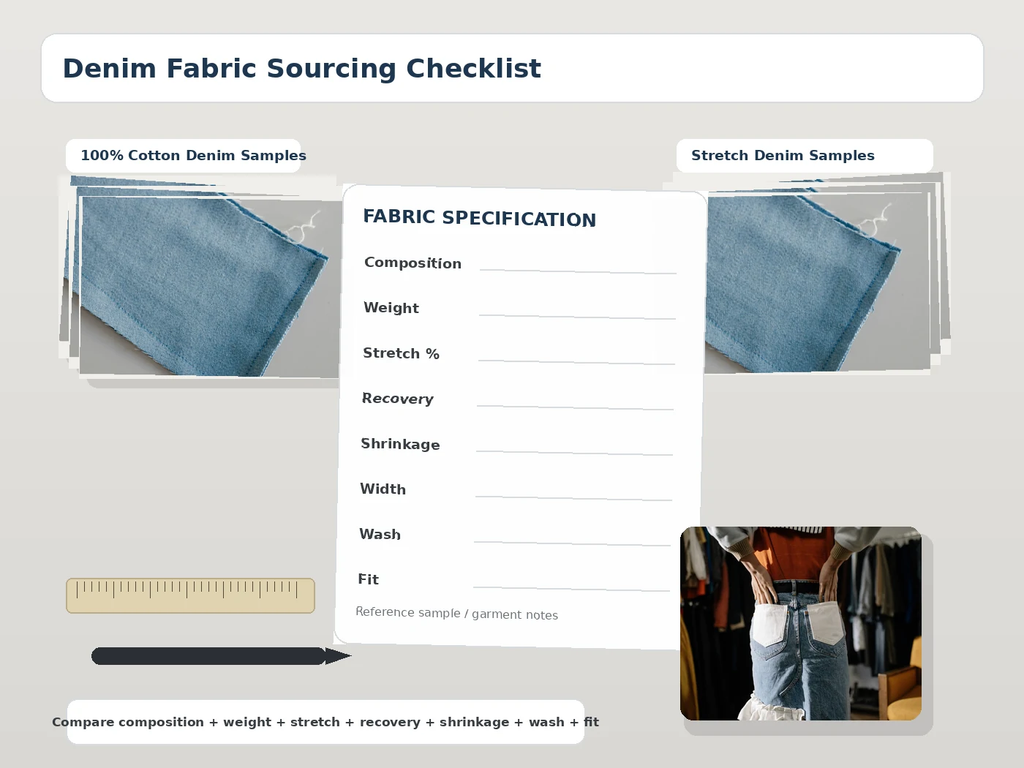
A Buyer’s Checklist Before Choosing
Before requesting fabric samples, define the following.
1. Garment Type
Jeans, shorts, skirts, jackets or another product?
2. Fit
Is it:
- wide
- relaxed
- straight
- slim
- skinny?
3. Target Weight
Provide oz or GSM.
4. Desired Hand Feel
For example:
- rigid
- dry
- firm
- soft
- flexible
- compact
5. Stretch Requirement
If stretch is needed, specify:
- stretch direction
- target stretch %
- recovery expectations
6. Wash Direction
For example:
- dark rinse
- medium wash
- vintage wash
- heavy wash
- black wash
7. Shrinkage Requirement
Ask for warp and weft shrinkage information relevant to the intended process.
8. Reference Sample
A physical swatch or existing garment often communicates the target much better than words alone.
A Better Way to Ask a Denim Supplier
Instead of asking:
“Which is better, cotton or stretch denim?”
describe the garment.
For a rigid project:
We are developing men’s relaxed straight-leg jeans. We want approximately 12–13oz 100% cotton indigo denim with a medium-firm hand and a vintage wash direction. Please suggest suitable fabrics and provide finished width and shrinkage information.
For a stretch project:
We are developing women’s slim jeans. We need approximately 10–11oz stretch denim with comfortable movement and good shape recovery. Please provide composition, stretch percentage, growth/recovery data if available, width and shrinkage.
This gives the supplier enough information to recommend fabrics based on the actual product.
Common Mistakes Buyers Make
Mistake 1: Assuming 100% Cotton Means Better Quality
Fiber composition does not determine overall fabric quality.
Construction and suitability for the garment matter more.
Mistake 2: Assuming Stretch Denim Is Always More Comfortable
Stretch helps movement, but garment fit, weight and finishing also affect comfort.
Mistake 3: Choosing Stretch Denim by Elastane Percentage
2% elastane does not equal 2% fabric stretch.
Ask for actual fabric performance.
Mistake 4: Ignoring Recovery
More stretch is not automatically better.
Mistake 5: Choosing Rigid Denim Without Considering the Finished Wash
A rigid roll may soften considerably after garment washing.
Mistake 6: Using the Same Pattern for Rigid and Stretch Fabrics
The garment dimensions and wearing behavior can change significantly.
FAQ: 100% Cotton Denim vs Stretch Denim
Is 100% cotton denim better than stretch denim?
Neither is universally better.
100% cotton is often preferred for structured, rigid and vintage-style garments.
Stretch denim is usually better for closer fits and easier movement.
Is 100% cotton denim uncomfortable?
Not necessarily.
Weight, finishing and garment fit have a major influence on comfort.
A soft or lightweight 100% cotton denim used in a relaxed fit can be very comfortable.
Does 100% cotton denim stretch?
Traditional 100% cotton rigid denim has relatively limited stretch.
However, some specially engineered mechanical constructions can create measurable stretch without elastane. One Cotton Incorporated system reports roughly 10–18% fill-direction stretch depending on weight and weave.
Is stretch denim less durable?
Not automatically.
Durability depends on yarn, construction, fiber quality, garment fit, finishing and use.
Stretch denim also introduces recovery performance as an additional factor buyers should evaluate.
Is 1% elastane enough for jeans?
It can be.
A small amount of elastane may create noticeable comfort stretch depending on the fabric construction.
Composition alone cannot predict the final stretch percentage.
Is 2% elastane good for skinny jeans?
It may be suitable, but buyers should not approve the fabric based on 2% elastane alone.
Check actual stretch, recovery and finished garment fit.
Which is better for wide-leg jeans?
100% cotton is often a strong choice because wide-leg garments already provide physical ease and may benefit from more structure.
Stretch denim can also work if a softer or more fluid result is desired.
Which is better for skinny jeans?
Stretch denim is generally more practical because the garment needs to move while fitting closely around the body.
Which is better for vintage jeans?
100% cotton rigid denim is usually the more traditional choice when both vintage appearance and rigid wearing character are part of the design.
Final Thought: Start With the Jeans You Want to Make
The question should not be:
“Is 100% cotton denim better than stretch denim?”
The better question is:
“What should this garment look and feel like when someone wears it?”
Choose 100% cotton denim when you want:
- traditional structure
- rigid denim character
- relaxed or straight silhouettes
- heritage-inspired styling
Choose stretch denim when you want:
- easier movement
- closer fit
- immediate comfort
- greater flexibility
And remember that these categories can overlap.
A 100% cotton fabric can be soft.
A stretch denim can still be structured.
Some 100% cotton constructions can even provide limited mechanical stretch.
For buyers, the safest approach is to evaluate the full specification:
- composition
- weight
- stretch
- recovery
- shrinkage
- width
- wash
- hand feel
- garment fit
If you are sourcing denim fabric, send ZLDENIM your garment type, target weight, fit, composition preference, stretch requirement, color, wash direction or reference sample.
We can use those details to help narrow down suitable 100% cotton or stretch denim options from available fabrics and our supplier network.