
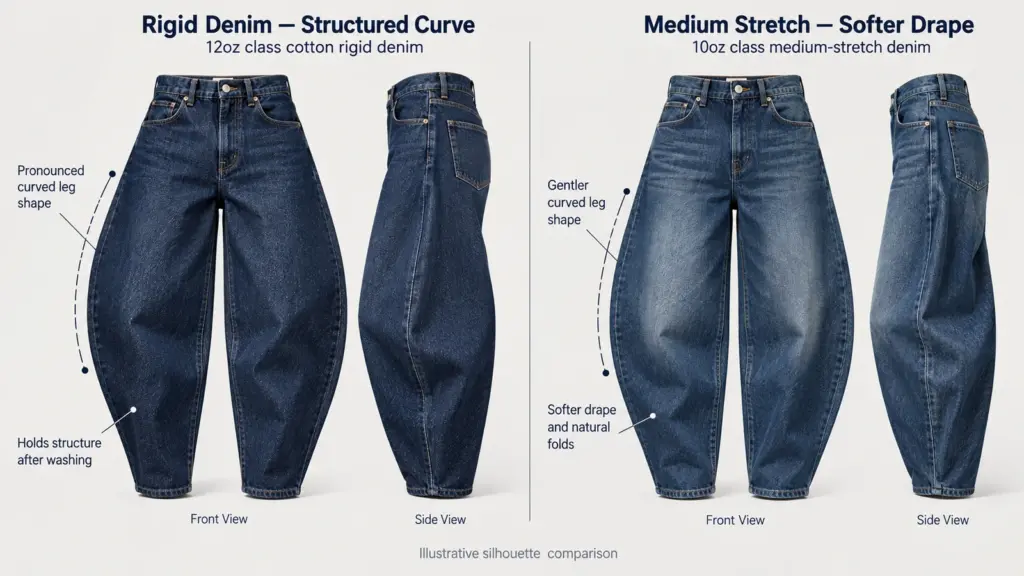
Cut two pairs of barrel jeans using the same pattern: one in firm 12oz cotton rigid denim, the other in softer 10oz medium-stretch denim.
After washing, the first may hold a pronounced horseshoe-shaped leg, while the second may fall more softly around the knee. The pattern hasn’t changed, but the fabric changes how the design looks and moves.
This is the central challenge when selecting the best denim fabric for barrel jeans.
Also marketed as horseshoe, balloon or curved-leg jeans, barrel styles need fabric with enough body to support the intended shape without making the waist, seat and tapered hem uncomfortable.
For clothing brands and garment developers, fabric weight is only the starting point. Bending stiffness, drape, dimensional stability, stretch recovery and the construction of the curved leg all influence the finished result.
Quick Fabric Selection Guide
For a bold, structured silhouette, start by sampling medium-weight cotton rigid denim with sufficient body. For a softer commercial barrel fit, compare compact 10–12oz medium-stretch constructions. In both cases, approve the fabric after the actual garment wash, because a good-looking unwashed sample does not guarantee the final silhouette.
1. Why Barrel Jeans Need More Careful Fabric Selection
Traditional straight-leg jeans follow a relatively consistent leg line. Barrel jeans deliberately create volume through the thigh or knee before tapering toward the ankle.
Pattern makers achieve this shape using curved leg panels, shaped side seams, darts, seam placement and controlled ease.
Two fabric properties become particularly important.
Fabric Body: Can the Leg Hold Its Curve?
Fabric body is influenced by yarn size, weave density, finishing and bending stiffness.
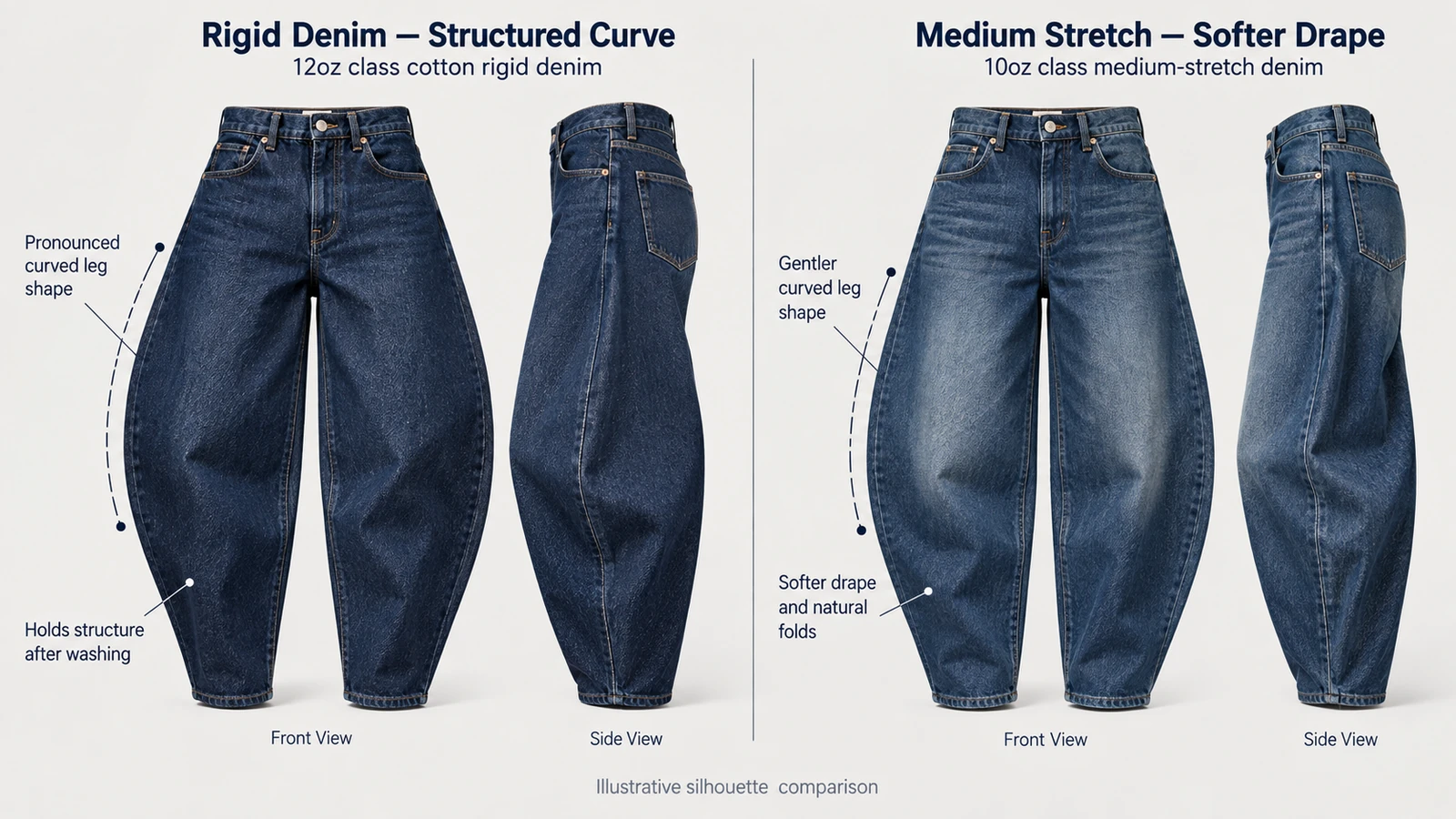
A firmer denim can help the leg stand away from the wearer’s body, producing a more sculptural silhouette. A softer construction can create a relaxed barrel shape with natural folds.
Neither effect is automatically preferable. The best choice depends on whether the collection calls for an architectural horseshoe shape or a softer everyday jean.
Curved Outseams and Grainline Control
A curved outseam presents a less obvious development challenge.
The edge of a curved pattern piece changes direction relative to the fabric grain. Some sections may have more off-grain behavior than a straight edge, increasing the need to control handling, sewing tension and washing distortion.
This does not mean the entire panel is bias-cut. Its grainline must still be established by the pattern maker.
If the fabric has substantial bow, skew or unstable dimensional change, the washed garment may develop unexpected seam movement or puckering.
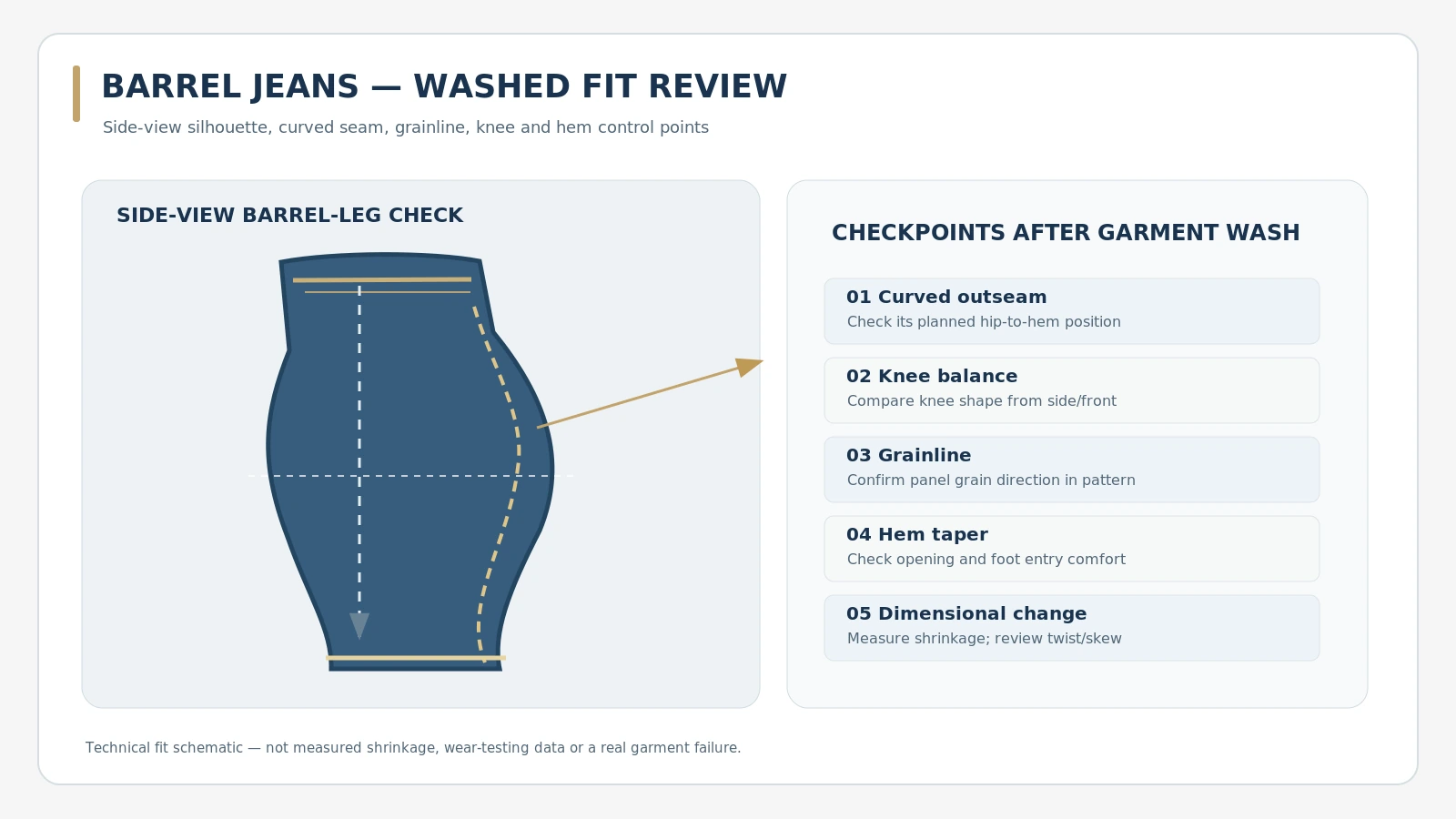
During sampling, check whether the curved side seam stays in its intended position from hip to hem, whether the knee shape remains balanced and whether the front and back panels shrink compatibly.
A barrel shape that looks good on the cutting table can change considerably after washing.
2. Rigid vs Stretch Denim: Which Is Better for Barrel Jeans?
Both rigid and stretch denim can produce successful barrel-leg styles.
The choice depends on silhouette, comfort and performance.
| Development Factor | Cotton Rigid Denim | Comfort / Medium-Stretch Denim |
|---|---|---|
| Main advantage | More defined structure | Flexibility and ease of movement |
| Initial weight direction | Approximately 11–14oz | Approximately 9.5–12oz |
| Curved-leg appearance | Can support pronounced volume | Often produces a softer silhouette |
| Waist and seat comfort | Relies on pattern ease | Can provide additional extension |
| Main concern | Bulk, stiffness, restricted movement | Growth, poor recovery or insufficient body |
| Key garment test | Washed shape and movement | Washed shape, extension, growth and recovery |
| Typical development direction | Vintage or sculptural horseshoe jeans | Everyday tapered or relaxed barrel jeans |
These are sampling directions, not fixed engineering limits.
When to Choose Rigid Denim
Rigid denim is a strong candidate when the design calls for a visible outward curve, structured folds or a traditional workwear appearance.
The pattern must supply enough ease through the hip, seat and rise, because rigid fabric provides limited functional stretch.
For cropped or heavily tapered barrel jeans, test foot entry through the hem as well as sitting and bending comfort.
Browse our Cotton & Rigid Denim collection for suitable constructions.
When to Choose Medium-Stretch Denim
Medium-stretch denim is useful when comfort and freedom of movement are important, but the design still needs a defined curved leg.
The crucial distinction is between stretch and recovery.
A fabric can extend comfortably yet remain stretched after repeated movement. That may produce bagging around the knee or seat and soften the intended barrel outline.
For this reason, 1.5% spandex should not be treated as a guaranteed performance result. The actual extension and growth must be checked.
Practical Stretch Testing for Fabric Development
Some brands begin by comparing fabrics in an illustrative 12–22% extension range and may specify a recovery target around 90%. Those figures can help define an initial development brief, but they are not universal requirements for barrel jeans.
A meaningful specification must identify the test method, load, extension or hold time, recovery period and direction tested.
ASTM D3107-26 provides methods for measuring stretch, growth and recovery of suitable woven stretch fabrics. Its scope also cautions that between-laboratory precision can be poor, so comparable testing conditions matter.
Importantly, 90% recovery and less than 3% fabric growth are not interchangeable limits. They are separate measurements and should be evaluated separately.
The garment factory should also examine knee shape after repeated bending and wear simulation.
If the fabric stretches well but the knee bags out, a comfortable fit on day one may not remain attractive during actual wear.
3. Choosing the Right Denim Weight
Barrel-leg jeans generally benefit from a fabric that can support controlled volume.
But weight alone cannot tell buyers whether the fabric will drape well or hold its shape.
8–10oz: Lightweight Barrel Jeans
This range can suit relaxed spring/summer styles, lighter balloon trousers and soft fashion silhouettes.
A compact construction may still offer sufficient body for a gentle barrel curve, while a very soft fabric may fall closer to the leg.
10–12oz: Everyday Commercial Barrel Fits
This is a useful starting range for many brands developing wearable barrel jeans.
A 10oz medium-stretch denim may balance flexibility and structure, while a firmer 11–12oz rigid option may create a stronger curve.
Compare both after the planned wash instead of selecting solely by weight.
12–14oz: Structured Horseshoe Silhouettes
For an exaggerated or vintage-inspired curve, a medium-heavy denim can provide a more substantial appearance.
The trade-off is additional seam bulk around knee darts, pockets, side seams and narrow hems.
Heavyweight fabrics also require appropriate sewing equipment, needle selection and garment finishing.
For broader weight comparisons, see the Denim Fabric Weight Guide.
4. Three ZLDENIM Fabrics to Compare for Barrel Jeans
A useful development method is to make the same barrel-jeans design in different fabric constructions.
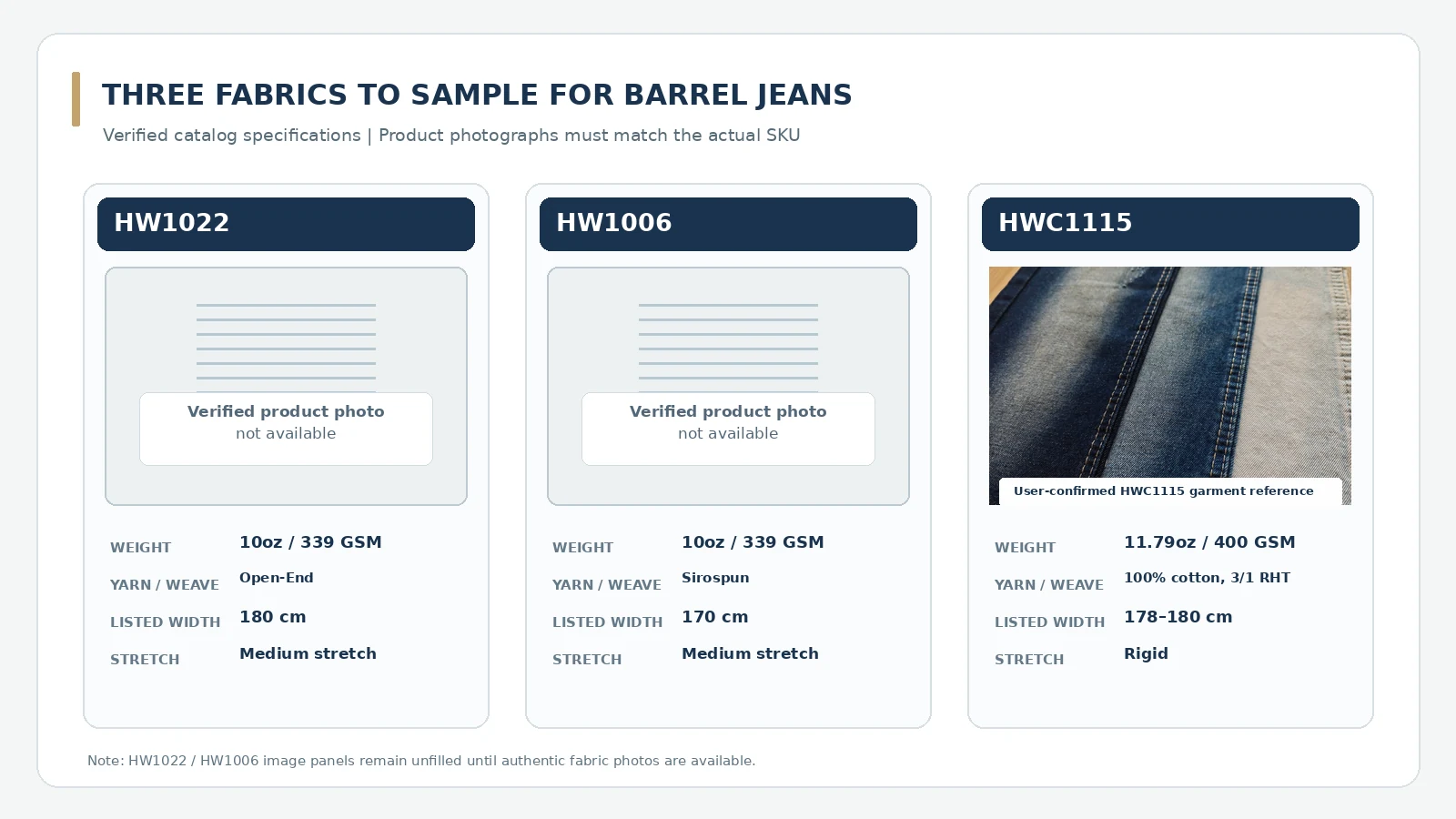
ZLDENIM currently lists three relevant styles with different surface characteristics and stretch behavior.
| Specification | HW1022 | HW1006 | HWC1115 |
|---|---|---|---|
| Weight | 10oz / 339 GSM | 10oz / 339 GSM | 11.79oz / 400 GSM |
| Composition | 65% cotton, 33.5% polyester, 1.5% spandex | 65% cotton, 33.5% polyester, 1.5% spandex | 100% cotton |
| Stretch | Medium | Medium | Rigid |
| Construction | Open-End | Sirospun | 3/1 RHT, clean surface |
| Listed width | 180cm / 71in | 170cm / 67in | 178–180cm / 70–71in |
| Main development direction | Textured vintage barrel | Cleaner commercial barrel | Structured rigid barrel |
HW1022 — 10oz Open-End Medium-Stretch Denim
HW1022 uses an open-end yarn construction with a fuller, more textured surface character.
At 10oz with medium stretch and a listed 180cm width, it is a practical fabric to sample for relaxed barrel jeans, tapered styles and vintage-inspired finishes.
Its published catalog lists 11 color options. Current availability and dye lots should be checked for the selected color.
The key development question is whether its washed handfeel provides enough body for the intended barrel curve.
HW1006 — 10oz Sirospun Medium-Stretch Denim
HW1006 shares the same published weight and fiber composition as HW1022 but uses Sirospun yarn construction.
Its cleaner surface and more defined twill appearance make it worth considering for refined barrel and tapered jeans, especially where the wash direction favors a neat indigo appearance.
Its listed width is 170cm, approximately 67 inches.
The two fabrics should be compared for washed drape, surface character, growth and usable cutting width.
HWC1115 — 12oz-Class 100% Cotton Rigid Denim
HWC1115 provides a different direction for buyers seeking a structured cotton fabric.
Its published specifications include 400 GSM, approximately 11.79oz, 100% cotton composition, 3/1 right-hand twill and a width of 178–180cm.
This makes it a useful candidate for sampling sculptural barrel shapes and heritage-inspired designs.
However, the preferred shape must be confirmed after garment washing and fit testing. A 100% cotton composition does not by itself guarantee a particular bending stiffness or crease-retention performance.
The practical comparison is simple: HW1022 for textured medium-stretch character, HW1006 for a cleaner medium-stretch surface, and HWC1115 for a cotton rigid construction.
5. Washed Prototype Testing: Where Barrel Fits Often Go Wrong
Approving the unwashed garment is not enough.
Garment washing can change fabric softness, shrinkage, drape and seam appearance. With a curved-leg design, relatively small dimensional changes can noticeably alter the silhouette.
Check the Curved Side Seam
Fit the washed sample on a model and examine the garment from the front, side and back.
Look for a balanced knee curve and consistent side-seam position. Unexpected twisting, rippling or pulling may come from a combination of pattern geometry, grainline placement, sewing and fabric dimensional behavior.
Do not attribute every twisted seam to the weave alone.
Check the Hip, Seat and Hem
A barrel jean still needs comfortable movement.
Ask the fitting model to sit, walk, squat and pass the foot through the tapered leg opening.
For rigid fabric, the important variables are pattern ease and available movement. For stretch fabric, also check recovery after repeated movement.
Compare Actual Wash Shrinkage
Do not use one pattern’s shrinkage allowance for every fabric.
For example, HW1006 and HW1022 do not have published shrinkage test values on their current product pages, so their results need to be measured for the planned laundry process.
HWC1115 has published warp and weft shrinkage values, but those figures should still be evaluated against the factory’s actual garment wash.
Never assume that all medium-stretch fabrics shrink more than rigid denim. The outcome depends on fabric construction, finishing and processing conditions.
6. How Curved Patterns Affect Fabric Consumption
Barrel jeans often contain curved, tapered or shaped pattern pieces that can be challenging to nest efficiently.
The fabric’s usable width and the size ratio both affect how efficiently those pieces fit together on the cutting marker.
ZLDENIM’s three comparison fabrics have different listed widths, but a wider fabric does not automatically produce lower garment cost.
Use the actual pattern and approved grainline restrictions to run a separate marker for each fabric.
Fabric Cost per Pair = Fabric Price per Meter × Marker Consumption per Pair
Do not calculate consumption by simply reducing the cost in proportion to fabric width. Pattern geometry, seam construction and usable edge areas may change the result.
For a detailed costing example, see the Denim Fabric Width Guide.
7. A Practical Fabric Approval Checklist
Before approving bulk denim for barrel jeans, the development team should confirm the desired silhouette, weight, handfeel, extension and growth, as well as the intended wash result.
The factory should then evaluate the garment in the following order:
- Approve the paper pattern and grainlines.
- Sew comparative samples using the shortlisted fabrics.
- Wash each sample using the intended process.
- Compare silhouette, measurements, seam behavior and comfort.
- Confirm usable width, CAD consumption and current stock before committing to bulk production.
The most useful fabric choice is the one that consistently creates the desired garment after washing and wear—not simply the heaviest, softest or most expensive option.
Frequently Asked Questions
Is rigid or stretch denim better for barrel jeans?
Rigid denim is often useful for a more defined, sculptural shape. Medium-stretch denim can provide a softer silhouette and greater movement. The best choice depends on the finished fit.
What denim weight is best for barrel jeans?
Approximately 10–12oz is a useful sampling direction for many commercial barrel styles. Firmer 12–14oz constructions may suit more exaggerated silhouettes.
Why do barrel-jean side seams sometimes twist after washing?
Possible causes include fabric skew, uneven shrinkage, grainline placement, pattern geometry and sewing tension. The curved seam may expose these problems, so test the garment after washing.
How much stretch should barrel-jeans denim have?
There is no universal percentage. The buyer should specify extension, growth and recovery targets under an agreed method and then approve the finished garment.
Source Barrel-Jeans Denim From ZLDENIM
A well-developed barrel jean starts with the silhouette and ends with a garment that maintains its intended shape after washing.
Compare real constructions through the Stretch Denim collection and Cotton & Rigid Denim collection.
For project development, visit our Samples page or send your tech pack and target specifications through ZLDENIM Sourcing.
We can help check suitable ready-stock fabrics or sourcing alternatives based on your target weight, width, stretch, wash direction and estimated order quantity.