
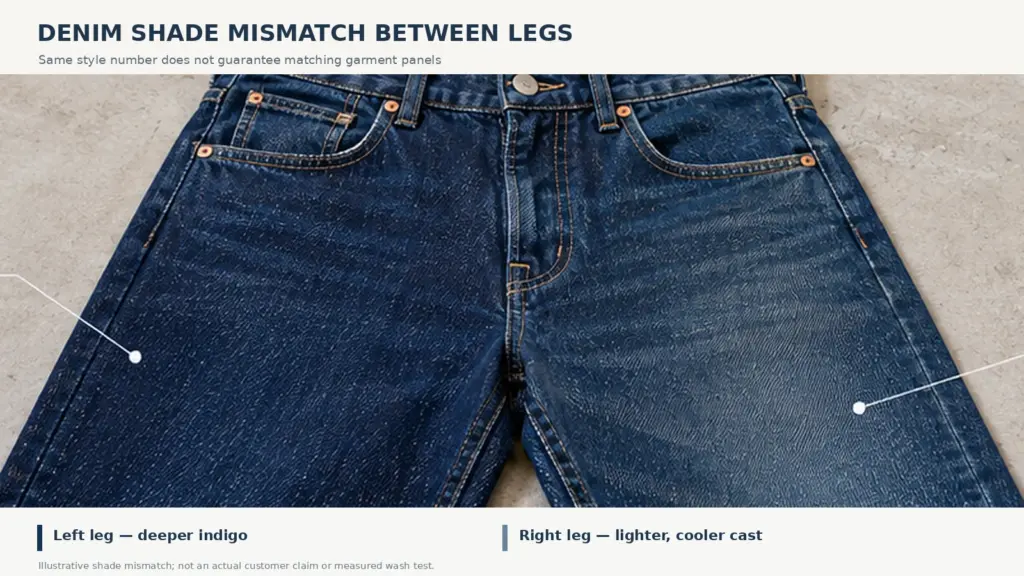
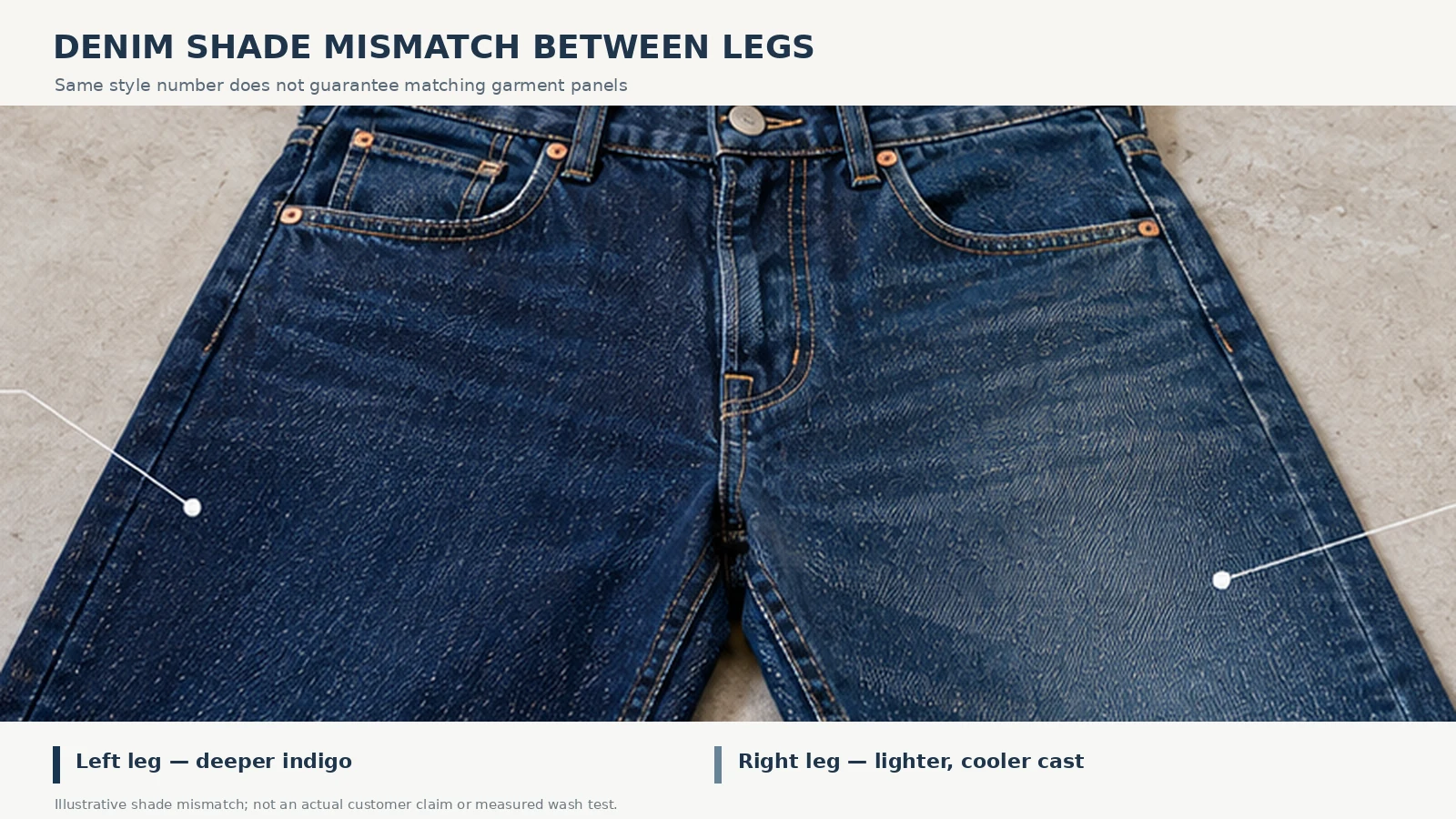
Imagine a factory cutting the left and right legs of a pair of jeans from two different denim rolls. Both rolls carry the same style number, weight and “dark indigo” description. On the cutting table, the panels look close enough. After an enzyme wash, however, one leg is visibly darker and has a greener cast. Cutting, sewing and laundry have already been paid for, yet the finished jeans may not meet the buyer’s shade standard.
That mismatch can start at the dyeing line, at fabric inspection or when cut parts lose their roll identity. Washing can expose a difference that was difficult to see on unwashed fabric; inconsistent laundry conditions can create additional variation. Preventing the problem takes a linked process: inspect the rolls, compare their washed response, establish shade bands, and keep the cutting and sewing bundles traceable.
For sourcing teams and jeans factories, there are four immediate checks: record roll-to-roll shade differences; inspect center-to-selvedge variation (CSV) and beginning-to-end shading; make a washed shade blanket where required by the garment wash; and use roll/lay/ply identification to prevent mismatched panels from being assembled.
1. Why do denim rolls vary in shade?
Traditional indigo denim often uses ring-dyed warp yarns: color is concentrated toward the yarn surface, creating the white-core fading associated with jeans. Its shade is influenced by yarn characteristics, dye application and oxidation, finishing and the wash process. Two rolls described as “dark indigo” can therefore differ in both depth (lighter versus darker) and cast (for example, a reddish versus greener undertone).
During rope or slasher dyeing, control of the indigo reduction bath, including pH and reducing-agent conditions, and the exposure of yarns to air for oxidation (skying) affects the final dyeing result. Differences in dye application or oxidation can contribute to changes in shade. If a fabric uses sulfur bottoming or topping, the sulfur layer can also influence its cast and how the color develops through washing. These are possible contributors to variation, not a diagnosis that can be made from appearance alone.
Finishing introduces further variables. Tension, drying and heat-setting conditions can affect the appearance and dimensional behavior of a fabric. With stretch denim, poorly controlled thermal finishing may contribute to unwanted discoloration or widthwise variation, so the finished roll—not just the dyeing record—needs assessment. Classic cotton and rigid denim and black denim likewise need shade approval against their own construction and intended finish.
2. Separate roll-to-roll, center-to-selvedge and beginning-to-end shading
Not every shade problem should be handled in the same way. A factory needs to identify where the variation occurs before deciding whether to group, segregate, trim or hold the material.
| Variation type | Where to inspect | Main production risk | Practical action |
|---|---|---|---|
| Roll-to-roll | Swatches from different rolls, including rolls within one dye lot | Incompatible garment panels or inconsistent wash batches | Make a roll shade continuity card and assign approved shade bands |
| Center-to-selvedge (CSV) | Left, center and right across the cuttable fabric width | One leg or panel differs from another even in the same roll | Check usable width and panel placement; hold or restrict affected fabric if needed |
| Beginning-to-end (head-to-tail) | Early, middle and later sections of a roll | Shade changes across plies or cutting lays | Inspect additional points and segregate affected roll sections |
Why CSV can increase fabric cost
Even same roll, same ply is not enough if the left edge and center of that ply have unacceptable shade differences. A marker that uses the entire nominal width may place a front leg in one shade zone and a back leg in another. The cutting team may need to reduce its usable marker width, rework the layout or reject the affected section. That increases fabric consumption. The excluded width must come from actual roll inspection; it should not be assumed to be a fixed number of centimeters on every denim.
3. Inspect incoming rolls under controlled viewing conditions
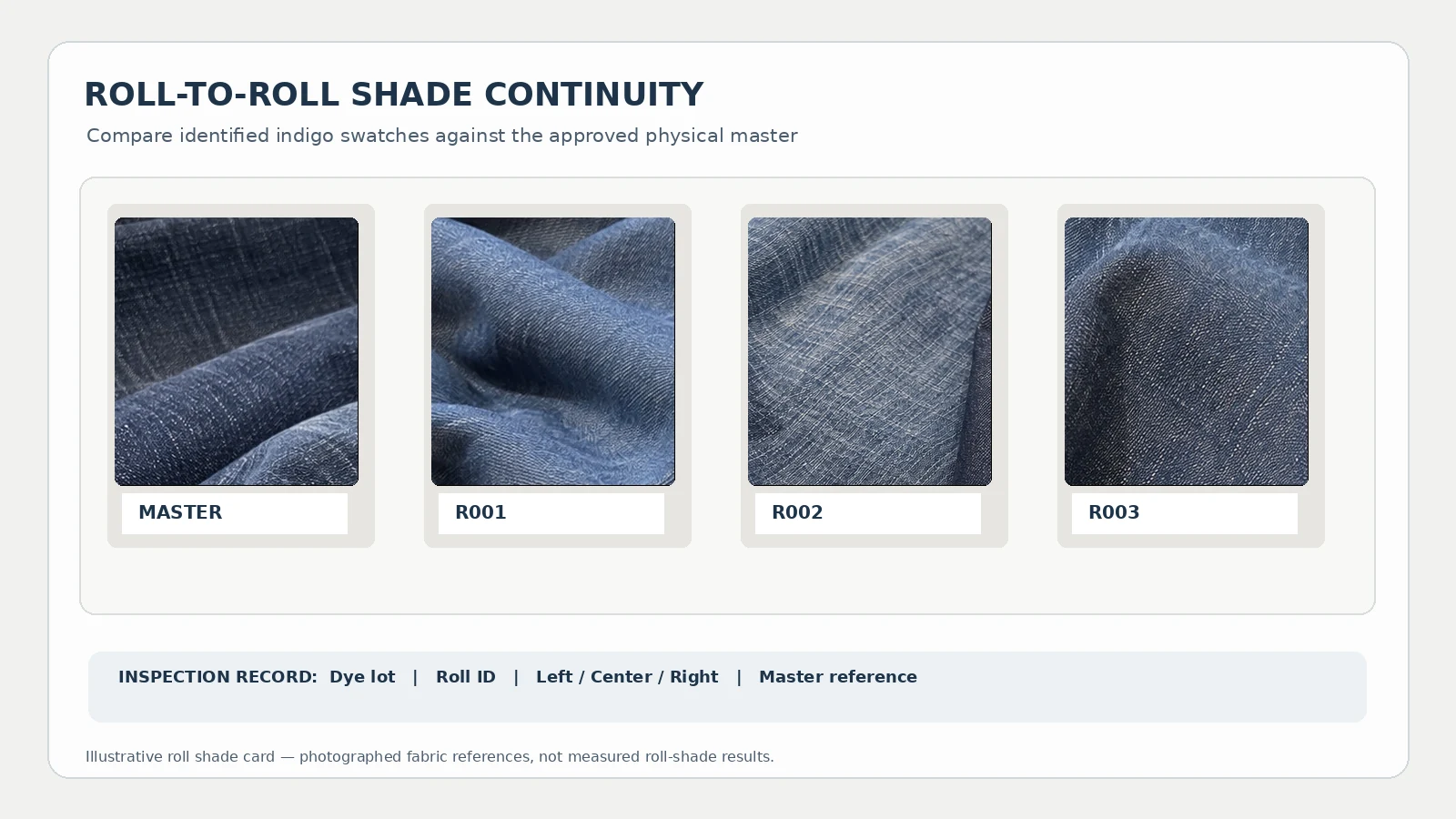
Incoming inspection is the point at which a factory can detect variation before fabric becomes cut components. Compare identified swatches against the buyer’s approved physical master and record the style, dye lot, roll number, length or meterage, and any left-center-right observations. When a roll shows changing shade, inspect additional positions along its length rather than approving the entire roll from one header swatch.
D65, TL84 and gray-scale evaluation
A calibrated light cabinet helps make visual decisions repeatable. D65 is a commonly specified daylight illuminant, with a correlated color temperature of approximately 6500 K. Buyers may request a second viewing condition, such as TL84 or CWF, to examine possible metamerism—a match under one light source that changes under another. TL84 and CWF are different illuminants and should not be treated as interchangeable. Follow the customer’s viewing geometry and approval procedure rather than assuming every brand uses the same angle and light settings.
The AATCC EP1 Gray Scale for Color Change and ISO 105-A02 are recognized ways to evaluate color change in colorfastness work. Some buyer programs also specify gray-scale comparisons in their visual shade-approval instructions. However, Grade 4 or Grade 4–5 is not a universal pass mark for roll-to-roll or CSV acceptance. The buyer and supplier need to agree on the relevant method, viewing setup and acceptance limits. Instrumental measurements, including CIELAB color-difference values, can support this process, but denim texture, direction and finishing can influence readings; keep the physical and washed comparisons in the approval loop.
A shade continuity card makes the result understandable to the cutting room: mount labeled swatches in roll order beside the master, record depth and cast differences, and note which rolls need a wash test or a hold decision.
4. Washed shade blankets reveal differences a dry swatch can miss
A washed shade blanket is one of the most useful checks for jeans that will undergo garment finishing. Representative pieces from identified fabric rolls are joined in a single comparison assembly, washed under a documented, suitable trial process, and then compared after drying. The roll identity stays with every piece so the result can be traced back to the fabric.
For orders where side-to-center shading is a concern, a strip spanning the usable fabric width can help reveal left-center-right differences after washing. If head-to-tail drift is suspected, include pieces from more than one length position. Sample size and whether every roll must be represented depend on the agreed inspection plan; a single fixed strip length cannot cover every fabric and factory.
A practical sequence is straightforward:
- Label swatches before assembly. Record roll number, dye lot and sampling position; mark left, center and right when widthwise variation is being checked.
- Join samples with a known reference. Use an approved master or development standard, and preserve the identifiers during laundering.
- Run a representative wash trial. Align the process with the intended garment finish—rinse, enzyme, stone or bleaching as applicable—and document the test conditions. A small blanket is a comparison aid, not a complete substitute for the finished-garment trial.
- Assess after drying and conditioning. Compare depth, cast and left-to-right appearance, then decide whether rolls can share a cutting shade band.
A dark-indigo pair of rolls may look similar before washing yet respond differently to abrasion or chemistry. The time to discover that difference is before bulk cutting, not after the garments leave the laundry.
5. Make shade bands, then give the cutting room a usable roll plan
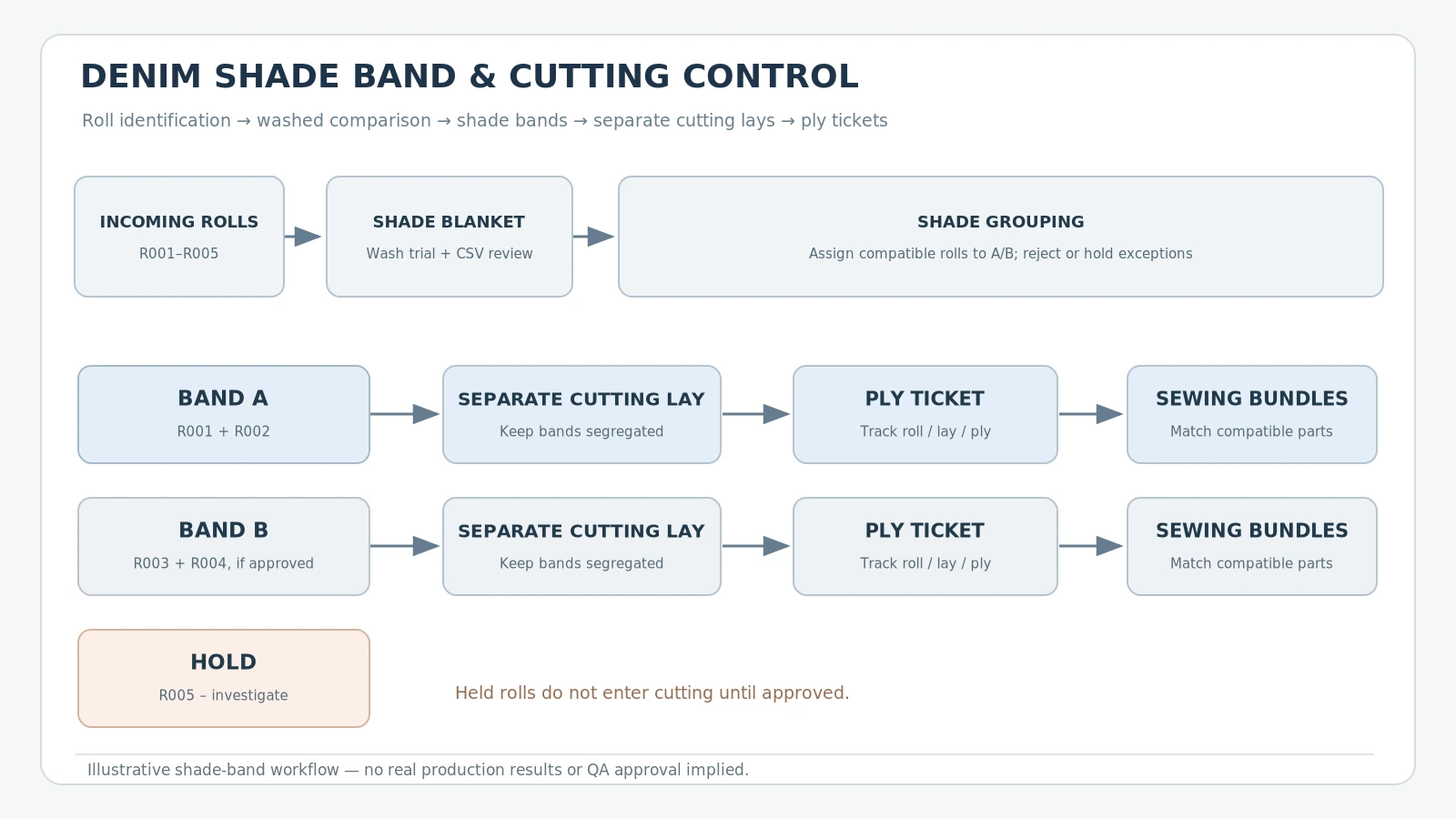
A shade band groups rolls whose appearance is compatible under the buyer’s approved assessment, particularly after the planned wash where that is relevant. Band A and Band B are factory identifiers; each represents an approved, separated group. Dye-lot identity remains important, but two rolls from the same lot do not automatically belong in the same shade band.
Example of a shade-band control log
| Roll | Dye lot | Washed shade finding | Assigned band | Cutting instruction |
|---|---|---|---|---|
| R001 | Lot 2601 | Matches approved Group A reference | A | Cut in approved Group A lays |
| R002 | Lot 2601 | Compatible with R001 | A | Cut in approved Group A lays |
| R003 | Lot 2601 | Slightly redder cast, within separate approved group | B | Keep apart from Group A |
| R004 | Lot 2602 | Compatible with R003 after wash review | B | Group with R003 only if approved |
| R005 | Lot 2602 | Unacceptable side-to-center shading | HOLD | Investigate; do not release |
Illustrative production-control log; these are not actual ZLDENIM inspection records or measured test results.
R003 shares a dye lot with R001 but belongs to a different shade band. R004 comes from a different dye lot yet could join Band B only after its compatibility is approved. This is why factories need both identifiers instead of relying on either one alone.
6. Prevent shade mixing during spreading, cutting and sewing
Good roll inspection is wasted if cut parts lose their identity on the sewing floor. Every cutting lay should identify the allowed rolls and shade band. If the factory changes rolls during spreading, it needs a clear roll boundary: colored separator tissue or divider sheets can help operators see the transition, while a lay record confirms precisely which plies came from which roll. Separator paper is an identification aid, not permission to mix incompatible shade bands.
Sequential ply numbering (ticketing) is another practical control. Operators attach temporary ply labels or use equivalent bundle-tracking methods so a garment’s front legs, back legs, yokes and pockets can be assembled from the compatible roll and lay positions intended by the cutting plan. For especially shade-sensitive styles, a same-roll, same-ply rule helps maintain pairing. But it must be combined with the CSV inspection described earlier: parts cut from different width positions of the same ply can still be visibly different.
A simple traceability ticket should travel with each bundle and contain the fabric style, dye lot, roll number, shade band, lay number and ply range. The sewing line should not swap a missing left leg, waistband or pocket for a loose component of unknown origin simply because the fabric looks close in the workshop.
7. Check the laundry process and the final garment
Even perfectly segregated rolls can produce different outcomes if laundering varies by batch. Washer loading, liquor ratio, enzyme activity, temperature, pH, mechanical action, process time, oxidation or bleaching stages, neutralization and drying all deserve control appropriate to the garment recipe. The factory should use an approved wash standard and record meaningful changes between production loads.
After washing, compare the finished jeans under the agreed lighting setup. Look not only at the overall shade but also at left leg versus right leg, front panel versus back panel, yoke versus body and pockets versus surrounding cloth. Where the buyer approves multiple finished shade bands, keep the groups clearly identified through packing. Sorting garments by final overall shade does not fix an individual pair whose two legs visibly disagree.
For wider context on inspection and performance expectations, see the Denim Fabric Quality Control guide.
8. Seven questions buyers should ask before ordering bulk denim
A purchase order stating only “12oz dark indigo denim, 5,000 meters” leaves too many shade-control decisions unresolved. Ask the supplier and the garment factory these questions before the order is released:
- Dye lots and roll count: Will the order come from one lot or several? Can the shipment be broken down roll by roll?
- Roll and CSV inspection: Which incoming inspection method is used, and how are left-center-right or head-to-tail concerns recorded? A four-point fabric grading system such as ASTM D5430 addresses visual fabric inspection; shade acceptance still needs its own agreed criteria.
- Approved appearance standard: Which physical master, light conditions and gray-scale or instrumental method will be used, and what limits has the buyer actually approved?
- Washed blanket or test yardage: Can identified fabric from the proposed stock lot be supplied for the intended wash trial before cutting?
- Usable width and shrinkage: Are width and dimensional changes consistent enough to support the proposed cutting markers and shade grouping?
- Roll-level packing information: Can the supplier provide roll number, dye lot, meterage and width on the packing list or accompanying records?
- Repeat orders: If a repeat lot will be needed, how will the next delivery be checked against the approved washed standard?
As a real sourcing reference, ZLDENIM lists HW1006 10oz Sirospun medium-stretch denim and HW1022 10oz open-end medium-stretch denim. These are distinct fabric constructions; their published descriptions do not establish that any specific future shipment has already passed your wash-blanket or roll-level shade requirements. Confirm the proposed stock lot and available documentation when requesting samples.
Example inquiry to send a denim supplier
We are sourcing 12oz dark-indigo rigid denim for jeans with a medium enzyme wash. Our estimated requirement is 5,000 meters. Please confirm the proposed dye lots and roll count, available roll-header or left-center-right shade samples, and whether sample yardage from the actual supply lot can be provided for our washed shade-blanket approval. We will agree on the shade acceptance method before bulk cutting.
Frequently asked questions
Can two rolls from the same denim dye lot have different shades?
Yes. Dye-lot identification does not prove perfect roll-to-roll consistency. Swatch inspection and, when relevant, a washed shade blanket help establish which rolls belong together.
What is center-to-selvedge variation (CSV) in denim?
CSV is a difference between the fabric center and the areas nearer its left or right selvedge. It matters because panels placed across the width of a single roll can show different shades after washing.
What is a denim shade blanket?
A shade blanket is an assembly of labeled fabric pieces taken from identified rolls, washed for comparison. It helps the factory assess whether those rolls will produce compatible shades in the intended garment finish.
Is AATCC Gray Scale Grade 4 a universal denim shade limit?
No. AATCC EP1 and ISO 105-A02 define gray-scale methods for evaluating color change in colorfastness tests. A buyer may set a specific visual shade criterion in its own quality manual, but there is no single Grade 4 pass mark that governs every roll-to-roll or CSV comparison.
Can garment washing repair two mismatched denim legs?
Not reliably. A corrective treatment may alter their appearance, but matching the panels is not guaranteed and can introduce other quality issues. Preventing incompatible panels from being sewn together is the safer production control.
Final thoughts: inspect, group, trace and verify
Shade consistency in jeans depends on more than the color name printed on a roll label. Effective controls connect the original fabric to the finished garment: check roll-to-roll and CSV variation, compare samples after the intended wash, assign compatible shade bands, preserve roll and ply identity, and inspect the finished jeans.
Explore ZLDENIM’s Cotton & Rigid Denim, Stretch Denim and Black Denim collections, or browse the full denim fabric catalog. For trial wash development, request swatches or sample yardage. If a bulk order needs a specific dye lot, shade-control method or width, submit your requirements through ZLDENIM’s sourcing page so availability and supporting documentation can be checked for the actual material proposed.
Pingback: Denim Swatch Vs Bulk Fabric: 5 Approval Checks