
A shipment of dark-indigo denim arrives at a jeans factory with the correct style number, weight and packing list. The first rolls look clean, so the cutting department begins spreading fabric.
During production, the team discovers a repeated loom stop mark, an oil stain and a roll whose usable width is smaller than the approved marker.
These problems can delay cutting, consume additional fabric and create rejected garment panels.
The purpose of fabric inspection is to find those problems before they reach the cutting table.
The 4-point fabric inspection system provides a structured method for recording visible defects and comparing fabric rolls. But experienced quality teams also check shade, usable width, shrinkage and other material specifications before releasing denim for production.
Here is how the process works.
Quick Reference for Factory QA Teams
The commonly used four-point method assigns 1–4 penalty points according to defect size. It normally applies a maximum of four points within one linear yard or meter and reports a normalized score per 100 square yards or square meters.
The acceptance limit, hole treatment, inspection coverage and other quality requirements should be agreed before inspection.
1. What Is the Four-Point Fabric Inspection System?
Four-point inspection is a visual fabric-grading method used in textile manufacturing and apparel sourcing.
The inspector examines the fabric, identifies visible defects, measures them and assigns penalty points under the specified scoring rules.
Results are then recorded by roll and normalized against the inspected fabric area.
The method is associated with ASTM D5430-26: Standard Test Methods for Visually Inspecting and Grading Fabrics.
ASTM D5430 provides different grading options. Buyer and supplier must use the same agreed option when comparing inspection results.
That matters because two factories using different scoring or acceptance rules can reach different decisions about the same fabric.
Setting Up the Inspection Station
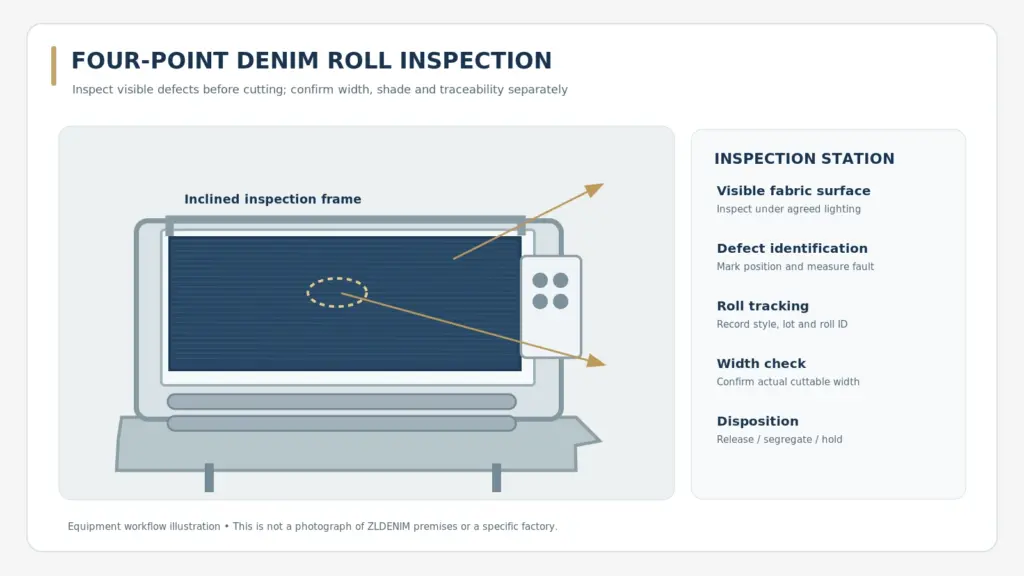
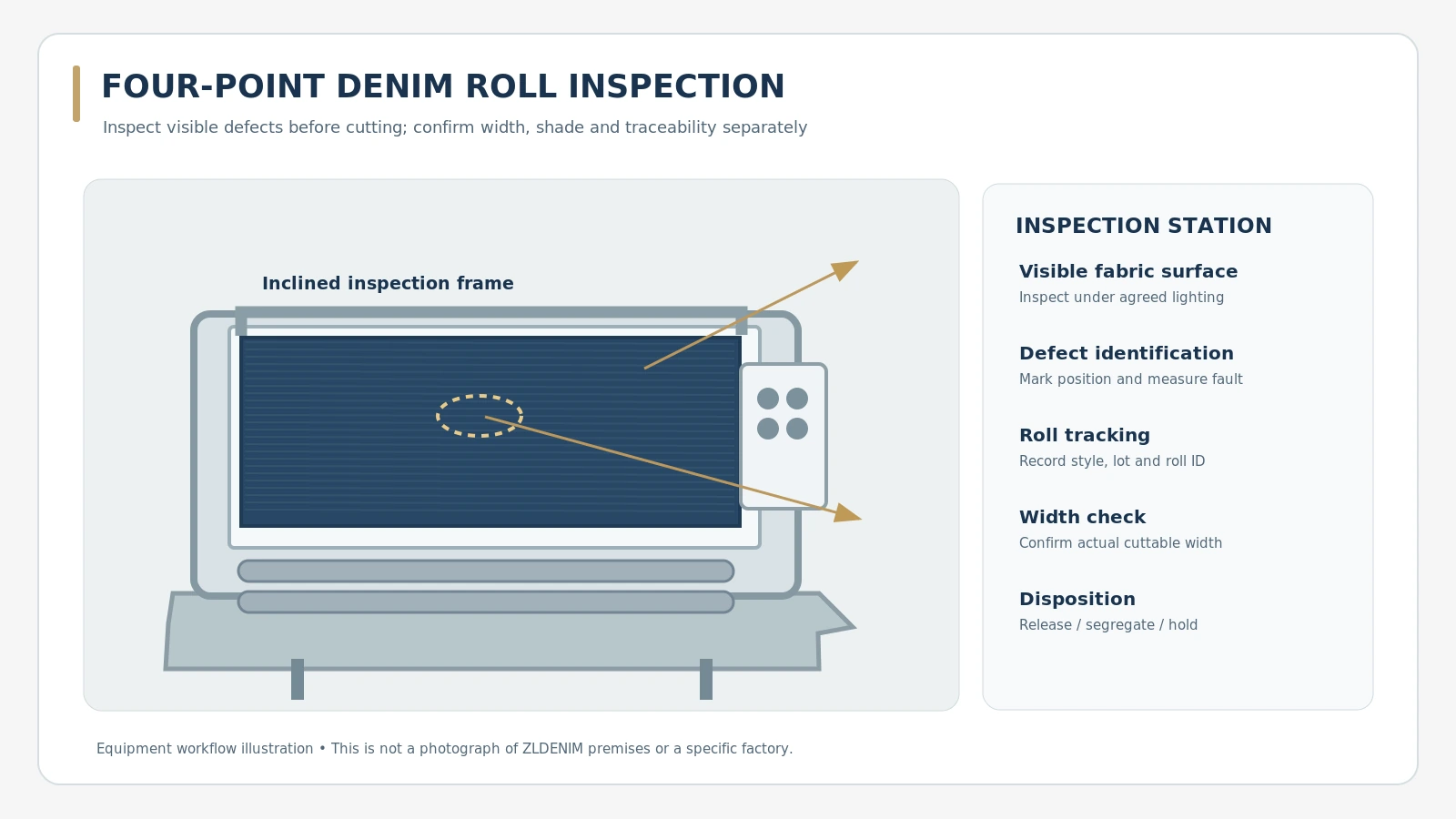
A reliable station needs sufficient, consistent illumination, controlled fabric movement and a viewing arrangement that lets the inspector identify defects.
Some factory SOPs specify an inclined inspection board, a particular light level and machine-speed limits. Those settings should be defined and verified for the actual equipment, rather than treated as universal requirements for every inspection.
The inspector should also know the approved fabric appearance, especially when the denim uses intentional slub yarn, crosshatch effects or irregular surface texture.
2. How Four-Point Fabric Defects Are Scored
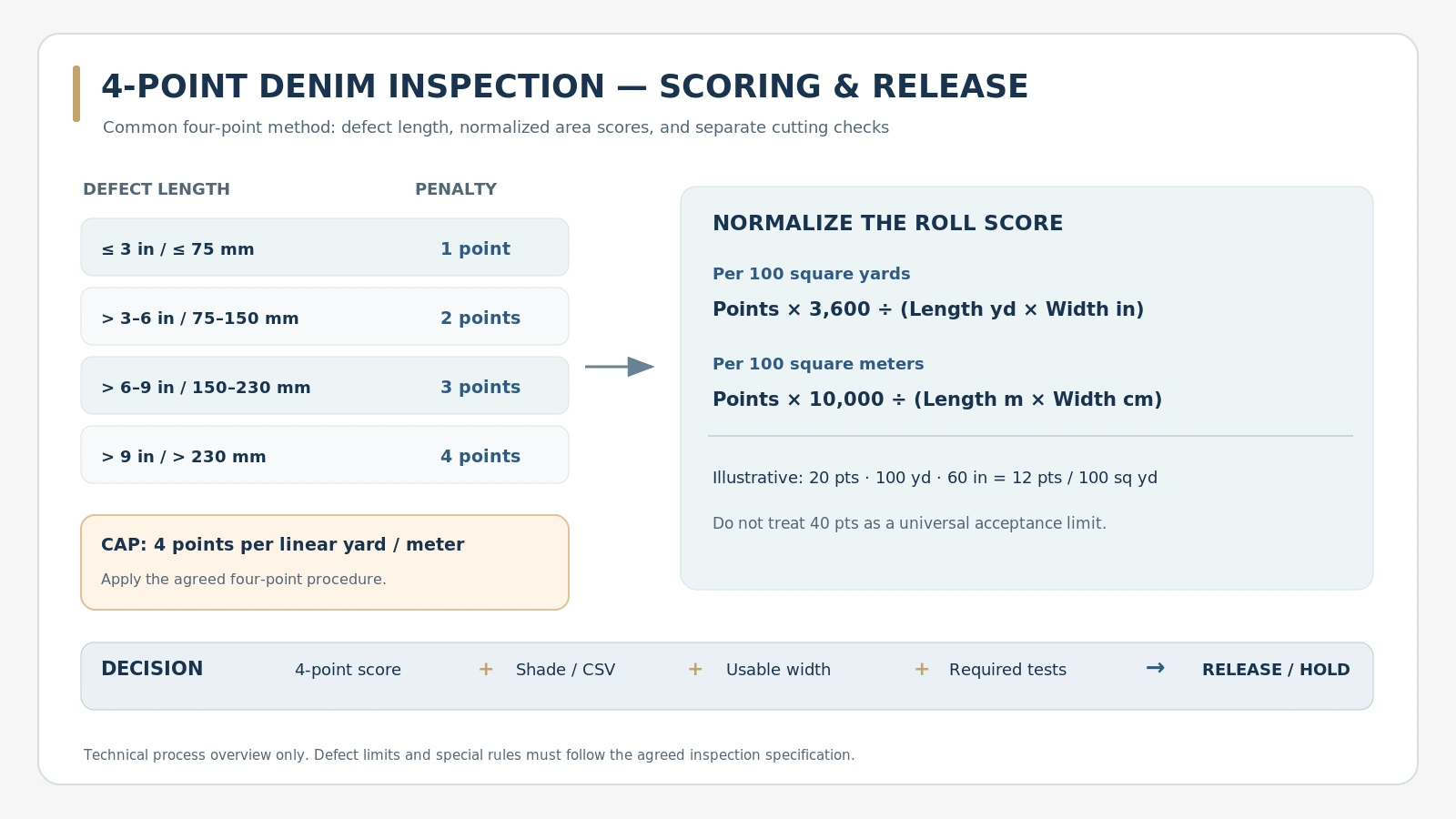
The commonly used scoring bands are based on measured defect length.
| Defect Length | Approximate Metric Length | Penalty Points |
|---|---|---|
| Up to 3 inches | Up to 75mm | 1 |
| Over 3 to 6 inches | Over 75 to 150mm | 2 |
| Over 6 to 9 inches | Over 150 to 230mm | 3 |
| Over 9 inches | Over 230mm | 4 |
These bands summarize a commonly used four-point method. The complete inspection specification governs the exact treatment of special defects.
Rule 1: Maximum Four Points per Linear Yard
Under the commonly used four-point method, the total penalty for defects occurring within one linear yard or meter is capped at four points.
For example, if two defects in the same linear yard would individually receive three points each, the recorded total for that yard is four points rather than six.
The inspector should apply this cap when preparing the final roll score.
Rule 2: Continuous Defects Need Special Attention
A running warp fault or persistent finishing streak may extend through several consecutive yards.
In a commonly used four-point procedure, continuous running defects are scored across the affected length, subject to the specified rules.
The inspector should record where the fault begins and ends.
A defect that continues through a large section may also trigger a separate rejection or fabric-splice decision under the buyer’s quality requirements.
Rule 3: Holes and Full-Width Defects Are Not Ordinary Spots
Holes, tears and full-width faults can be more serious than their visible dimensions suggest.
A full-width defect may receive the maximum penalty under the applicable procedure.
Hole scoring, however, varies between published four-point guidance and buyer specifications. Some manuals assign four points to every hole; others distinguish holes by size.
For denim intended for visible garment panels, the inspector should follow the agreed hole rule and separately flag any damage requiring removal from the cutting plan.
Rule 4: Defects Must Be Recorded With Their Locations
A four-point score does not tell the cutting department where defects are located.
Inspection records should identify the defect position along the roll and, where useful, across the fabric width.
That allows the spreading team to mark, avoid or splice affected sections in accordance with the factory’s cutting procedure.
3. How to Calculate Points per 100 Square Yards
The raw point total must be normalized so rolls of different widths and lengths can be compared.
When length is recorded in yards and the agreed inspection width in inches:
Points per 100 sq yd = Total Penalty Points × 3,600 ÷ (Inspected Length in Yards × Width in Inches)
Worked Example
Suppose an inspector records the following for one roll:
- Inspected length: 100 yards
- Agreed inspection width: 60 inches
- Total penalty points after applicable caps: 20
The inspection area is:
100 yd × 60 in ÷ 36 = 166.67 sq yd
The normalized result is:
20 × 3,600 ÷ (100 × 60) = 12 points per 100 sq yd
This score is compared with the buyer’s specified acceptance criteria.
Metric Formula: Points per 100 Square Meters
For buyers and factories that measure fabric in meters and centimeters, use:
Points per 100 sq m = Total Penalty Points × 10,000 ÷ (Inspected Length in Meters × Width in Centimeters)
If the width is recorded in meters rather than centimeters, the formula becomes:
Points per 100 sq m = Total Penalty Points × 100 ÷ (Inspected Length in Meters × Width in Meters)
Both formulas produce the same metric result.
Converting Between Units
Because 1 square meter equals approximately 1.196 square yards, the normalized scores have this relationship:
Points per 100 sq m ≈ Points per 100 sq yd × 1.196
For example, 40 points per 100 square yards corresponds to approximately 47.84 points per 100 square meters.
The acceptance limit must be converted along with the result. Comparing a metric score against an unconverted square-yard limit can produce a false rejection.
Is 40 Points an Automatic Pass?
Forty points per 100 square yards is a familiar commercial benchmark.
It is not a universal pass limit imposed on all denim orders by ASTM D5430.
The purchase agreement should identify whether the limit applies to each roll, a shipment average or another agreed sampling unit. Major-defect restrictions and separate quality requirements may also apply.
4. Six Denim Defects Inspectors Should Recognize
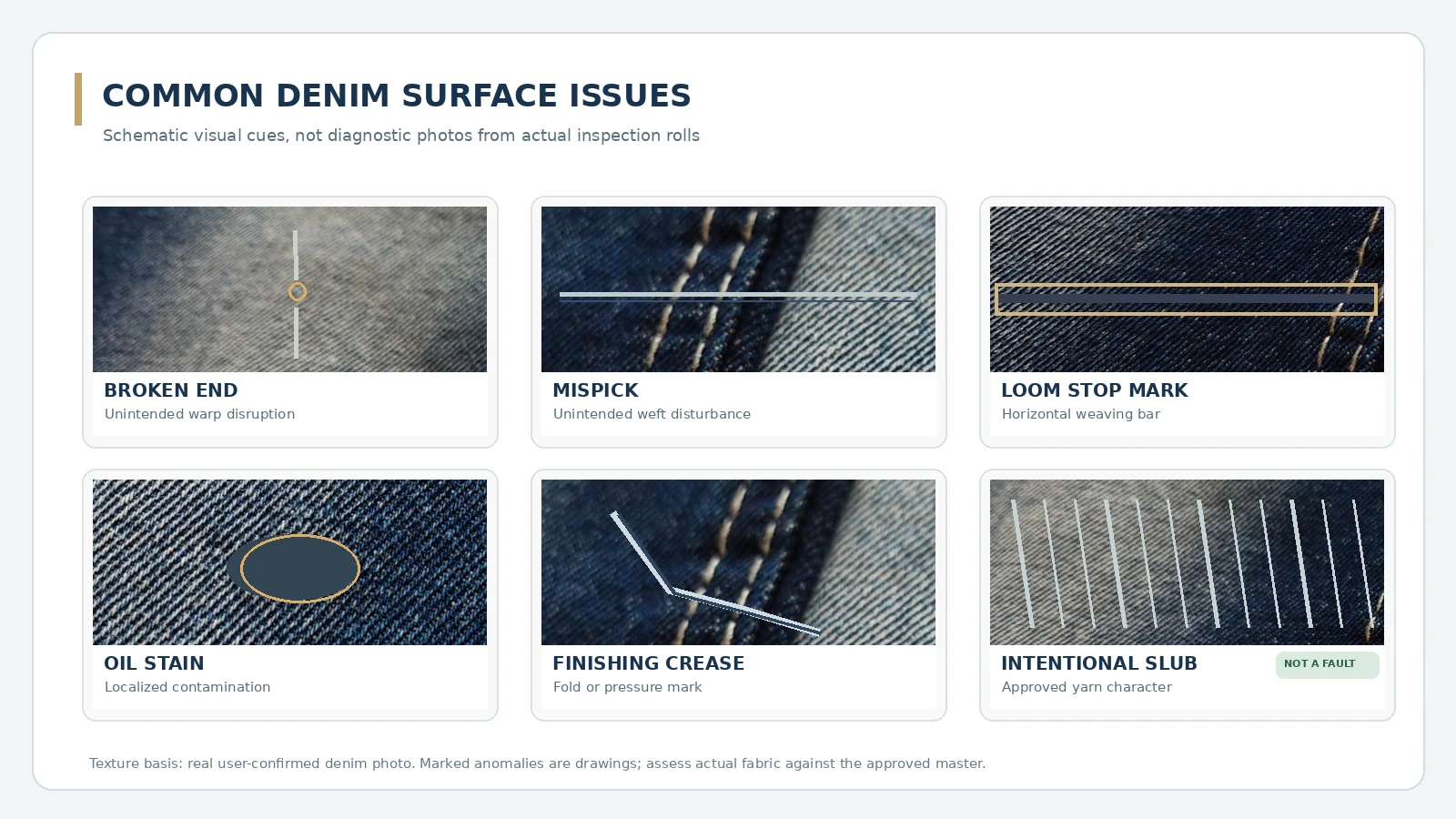
Denim combines a visible twill structure with dyed warp yarns, so inspectors need to understand both weaving faults and finishing defects.
1. Broken End / Missing Warp
A broken warp yarn may produce a vertical defect along the fabric.
Its appearance and length should be recorded, particularly if it affects a prominent garment panel.
2. Broken Pick / Mispick
A missing, incorrect or irregular weft insertion can leave a horizontal disturbance in the weave.
Some defects are visible immediately, while others become more noticeable after washing.
3. Loom Stop Mark / Start-Up Bar
A loom stop or restart can create a horizontal bar caused by a change in weaving conditions.
For a clean dark-rinse jean, even a subtle repeating bar may be visually unacceptable.
4. Coarse Pick, Nep and Intentional Slub
This distinction is important when inspecting textured denim.
A deliberate slub pattern is part of the approved fabric design and should not automatically be counted as a defect.
Unexpected thick yarns, contamination, loose knots or other abnormalities must be assessed against the approved master sample.
5. Oil Stain / Rust Stain
Oil or rust contamination can produce localized discoloration.
The cutting room should not assume that garment washing will remove such marks.
6. Sanforizing Crease / Dye Streak / Pinholes
Creases from finishing, dye streaks and tenter pinholes can affect garment appearance or usable width.
The inspector should record whether the fault extends into the approved cutting area.
For fabric buyers, the main lesson is to distinguish intentional denim character from unwanted production faults.
5. Why a Passing Score Does Not Mean the Roll Is Ready for Cutting
A roll can have a low visual-defect score and still cause expensive problems.
Before cutting, five additional areas deserve attention.
Roll-to-Roll Shade Variation
Two rolls may receive the same defect score while producing different shades after garment washing.
For significant indigo programs, factories should evaluate roll-to-roll compatibility and assign appropriate shade groups.
Shade differences are not eliminated by a low four-point score.
Center-to-Selvedge Variation (CSV)
Inspect the left, center and right areas of the fabric for unacceptable color differences.
Severe side-to-center variation may require a smaller usable width or a hold decision.
Actual Cuttable Width
Compare the measured usable width with the cutting marker’s requirements.
A roll can appear clean but still be unsuitable if the usable width is insufficient.
Measurements should be taken at the positions required by the inspection SOP, especially if width variation is suspected.
Weight, Bow and Skew
Confirm that the fabric matches the approved weight and construction.
Where relevant, evaluate bow and skew because these can affect pattern placement and finished seam appearance.
Shrinkage and Stretch Recovery
The intended garment wash must be considered before final approval.
For rigid denim, dimensional stability is a major concern. For stretch denim, growth and recovery also influence garment fit.
These checks require relevant testing or approved technical evidence; they are not established by four-point visual inspection alone.
6. How to Read a Denim Roll Inspection and Release Log
An effective inspection report combines defect results with cutting-relevant information.
The following record is an illustrative example.
| Roll | Inspected Length | Cuttable Width | 4-Point Score / 100 sq yd | Shade / Width Result | Decision |
|---|---|---|---|---|---|
| R001 | 95yd | 178cm | 11.5 | Band A, width pass | Release |
| R002 | 102yd | 177cm | 18.2 | Band B, width pass | Segregate |
| R003 | 88yd | 171cm | 8.4 | Band A, width short | Hold |
| R004 | 90yd | 178cm | 46.0 | Shade issue, high points | Hold / review |
Assume this production marker requires at least 176cm of cuttable width.
Roll R003 has the lowest visual-defect score, but it is only 171cm wide. It cannot be used with the existing marker without revising the cutting plan.
Roll R002 may be acceptable for cutting, but its Band B shade must be kept separate from incompatible Band A material.
Roll R004 requires review under the agreed defect and shade criteria.
The cutting manager needs both the numerical score and the disposition instruction.
7. Six-Step Pre-Cutting Inspection SOP
Step 1: Verify the Shipment
Compare the packing list with physical roll labels.
Confirm the fabric style, color, dye lot, roll count, length and declared width.
Resolve unidentified or inconsistent rolls before releasing them.
Step 2: Determine Inspection Coverage
Follow the buyer’s approved sampling plan.
Some factories use sampling inspections; higher-risk orders may require inspection of every roll.
A fixed 10–20% sample should not be described as a universal requirement. Inspection coverage depends on the quality agreement, lot history and production risk.
Step 3: Inspect and Record Defects
Run the fabric through the inspection frame under the agreed viewing conditions.
Identify defects, measure relevant dimensions, assign the applicable points and record locations.
Use clear fault markers so the cutting department can identify sections requiring avoidance or splicing.
Step 4: Confirm Width and Shade
Measure the usable width and inspect shade consistency.
Record roll-level information rather than relying solely on the supplier’s nominal specifications.
Where required, organize representative swatches and review the intended wash response.
Step 5: Check Dimensional Requirements
Confirm required technical results for fabric weight, shrinkage, bow, skew and stretch performance.
If the relevant test information is missing or does not represent the intended garment wash, keep the approval open until the required evaluation is completed.
Step 6: Release, Segregate, Hold or Reject
Communicate the final disposition to the cutting department.
Approved rolls should retain their style, lot, shade and usable-width identification.
Segregated rolls must remain within the intended production group. Held or rejected rolls should be physically identified so they cannot be spread accidentally.
This is where inspection becomes useful: the report changes the factory’s cutting decisions.
8. What Denim Buyers Should Request From Suppliers
A purchase specification should state more than the fabric weight and color.
For projects requiring incoming inspection, buyers should request the available roll details and agree on the quality method before shipment.
A useful enquiry is:
We are sourcing denim fabric for a jeans production program. Please confirm the fabric specifications, available roll and dye-lot information, nominal and usable width, and any existing inspection records. Our factory uses a four-point visual grading procedure. We will share our required point limit and other acceptance criteria, including shade consistency and dimensional stability, before bulk approval. Please also confirm whether swatches or sample yardage are available from the proposed stock.
This wording lets both parties establish what is already documented and which additional checks are required.
It is more useful than simply asking whether the denim is “first quality.”
Frequently Asked Questions
What is the maximum score per linear yard in the four-point system?
A commonly used four-point method caps the combined penalties within one linear yard or meter at four points. Apply the version and scoring option agreed for the inspection program.
Does every hole automatically receive four points?
Not under every published inspection procedure. Hole scoring can vary with the method and buyer manual. The applicable rule should be agreed before inspection.
How do you convert points per 100 square yards to points per 100 square meters?
Multiply the square-yard result by approximately 1.196. For example, 40 points per 100 square yards equals about 47.84 points per 100 square meters.
Is 40 points per 100 square yards acceptable?
It is a commonly used commercial limit, but the buyer may specify a different threshold. Shade, width and other requirements still apply separately.
Does passing a four-point inspection guarantee the fabric is ready for cutting?
No. The factory must also confirm that the material satisfies the relevant width, shade, dimensional and technical specifications.
Final Thoughts: Four-Point Inspection Is a Release Decision, Not Just a Score
The four-point system helps garment factories record visible defects and compare fabric rolls consistently.
But a low defect score cannot compensate for incorrect usable width, incompatible shade groups or unacceptable shrinkage.
For reliable jeans production, the factory should combine defect grading with the technical information needed for cutting and garment washing.
Inspect the roll → Record defects → Check width and shade → Verify required tests → Release or hold.
Browse the ZLDENIM Fabric Catalog to compare available denim constructions.
For sampling, visit ZLDENIM Samples. If your project has specific inspection limits, color requirements or usable-width targets, send those details through our Denim Sourcing page.
ZLDENIM can help check appropriate materials through its available stock and sourcing network. Current roll quantities, inspection documentation and additional testing arrangements are confirmed for each order.