
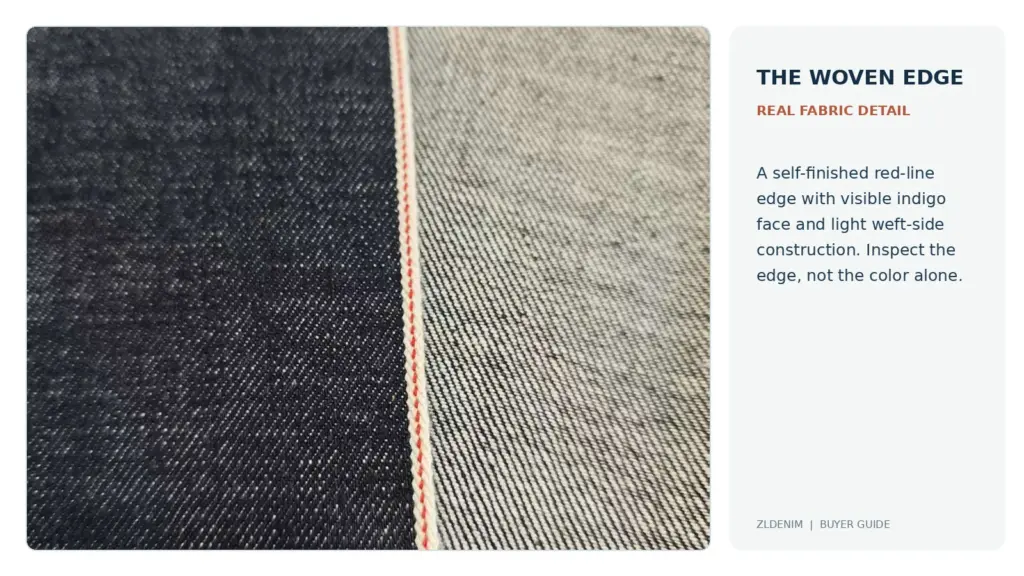
Two denim suppliers show a buyer fabric with a red line running along the edge. Both call it red selvedge denim. One costs substantially more, and both say their fabric is premium. Which one should a clothing brand choose?
The red line alone cannot answer that question. Red selvedge is a construction and design detail, not a guarantee of fabric quality, color consistency, shrinkage or garment performance. For denim buyers, the real decision involves the woven edge, yarn and fabric construction, usable width, wash behavior and final cost per garment.
Here are seven checks to make before approving red selvedge denim fabric for a jeans collection.
1. Check Whether the Red Selvedge Is a Genuine Woven Edge
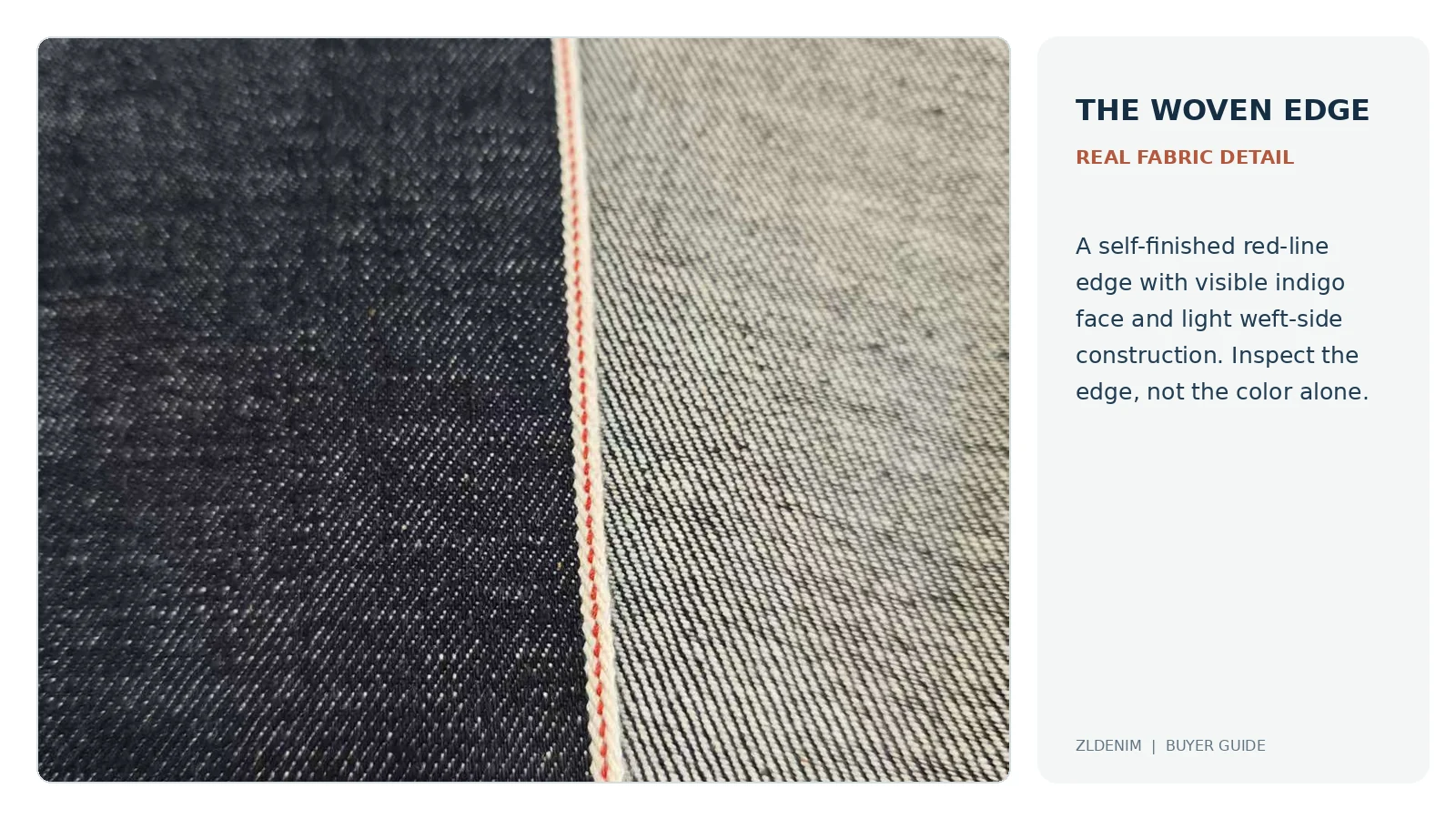
Traditional selvedge denim is usually made on shuttle looms. The weft carries across the warp and returns at the edge, creating a self-finished woven border. The colored identification line—often red, but sometimes another color—is called the selvedge ID.
Unfold the sample and inspect the face, reverse and both edges. A genuine woven selvedge is structurally part of the cloth, not just a decorative colored strip attached to an ordinary cut edge. If a brand is paying specifically for shuttle-loom production, ask the supplier for details about weaving and origin. A red line does not, by itself, prove that the fabric was made in Japan, produced on a vintage loom or woven to a particular quality standard.
The buyer should approve what matters to the garment: edge construction, appearance, width and finish. Those are measurable or visually verifiable characteristics; a vague claim of “premium redline” is not.
2. Calculate the Cost of Narrow-Width Selvedge Denim
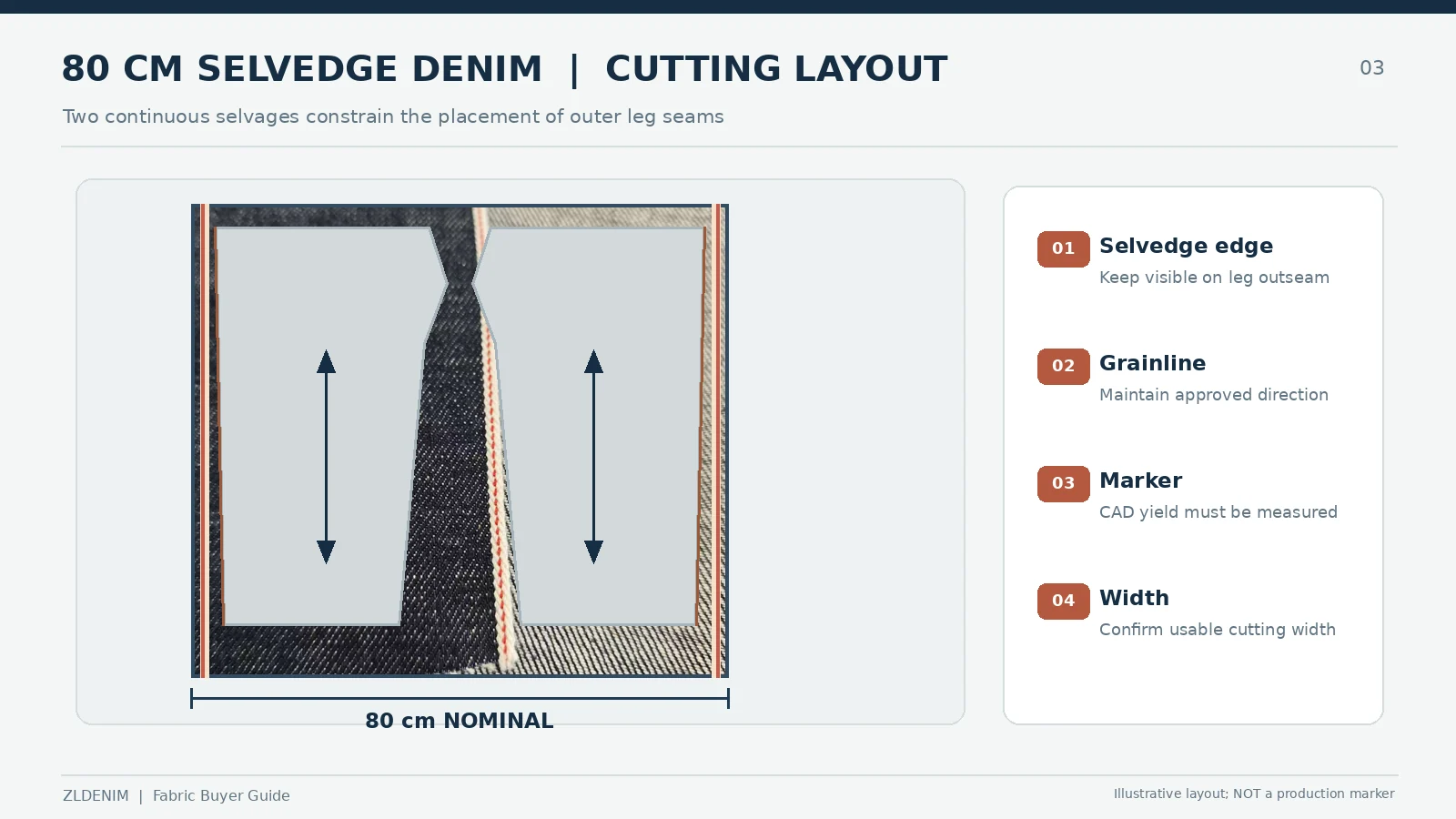
A major difference between traditional selvedge and conventional wide-width denim is fabric width. Narrow shuttle-loom goods may require more linear meters per pair of jeans, even before accounting for the higher price per meter.
A traditional five-pocket pattern needs two front legs, two back legs, yokes, waistband, pocket pieces and other components. If the design calls for the woven selvedge to remain visible down the outside seam, the leg panels must be placed against the edges. That limits the pattern maker’s freedom to nest pieces across the marker.
Fabric Cost per Pair = Price per Linear Meter × Marker Consumption per Pair
Do not estimate the cost by dividing fabric widths. Use a CAD marker with the actual graded jeans pattern, approved grainlines and desired selvedge placement. A carefully constructed narrow-width marker may still be the right design choice, but the price needs to reflect its true fabric consumption. See our Denim Fabric Width & Garment Cost Guide for the broader calculation method.
3. Check the Fabric Body, Not Just the Edge
Two fabrics with identical red selvedges may behave very differently after cutting and washing. Inspect the actual construction independently from the decorative edge.
| Specification | Why It Matters to Buyers |
|---|---|
| Weight in oz/yd² and GSM | Affects garment mass, structure and seam bulk |
| Fiber composition | Influences care, handfeel and performance |
| Warp and weft yarn | Helps explain texture and visual grain |
| Weave and twill direction | Influences appearance and distortion behavior |
| Slub or crosshatch pattern | Must match the approved vintage aesthetic |
| Handfeel and finishing | Affects comfort and washed drape |
| Usable cutting width | Determines layout options and fabric yield |
| Wash and shrinkage performance | Informs pattern allowances and finished measurements |
A 14oz rigid, crosshatch denim will not sew or drape like a smooth 12oz denim merely because both have a red line. Ask for a full specification and a representative cutting before deciding.
4. Product Example: H7302 Red Selvedge Denim
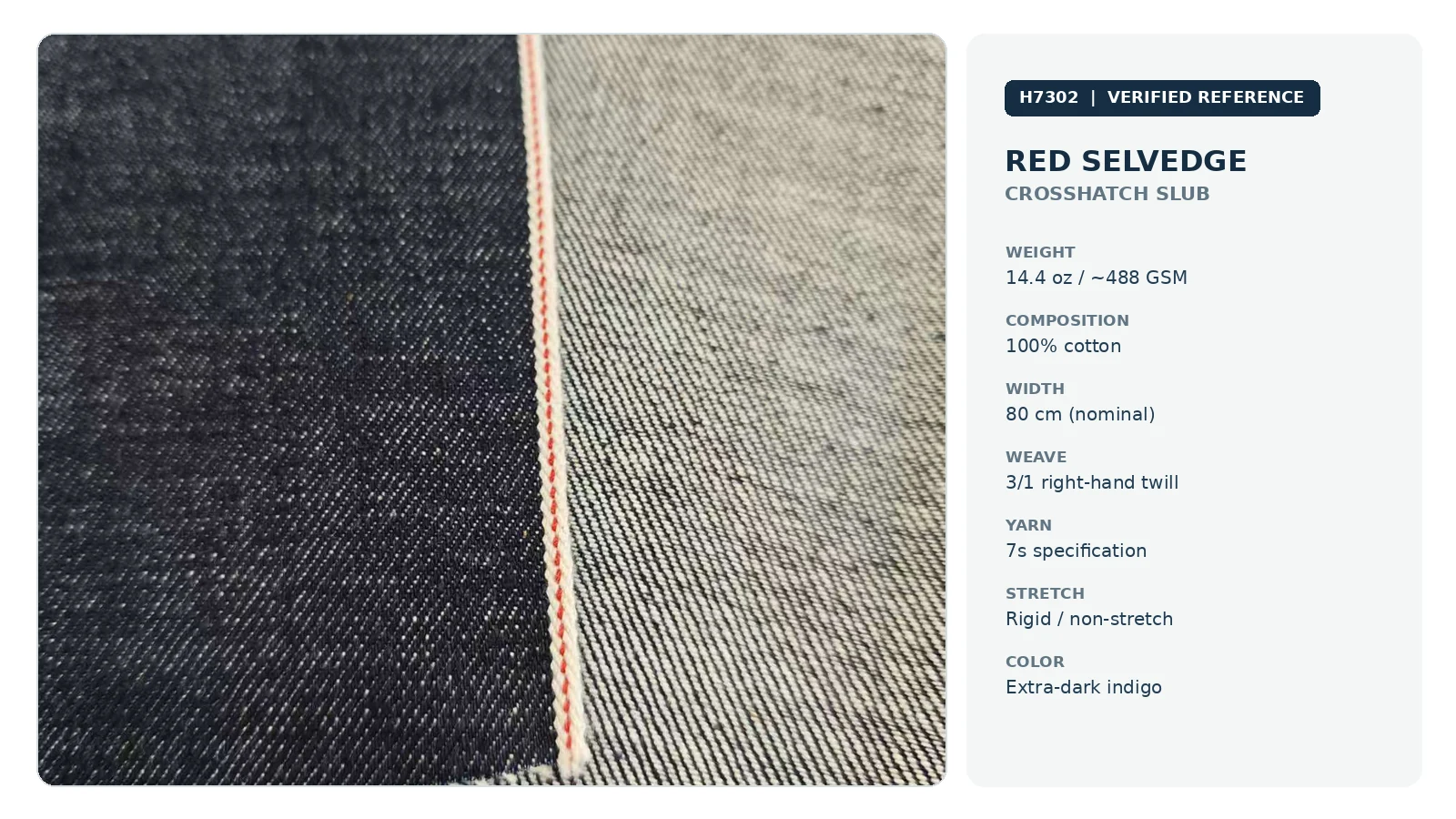
ZLDENIM’s H7302 product-preparation record is an example of the specification detail a buyer should review. The recorded details are:
| Specification | H7302 Reference |
|---|---|
| Fabric type | Red selvedge crosshatch slub denim |
| Weight | 14.4oz / approximately 488 GSM |
| Composition | 100% cotton |
| Width | 80cm / approximately 31.5 inches |
| Construction | 3/1 right-hand twill; 7s yarn specification |
| Surface | Warp-and-weft slub / crosshatch |
| Stretch | Rigid / non-stretch |
| Color | Extra-dark indigo |
| Handfeel | Firm and structured |
| Reported warp / weft shrinkage | 3% / 2% in the product reference |
H7302 is worth evaluating for structured heritage jeans and workwear-inspired trousers where a visible woven selvedge is part of the design. Its narrow 80cm width is important to the cutting plan, particularly when the outer leg seams must display the selvedge line.
The reported 3% warp and 2% weft shrinkage values are reference specifications, not a promise that every garment-washing recipe will reproduce those numbers. Ask for the relevant test conditions, actual lot and a wash trial before setting bulk pattern allowances. Current H7302 availability, usable width, pricing and sampling must be confirmed by inquiry.
5. Distinguish Selvedge From Sanforization
Selvedge describes the woven edge. Sanforization describes a dimensional-stabilizing finish. They are separate specifications. A selvedge fabric may be sanforized or unsanforized, and their expected behavior after the first wash can differ substantially.
For any red selvedge order, ask whether the product has been sanforized, what warp and weft shrinkage data are available and which test or wash conditions produced the data. If the garment will receive enzyme washing, stone washing or a heavy vintage finish, validate its dimensions under that intended process. A hand swatch alone cannot establish the correct jeans pattern allowance.
Also discuss leg twist. Some heritage buyers accept seam movement as part of raw-denim character; brands developing a clean commercial jean may require a more controlled finished seam position. The specification should reflect the desired product, not a blanket assumption that all traditional denim behaves identically.
6. Make the Actual Jeans Before Approving Bulk Fabric
A distinctive woven edge can be attractive on a hanger yet difficult to incorporate into a well-fitting garment. Cut a sample in the proposed style and check the selvedge position at the outseam and cuff. For heavily tapered patterns, confirm whether the edge can remain visible without compromising the intended shape.
After washing, evaluate waist, hip, inseam and hem measurements, twisting, surface color, abrasion character and sewing bulk. Heavy fabric may build thickness around the fly, waistband, pockets and folded hems; the production team must confirm its equipment and seam construction are suitable. A factory sample is far more informative than an untouched roll edge.
7. Verify Dye Lot, Quantity and Reorder Feasibility
Before committing to a brand launch, check the actual supply plan. How many meters are available? Are the rolls in one dye lot? Can the current quantity cover cutting loss and possible replacement panels? What happens if the collection sells and another order is needed?
A matching red-line edge and style number do not guarantee that a later dye lot will match the first in shade, handfeel or wash performance. Keep an approved master sample and establish how follow-up lots will be reviewed. This is particularly important for small heritage collections, where the visual identity of the fabric is central to the product.
A Useful Red Selvedge Denim Sourcing Request
We are developing men’s heritage straight-leg jeans in extra-dark indigo red selvedge denim. Our target is approximately 14oz with a structured rigid handfeel, visible woven selvedge on the outside seam and a vintage wash. Please confirm whether H7302 or an equivalent construction is available, including usable width, lot quantity, finishing, shrinkage data and sample options.
Providing the jeans pattern or a side-view reference will make the sourcing discussion more productive than asking only for “premium redline denim.”
Frequently Asked Questions
Is red selvedge denim always better quality?
No. The edge is a construction feature. Yarn, weaving, finishing, color consistency and garment performance determine whether a particular fabric suits an order.
Does red selvedge denim have to come from Japan?
No. Selvedge denim can be woven in different countries. If origin matters, request evidence for the specific lot.
Why can selvedge denim cost more per pair of jeans?
Narrow-width weaving and edge-placement requirements can reduce cutting yield. The fabric price, weight, production scale and finishing also affect cost.
Is selvedge denim always unsanforized?
No. Woven-edge construction and sanforization are independent properties.
What is H7302 suitable for?
Its recorded 14.4oz, 100% cotton, firm, narrow-width construction makes it a potential choice for heritage-style jeans and workwear, subject to garment and wash approval.
Source Red Selvedge Denim With ZLDENIM
A red line is a starting detail, not the end of the buying decision. Check the full construction, usable width, cutting yield, washed dimensions and availability before approving a garment program.
Explore our Selvedge Denim collection and Fabric Catalog. If you want to evaluate H7302 or a similar construction, send your specifications through ZLDENIM Sourcing. We can check current stock or suitable sourcing alternatives and confirm applicable sampling and order arrangements.