
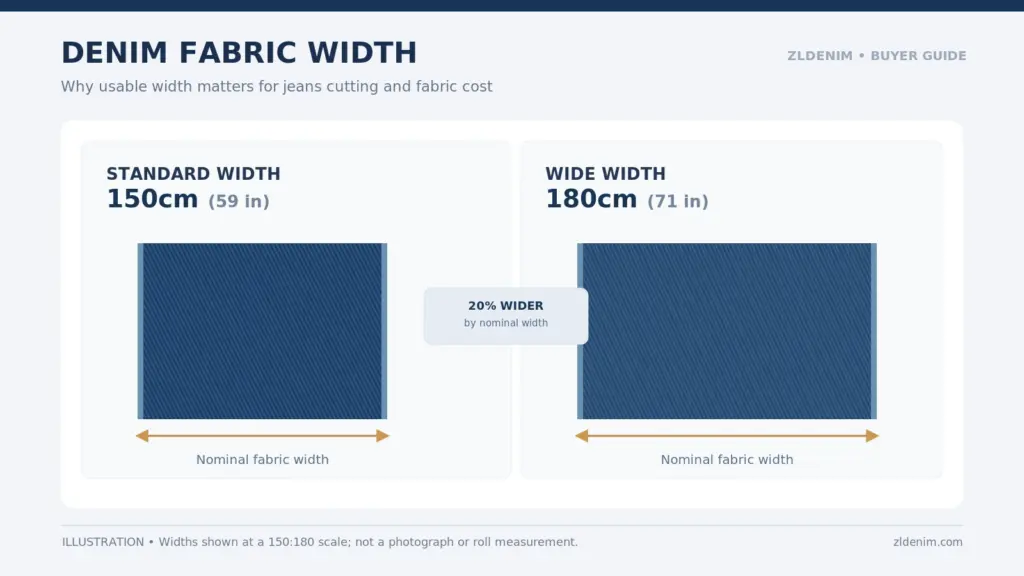
Imagine comparing two denim fabrics with similar weights and constructions.
One is 150cm (approximately 59 inches) wide. The other is 180cm (approximately 71 inches) wide.
The 150cm fabric costs $4.60 per meter, while the 180cm fabric costs $5.20.
Which one actually costs less per finished pair of jeans?
At first glance, the narrower fabric looks like the better deal. But once the pattern maker completes the cutting layout, the answer can change. The wider fabric may use fewer linear meters per garment, offsetting its higher price.
A cheaper price per meter does not always mean a cheaper pair of jeans.
For clothing brands, garment factories and sourcing teams, the important numbers are usable fabric width, marker efficiency and actual fabric consumption. Here’s how to compare them before placing an order.
Three Things Buyers Should Remember
- Buy by usable width, not just nominal width. A roll labeled 150cm may offer less space for cutting once the unusable edges are excluded.
- Compare fabric cost per garment. The wider option only saves money when its reduced consumption offsets its higher meter price.
- Check stretch denim after relaxation. Width measured under tension may differ from the width available during cutting.
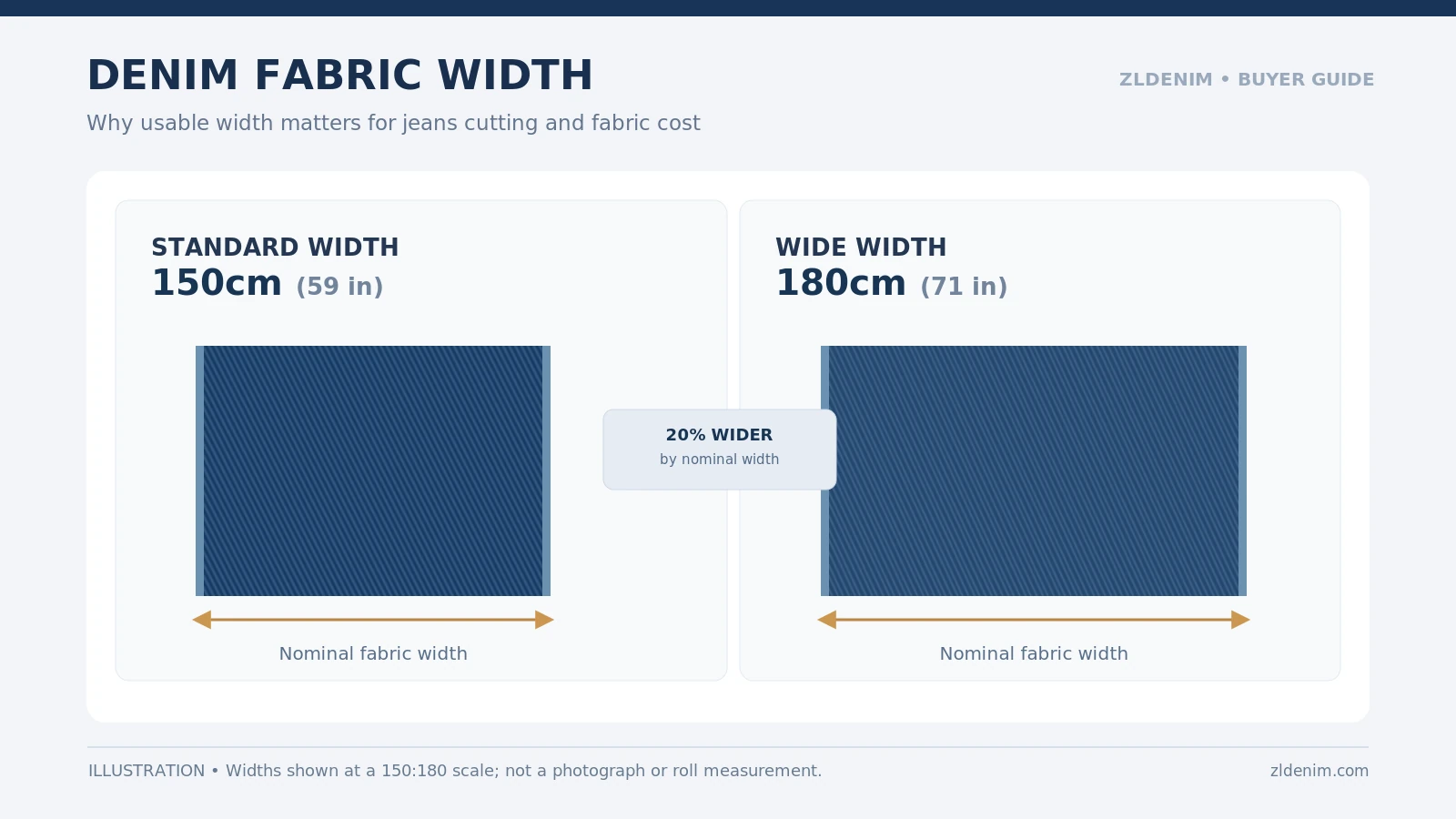
1. Nominal Width vs Usable Width: What Are You Actually Buying?
When a supplier quotes 150cm (59″) or 180cm (71″) denim, the first question should be whether that number represents the full width or the usable cutting width.
Nominal width is the stated commercial width of the fabric. Usable width, also called cuttable width, is the width available for laying out garment pattern pieces.
These measurements are not always identical.
Where Does the Width Go?
Several production details can reduce the cuttable area:
Selvedges and tenter pinholes. Depending on the weaving and finishing process, fabric edges may contain selvedges, pin marks or areas unsuitable for visible garment panels.
Edge curling and relaxation. Stretch denim can behave differently after being unwound and laid without excessive tension. If the fabric contracts or curls at the edges, the cutting room may have less usable width than the roll initially appeared to provide.
Side-to-center shading. Indigo shade variation across the width can make certain edge areas unsuitable for matching prominent garment panels. Buyers should check the actual shade difference rather than apply a fixed exclusion to every fabric.
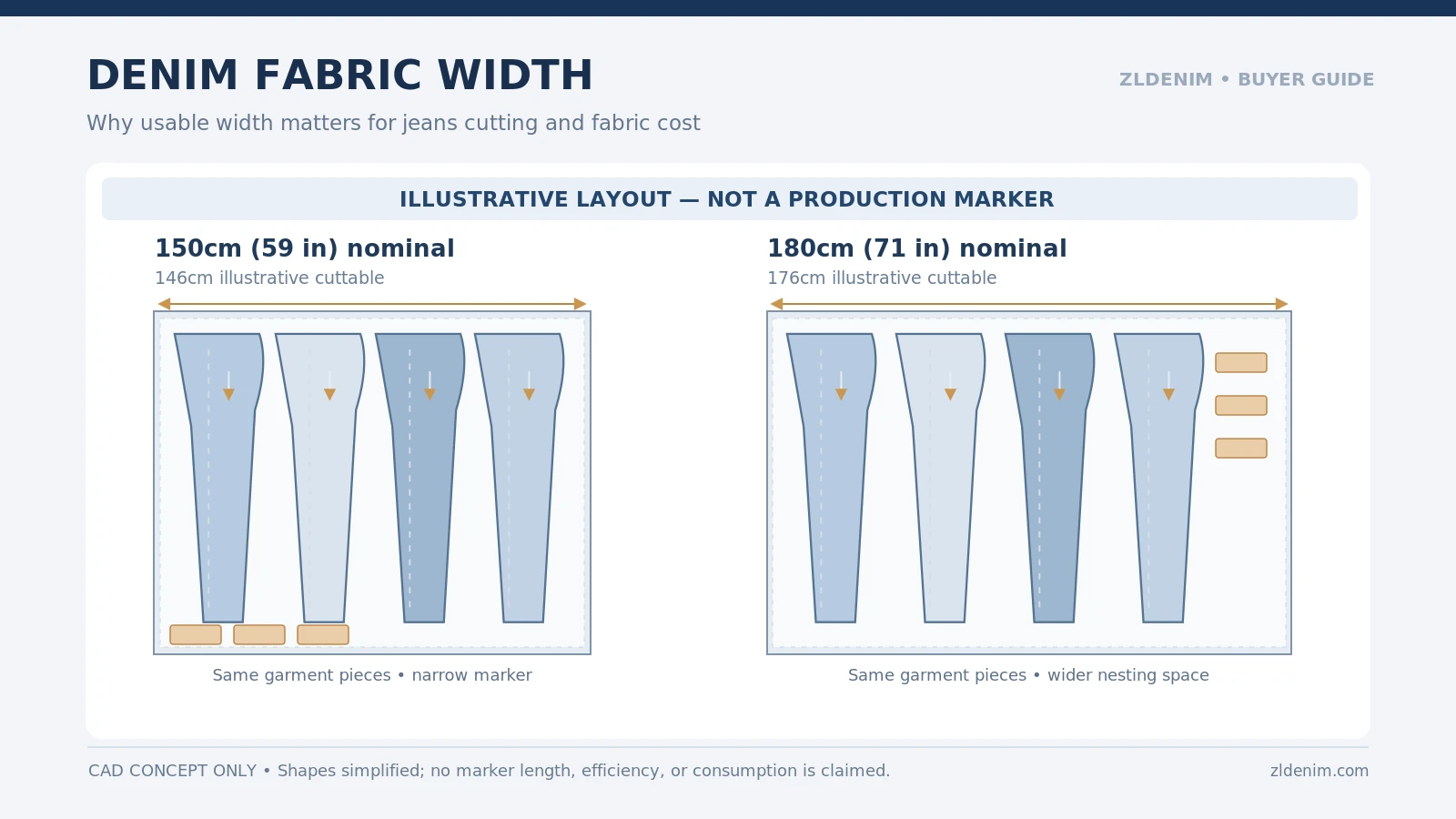
For example, a nominal 150cm fabric might offer 146cm of cuttable width, while a nominal 180cm fabric might offer 176cm. Those figures are useful for illustrating the calculation; the production values must come from the supplied rolls.
Why Two Centimeters Can Matter
Suppose a cutting marker requires 148cm of usable width, but the incoming fabric provides only 146cm.
The original layout no longer fits.
The pattern maker may have to rearrange the leg panels, change the nesting or extend the marker length. That can increase consumption even though the difference in width seems small.
This is especially important with wide leg panels, where a minor width reduction can force a different arrangement.
Before finalizing the price, confirm the minimum usable width that the cutting department can actually work with.
2. Why Wider Denim Does Not Automatically Save Money
A wider fabric creates more horizontal space for pattern pieces, but extra space only reduces consumption when those pieces fit together efficiently.
This is where CAD marker efficiency becomes important.
How Marker Efficiency Works
A marker is the arrangement of front legs, back legs, waistbands, yokes, pockets and other garment components across the fabric.
Marker Efficiency (%) = Total Pattern Piece Area ÷ Total Marker Area × 100
A higher percentage means the pattern pieces occupy more of the available marker area.
However, width alone does not determine that percentage.
The actual result depends on the jeans silhouette, graded size ratio, grainline restrictions and whether fabric appearance requires one-way cutting.
A slim jean and a barrel-leg jean do not use the same pattern layout. Even for the same garment, changing the size ratio can produce a different marker result.
Why Grain Direction Matters
Denim pattern pieces cannot always be rotated freely to fill empty spaces.
The grainline must follow the garment’s technical requirements, while twill direction, slub appearance and shade variation can impose additional placement restrictions.
If a cutting room changes the direction of a prominent panel merely to improve efficiency, the finished garment may show unwanted appearance differences or distortion.
For that reason, a valid comparison requires two CAD markers prepared with the same pattern, size ratio and cutting restrictions.
An efficient 150cm marker may sometimes outperform a poorly arranged 180cm marker. The garment pattern decides how useful the additional width really is.
3. How to Calculate Denim Fabric Cost Per Pair of Jeans
To compare two widths properly, convert the quotation into fabric cost per finished garment.
Two calculations are enough to get started:
Consumption per Pair = Total Marker Length ÷ Number of Pairs in the Marker
Fabric Cost per Pair = Price per Linear Meter × Consumption per Pair
The marker length already accounts for the spaces between pattern pieces. Do not subtract marker efficiency a second time.
Example: 150cm vs 180cm Denim for 5,000 Jeans
Consider a hypothetical order of 5,000 pairs of straight-leg jeans. Two fabrics have comparable weight and performance, but different widths and prices.
The following figures illustrate a costing method rather than actual factory marker results.
| Costing Item | 150cm (59″) Denim | 180cm (71″) Denim | Difference |
|---|---|---|---|
| Nominal width | 150cm | 180cm | +30cm |
| Assumed usable width | 146cm | 176cm | +30cm |
| Price per meter | $4.60 | $5.20 | +$0.60 |
| Assumed consumption per pair | 1.50m | 1.25m | −0.25m |
| Fabric cost per pair | $6.90 | $6.50 | −$0.40 |
| Total for 5,000 pairs | $34,500 | $32,500 | −$2,000 |
The result is interesting.
The wider fabric costs $0.60 more per meter, yet its assumed cutting layout uses 0.25m less fabric per pair.
Across the full order, that produces a $2,000 saving in the base fabric calculation.
In this example, the difference in linear consumption is approximately 16.7%. It is a result of the assumed marker lengths, not a standard saving that can be applied to every jeans style.
Finding the Break-Even Price
Now suppose the 180cm supplier raises the price to $5.60 per meter.
At 1.25m per pair, its fabric cost becomes $7.00—higher than the 150cm option’s $6.90.
The break-even price is:
Break-Even Price = $6.90 ÷ 1.25m = $5.52 per meter
At $5.52 per meter, both options produce the same base fabric cost per pair under this example’s assumptions.
Above that price, the 180cm option loses its cost advantage unless some other production benefit offsets the difference.
This is the number a buyer can take back into price negotiations.
The final purchase quantity must still account for the factory’s actual spreading losses, defects, shrinkage allowances and other production requirements.
4. Real ZLDENIM Examples: 170cm vs 180cm Medium-Stretch Denim
Width differences become more interesting when buyers compare real fabrics.
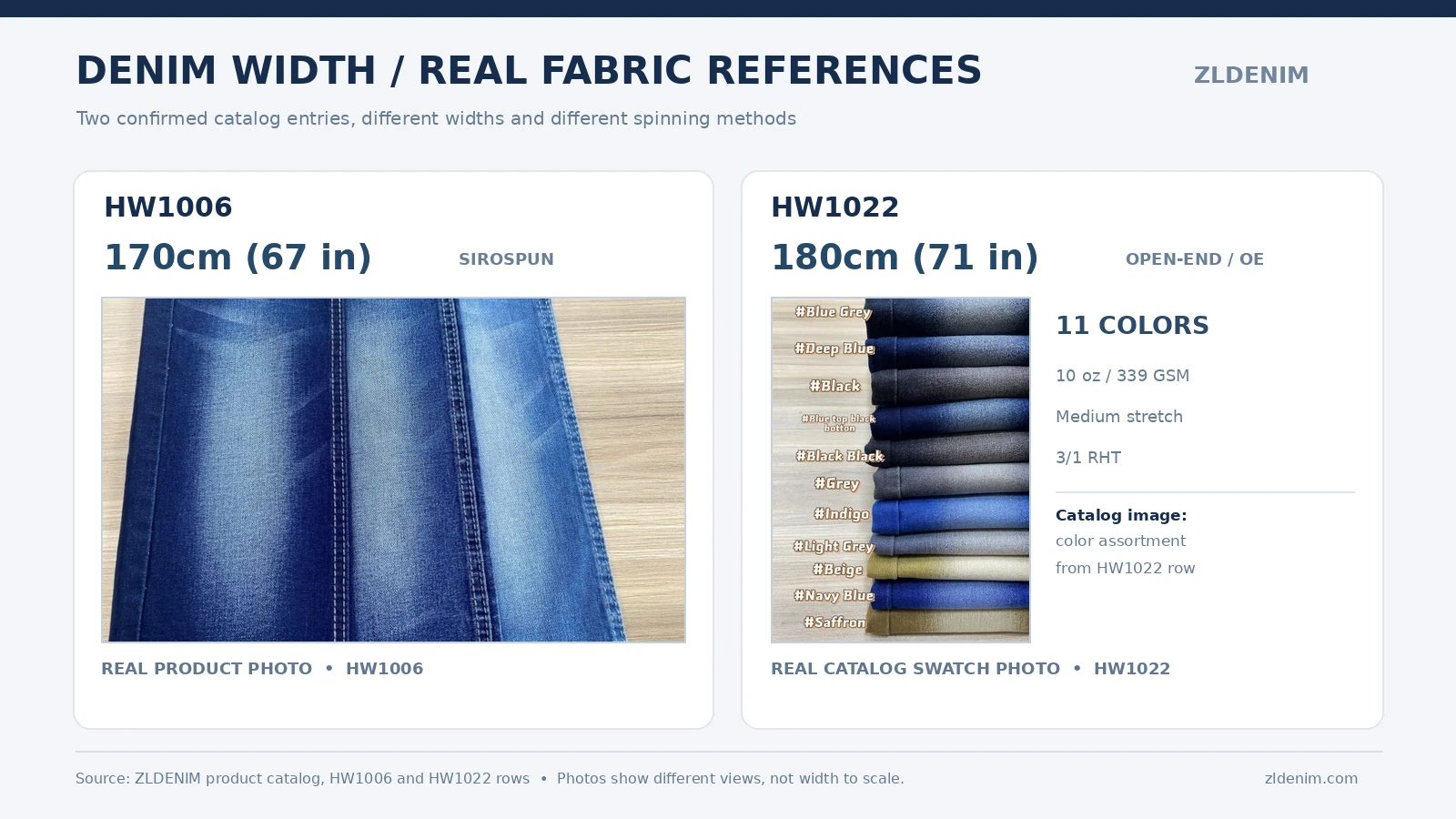
ZLDENIM lists two 10oz medium-stretch constructions that provide a useful example: HW1006 at 170cm and HW1022 at 180cm.
| Specification | HW1006 — Sirospun | HW1022 — Open-End |
|---|---|---|
| Listed width | 170cm (67″) | 180cm (71″) |
| Weight | 10oz / 339 GSM | 10oz / 339 GSM |
| Composition | 65% Cotton / 33.5% Polyester / 1.5% Spandex | 65% Cotton / 33.5% Polyester / 1.5% Spandex |
| Stretch | Medium | Medium |
| Weave | 3/1 Right-Hand Twill | 3/1 Right-Hand Twill |
| Yarn construction | Sirospun | Open-End |
| Surface character | Cleaner twill appearance | Fuller, more textured appearance |
The HW1006 10oz Sirospun Denim is aimed at buyers looking for a cleaner surface and more defined twill appearance.
The HW1022 10oz Open-End Denim offers a different yarn character with a fuller, more textured appearance suited to selected vintage-style garment developments.
Although the two fabrics share the same listed weight, composition and basic weave, they are not identical fabrics manufactured at different widths.
Their yarn constructions and surface characters differ, so any final garment-cost comparison must account for those differences as well as width.
Stretch Denim Needs an Extra Width Check
There is another important detail: both fabrics contain 1.5% spandex.
When preparing cutting markers for stretch denim, the factory should check how the fabric behaves after unwinding, relaxation and spreading.
Three points deserve particular attention.
Relaxed width. The usable width should be measured under the cutting room’s approved relaxation and spreading conditions, not simply assumed from a width measured while the fabric is under tension. Relaxation time and dimensional change depend on the fabric and the factory’s validated procedure.
Weft shrinkage and recovery. If the garment-washing process causes widthwise shrinkage, pattern allowances may need adjustment. This can change the space needed for pattern pieces and therefore the marker yield.
Side-to-center shade consistency. A wide nominal width provides little benefit if the outer areas cannot be used for visible garment panels because of unacceptable shade variation.
For HW1006 and HW1022, buyers should therefore compare their actual usable widths, cutting markers and washed garment results before deciding which offers the better total cost.
5. Six Questions to Ask Before Placing a Denim Order
Before committing to a bulk fabric purchase, make sure your supplier and cutting room can answer these six questions.
- What is the minimum usable width? Confirm the width available after excluding unsuitable edges and inspect width variation between rolls.
- Has the factory run separate CAD markers? Use the actual jeans pattern, graded sizes, size ratio and cutting restrictions for each fabric width.
- What happens after relaxation and washing? For stretch denim, check relaxed cuttable width, warp and weft shrinkage, stretch recovery and final garment measurements.
- Is the quotation per meter, yard or kilogram? One meter equals approximately 1.094 yards. At the same GSM, one linear meter of 180cm fabric contains 20% more area and mass than one linear meter of 150cm fabric.
- Are the widths consistent across production lots? The cutting plan must accommodate the actual usable widths delivered, not only the supplier’s nominal specification.
- Have production losses been included? Spreading ends, fabric defects, splices and roll remnants can increase the quantity required beyond the theoretical CAD consumption.
When these details are confirmed, price comparisons become much more meaningful.
Frequently Asked Questions
What is the standard width of denim fabric?
There is no single universal denim width. Many commercial denims are offered around 150cm (59″), while wider options around 170cm (67″) and 180cm (71″) are also available. Narrow shuttle-loom selvedge fabrics form a different category. Always confirm the actual width of the selected product.
How many meters of 150cm vs 180cm denim are needed for one pair of jeans?
There is no fixed consumption figure based on width alone. In the hypothetical example above, the 150cm fabric uses 1.50m per pair and the 180cm fabric uses 1.25m. Actual consumption depends on the garment pattern, size mix, cuttable width and CAD marker layout.
Why is usable denim width narrower than full width?
Usable width excludes areas that cannot safely be used for garment panels. Depending on the fabric, these may include selvedges, tenter pinholes, curled edges or areas with unacceptable shading. The cutting room should verify the minimum usable width after appropriate preparation.
Final Thoughts: Compare Cost per Garment, Not Price per Meter
A 150cm fabric can be cheaper per meter but more expensive per finished pair of jeans.
A 180cm fabric can cost more per meter and still deliver a lower garment cost—provided the cutting layout uses the additional width efficiently.
The practical decision follows four steps:
Confirm cuttable width → Run the CAD marker → Calculate consumption → Compare fabric cost per pair.
You can explore different weights, constructions and listed widths in the ZLDENIM Fabrics Catalog.
If you need swatches or sample yardage for garment development, visit our Samples page. Availability and sampling arrangements are confirmed for the selected fabric.
Looking for a specific width or construction? Send your target weight, composition, stretch requirement, usable width and quantity through our Denim Sourcing page.
ZLDENIM can help identify suitable fabrics through available stock and its sourcing network, with current specifications and quotations confirmed during the inquiry process.
Pingback: Red Selvedge Denim Fabric: 7 Checks Before Buying