
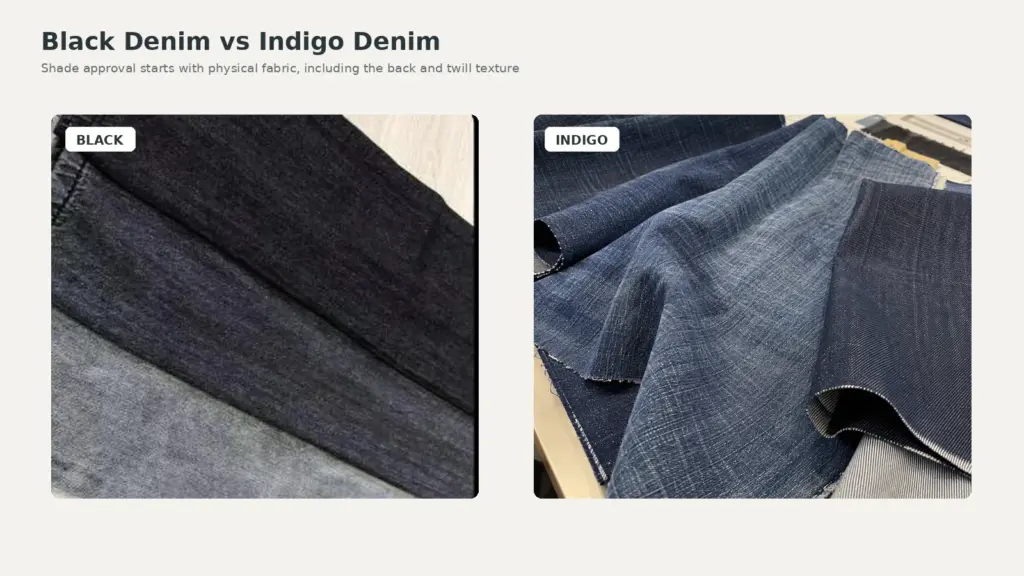
Two jeans leave the washing line after the same abrasion trial.
The indigo pair develops bright blue highlights with a lighter core showing at the worn areas. The black pair moves toward charcoal—but not necessarily at the same speed or with the same contrast.
Both are denim. Both may be woven from cotton. Why do their wash results look so different?
The answer is not simply blue versus black. It often lies in which dye was used, how it was applied to the yarn, and what the washing process was designed to remove.
For fabric buyers, understanding black denim vs indigo denim is essential when the target garment needs a particular fade, deep shade, wash-down or long-term appearance.
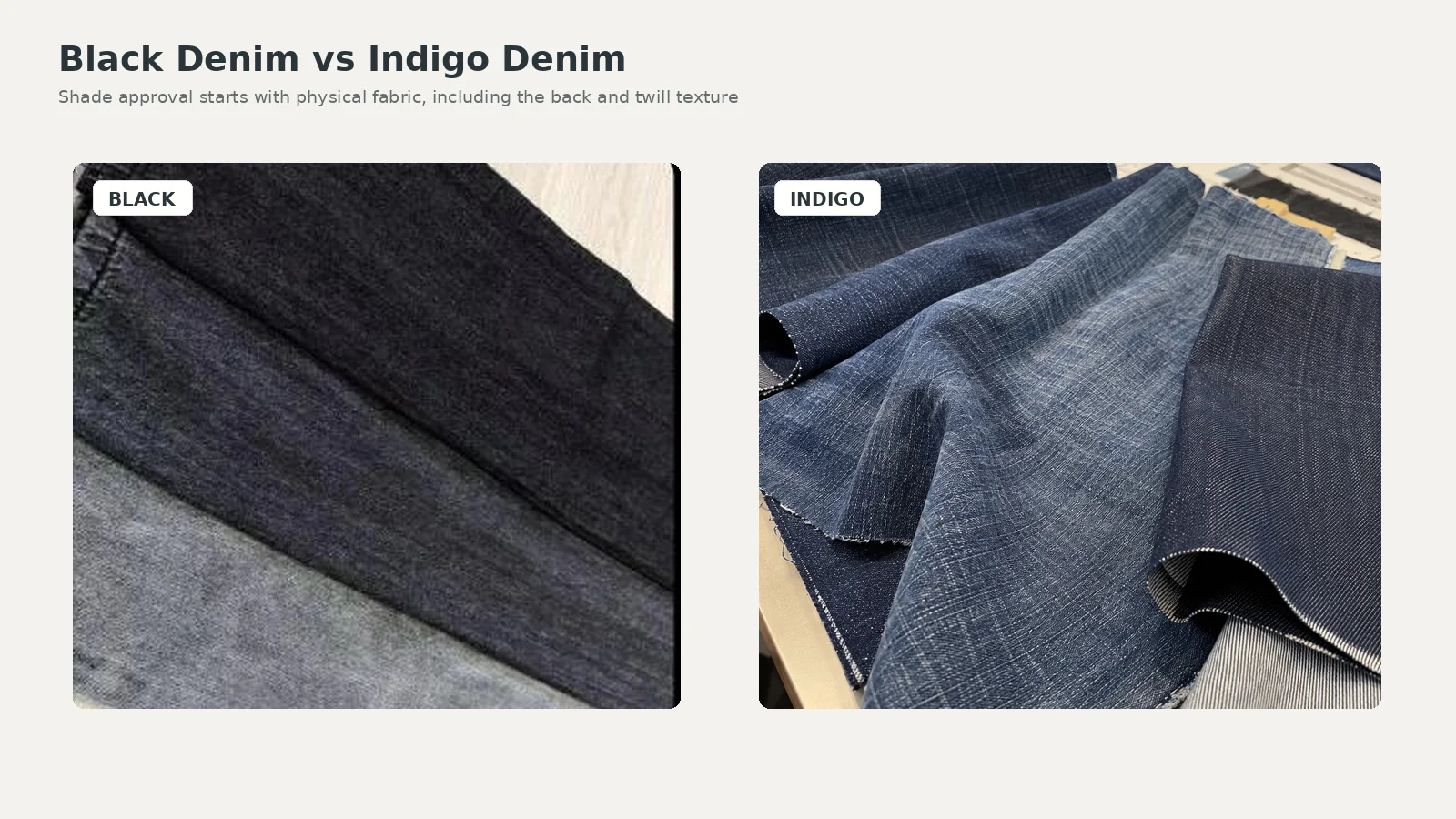
Indigo Denim and Black Denim Are Not Defined by Color Alone
Traditional indigo denim commonly has indigo-dyed warp yarns and lighter weft yarns. The indigo dye is generally concentrated toward the outer portion of the yarn. Abrasion can remove some of that surface color and reveal lighter material underneath.
Black denim describes an appearance, not one mandatory dye chemistry. Deep black cotton denim often uses sulfur dyes, but black can also involve other dye systems, overdyeing or different warp/weft combinations.
Before you order, confirm at least three things:
- The dye system: indigo, sulfur black, another dye, or a combination.
- The fabric face and back: black face/light back, dark face/dark back, indigo face/light back or an overdyed appearance.
- The desired final wash: dark retention, subtle aging, charcoal fade or strong high-low abrasion.
Two fabrics with similar initial shades can produce markedly different garments after the same wash recipe.
How Indigo Denim Gets Its Color
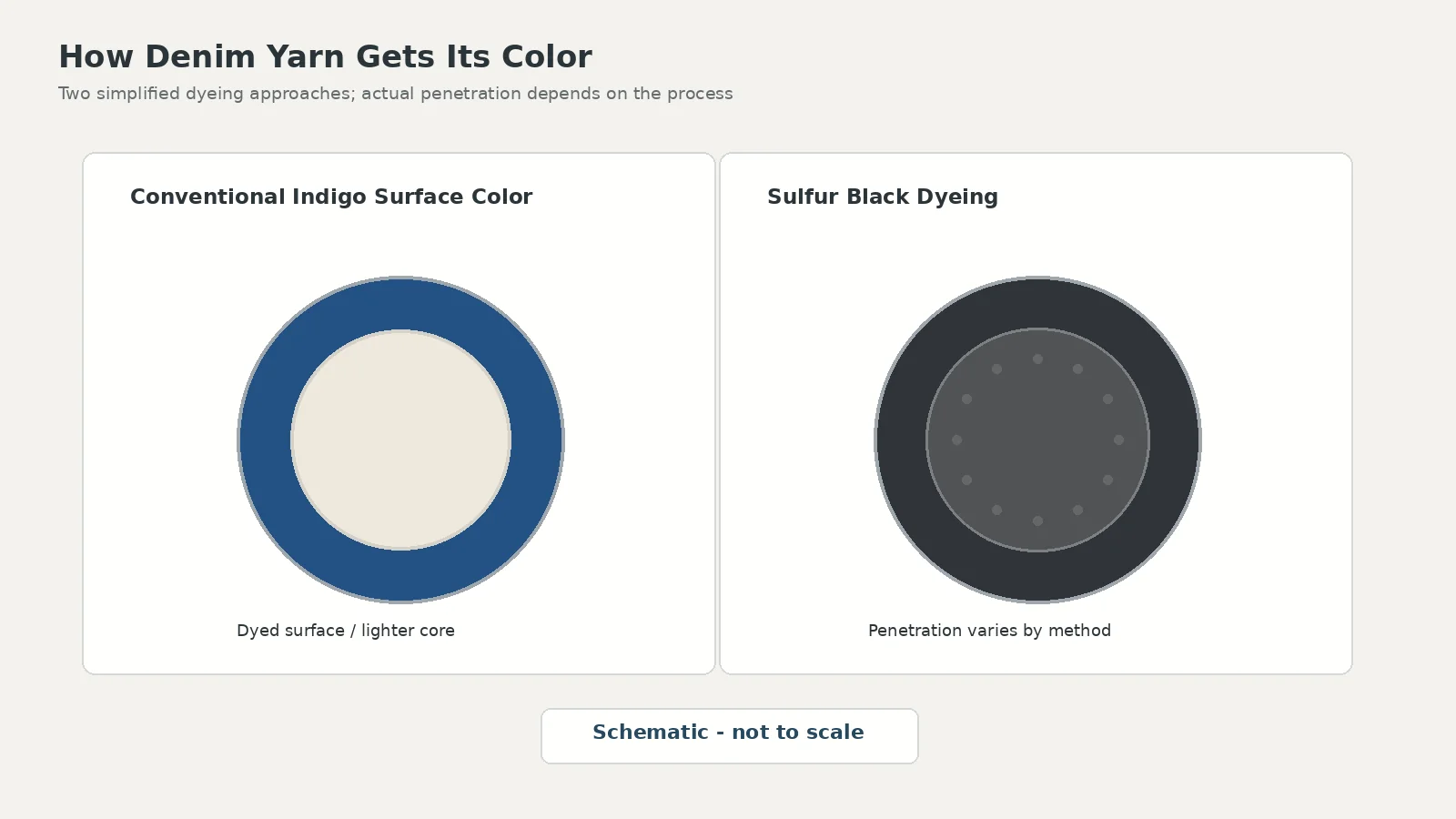
Indigo is a vat dye. In conventional yarn dyeing, it is reduced to a soluble form, applied to cotton yarn and then exposed to oxygen to return to its insoluble colored state. Multiple application and oxidation stages can build a deeper shade.
The outer-layer coloring commonly associated with indigo denim is often called ring dyeing. A yarn can remain comparatively lighter inside than at the surface.
That matters because abrasion, sanding and garment washing can remove some surface indigo and create contrast between darker and lighter areas.
CottonWorks explains this process in its Denim Construction guide.
Does Indigo Always Fade the Same Way?
No. Dye depth, yarn structure, weave, abrasion and wash chemistry all affect the result. A deeply dyed compact denim will not necessarily fade like a lighter indigo slub construction.
Even when two fabrics use indigo, their finished wash appearance needs separate approval.
How Black Denim Gets Its Color
Sulfur black is an important route to deep black shades on cotton. Sulfur dyes are reduced for application and oxidized after dyeing. CottonWorks identifies sulfur dyes as a standard option for black, while also noting sensitivity to chlorine and the need to pay attention to rubbing fastness.
But sulfur black is not synonymous with every black denim fabric.
Depending on the intended effect, buyers may encounter:
- Black warp with lighter weft: a dark face with recognizable denim contrast on the reverse.
- Black-on-black appearance: a construction where both sides are relatively dark, through appropriate yarn/color choices or processes.
- Indigo overdyed black: a base denim followed by a black overdying treatment, creating a different visual development route.
- Specialty dark indigo: indigo combined with sulfur dyeing to deepen or alter the blue shade.
These are not guaranteed product specifications. Ask the supplier to explain the actual route for the fabric offered.
What Do Sulfur Bottom and Sulfur Top Mean?
These names normally arise when sulfur dyeing is combined with indigo yarn dyeing.
- Sulfur bottom: sulfur dye is applied before the indigo dye.
- Sulfur top: sulfur dye is applied after the indigo dye.
Both approaches can affect the depth and cast of dark indigo. They do not mean every pure black denim must have a sulfur top or bottom.
CottonWorks describes the distinction in its denim yarn dyeing overview.
Black vs Indigo Denim: Quick Buyer Comparison
| Buying Question | Indigo Denim | Black Denim |
|---|---|---|
| Typical color direction | Blue, from lighter indigo to deep navy | Clean black, dark black, charcoal or washed black |
| Common dye route | Indigo yarn dyeing | Often sulfur black; other routes are possible |
| Fade direction | May develop blue-to-light contrast under abrasion | May develop grey/charcoal contrast or remain relatively dark, depending on chemistry |
| Yarn core and penetration | Conventional indigo often emphasizes outer yarn color | Depends strongly on dye chemistry and construction |
| Back appearance | Often lighter weft | May have light or dark back |
| Wet and dry crocking | Must be tested | Must be tested, especially for deep shades |
| Ozone and chlorine exposure | Specific recipes can alter indigo | Sulfur and other black systems may respond differently |
| Best first reference | Approved indigo shade and washed garment | Approved black shade, cast and desired wash-down |
This table describes possible directions—not laboratory performance grades. Neither color guarantees better durability, colorfastness or quality.
Washing: The Same Recipe Does Not Guarantee the Same Result
A denim wash is not just “light,” “medium” or “heavy.” It is a set of mechanical and chemical processes whose results depend on the fabric.
Indigo: Surface Contrast Is Part of the Design
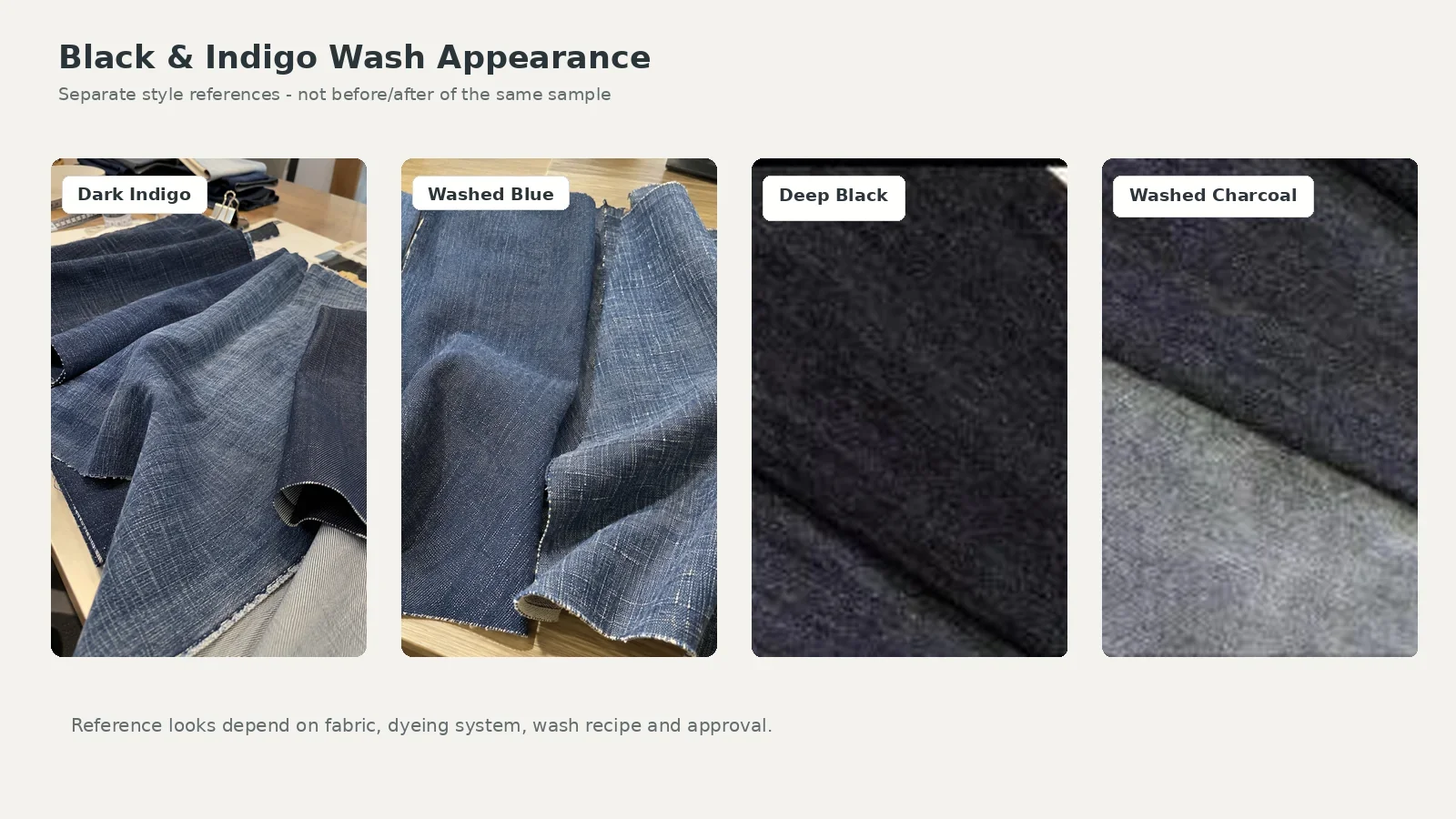
For many traditional blue jeans, designers deliberately use abrasion to expose lighter yarn areas. Enzyme washing, mechanical abrasion and other finishing methods can produce faded regions, seams and creases.
But aggressive treatment can also change shade, dimensional stability, hand and strength. Approve the finished garment—not just the original fabric color.
Black: Decide Whether It Should Fade or Stay Dark
Buyers often ask for “good black denim” without defining the desired wash result.
One brand wants a deep, clean black jean that remains dark-looking after normal laundering. Another wants vintage charcoal with strong seam abrasion. Both are legitimate directions, but they call for different material and finishing choices.
CottonWorks notes that sulfur black is sensitive to chlorine and may present rubbing-fastness challenges. That is a reason to test, not evidence that every black denim must fade badly.
Can Black Denim Develop Red, Brown or Grey Casts?
Different dye formulations and wash processes can shift a dark shade or reveal an undertone. The visual result should be confirmed from a washed physical sample under consistent lighting. Do not assume a black dye automatically creates a particular warm or cool cast after washing.
What About Ozone Finishing and Storage?
Ozone can change indigo and sulfur shades; CottonWorks discusses both controlled ozone finishing and unwanted ozone fading during shipment or storage. If shade stability is critical, discuss exposure and appropriate tests with the washing factory and supplier.
For more about dyeing and finishing risks, see CottonWorks’ Denim Finishing guide.
Colorfastness: The Risk Hidden by a Deep Shade
A dark surface can look rich in a fabric swatch and still transfer color when rubbed against another textile.
Crocking is the transfer of color by rubbing. AATCC TM8 provides standardized dry and wet crocking methods using white test cloths.
For both indigo and black denim, ask for:
- dry rubbing fastness result;
- wet rubbing fastness result;
- the test method and acceptance requirement;
- results before and after the intended garment wash, if the specification calls for both stages.
Do not accept a blanket claim such as “fastness is good” without a method or grade. Do not invent a single minimum grade for every brand and market.
Why It Matters for Garments
Potential transfer surfaces include pale shirts, bags, shoes, light pocket linings, upholstered seats and other clothing. Transfer risk may change after washing or finishing.
For a black jeans collection worn with white trainers, wet and dry transfer can be a practical complaint source. For dark indigo jeans, the same question applies.
Does Dye Color Change Shrinkage or Stretch?
Not by itself in a simple, predictable way.
Shrinkage, skew and stretch performance depend on fiber composition, yarn, weaving, finishing and the garment wash. Indigo and black fabrics with otherwise similar specifications should still be evaluated independently.
If the jeans are fitted, check fabric extension, growth and recovery. If the fabric is rigid, focus on appropriate pattern ease and dimensional behavior after laundering.
Fabric weight must also be compared independently. A 10oz black stretch denim and a 14oz indigo rigid denim differ in more than color.
The Denim Fabric Weight Guide and Stretch Denim Fabric Guide provide the relevant selection framework.
Which Color Direction Suits Different Jeans Collections?
Treat the following as starting points for design development rather than rules about fiber or quality.
| Collection Goal | Direction Worth Sampling | Main Approval Question |
|---|---|---|
| Traditional blue jeans | Indigo warp-dyed denim | Does the washed garment develop the intended blue contrast? |
| Dark navy fashion jeans | Deep indigo or appropriate sulfur-combined indigo | Is the final cast and wash-down consistent? |
| Clean black slim jeans | Black denim with suitable stretch | Does it stay visually clean and retain fit after washing? |
| Vintage faded black jeans | Wash-down black construction | Does it reach the approved charcoal/grey appearance? |
| Contrast-cuff black styles | Black face with lighter back, if desired | Does the reverse meet the design requirement? |
| Workwear-inspired dark pants | Black or indigo in a suitable construction | Are the required strength, shrinkage and rubbing results acceptable? |
Do not make a color decision without testing the actual fabric with the intended wash.
A Six-Step Sampling Plan for Black and Indigo Denim
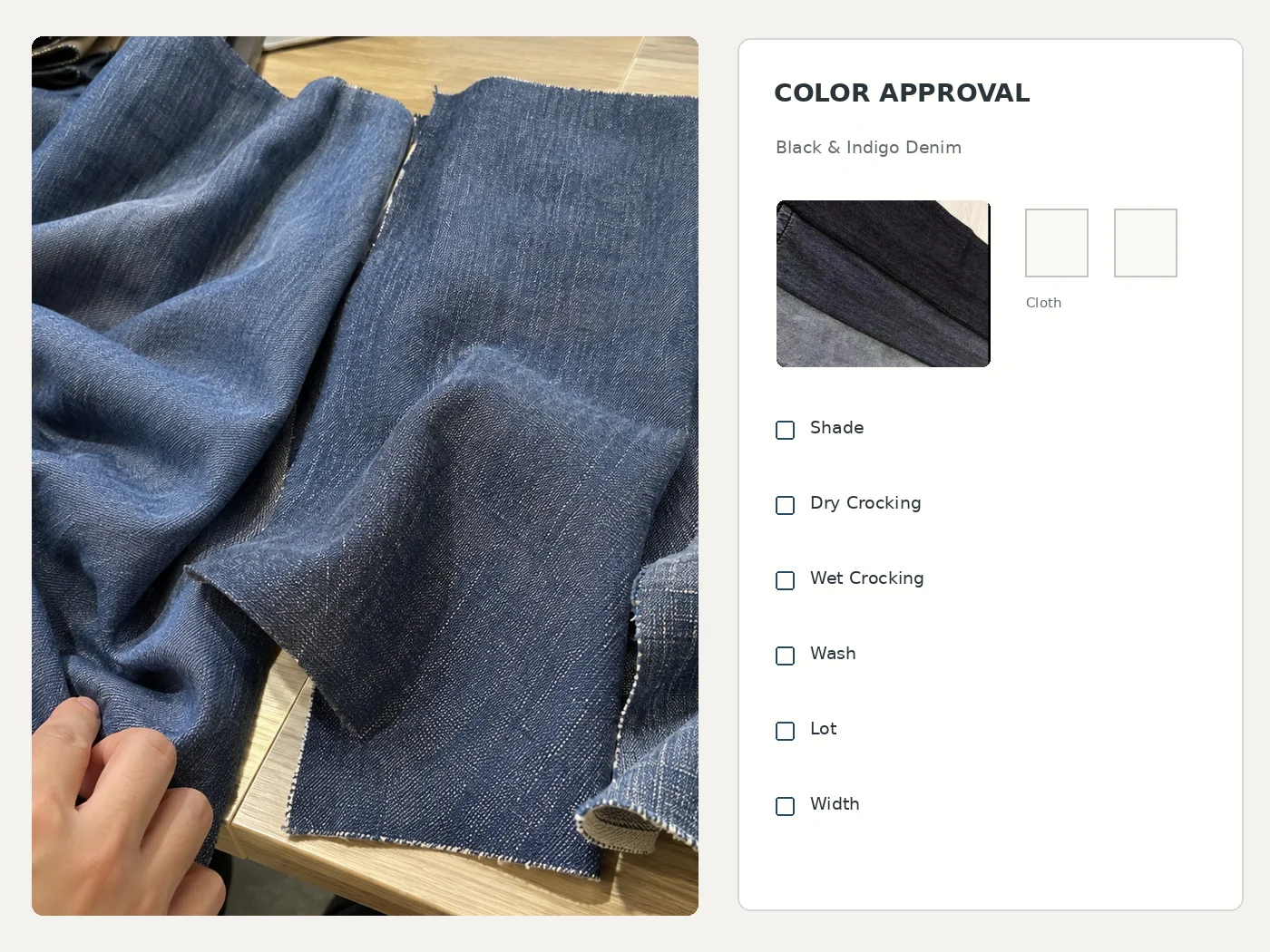
1. Approve the shade target. Share a physical garment or fabric reference where possible. Decide whether you want clean black, charcoal black, dark indigo or vintage blue.
2. Confirm the dye route. Ask what is known about indigo, sulfur, overdyeing, face/back color and any dye-process restrictions. Not all sourcing suppliers will have complete mill process records; distinguish confirmed details from assumptions.
3. Match base construction. Compare weight, composition, stretch and usable width. Avoid treating a dye difference as the only variable when the fabrics are structurally different.
4. Wash representative samples. Use the actual planned finish. Compare shade, abrasion, hand, dimensional change and relevant seam performance.
5. Check rubbing and care performance. Use specified test methods and brand acceptance requirements; pay particular attention to dark shade transfer and wash-down.
6. Confirm bulk lot consistency. Before cutting, compare roll-to-roll and lot-to-lot shades and, for important programs, compare left, center and right across the width. Current available quantity and lot identity should be reconfirmed.
Questions to Ask a Denim Fabric Supplier
If you only send “10oz black denim or 10oz blue denim?”, important questions remain unanswered.
A more useful inquiry might be:
We are developing men’s straight-leg jeans in two colors. We need approximately 11–12oz medium-firm denim. For blue, our target is dark indigo with a medium vintage wash. For black, our target is clean deep black with only limited wash-down. Please propose suitable fabrics and explain the known dye route and face/back appearance. Also share composition, usable width, available dry/wet crocking data, shrinkage, present quantity, sampling options and lot details. We can send finished-garment references.
This makes it clear that the two colors have different wash targets even if they share one silhouette.
To see available black constructions as examples, explore the ZLDENIM Black Denim Fabric category. Listed fabric specifications and stock must be confirmed at inquiry time.
Common Mistakes When Buying Black or Indigo Denim
Assuming Every Black Denim Is Sulfur-Dyed
Sulfur black is important, but black fabric can be produced through different routes. Confirm the particular fabric.
Expecting the Same Wash Formula to Make Matching Fades
Different color systems can require different wash development. Evaluate finished garments side by side.
Ignoring the Back of the Fabric
Dark face and light back may be desirable for rolled cuffs; a uniformly dark appearance may be better for another design. Inspect both sides.
Confusing Color Retention With Color Transfer
A shade may remain dark after laundering but still transfer under rubbing. Ask for the appropriate tests separately.
Approving Only a Phone Photograph
Black cast and indigo depth can appear different under lighting and displays. Approve critical colors with physical standards and consistent illumination.
FAQ: Black Denim vs Indigo Denim
Is black denim always sulfur dyed?
No. Sulfur black is widely used, but other dyeing and overdying approaches can create black denim. Verify the dye system of the proposed fabric.
Does black denim fade faster than indigo denim?
There is no universal answer. Dye chemistry, depth, yarn construction and laundering change the rate and appearance of fade.
Why does indigo denim develop contrasting fades?
Conventional indigo yarn dyeing often leaves more dye near the yarn exterior. Abrasion can remove surface color and expose lighter material beneath.
What is black-on-black denim?
It usually describes denim with a dark appearance on both face and back, but suppliers use the term differently. Confirm the actual yarn colors and physical swatch.
What is sulfur bottom versus sulfur top denim?
The terms refer to when sulfur dye is applied in relation to indigo during combined yarn dyeing: before indigo for sulfur bottom, after indigo for sulfur top.
Which is better for a vintage wash, black or indigo?
Both can support a vintage look, but the desired end shade is different. Indigo may be selected for blue contrast, while an appropriate wash-down black can produce a charcoal or grey direction.
Which color needs wet rubbing fastness testing?
Both. The requirement should be based on the garment, dye depth, target market and applicable brand standard.
Can black and indigo jeans use the same fabric weight?
Yes, weight and color are different properties. However, equal weight does not mean identical construction or wash performance.
Final Thoughts: Approve the Fade, Not Just the Shade
The two jeans in our opening example started as different colors and developed different wash appearances. That is not necessarily a problem. It becomes a problem when the buyer approves a raw shade without defining the finished result.
For indigo denim, ask how the desired blue contrast will develop. For black denim, decide whether the goal is dark retention or a controlled wash-down. For both, review physical shade standards, dry and wet crocking, wash tests and actual bulk consistency.
If you are sourcing black or indigo denim from China, send ZLDENIM the garment type, weight range, composition, stretch requirement, shade reference, wash target and estimated quantity. We can compare suitable stock or supplier-network options and confirm their specific availability before quotations or sampling. Contact ZLDENIM to share your brief.