
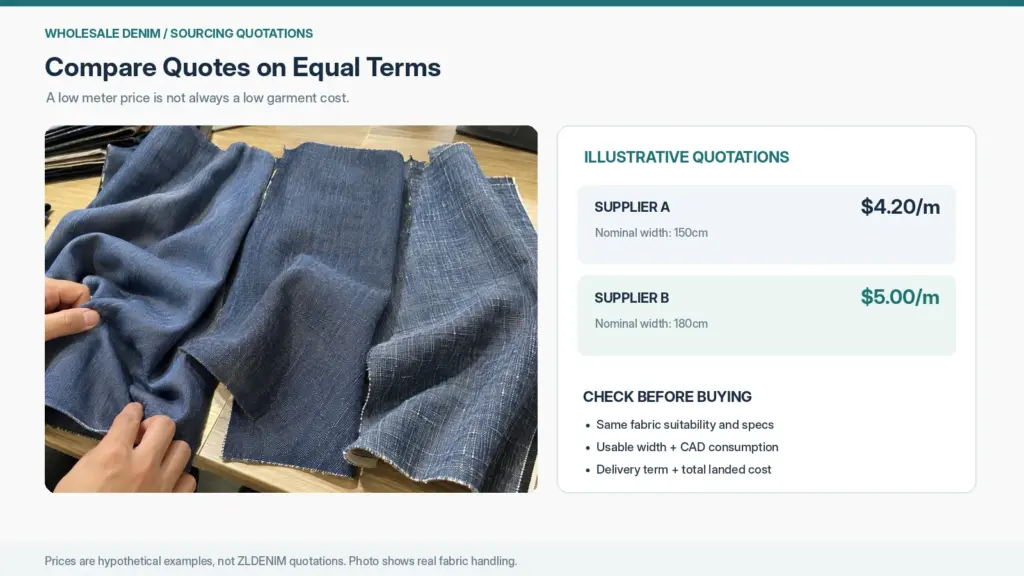
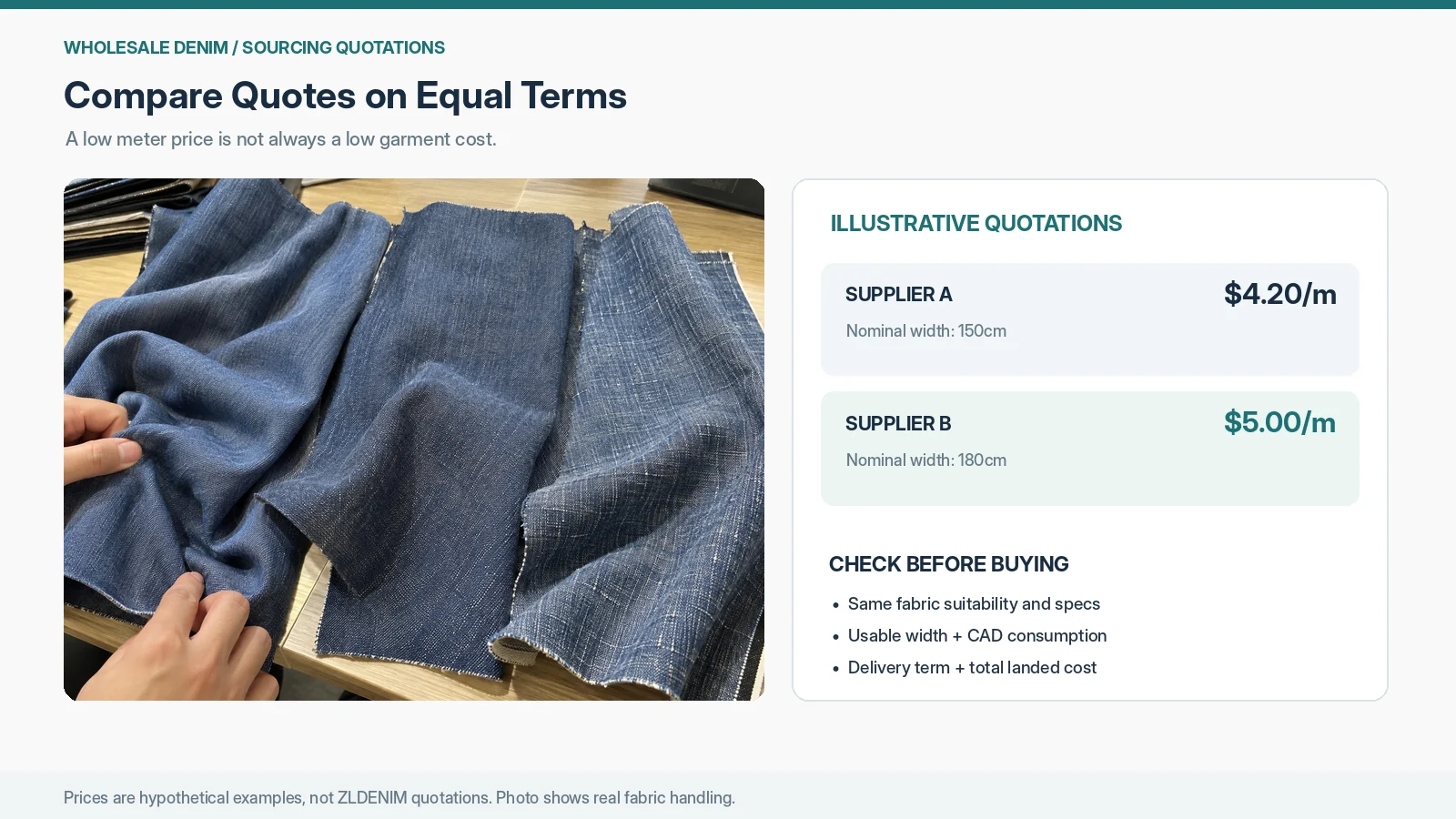
Supplier A quotes $4.20 per meter for denim fabric. Supplier B quotes $5.00 per meter. Both look suitable for the same jeans project. Which is cheaper?
Most buyers initially choose Supplier A. But what if the first fabric is 150cm wide and the second is 180cm? What if the narrow fabric consumes more linear meters per garment? What if one quotation excludes transportation or inspection costs included in the other?
The lowest wholesale denim fabric price per meter is not necessarily the lowest jeans production cost. For clothing brands, garment factories and sourcing teams, an accurate comparison needs more than a single unit price.
This guide shows how to normalize denim supplier quotations by specification, unit, usable width, cutting consumption, delivery terms and total purchasing cost. All sample prices in the calculations are hypothetical, not current ZLDENIM quotations.
1. Why Wholesale Denim Fabric Prices Vary
There is no single market price for wholesale denim. Two materials described as “12oz dark-blue denim” can have different manufacturing inputs, appearance and performance.
Fiber composition matters: a cotton-rich rigid fabric, cotton-polyester blend and cotton-elastane construction serve different requirements. Composition alone does not determine quality.
Yarn and weaving construction also matter: yarn count, spinning method, density, 3/1 versus 2/1 twill, slub and weave regularity influence the production process. Open-end and Sirospun yarns may yield different surface characters even at the same weight.
Dyeing and finishing matter: shade depth, dyeing route, finishing, shrinkage control and special treatments may affect production economics and the expected wash response.
Width, available quantity and production route matter: wide-width denim contains more fabric area per linear meter than a narrower fabric at equal GSM. Ready-stock material and a newly manufactured custom order may also have different cost structures, availability and terms.
2. Compare the Same Technical Specification First
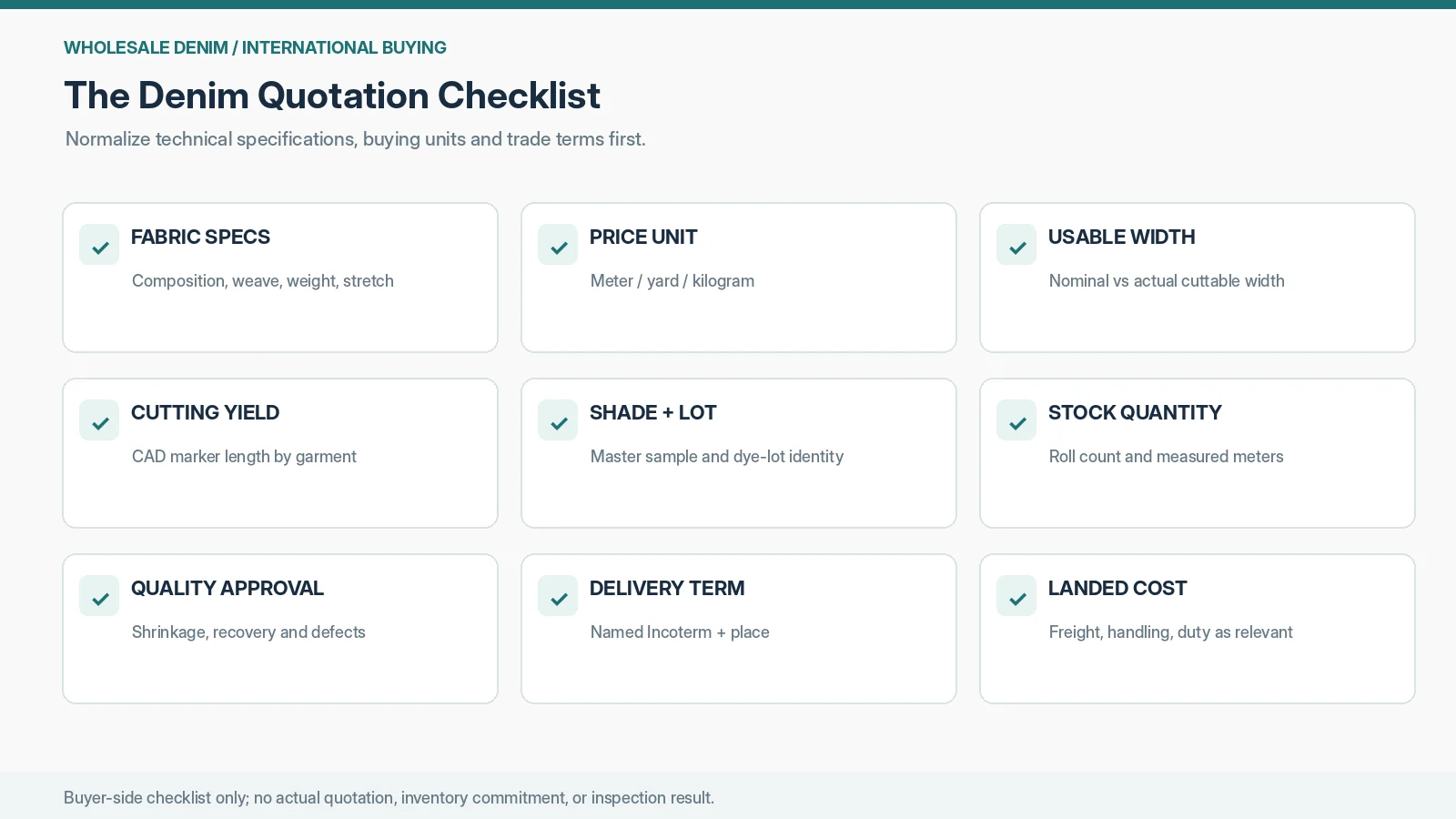
Before ranking prices, make sure both quotations can meet the garment design.
| Specification | Supplier A | Supplier B | Buyer question |
|---|---|---|---|
| Finished weight | 11oz | 11oz | Are measuring conditions equivalent? |
| Composition | Confirm | Confirm | Are blends interchangeable for the garment? |
| Stretch / recovery | Confirm | Confirm | Will fit performance match? |
| Usable width | Confirm | Confirm | Will CAD marker yield change? |
| Color and shade | Reference | Reference | Are washed results acceptable? |
| Shrinkage | Agreed method | Agreed method | Will pattern allowances differ? |
| Quantity / dye lots | Confirm | Confirm | Can the actual order be supplied? |
| Price unit | Meter / yard / kg | Meter / yard / kg | Are prices normalized? |
| Named delivery term | Confirm | Confirm | What costs are included? |
If Supplier A quotes rigid cotton denim and Supplier B quotes high-stretch denim, their prices should not be compared as equivalent offers. Technical suitability comes first. Keep approved physical swatches and a written specification as the reference for both suppliers.
3. Wholesale Denim Price per Meter vs per Yard
International suppliers may quote in meters or yards. They are different quantities.
1 yard = 0.9144 meter and 1 meter ≈ 1.09361 yards.
To convert a yard quotation into a meter quotation:
Price per Meter = Price per Yard × 1.09361
For example, a hypothetical price of $4.50 per yard is approximately $4.92 per meter. A $4.75-per-meter offer could therefore be cheaper than the $4.50-per-yard offer, assuming identical quality and conditions.
Confirm the invoice unit, measured roll quantities and whether the seller quotes an individual roll price or actual meters/yardage. Converting only the unit price without checking supplied quantity can still cause a misleading comparison.
4. How to Compare Quotations per Kilogram
Some textile suppliers quote fabric by weight. To compare a kilogram price with a linear-meter quotation, you need the correct finished weight and width.
Price per Linear Meter = Price per Kg × GSM ÷ 1,000 × Width in Meters
Suppose a fabric costs a hypothetical $8/kg, weighs 350 GSM and is 1.60m wide. Its calculated mass is 350 × 1.60 ÷ 1,000 = 0.56kg per linear meter. The equivalent price is $4.48 per meter.
This simple conversion assumes the quoted GSM and width represent the invoiced goods and that the seller’s kilograms refer to net fabric mass. Verify weighing, packaging and length measurement terms. Do not use the usable cutting width in a kilogram conversion if the invoice uses total full-width fabric mass; the width basis must match the commercial measurement.
5. Why Wider Denim Can Be Cheaper per Pair of Jeans
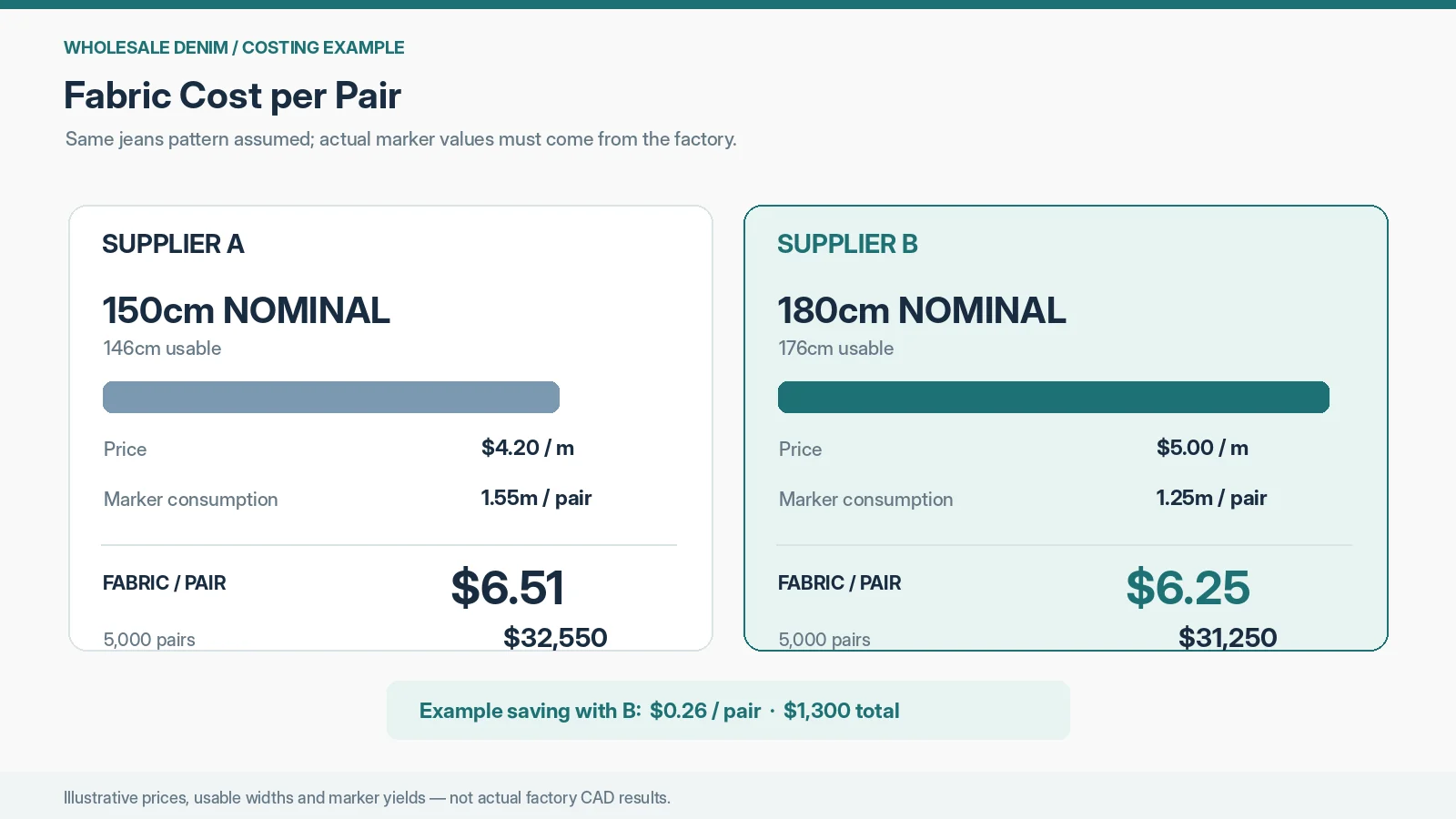
Now compare two hypothetical suppliers for an order of 5,000 pairs of straight-leg jeans.
| Costing item | Supplier A | Supplier B |
|---|---|---|
| Nominal width | 150cm | 180cm |
| Assumed usable width | 146cm | 176cm |
| Price per meter | $4.20 | $5.00 |
| Hypothetical marker consumption per pair | 1.55m | 1.25m |
| Fabric cost per pair | $6.51 | $6.25 |
| Fabric cost for 5,000 pairs | $32,550 | $31,250 |
The more expensive fabric costs $0.26 less per garment, or $1,300 less for this hypothetical order, because its assumed marker consumes less length. These figures are an illustration, not actual CAD results, a market quote or a standard saving percentage.
Find the Break-Even Meter Price
Supplier B breaks even at Supplier A’s $6.51 per pair divided by Supplier B’s 1.25m consumption:
$6.51 ÷ 1.25m = $5.208 per meter
Above approximately $5.21/m, the wider offer loses its base fabric-cost advantage under these assumptions. Production allowances and other differences may alter the real result.
6. Usable Width, Marker Efficiency and Cutting Waste
Nominal width is not always cuttable width. Selvedges, pin marks, curled edges and unacceptable side-to-center shade variation can reduce usable space. The actual cutting marker also depends on jeans style, graded sizes, grainlines and fabric face restrictions.
Fabric Cost per Pair = Quoted Price per Meter × Actual CAD Marker Consumption per Pair
Then add the agreed production allowances for roll ends, defects and spreading losses. Do not assume that a 20% wider fabric reduces every garment’s consumption by 20%. An accurate comparison uses separate CAD markers for the actual garment and each candidate material.
For an example of this calculation, see ZLDENIM Denim Fabric Width Guide.
7. Ready Stock and New Production Are Different Offers
Ready-stock denim has already been manufactured. It can be useful for sampling, smaller runs and replenishment. But current quantities, dye lots and reorder possibilities must be confirmed. A style listed online does not establish live inventory.
New mill production may suit a specified custom construction, shade or repeat volume but can involve production minimums, development and longer manufacturing lead times.
Do not compare them solely by meter price when timing, batch consistency and repeatability are central to the project. See ZLDENIM Ready Stock and our Sourcing service for the available-stock and sourcing model.
8. Compare the Same Delivery Terms and Landed Cost
A quotation may exclude some of the following: local collection, export handling, documentation, international freight, insurance, import charges, destination handling, onward delivery, inspection and testing. Other suppliers may include some of these items.
Landed Cost per Meter = Total Relevant Purchasing and Delivery Costs ÷ Net Usable Quantity Received
Landed Fabric Cost per Garment = Landed Cost per Meter × Actual Consumption per Garment
The precise calculation should distinguish duties, recoverable taxes and other business-specific items. Ask for the named Incoterms rule, named place and version, and clarify every excluded cost. A FOB factory quotation and a DAP delivery quotation do not represent the same obligations. The buyer should compare offers on a common basis.
9. Why the Cheapest Fabric Can Become Expensive
Imagine a supplier offers a very low price for a dark-indigo stretch denim. The original sample looks right, but nobody verifies the actual bulk dye lot. When the shipment arrives, the factory finds shade differences between rolls. Mixed panels create visible mismatches after washing.
The saving per meter can be lost in sorting, rework or rejected jeans. Similar downstream costs can arise from unsuitable usable width, excess growth, shrinkage, weaving defects, incorrect wash cast or insufficient quantity. Buyers should request available inspection records and agree on any required tests before shipment.
10. How to Request Comparable Wholesale Quotations
A request such as “quote 10oz blue denim” leaves too many assumptions open. A better brief gives garment use, weight, fiber blend, stretch, shade, width, quantity, destination and wash process.
We are sourcing denim for approximately 5,000 pairs of men’s straight-leg jeans. Our target is 11–12oz dark indigo, medium-firm hand and low stretch. Please quote available styles, composition, nominal and usable width, actual dye-lot quantity, price per meter or yard, payment terms, validity and your named delivery term. Our garments will receive an enzyme wash. Please confirm whether actual-lot swatches or sample yardage are available.
A physical reference and approved technical specification make the offers easier to compare.
Frequently Asked Questions
How much does wholesale denim fabric cost per meter?
There is no universal rate. Construction, composition, finish, width, quantity, available stock and commercial conditions all influence the quotation. Request a current price for a defined fabric.
Is denim cheaper by the meter or the yard?
A unit alone does not change its value. Convert with 1 meter ≈ 1.09361 yards before comparing.
Is 100% cotton denim always more expensive than blended denim?
No. Fiber content is one variable among yarn, weave, dyeing, finish, quantity and other terms.
Does wider denim always reduce garment cost?
No. The effect depends on usable width and the actual CAD marker. Greater width is helpful only when the pattern uses it efficiently.
Why do suppliers quote different prices for 12oz denim?
The ounce weight alone does not establish matching yarn construction, composition, dyeing, finishing, width, quality or delivery terms.
Can I receive an initial quote without a physical sample?
Usually yes if the specifications are sufficiently detailed. A reference swatch and technical approval generally improve price accuracy and reduce mismatches.
Compare Denim Quotations With ZLDENIM
The best quotation is one that meets the garment’s requirements at a defensible total cost. Compare construction, yield, shade, quality and delivery—not only the meter figure.
Browse the ZLDENIM Fabric Catalog, review Ready-Stock Denim or send your specifications, quantity, destination and delivery requirements through ZLDENIM Sourcing. We can check suitable available fabrics and sourcing options. Prices, quantities and commercial terms are confirmed for the actual inquiry.