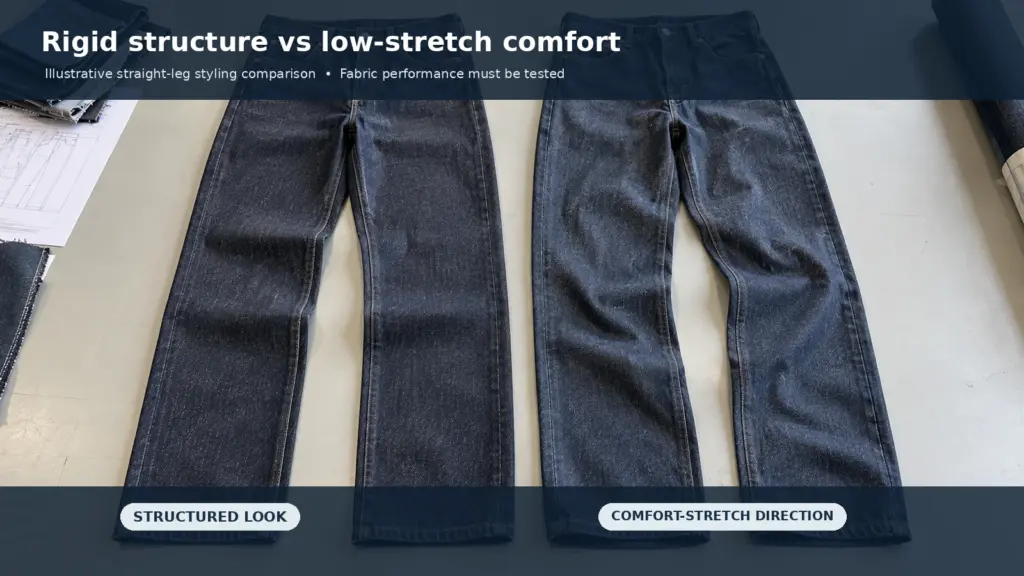
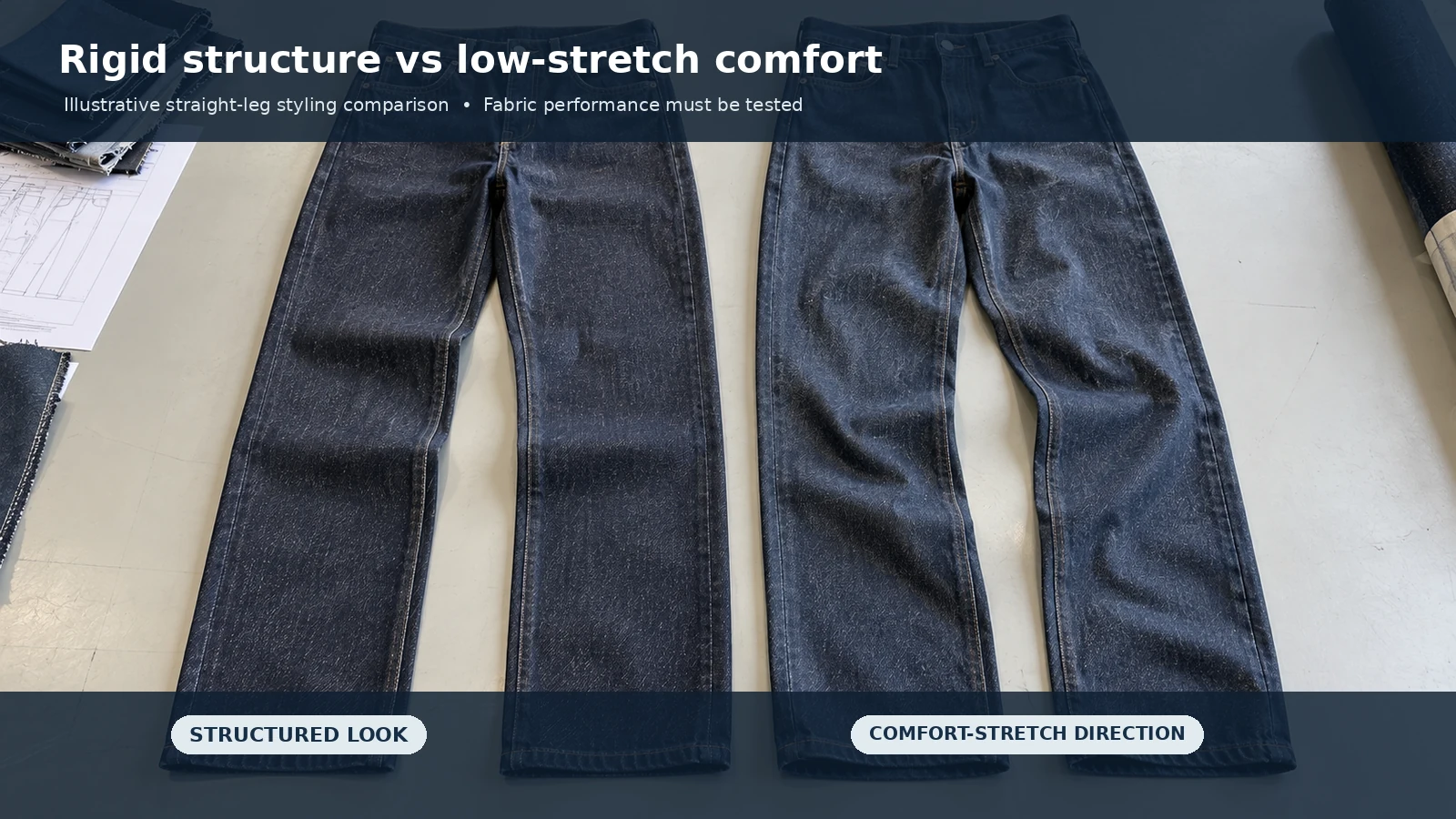
A clothing brand develops two pairs of straight-leg jeans using the same pattern. The first pair uses rigid denim: it holds a defined shape, but feels restrictive when sitting. The second uses stretch denim: it moves more easily, but the fabric is softer than the designer intended. The buyer needs something between the two.
Low stretch denim fabric is worth considering when a straight-leg jean needs the appearance of structured woven denim with a modest amount of comfort extension. Yet the label “low stretch” is not a measured performance guarantee. Buyers must compare actual extension, recovery, growth, fabric weight and the washed garment before placing a bulk order.
1. Why Straight-Leg Jeans May Benefit From Low Stretch Denim
Straight-leg jeans usually provide more room through the leg than skinny jeans. Their silhouette does not depend on fabric stretching tightly around the body. Most wearing ease should be built into the pattern; low stretch can add movement around the seat and knees without necessarily changing the intended straight appearance.
If a garment is uncomfortable because the rise or hip is incorrectly drafted, simply increasing stretch may conceal rather than fix the fit problem. The developer should evaluate the pattern and fabric together. A loose heritage straight-leg style may be ideal in rigid denim, while a closer-cut everyday straight jean may benefit from low stretch.
2. Rigid vs Low Stretch vs Medium Stretch Denim
| Buyer Check | Rigid Denim | Low Stretch Denim | Medium Stretch Denim |
|---|---|---|---|
| Extension | Limited functional stretch | Modest comfort extension | More flexibility |
| Straight-leg appearance | Often structured | Can retain structure | Depends on fabric body |
| Sitting comfort | Primarily pattern ease | Some additional movement | Usually greater movement |
| Main risk | Restriction or excess stiffness | Insufficient extension or growth | Excess softness or shape change |
| Useful starting point | Heritage straight jeans | Everyday structured straight jeans | Comfort-focused straight or tapered fits |
Commercial descriptions vary between suppliers. Do not assign an exact extension percentage to “low stretch” unless it has been measured using the same agreed method. Nor is low stretch automatically stronger or more durable than medium stretch: yarn strength, density, finishing and construction all contribute to performance.
3. Stretch, Recovery and Growth Are Different Measurements
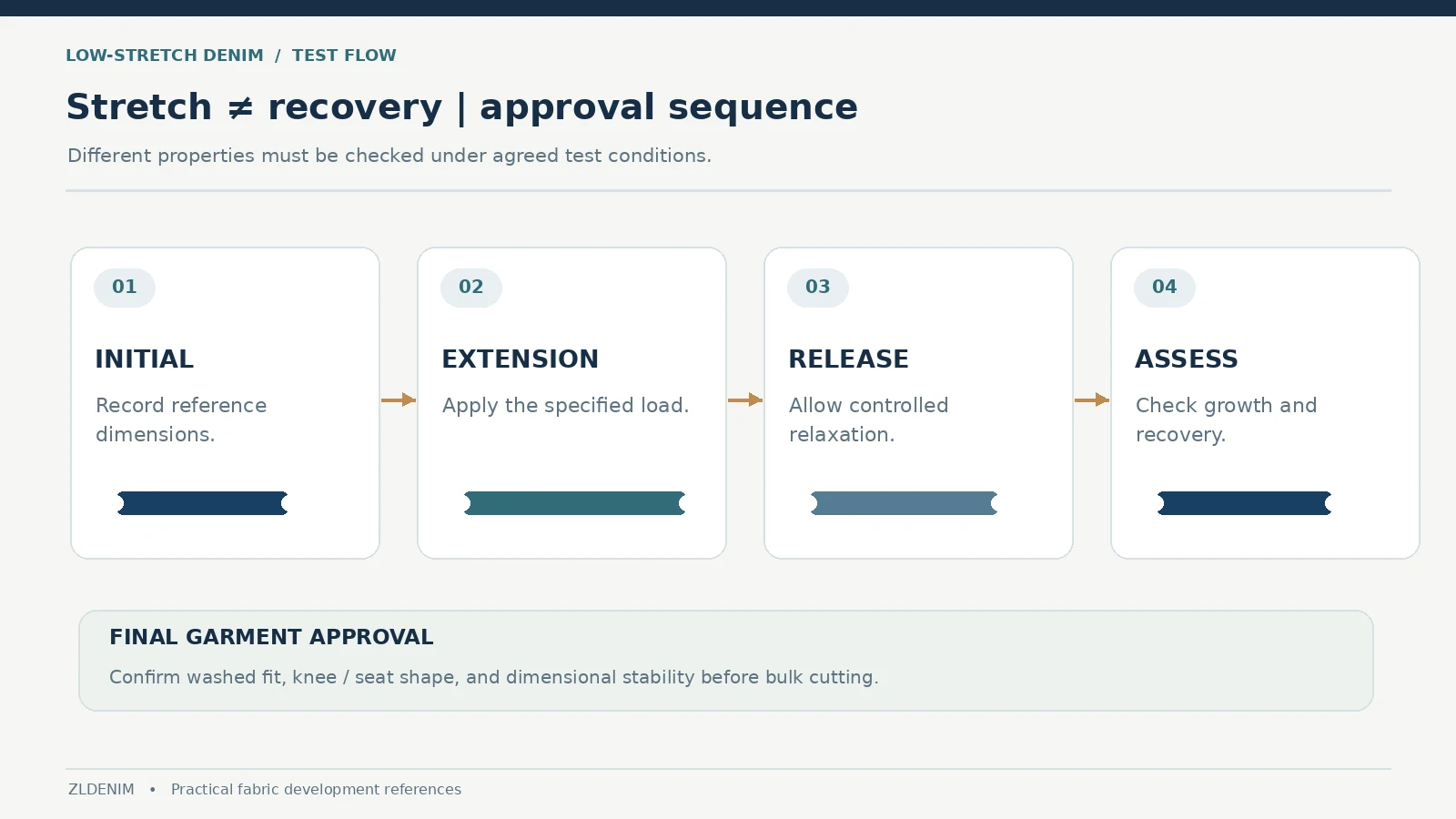
Pulling a fabric by hand demonstrates that it extends, but it does not demonstrate whether it will return to shape after hours of wear.
Stretch is extension under specified conditions. Recovery is the degree to which the material returns toward its original dimensions. Growth is dimensional increase remaining after extension and relaxation. A fabric may offer welcome comfort but retain unacceptable growth around the knee or seat.
For appropriate woven stretch fabrics, ASTM D3107 describes measurements of stretch, growth and recovery. A useful comparison identifies the test method, loading conditions, specimen direction and recovery conditions. Recovery percentages from incompatible methods should not be treated as equivalent. For a straight-leg program, the factory should also check the washed garment after repeated sitting and knee movement.
4. Why Weight Does Not Tell the Whole Story
An 11oz fabric and a 13oz fabric can have very different drape and bending stiffness. Weight affects garment mass and may influence structure, but spinning, weave density, elastic yarn arrangement and finishing also affect handfeel.
Around 10–11oz can be a practical sampling direction for lighter everyday straight jeans. Around 12–13oz is worth comparing for a more substantial look. Neither range guarantees the desired silhouette. Compare samples after the actual proposed wash, including movement, seam bulk and the appearance of the straight leg.
5. ZLDENIM Low-Stretch Options: HW704 and HW804
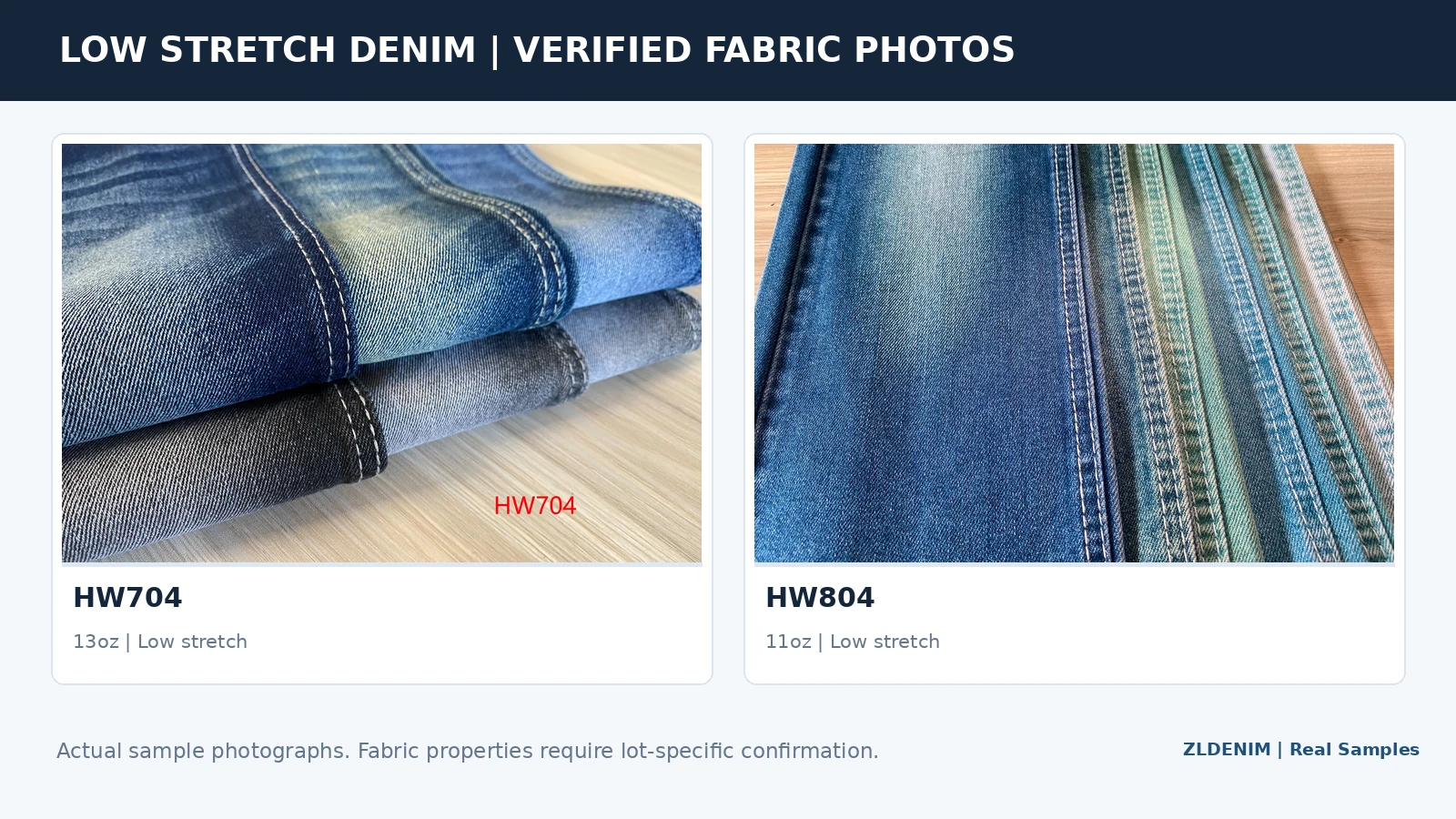
Two styles in ZLDENIM’s catalog offer different starting points for straight-leg development.
| Specification | HW704 | HW804 |
|---|---|---|
| Listed weight | 13oz | 11oz |
| Stretch category | Low Stretch | Low Stretch |
| Color reference | Confirm selected color | Imperial Green Blue |
| Initial development direction | More substantial straight-leg jeans | Lighter structured straight-leg jeans |
HW704 — 13oz Low Stretch Denim
HW704 is a candidate where the collection requires substantial denim with some flexibility. Buyers can compare its washed handfeel and leg structure against a rigid fabric in a similar weight class. The product category alone does not establish any particular elongation or growth result; those must be measured if the garment specification requires them.
HW804 — 11oz Imperial Green Blue Low Stretch Denim
HW804 provides a lighter weight direction and a distinctive listed color. It is worth sampling for everyday straight-leg jeans requiring somewhat softer movement. Its actual drape, recovery and finished dimensions still need to be approved using the selected lot and wash.
Browse the ZLDENIM Stretch Denim collection for the wider range of constructions.
6. Check Shrinkage and Cutting Behavior Before Bulk Approval
A sample may fit in its unwashed state but become uncomfortable after laundering. Warp shrinkage affects garment length; weft shrinkage affects waist, hip, thigh and knee measurements. Both matter in a straight-leg jean with a comparatively close-fitting waist.
If the fabric contains elastic yarn, relaxation after unwinding can change its working width and dimensions. The factory should determine cuttable width under its approved spreading conditions instead of assuming the label width is usable at every point of the roll.
Approve pattern allowances using the intended production wash and representative sample garments. Do not automatically reuse allowances from a rigid denim style.
7. Five Questions to Settle Before Ordering
- Which straight-leg fit? A relaxed vintage cut and a closer-fitting straight jean require different ease and fabric behavior.
- What are measured extension, growth and recovery? Agree on a method if these are critical.
- Does the washed fabric retain the desired body? Compare actual garments, not only hand swatches.
- Are dimensional changes acceptable? Measure before and after the approved process.
- What is the true garment cost? Confirm usable width and CAD marker consumption.
A fabric that looks correct on a hanger but bags excessively at the knee may not be the right choice. Equally, a relatively low-extension fabric may work well when pattern ease has been designed correctly.
What to Send Your Denim Supplier
We are developing regular straight-leg jeans with a structured look and modest comfort stretch. We want to compare an approximately 11oz option with a firmer 13oz construction. Please check HW804 and HW704, including available colors, composition, usable width, sampling options and any relevant stretch, recovery and shrinkage information. The planned garment process is a light enzyme wash.
A garment reference or tech pack gives the supplier a clearer design target than a request for “low stretch denim” alone.
Frequently Asked Questions
What is low stretch denim?
It is a commercial description of relatively limited designed extension compared with higher-stretch fabrics. Exact values depend on measured construction and the supplier’s classification.
Is low stretch denim suitable for straight-leg jeans?
Yes, when a brand wants a balance of traditional structure and modest movement. It is not necessary for every straight-leg pattern.
Does low stretch prevent knee bagging?
Not automatically. Growth, recovery, construction, fit and repeated movement all matter.
Is 13oz too heavy for straight-leg jeans?
Not necessarily. It can support a substantial silhouette, but comfort, bulk and final handfeel require garment approval.
Is low stretch the same as one-way stretch?
No. “Low” describes the relative amount of extension; one-way and two-way describe stretch direction.
Source Low Stretch Denim From ZLDENIM
Choose the fabric that produces the desired finished silhouette, rather than choosing by category name alone. Compare ZLDENIM’s fabric catalog, request available samples and sample yardage and submit target specifications through Denim Sourcing. Availability, technical documentation and sampling arrangements are confirmed for the selected lot.