
A clothing brand approves a pair of skinny jeans after the first fitting. The fabric stretches comfortably, the waist fits and the legs follow the body closely.
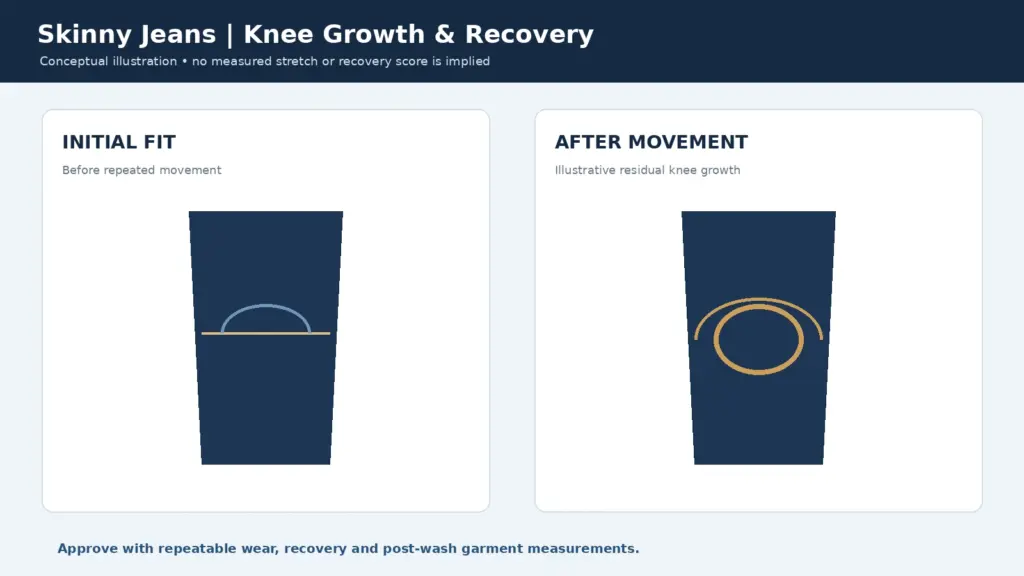
Then the fitting model wears the jeans for several hours. The knees begin to look loose, and the seat no longer holds its original shape.
The development team checks the fabric composition. It contains spandex and is sold as high-stretch denim, so why has the fit changed?
The problem is often not how far denim stretches, but how well it returns to shape after repeated movement.
For brands sourcing high stretch denim fabric for skinny jeans, extension, recovery, growth, washing and pattern design must be considered together.
This guide uses two ZLDENIM fabrics, HW1004 and HW1033, to explain how buyers can approve a high-stretch construction before bulk cutting.
1. Why Skinny Jeans Require More Than High Stretch
Skinny jeans are designed to fit closely around the seat, thighs and knees.
Unlike loose or relaxed jeans, they often rely on fabric extension to accommodate movement.
That creates two competing requirements. The material must stretch sufficiently when the wearer bends or sits, but it must also recover so the garment retains its intended shape.
A fabric that extends easily may feel excellent during the first fitting. If it develops excessive growth, however, the garment can lose its close-fitting appearance.
The purchasing team should therefore evaluate stretch, growth and recovery as separate properties.
2. Stretch vs Recovery vs Growth
These terms describe different aspects of elastic fabric behavior.
| Property | What It Measures | Why It Matters |
|---|---|---|
| Stretch / extension | How far the fabric extends under a specified condition | Movement and wearing comfort |
| Recovery | How effectively the fabric returns toward its initial dimensions | Shape retention |
| Growth | Residual dimensional increase after stretching and relaxation | Knee and seat bagging |
| Wash shrinkage | Dimensional change after laundering | Finished garment measurements |
| Fabric body | Structural handfeel and support | How the skinny silhouette looks and feels |
Stretch Is Not the Same as Spandex Content
A denim composition of 98% cotton and 2% spandex means that spandex represents 2% of the fabric’s fiber composition by mass.
It does not mean the fabric stretches by 2%.
Actual extension depends on the elastic yarn, yarn arrangement, weaving density, finishing and testing conditions.
Two fabrics containing 2% spandex can therefore produce different stretch and recovery results.
Why Recovery Matters
Imagine two fabrics that both stretch comfortably during fitting.
After repeated bending, Fabric A returns close to its original dimensions. Fabric B retains noticeably more extension around the knee.
For skinny jeans, Fabric A may produce better shape retention even if Fabric B feels easier to stretch by hand.
A buyer should choose based on the approved garment result rather than the strongest immediate pull.
3. What Causes Knee Bagging in Skinny Jeans?
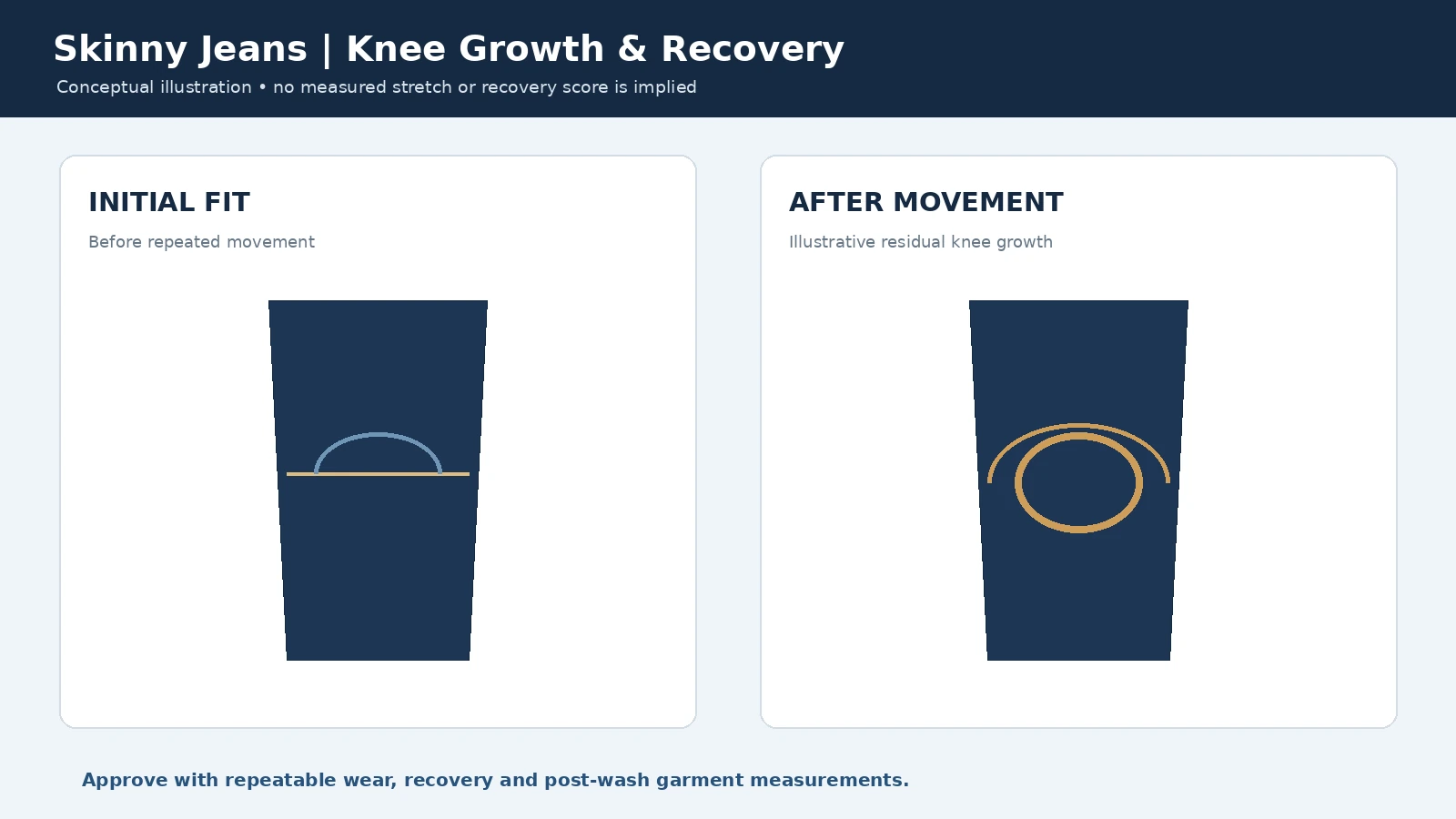
Knee bagging appears when the fabric around the knee no longer follows the intended silhouette after repeated movement.
It can be influenced by fabric growth, recovery, knee shaping and garment fit.
Repeated Bending
When a wearer sits, walks or bends, the fabric around the knee extends.
If the material retains some of that extension, the knee area may develop an unwanted bulge.
Pattern Fit
A very tight pattern can concentrate strain around the knee and thigh.
The pattern maker should review how much ease is available and whether the fabric’s measured extension is suitable for that fit.
More stretch cannot compensate for every pattern problem.
Washing and Finishing
The fabric’s behavior may change during garment washing and drying.
A high-stretch sample should therefore be tested after the intended production wash, not just in its original condition.
How to Evaluate Knee Bagging
Make a representative sample garment.
Record its initial knee and seat measurements. Have the fitting model perform a repeatable movement sequence, including sitting, standing and knee bending.
After the agreed recovery period, measure the same points again and inspect the silhouette.
The buyer should set an acceptable appearance and measurement requirement for the finished garment.
4. Real ZLDENIM Options: HW1004 and HW1033
ZLDENIM offers two high-stretch denim options with different composition and width profiles.
| Specification | HW1004 | HW1033 |
|---|---|---|
| Product direction | 10oz black high-stretch denim | High-stretch denim |
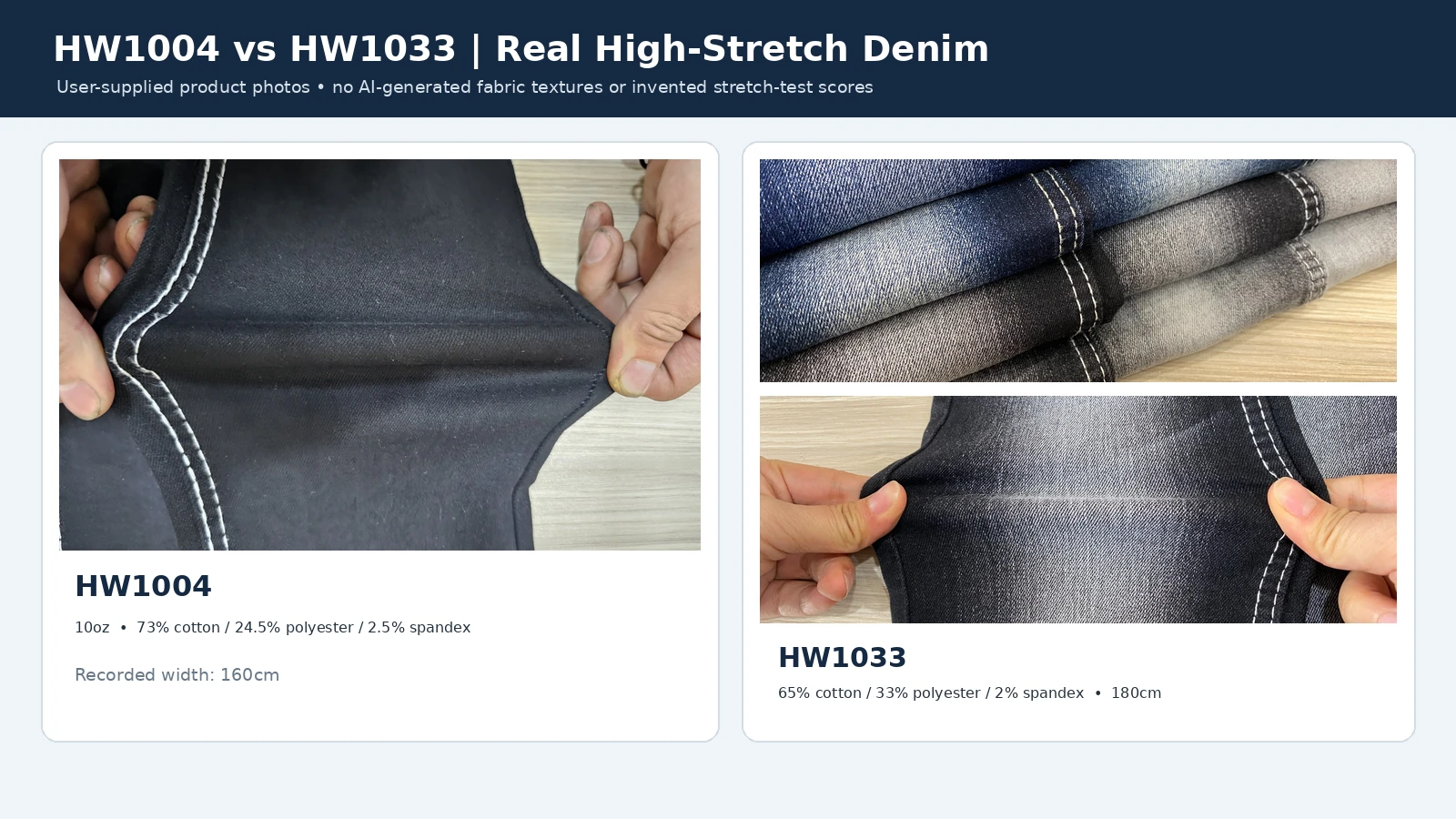
| Composition | 73% cotton / 24.5% polyester / 2.5% spandex | 65% cotton / 33% polyester / 2% spandex |
| Stretch category | High Stretch | High Stretch |
| Recorded width | 160cm | 180cm |
| Listed colors | Deep Black / Black | Deep Blue / Black / Blue-Grey / Black-Black |
| Development focus | Close-fitting black jeans and color performance | High-stretch jeans in multiple color directions |
| Key approval | Knee recovery, washed fit and black shade | Growth, recovery, weight and washed fit |
HW1004 — 10oz Black High-Stretch Denim
View HW1004 Black High Stretch Denim
HW1004 is a 10oz, approximately 339 GSM, black high-stretch denim containing 2.5% spandex.
Its recorded width is 160cm.
For black skinny jeans, this is a relevant starting sample. The development team should evaluate the fabric’s stretch and recovery together with the required black shade after the intended garment wash.
Pay particular attention to the knees, seat and waistband. Also assess rubbing and staining performance where the garment may contact light-colored accessories or other clothing.
HW1033 — High-Stretch Denim
View HW1033 High Elasticity Denim
HW1033 contains 65% cotton, 33% polyester and 2% spandex, with a recorded width of 180cm.
The listed color directions include deep blue, black and blue-grey.
It is worth sampling for high-stretch jeans when the brand needs a broader color direction or wants to compare a wider fabric with HW1004.
For the HW1033 development pack, request the current roll’s GSM and finished technical sheet together with the fabric sample. This lets the pattern and cutting teams evaluate the actual material intended for production.
Which One Should You Start With?
For a deep-black skinny-jeans collection, HW1004 is a useful first sample because its documented weight and black color direction align with that brief.
For a project requiring other indigo or grey color directions, HW1033 is worth evaluating.
The final choice should follow measured extension, residual growth, washed fit and cutting yield.
5. How to Test Stretch, Growth and Recovery
ASTM D3107-26 provides test methods for evaluating stretch, growth and recovery in suitable woven stretch fabrics.
The method is intended for woven fabrics exhibiting high stretch (greater than 12%) and good recovery under the specified test conditions. Check that the selected construction falls within the method’s scope before applying it.
ASTM also notes that the method is not recommended as a stand-alone acceptance test for commercial shipments because between-laboratory precision is limited. For development comparisons, use consistent test conditions and an agreed laboratory, then combine the results with garment-level approval.
A Useful Development Test Plan
First, measure the extension in the direction relevant to the garment.
Next, evaluate residual growth and recovery under the selected method.
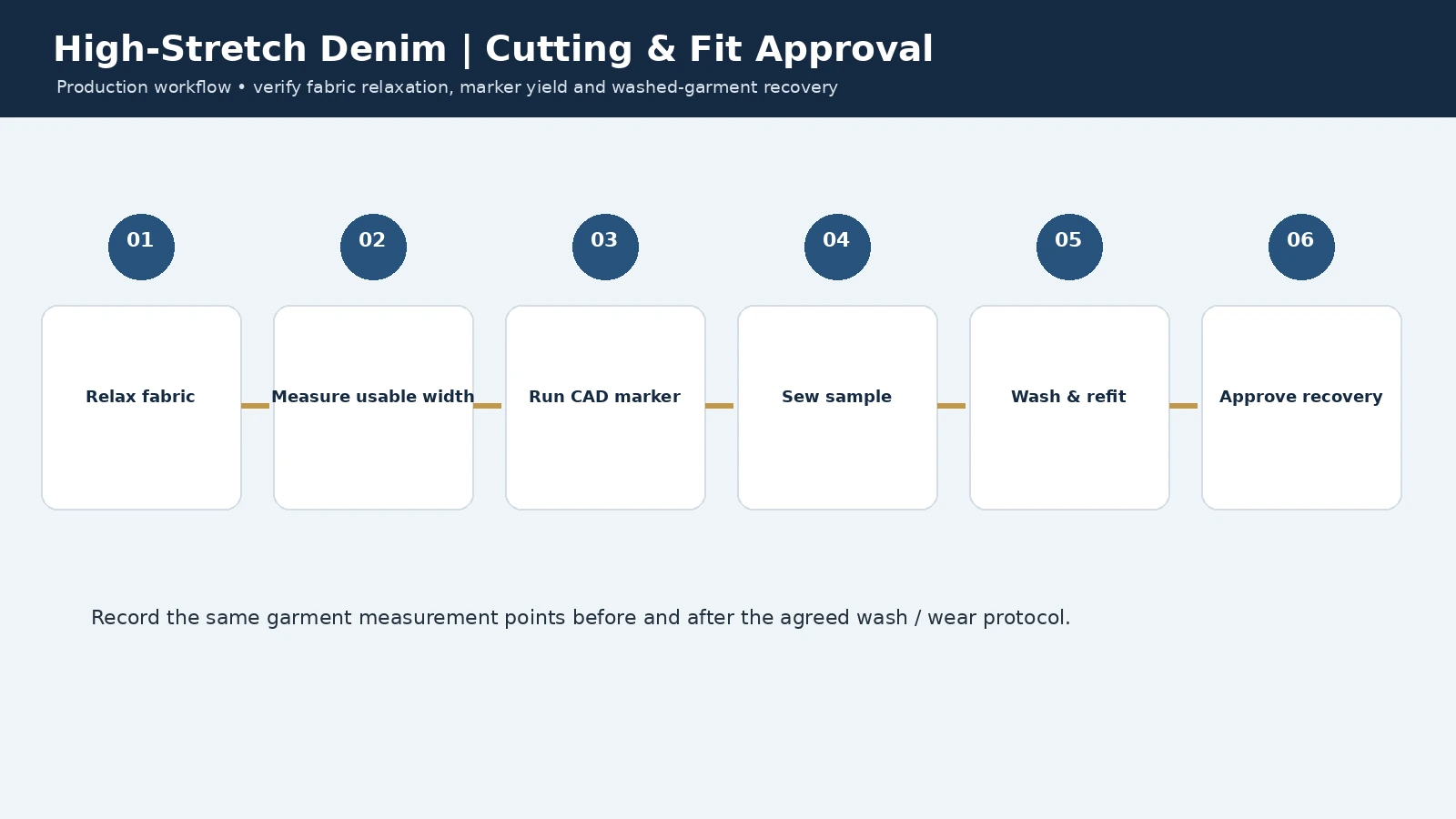
Then make a skinny-jeans sample, apply the intended washing process and repeat the fit and movement assessment.
Record both numerical measurements and visible garment appearance.
The result should tell the designer whether the material supports the target silhouette, not merely provide an isolated elasticity number.
6. Washed Fit Comes Before Bulk Pattern Approval
High-stretch denim can change dimensions during garment processing.
For close-fitting jeans, relatively small changes around the waist, hip and thigh can noticeably affect comfort.
The factory should measure the sample before and after washing and evaluate the finished garment on the fitting model.
Where to Measure
Focus on the waist, hip, thigh, knee, inseam and leg opening.
The garment’s intended level of negative ease or positive ease should be reviewed using the finished dimensions.
If the sample shrinks or relaxes differently from the original expectation, adjust the paper pattern rather than simply relying on fabric stretch to compensate.
Shrinkage Allowance Example
Suppose the target finished waist circumference is 70cm, and a representative garment test shows 4% reduction in that measurement after the approved wash.
A simplified starting calculation is:
70cm ÷ (1 − 0.04) = 72.92cm
This gives the theoretical pre-wash dimension under that specific assumption.
The factory must then review fitting, seam construction, elastic recovery and the complete size range before approving its production pattern.
The 4% in this example is illustrative, not a published result for HW1004 or HW1033.
7. Stretch Denim Needs Controlled Relaxation Before Cutting
High-stretch fabric may change dimensions when released from roll and spreading tension.
If the cutting team pulls the fabric too tightly during spreading, the resulting panels may not retain those dimensions after relaxation.
This can lead to inconsistent sizes and production rework.
Before cutting, establish a handling procedure appropriate for the selected construction.
Allow the fabric to relax under controlled conditions, then measure the cuttable width and adjust the CAD marker where necessary.
During production, avoid excessive spreading tension and keep rolls identifiable by lot.
The approved cutting method should reproduce the conditions used for the sample garments.
8. HW1004 vs HW1033: How Width Affects the Cost Per Pair
HW1004 has a recorded width of 160cm, while HW1033 is recorded at 180cm.
This difference can affect cutting efficiency, particularly for larger sizes and close-fitting patterns with several shaped pieces.
Hypothetical Marker Comparison
| Costing Item | 160cm Fabric | 180cm Fabric |
|---|---|---|
| Example cuttable width | 156cm | 176cm |
| Assumed marker consumption | 1.42m/pair | 1.27m/pair |
| Hypothetical price per meter | $4.40 | $4.80 |
| Fabric cost per pair | $6.25 | $6.10 |
Prices, cuttable widths and marker consumption are illustrative and do not represent current ZLDENIM quotations.
Despite the higher hypothetical meter price, the wider fabric produces a slightly lower fabric cost per pair in this example.
That is a reason to request CAD marker calculations before choosing between similarly suitable fabrics.
However, HW1004 and HW1033 may have different washed fit and recovery characteristics. The saving matters only when the selected fabric meets the garment brief.
9. A Buyer Approval Checklist for High-Stretch Skinny Jeans
Before bulk production, approve the fabric against the final garment requirements.
The development team should review:
- Target skinny fit and pattern ease
- Stretch direction and measured extension
- Residual growth and recovery
- Knee and seat behavior after repeated movement
- Washed garment dimensions and appearance
- Relaxed cuttable width and CAD marker consumption
- Available roll quantity, shade and lot information
For black jeans, include the intended washed shade and relevant colorfastness checks.
A reliable fabric choice should satisfy both wearer comfort and production consistency.
10. Request High-Stretch Denim Samples
A detailed inquiry can help narrow the options.
We are developing women’s skinny jeans and would like to compare HW1004 and HW1033.
The garment requires comfortable extension, good recovery and controlled knee growth after repeated movement.
Please advise on current available colors, usable widths, sample yardage and pricing.
Our factory will evaluate the intended wash, finished fit and CAD marker consumption before bulk approval.
Target quantity: [meters]. Destination: [country].
Send Your High-Stretch Denim Inquiry
Frequently Asked Questions
What is the best high-stretch denim for skinny jeans?
Choose a fabric with sufficient extension for the pattern and suitable recovery after repeated movement. The finished sample garment is the strongest practical comparison.
Does 2% spandex mean 2% fabric stretch?
No. Spandex percentage describes fiber composition. Measured fabric extension depends on the full yarn and fabric construction.
Why do skinny jeans become baggy at the knees?
Fabric growth, limited recovery, pattern fit and repeated bending can contribute to knee bagging.
Can high-stretch denim shrink during washing?
Yes. Buyers should measure finished garment dimensions after the actual planned wash and adjust the pattern.
Is a wider high-stretch fabric cheaper to use?
It may improve cutting efficiency, but the final cost depends on the actual marker and price per meter.
Should the factory test recovery after garment washing?
Yes. Recovery and finished fit should be evaluated in the condition in which the jeans will be sold.
Find High-Stretch Denim with ZLDENIM
High-stretch jeans succeed when the fabric combines comfortable movement with consistent shape retention.
Compare HW1004 Black High-Stretch Denim and HW1033 High Elasticity Denim against your intended jeans pattern.
You can also explore the ZLDENIM Stretch Denim Collection or review our broader Stretch Denim Fabric Guide.
For samples, stock and quotations, contact ZLDENIM Sourcing.