
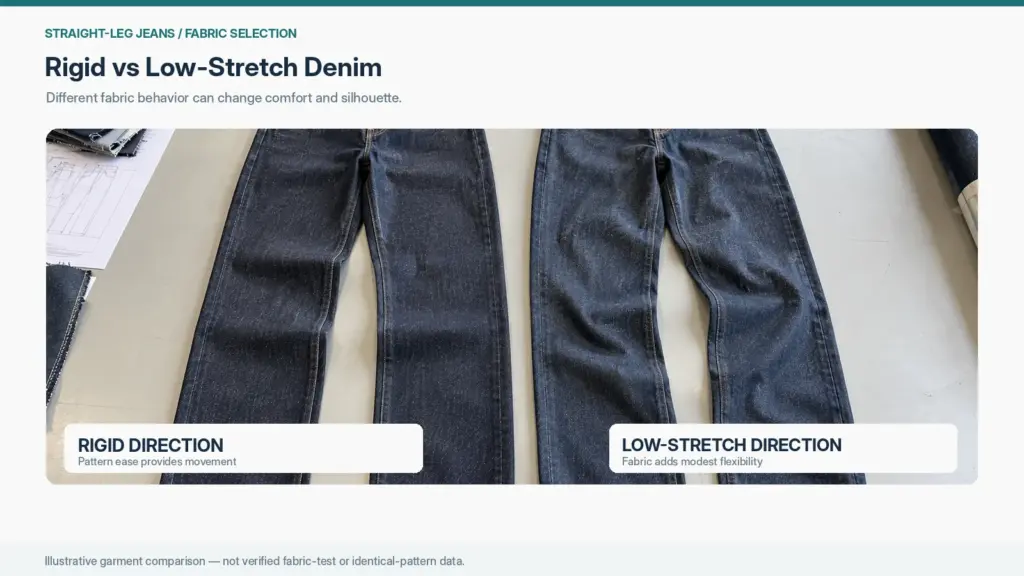
A clothing brand is developing a new collection of straight-leg jeans. The designer wants a traditional denim appearance: a clean leg line, enough structure to hold the silhouette, and a fabric that does not feel overly soft.
The factory offers two options. One is rigid denim. The other is low-stretch denim. Both look suitable on the sample hanger. But after cutting, washing and fitting, they can deliver different experiences. The rigid pair may hold its structure but require more ease through the hips and seat. The low-stretch pair may allow easier movement, although its growth and recovery need closer attention.
Low-stretch vs rigid denim is not a contest to find the fabric with more stretch. The better choice is the one that works with the intended jeans pattern.
For buyers sourcing low stretch denim for straight leg jeans, the decision begins with the garment silhouette, comfort target, washing process and production requirements.
1. Why Straight-Leg Jeans Can Work With Either Fabric
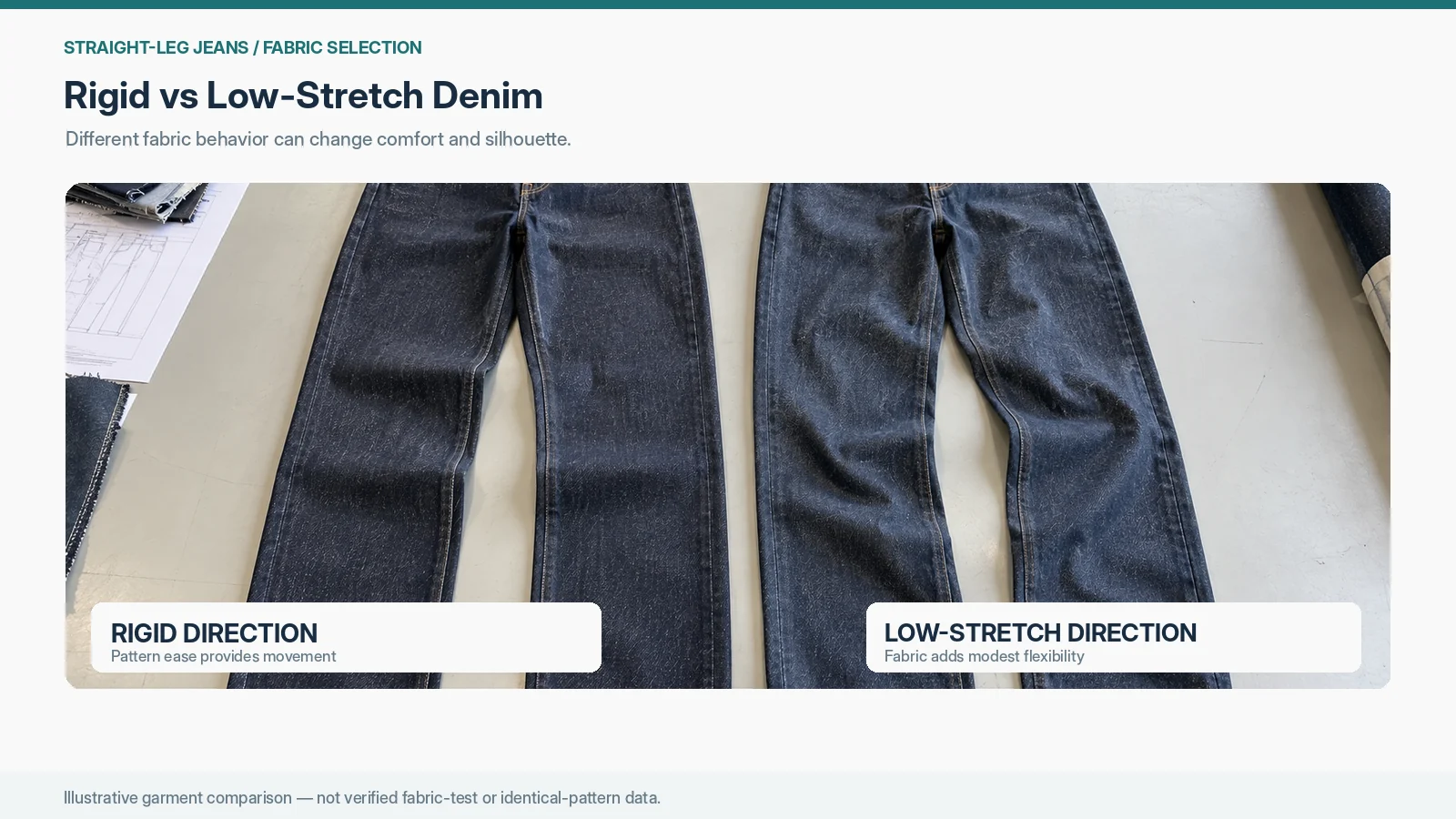
Straight-leg jeans generally maintain a relatively consistent leg shape from the knee toward the hem. Unlike skinny jeans, their design does not normally depend on the fabric stretching tightly around the body. This gives product developers more flexibility when choosing between rigid and low-stretch denim.
When Rigid Denim Makes Sense
Rigid denim is often a sensible starting point for relaxed straight-leg jeans, heritage-inspired five-pocket styles and garments intended to have a traditional denim character. The pattern supplies the wearing ease. With a properly developed rise, seat and thigh, a rigid jean can be comfortable without significant functional stretch.
When Low-Stretch Denim Makes Sense
Low-stretch denim becomes attractive when the designer wants a similar visual silhouette with additional freedom during movement. A regular straight jean with a relatively neat waist and seat may benefit from modest fabric extension. That can make sitting, bending and everyday movement feel less restrictive without necessarily adopting a soft, high-stretch construction.
However, low stretch cannot correct an unsuitable pattern. A well-developed rigid jean can fit better than a poorly developed stretch jean.
Low-Stretch vs Rigid Denim: What Should Buyers Compare?
The comparison is about more than comfort.
| Buying factor | Rigid denim | Low-stretch denim |
|---|---|---|
| Main strength | Traditional structure | Modest added flexibility |
| Straight-leg silhouette | Often firm and defined | Can remain structured |
| Comfort | Depends strongly on pattern ease | Combines pattern ease with extension |
| Knee and seat growth | Evaluate dimensional change and fit | Recovery and growth need specific checks |
| Washed appearance | Depends on yarn and finishing | Depends on yarn, elastic construction and finishing |
| Cutting behavior | Width and shrinkage checks | Also evaluate relaxation and spreading tension |
| Suitable starting direction | Relaxed, vintage, structured straight jeans | Regular, everyday and slightly fitted straight jeans |
Rigid does not necessarily mean 100% cotton: cotton-polyester denim without engineered stretch can also be rigid. Likewise, low-stretch denim cannot be judged solely by spandex content. The commercial category describes a general performance direction, not a universal measured extension range.
3. Choose the Fabric According to the Fit
A. Relaxed Vintage Straight Jeans
The silhouette has generous room around the seat and thigh. The designer wants substantial folds and a traditional denim appearance. Rigid denim is a sensible first sample because pattern ease already supports movement. Low stretch can still work, but the added flexibility may provide limited benefit for this design.
B. Regular Everyday Straight Jeans
The garment has a cleaner waist and seat fit while keeping a straight leg. Low-stretch denim may be useful here: it provides some movement without necessarily switching to soft high-stretch fabric. The factory should compare fit before and after the planned wash.
C. Structured Women’s Straight Jeans
The brand wants a defined hip and seat with a straight leg. Either fabric can work. If the design has little ease through the hips, low stretch may improve comfort. For a sculptural vintage appearance, rigid denim with a correctly graded pattern may be preferable. The fabric should follow the fit brief, not the other way around.
4. Recovery and Growth: The Hidden Risk With Low Stretch
Buyers often pull a fabric sample across its width and conclude that it offers sufficient flexibility. That does not establish how the jeans will behave after several hours of wear.
Stretch or extension measures how far the fabric extends under specified conditions. Recovery measures how it returns toward its original dimension after the force is removed. Growth measures the residual dimensional increase after stretching and relaxation.
A fabric may extend only moderately but still develop noticeable growth around the seat or knees. Spandex percentage alone cannot establish these results. For woven stretch fabrics within its scope, ASTM D3107 provides test methods for stretch, growth and recovery. Buyers should compare results under equivalent conditions, including measurement direction, applied force, duration and recovery conditions.
Test the Finished Jeans, Too
Laboratory values are important but cannot replace garment fitting. Have a fitting model sit, walk and repeatedly bend the knees. After an agreed recovery period, check whether the garment maintains its intended shape. A low-stretch label is not a guarantee against knee bagging.
5. Comparing Real ZLDENIM Fabric Options
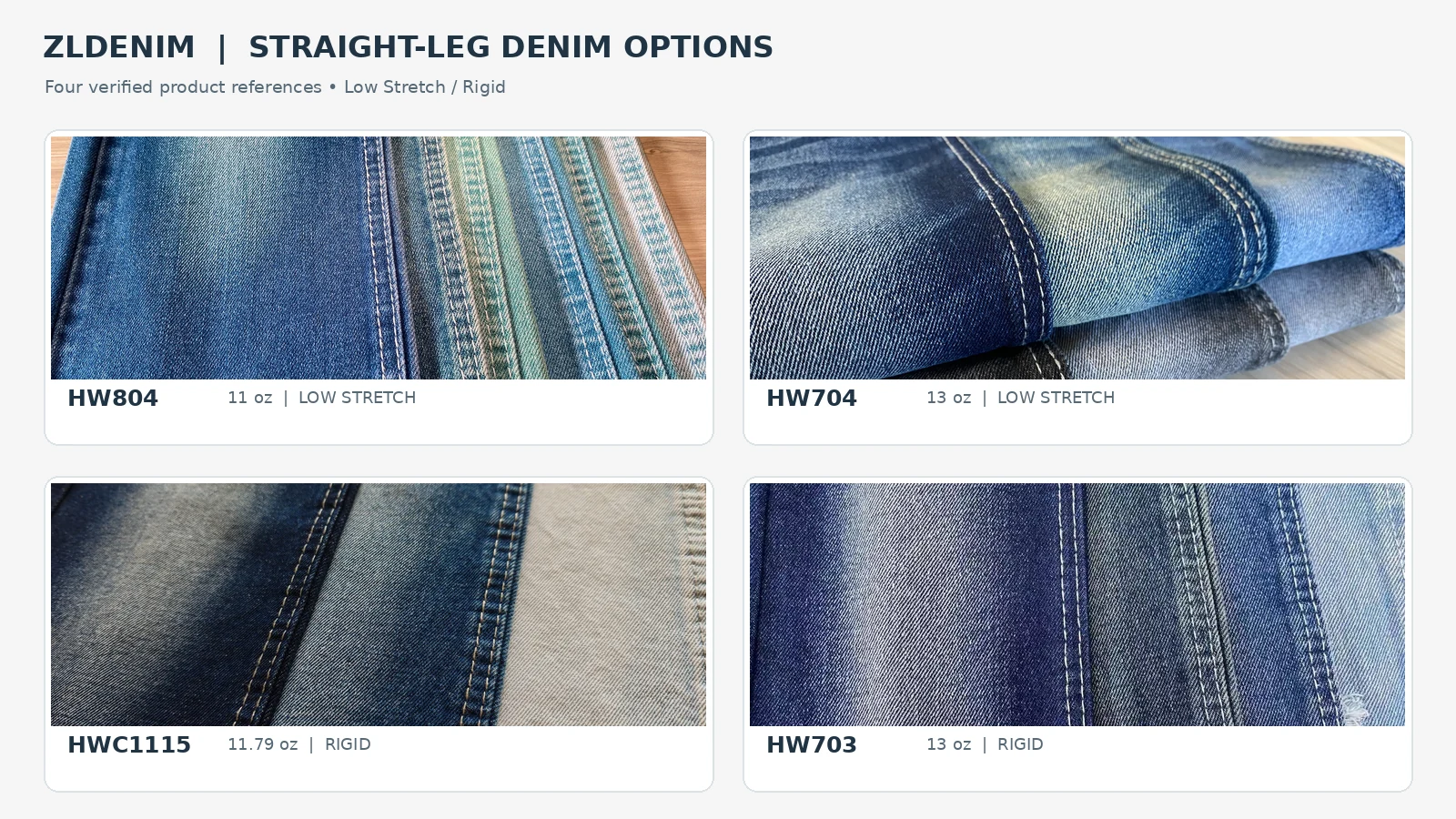
ZLDENIM lists constructions that provide useful starting points. Specifications should be reconfirmed for the stock lot proposed for purchase.
| Fabric | Published weight | Stretch category | Published width | Initial direction |
|---|---|---|---|---|
| HW804 | 11oz / 373 GSM | Low stretch | 170cm | Lighter everyday straight jeans |
| HW704 | 13oz / 441 GSM | Low stretch | Confirm current specification | More substantial straight jeans |
| HWC1115 | 11.79oz / 400 GSM | Rigid | 178–180cm | Clean dark-indigo cotton rigid jeans |
| HW703 | 13oz / 441 GSM | Rigid | 180cm | Structured straight jeans and jackets |
HW804: 11oz Low-Stretch Denim
HW804 is listed as an 11oz Imperial Green Blue low-stretch denim with a recorded 170cm width. It may suit everyday straight jeans where moderate weight and comfort are priorities. Verify composition, minimum usable width, measured extension and washed-garment behavior before approval.
HW704: 13oz Low-Stretch Denim
HW704 is a 13oz low-stretch option and a heavier comparison against HW804. Its greater weight does not automatically mean greater stiffness or better recovery. Compare actual fabric samples and post-wash garment shape, particularly where the collection needs a substantial straight-leg silhouette.
HWC1115: Deep-Indigo Cotton Rigid Denim
HWC1115 – 100% Cotton Rigid Denim is a 400 GSM cotton rigid construction with 3/1 right-hand twill and a recorded width of 178–180cm. Its technical record lists warp and weft shrinkage of 3%, but these are reference values that must be evaluated against the intended garment wash and actual lot.
HW703: 13oz Open-End Rigid Denim
HW703 – 13oz OE Rigid Denim is listed as 80% cotton / 20% polyester, rigid, with a 180cm width. It demonstrates that rigid denim and 100% cotton are not interchangeable labels. The construction may suit structured straight jeans and jackets where a non-stretch open-end surface matches the design brief.
6. Washing Can Change Your Initial Preference
A fabric that feels ideal before washing may behave differently after garment finishing. Rigid denim can soften, shrink and develop a different drape. Low-stretch denim may also change in dimensions, surface handfeel or recovery.
The garment factory should check waist, hip, thigh, inseam and hem measurements after the approved process. For low stretch, include actual extension and recovery where relevant. For rigid denim, focus on dimensional stability, retained structure and sufficient wearing ease.
If the brand changes from rigid to low stretch after approving a pattern, it should recheck garment fit and measurements. Similar silhouettes do not prove that the two materials can use an identical unchanged pattern.
7. Which Fabric Costs Less per Pair?
These fabrics do not all share the same width or construction. Even when prices per meter are similar, garment costs may differ because of cutting efficiency.
Fabric Cost per Pair = Price per Linear Meter × CAD Marker Consumption per Pair
Use actual usable width, pattern, size ratio and grainline restrictions for each candidate. Include any required changes in pattern development, washing allowances and sewing. A lower-priced rigid fabric is not automatically the lowest-cost finished jean.
For a broader costing method, see the Denim Fabric Width Guide.
8. A Practical Buyer Approval Process
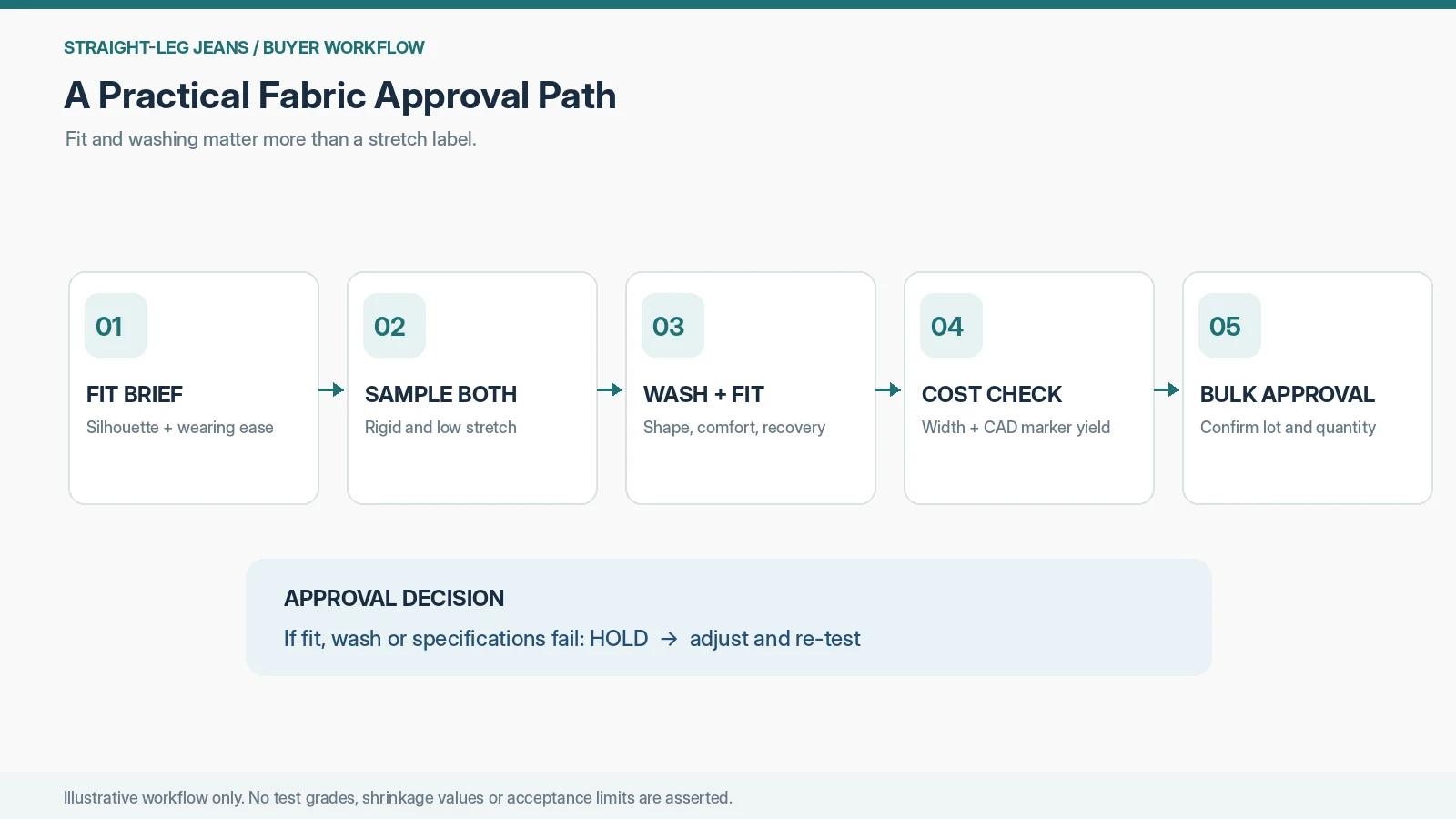
A useful comparison is a controlled garment development, not a simple hand-stretch demonstration:
- Define the straight-leg silhouette and comfort target.
- Select one rigid and one low-stretch candidate with appropriate weight and handfeel.
- Develop patterns that deliver the same intended finished fit.
- Wash sample garments under the planned production process.
- Compare shape, movement, measurements and recovery.
- Confirm usable width, cutting yield, dye lot, stock and quotation.
The winning fabric provides the approved appearance and fit consistently—not necessarily the highest cotton content or greatest extension.
Frequently Asked Questions
Is rigid denim better for straight-leg jeans?
It can be preferable for a structured or heritage appearance when the pattern provides sufficient ease. It is not automatically better for every straight-leg fit.
Is low-stretch denim good for men’s straight jeans?
Yes. It can provide additional movement while retaining a traditional denim appearance. Assess the intended fit and actual recovery rather than gender alone.
Can low-stretch denim develop knee bagging?
Yes. Low stretch does not guarantee low growth. Test both fabric and garment under relevant conditions.
Is 13oz rigid denim heavier than 11oz low-stretch denim?
Yes, in mass per unit area. But higher weight does not by itself establish stiffness, comfort or quality.
Can the same jeans pattern be used for rigid and low stretch?
Not automatically. Ease, stretch behavior, shrinkage and garment measurements may require changes.
Final Recommendation: Start With the Jeans, Not the Stretch Label
For relaxed vintage straight-leg jeans, rigid denim is often a useful starting point. For everyday straight-leg jeans requiring somewhat more comfort, low-stretch denim deserves comparison. Neither is universally superior.
Explore ZLDENIM Stretch Denim and Cotton & Rigid Denim to compare constructions. Request available swatches via ZLDENIM Samples, or send the target fit, weight, composition, color, stretch and quantity through ZLDENIM Sourcing. Current specifications, lots and availability are confirmed individually.