
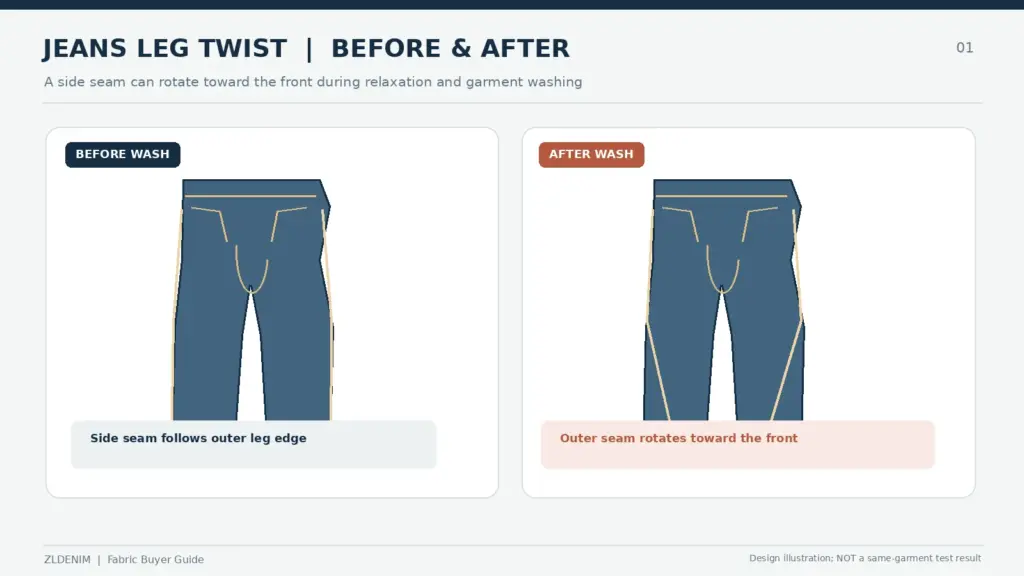
A garment factory cuts and sews a pair of dark-indigo jeans. Before washing, both outer seams appear straight, the panels are aligned and the hems sit as expected. After the first substantial wash, however, a side seam moves toward the front of the lower leg.
The buyer calls it a defect. The fabric supplier says some twisting is natural in denim. Which explanation is correct?
The answer depends on the fabric, the garment construction and the agreed finished appearance. Side-seam rotation can come from twill behavior, fabric relaxation, bow or skew, pattern grainlines, sewing conditions and washing. Some heritage denim accepts visible twisting as character; clean commercial jeans may require much stricter control.
For brands and garment manufacturers, knowing how to assess denim skew and leg twist before bulk cutting helps prevent costly disputes.
1. What Is Denim Leg Twist?
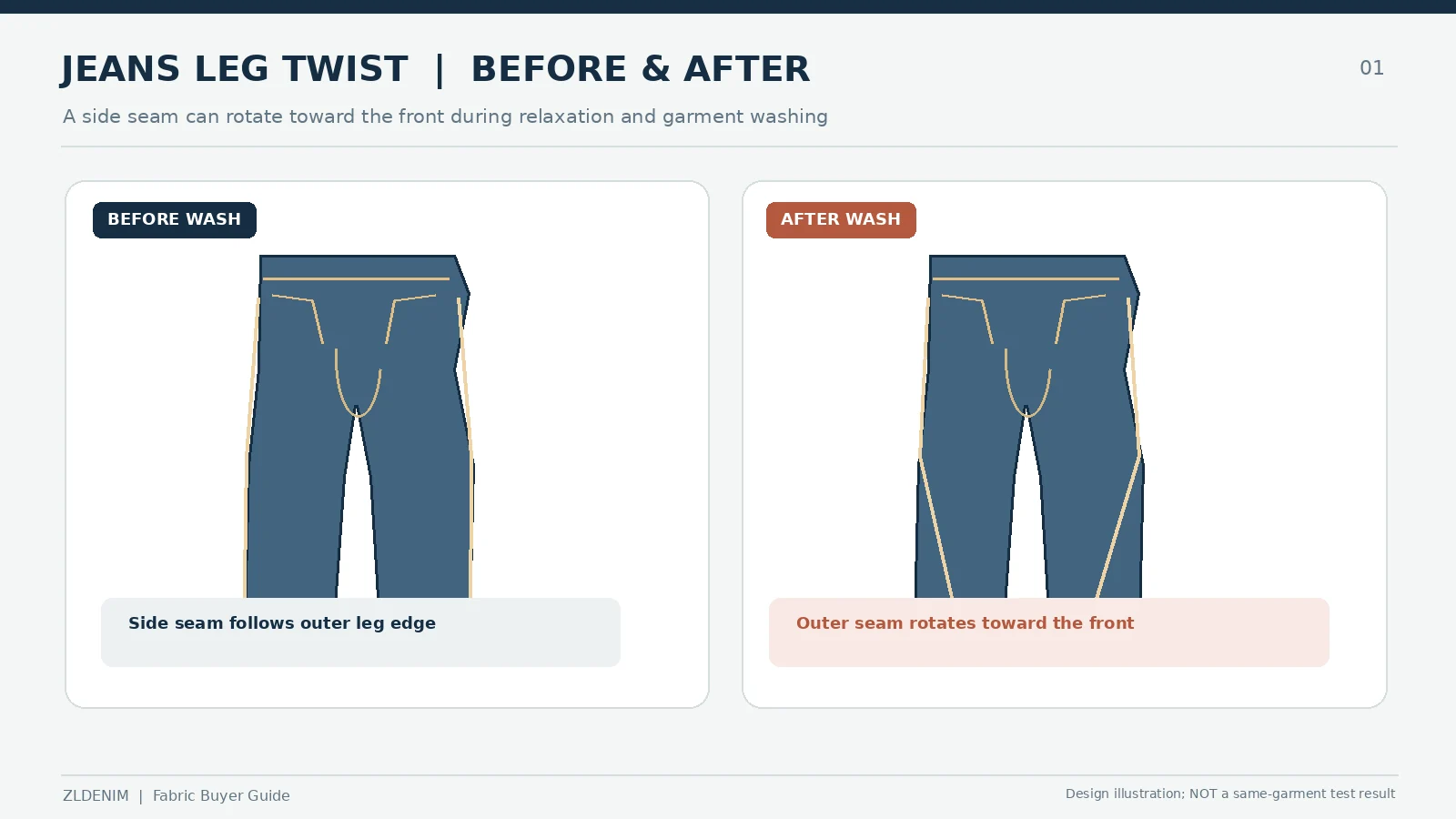
Leg twist is the visible rotation of a sewn jeans leg, often noticed where the outside seam moves toward the front or back of the lower leg instead of following its intended position. It may be especially obvious near the hem.
Buyers sometimes use skew and leg twist as though they mean the same thing. They do not. Skew describes weft-yarn distortion in the fabric; leg twist describes the appearance of the finished garment. A fabric may have measurable skew without producing unacceptable finished twist, and a twisted garment can have other causes besides the fabric’s original skew.
When investigating a complaint, first establish what was measured: a piece of woven fabric, a cut panel or the sewn and washed jean. Without that distinction, the mill and clothing factory may be comparing different problems.
2. Why Twill Denim Can Rotate During Washing
Conventional denim is commonly woven in a twill structure. The asymmetric interlacing, yarn twist and tensions developed during weaving and finishing can contribute to rotational behavior as the material relaxes. The first substantial wash may release some of that distortion while changing fabric dimensions.
In 3/1 right-hand twill, the diagonal line has the characteristic right-hand orientation. Left-hand twill uses the opposite direction. The twill direction can influence the tendency of denim to rotate, but it cannot predict the exact final seam position by itself.
Different yarns, densities, warp tensions, finishing processes and garment washes produce different results. A supplier cannot guarantee an acceptable washed leg just by stating “3/1 RHT” or “sanforized.” The complete fabric and garment need to be evaluated.
Why Unwashed Jeans Can Look Straight
A fabric roll arrives under conditions established during finishing and winding. The cut panels are assembled before the garment has experienced its final washing and drying. When dimensional relaxation occurs later, the sewn panels may rotate or redistribute tension. That is why a garment that looks straight in the sewing room can change after laundry.
3. Fabric Bow and Skew: Know the Difference
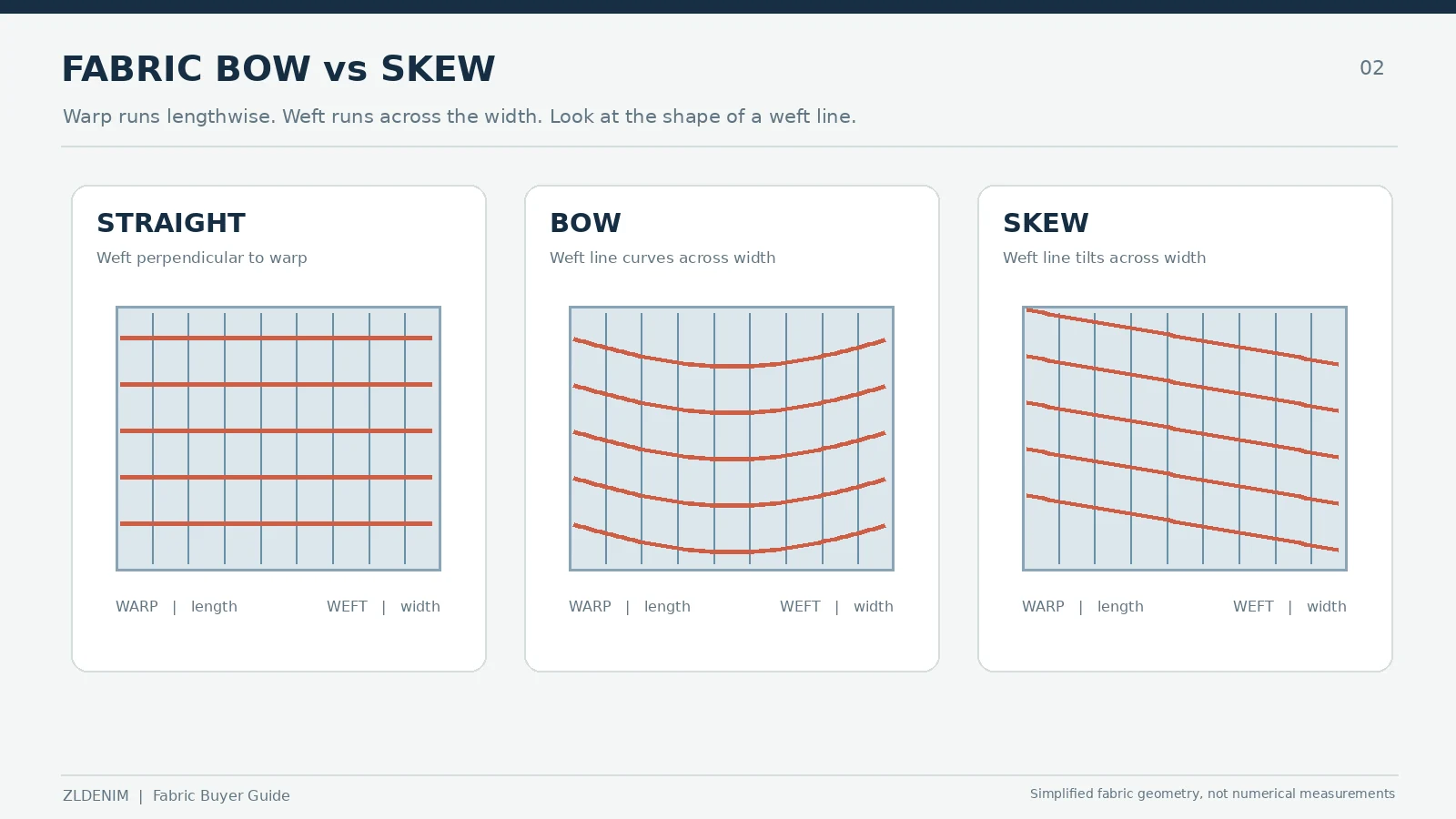
Both bow and skew concern the orientation of filling/weft yarns relative to their expected line across the fabric width.
| Inspection Term | What It Looks Like | Why Buyers Should Care |
|---|---|---|
| Straight weft | Weft follows its expected transverse direction | Reference for measurement |
| Bow | Weft line curves across the width | May affect appearance and pattern behavior |
| Skew | Weft line angles away from the expected direction | May influence garment seam position and twist |
| Finished leg twist | Sewn side seam rotates on the leg after processing | Must be assessed on the washed garment |
ASTM D3882 provides a test method for measuring bow and skew in woven and knitted fabrics. A reported percentage should identify the method and measurement conditions. It does not automatically establish how far a seam will move on a particular jeans pattern.
The distinction also matters when discussing a fabric claim. A fabric could be within its agreed skew requirement yet still produce a garment with an unacceptable seam position because of cutting or sewing. Conversely, a nonzero skew reading is not sufficient proof that a garment will fail.
4. Why Mills Sometimes Pre-Skew Denim on Purpose
This is an important practical point: zero fabric skew is not always the ideal finishing target for twill denim. Some denim finishing processes intentionally introduce controlled skew to counteract the material’s anticipated rotational behavior during later relaxation and washing. This is often called pre-skewing or skew correction.
The amount and direction depend on yarn, twill construction, finishing and the process the garment will undergo. It would be misleading to prescribe one fixed percentage for every right-hand twill fabric.
Instead, ask the supplier whether skew correction was applied, whether bow/skew data are available and what wash testing supports the proposed construction. The decisive assessment is the approved washed jeans, not a rule that every unwashed roll should show zero deviation.
5. How Shrinkage and Garment Washing Affect Side Seams
Denim can change in warp and weft dimensions during desizing, enzyme treatment, rinsing, drying and other operations. These dimensional changes interact with twill behavior, sewing stresses and the pattern shape.
Rigid Denim and Stretch Denim
Rigid denim is often discussed in connection with traditional twisted seams, especially on raw or heritage jeans. But rigid denim does not automatically mean excessive distortion. Stretch denim can also show seam movement, width changes or growth if the fabric and garment process are not well matched.
When sourcing, examine the specific construction instead of applying one shrinkage assumption to all rigid or stretch fabrics. The intended wash method matters.
Sanforized and Unsanforized Denim
Sanforization helps control fabric dimensional change. Unsanforized denim may undergo more substantial relaxation after washing; this can make its seam behavior more visible. Nevertheless, sanforization is not a universal promise of zero twisting. Its effectiveness should be assessed against the garment’s actual requirements.
Why a Different Wash Can Change the Outcome
A rinse, heavy enzyme wash and stone-bleach treatment need not produce identical dimensional or visual results. Drying conditions can also affect garment appearance. If a supplier provides a shrinkage or leg-twist result, ask which laundering method was used and whether it represents the buyer’s intended program.
6. Cutting, Grainline and Sewing Can Make Twisting Worse
Not every twisted seam is caused at the mill. When pattern pieces are placed off grain, pulled under excessive spreading tension or rotated merely to improve marker efficiency, the sewn garment may behave unpredictably during washing.
The cutting team should keep pattern grainlines aligned with the approved technical pattern. Altering grainline restrictions for a small saving in meter consumption can introduce a much larger quality problem.
Sewing also matters. Uneven feeding, seam tension, poorly matched panels or inconsistent handling can create puckering or apparent seam movement. If twisting appears only in a particular production line or cutting lay, review those operations as well as the fabric.
A useful investigation asks whether the problem repeats across different rolls, sizes, cutters and sewing lines. A consistent trend may point toward fabric or pattern behavior; an isolated cluster may indicate a handling or assembly issue.
7. How Buyers Can Test Leg Twist Before Bulk Cutting
The best pre-production assessment uses the intended fabric, actual jeans pattern and a representative washing process. Make sample garments using identified rolls, control cutting orientation and document the finished result.
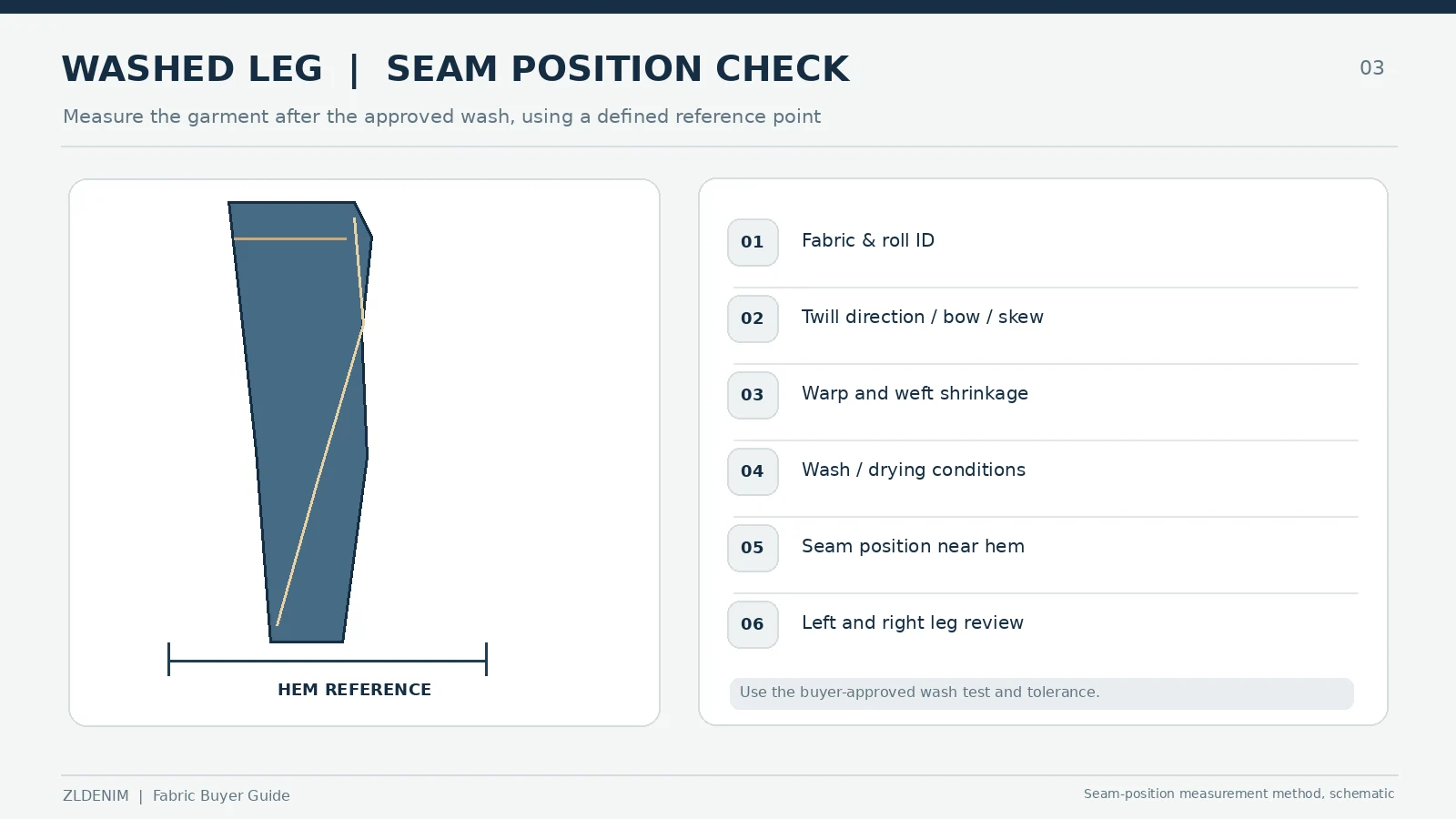
Record the seam position and key measurements before washing. After the intended wash and conditioning, check the jeans flat and on a fit model. Measure seam displacement using a defined reference point; do not rely only on “looks twisted.”
| Record | Why It Helps |
|---|---|
| Fabric style, roll and dye lot | Ties results to the proposed material |
| Twill type and bow/skew record | Helps assess construction and finishing |
| Warp and weft shrinkage | Connects dimensional changes to pattern needs |
| Pattern grainline and cutting lay | Controls garment-making variables |
| Wash recipe and drying | Makes testing reproducible |
| Seam position before and after wash | Measures the actual problem |
| Left-versus-right leg result | Detects asymmetric garment behavior |
For example, a factory might measure lateral displacement of the side seam at a stated distance above the hem. The acceptable tolerance must be agreed with the buyer for that garment size and style. There is no universal centimeter limit suitable for all jeans.
8. Is Leg Twist Always a Quality Defect?
No. Heritage denim brands sometimes accept a degree of seam rotation associated with traditional raw denim. For clean dark-rinse jeans or tailored-looking pants, the same visual effect may be unacceptable.
A practical purchase order identifies the intended washed appearance, measurement method and permissible tolerance. If the buyer only writes “no leg twist,” the mill and garment factory may interpret the condition differently. A retained washed master garment and technical measurements can reduce ambiguity.
9. Questions to Send Your Denim Supplier
Before ordering a sensitive jeans program, ask for the twill direction, fabric finishing, usable width, applicable bow/skew information and warp/weft dimensional stability data. Request sample yardage if the final result cannot be assessed without a garment wash trial.
We are sourcing dark-indigo denim for straight-leg jeans and need controlled side-seam position after washing. Please confirm twill construction, finishing, available bow/skew and shrinkage information, and sample yardage options. Our factory will evaluate the proposed lot using our intended garment wash before bulk fabric approval.
This is more actionable than assuming the side seam will stay straight because the fabric is sanforized.
Frequently Asked Questions
Why do jeans side seams twist after washing?
Twill behavior, fabric relaxation, bow/skew, cutting orientation, sewing tension and wash conditions can all contribute.
Is leg twist associated with right-hand twill?
Right-hand twill has directional construction, but the amount of finished twist depends on the entire fabric and garment process.
Does sanforization eliminate leg twist?
No. It helps control dimensional change but does not guarantee perfectly straight finished seams.
Is all fabric skew a defect?
No. Controlled pre-skew can be applied during finishing to reduce subsequent twisting.
Can washing correct already twisted jeans?
Changing the process may change the appearance, but it cannot be relied on to correct an unsuitable fabric or cutting method. Prevention and a trial wash are preferable.
Source Denim for Controlled Washed Performance
Leg-twist control is a combined fabric and garment-development decision. Explore the ZLDENIM Cotton & Rigid Denim collection and our Fabric Catalog. To run a relevant trial, ask about Samples or send your preferred construction, wash direction and testing requirements through ZLDENIM Sourcing. Available materials and technical information are confirmed for each specific inquiry.