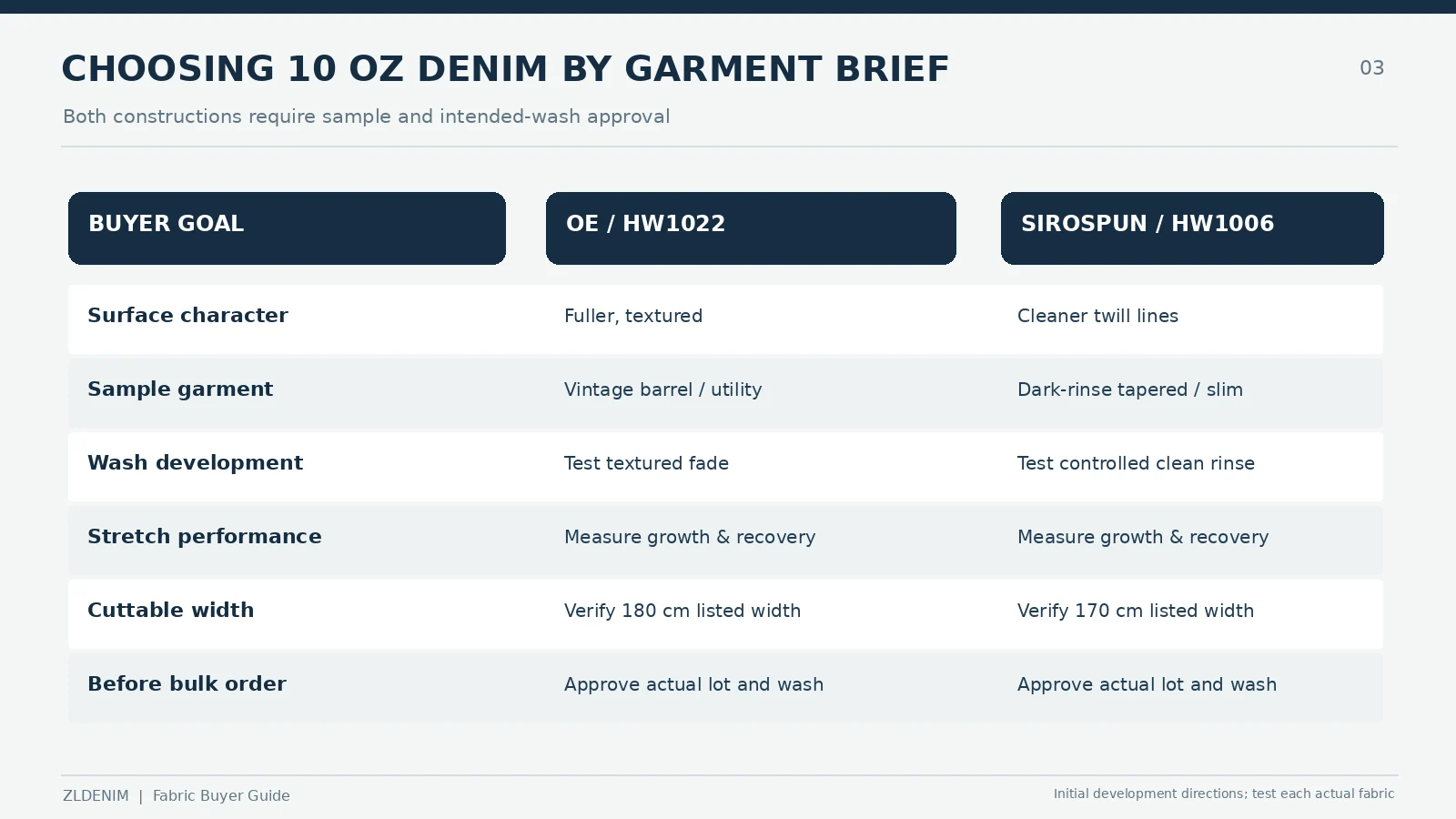
Two denim fabrics have the same published weight: 10oz. Both contain 65% cotton, 33.5% polyester and 1.5% spandex. Both are medium-stretch 3/1 right-hand twill. Yet one has a fuller, more textured appearance while the other looks cleaner and more defined.
Which one should a jeans brand purchase?
The answer depends on the finished garment, not a claim that one spinning method is universally better. A vintage-washed barrel jean may benefit from one surface direction, while a clean dark-rinse tapered jean may call for another. Width, cutting yield, growth, recovery and wash performance also affect the final commercial decision.
To make the comparison concrete, this guide uses two existing ZLDENIM fabrics: HW1022 Open-End (OE) denim and HW1006 Sirospun denim.
1. What Is Open-End (OE) Denim?
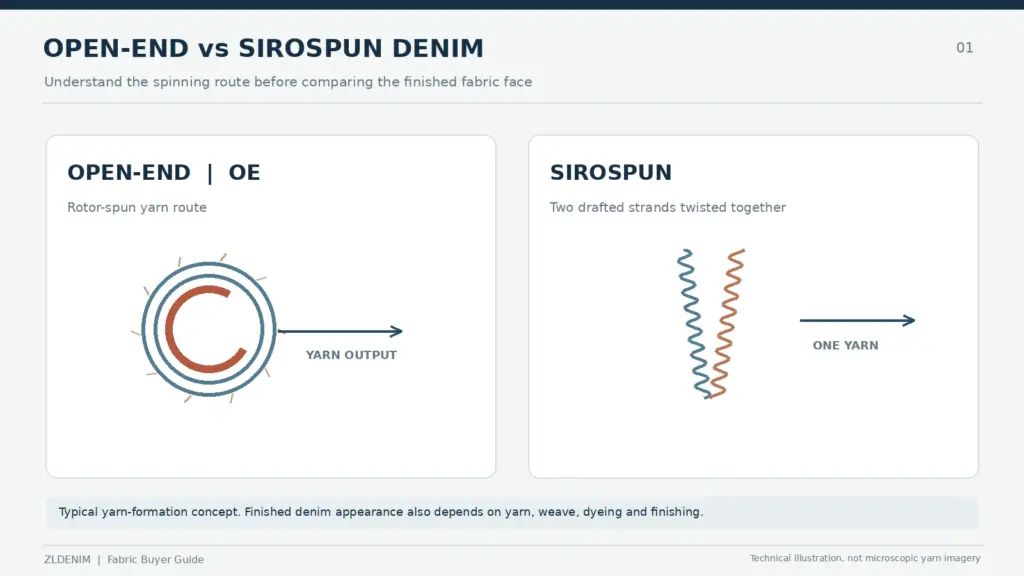
Open-end spinning, often called rotor spinning, creates yarn using a rotor-based process. Its yarn structure differs from conventional ring-spun yarn, and the final appearance depends on fiber, yarn count, twist and finishing.
In denim applications, OE yarn can contribute to a fuller or grainier surface character. Designers often evaluate this direction for casual vintage jeans, relaxed trousers and selected workwear-inspired styles.
However, OE does not automatically mean low quality, weak fabric or a rough handfeel. A high-quality fabric cannot be identified from its spinning category alone. Buyers need the actual cloth, test results and the wash they intend to use.
Where an OE Surface Can Be Useful
If the collection wants a visible vintage grain, a relaxed leg or a less polished look, an OE fabric deserves consideration. Barrel jeans, utility trousers and casual tapered jeans are possible uses. The fabric must still have suitable body and recovery for the pattern.
2. What Is Sirospun Denim?
Sirospun yarn is produced by feeding two drafted fiber strands into a combined spinning process. This construction can lead to a controlled yarn surface and, under appropriate conditions, lower hairiness compared with some conventional alternatives.
In denim, the result may be a cleaner face and more clearly defined twill diagonal. That makes Sirospun fabric useful to sample for neat indigo trousers, dark-rinse jeans, slim or tapered silhouettes and certain refined casual designs.
The spinning method itself does not guarantee specific tensile strength, pilling resistance or a particular washed result. Actual yarn conditions, weaving density and finishing determine whether these advantages appear in a given product.
3. OE vs Sirospun: A Buyer Comparison
| Buying Factor | Open-End (OE) | Sirospun |
|---|---|---|
| Yarn process | Rotor spinning | Paired-strand Sirospun process |
| Typical surface direction | Fuller, more visibly textured | Cleaner, more controlled face |
| Twill character | Often casual or grainy | Often more defined |
| Design starting point | Relaxed, workwear and vintage jeans | Refined, dark-rinse and tailored casual jeans |
| Washed fade | Must be evaluated on the actual fabric | Must be evaluated on the actual fabric |
| Strength and pilling | Require comparable testing | Require comparable testing |
| Stretch and recovery | Determined by complete construction | Determined by complete construction |
| Garment cost | Depends on meter price, usable width and yield | Depends on meter price, usable width and yield |
These are sampling directions, not rules proving that every OE denim is more textured than every Sirospun denim. Different finishing and yarn configurations can change the apparent ranking.
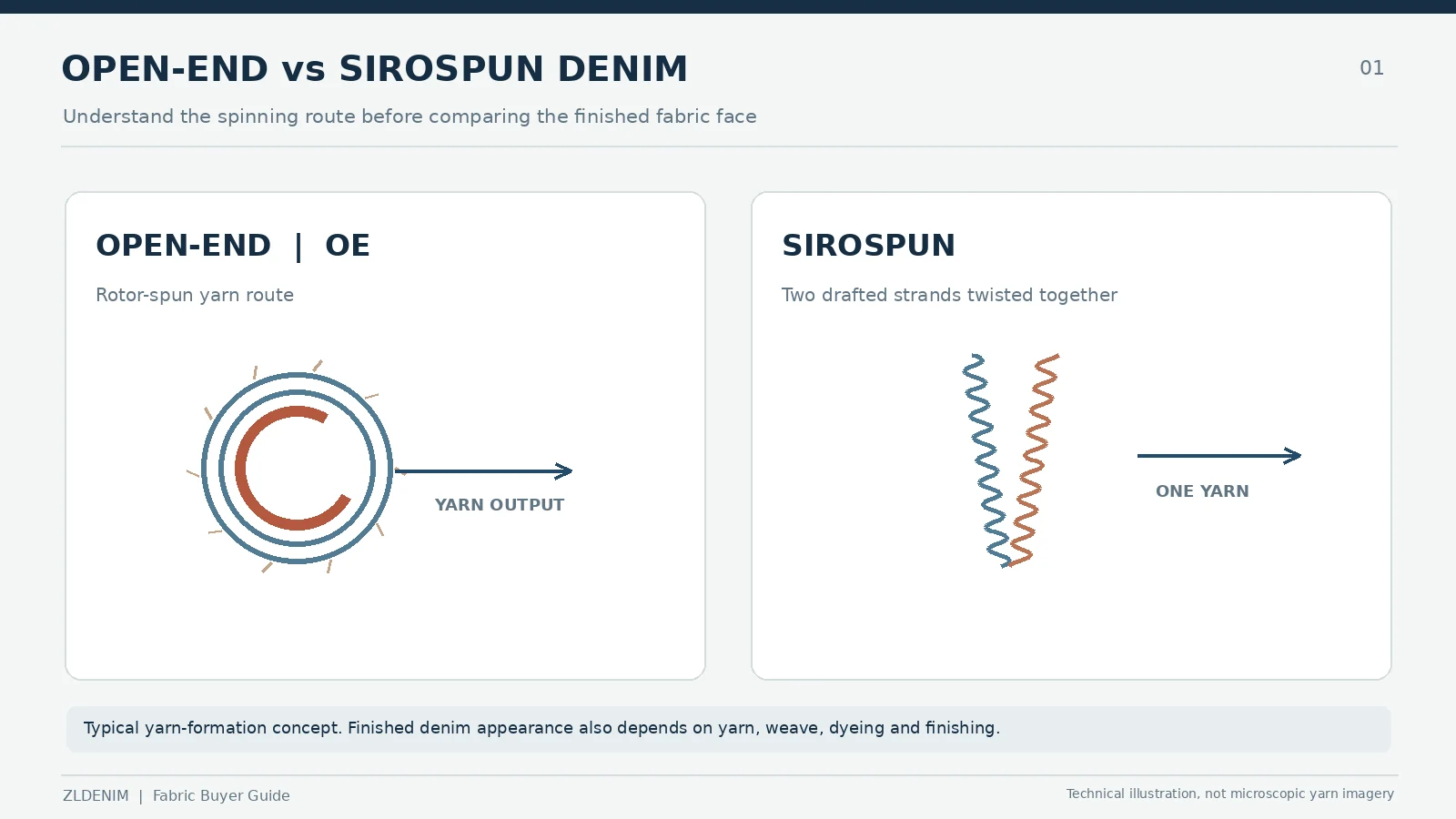
4. Real ZLDENIM Comparison: HW1022 vs HW1006
Comparing two actual styles helps separate the yarn question from unrelated specifications. HW1022 and HW1006 share several major published features but differ in spinning construction and listed width.
| Specification | HW1022 — OE Denim | HW1006 — Sirospun Denim |
|---|---|---|
| Weight | 10oz / 339 GSM | 10oz / 339 GSM |
| Fiber composition | 65% cotton / 33.5% polyester / 1.5% spandex | 65% cotton / 33.5% polyester / 1.5% spandex |
| Stretch | Medium stretch | Medium stretch |
| Weave | 3/1 right-hand twill | 3/1 right-hand twill |
| Yarn construction | Open-End (OE) | Sirospun |
| Nominal width | 180cm / 70.9 inches | 170cm / 66.9 inches |
| Published color options | 11 colors | Indigo / dark blue / black |
| Surface direction | Fuller, vintage grain | Cleaner, defined twill |
HW1022: 10oz Medium-Stretch OE Denim
HW1022 is a 10oz medium-stretch open-end denim with a published width of 180cm. Its fuller surface is worth considering for relaxed jeans, barrel-leg jeans and casual vintage-wash projects. It has 11 listed color options; the actual available colors, lots and quantities must be checked when the buyer inquires.
The most useful question is how its surface character changes under the intended garment wash. For a faded program, the buyer may welcome the texture; for a very clean rinse, it may not be the desired appearance.
HW1006: 10oz Medium-Stretch Sirospun Denim
HW1006 shares the same listed weight, fiber proportions, medium-stretch classification and 3/1 twill structure, but uses Sirospun yarn and has a published width of 170cm.
The cleaner face and defined twill direction make it a candidate for dark-rinse tapered jeans, refined slim jeans and collections emphasizing a neat surface. The result should be judged using actual material and a representative wash, not by the product description alone.
5. Does the 10cm Width Difference Change the Cost?
It can. HW1022 is listed at 180cm; HW1006 at 170cm. The additional nominal width gives pattern makers more horizontal room, but it does not create an automatic 10cm saving per garment.
The factory needs actual cuttable width, a graded jeans pattern, cutting restrictions and a marker calculation for both fabrics. A wider fabric might use fewer meters, but the difference only saves money if it offsets the actual price difference.
Fabric Cost per Pair = Fabric Price per Linear Meter × CAD Marker Consumption per Pair
Also consider losses associated with unusable edges, shrinkage, defects and shade segregation. The Denim Fabric Width Cost Guide walks through a numerical example.
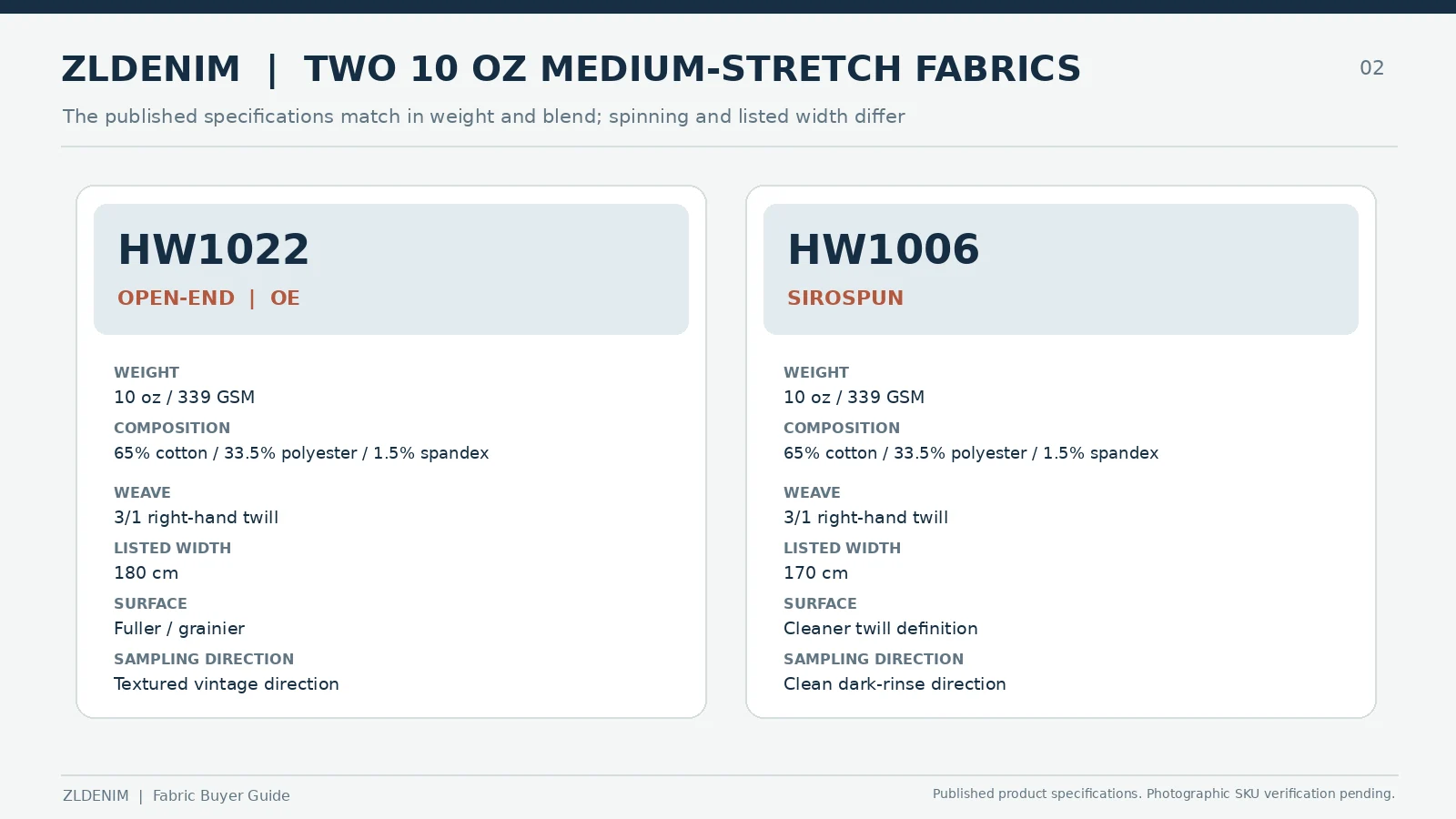
6. Which 10oz Denim Works for Different Jeans Designs?
Clean Dark-Rinse Tapered Jeans
Start by evaluating HW1006 when a tidy indigo surface and defined diagonal twill are priorities. Confirm the final wash shade, fit and recovery before approving the garment.
Vintage-Washed Barrel Jeans
HW1022 is worth sampling when the design calls for a fuller surface and relaxed texture. Barrel silhouettes also require adequate body to retain the curve, so test the sewn and washed sample rather than selecting based on yarn name alone.
Refined Slim Jeans
A cleaner Sirospun surface may align with the intended visual direction. For closer fits, actual extension, knee growth and recovery are more important than appearance alone.
Workwear-Inspired Casual Trousers
The textured direction of HW1022 may suit utility styles, depending on the desired handfeel and wash. Confirm abrasion, seam performance and dimensional stability where the order requires those properties.
Cost-Sensitive Production
Do not assume the OE fabric is always cheaper. Compare confirmed current meter prices and marker consumption. Two fabrics at the same ounce weight can have different garment costs because width and cutting yield differ.
7. Compare Both Fabrics After the Intended Wash
The meaningful selection stage happens after sampling. Rinse, enzyme and heavier vintage treatments may change the appearance of these two 10oz fabrics in different ways. Their surface textures can become more or less visible; color depth, strength, handfeel and dimensional change can also shift.
Ask the garment factory to record five results for both styles using comparable conditions:
- Appearance: Which surface best matches the intended design?
- Color and cast: Is the washed shade approved?
- Shrinkage: What warp and weft pattern adjustments are needed?
- Stretch and recovery: Does the garment retain the correct knee and seat shape?
- Strength and sewing: Does the material perform under the planned wash and construction?
The shared 1.5% spandex content does not mean that measured extension and recovery are identical. Do not invent uniform shrinkage or strength advantages for either product without testing.
8. How Buyers Should Request Comparative Samples
For the most reliable decision, use the same garment pattern and controlled sample process. Ask for genuine HW1022 and HW1006 fabric in the appropriate color direction, evaluate the original face and then make washed prototypes. Keep records of lot references and wash conditions.
A useful sourcing email is:
We are developing 10oz medium-stretch jeans and would like to compare OE and Sirospun denim. Our planned fit is [barrel / tapered / slim], with a [dark rinse / enzyme vintage wash]. Please confirm current color options, stock lots, usable width and sample availability for HW1022 and HW1006. We want to evaluate both fabrics after the intended garment wash before choosing a bulk style.
This makes the expected appearance and testing needs clear enough for the supplier to respond with relevant options.
Frequently Asked Questions
Is OE denim always lower quality than Sirospun?
No. The spinning processes produce different yarn characteristics. Quality depends on the full fabric specification and intended use.
Is Sirospun always stronger than OE denim?
Not automatically. Comparable strength and abrasion tests of the actual fabrics are needed before making a performance claim.
Which is better for vintage-washed jeans?
OE denim is worth testing when a fuller, textured visual effect is wanted, but the result depends on yarn, finish and wash.
Which is more suitable for clean dark-rinse jeans?
Sirospun denim is a useful first sample when a cleaner surface and defined twill are desired.
Do HW1022 and HW1006 have identical stretch?
They share 1.5% listed spandex and a medium-stretch label, but measured extension, growth and recovery still require testing.
Compare HW1022 and HW1006 With ZLDENIM
Select the finished jeans look first, then compare actual fabric rather than buying on the spinning label alone. Review HW1022 Open-End Denim and HW1006 Sirospun Denim.
Browse the Stretch Denim collection, request appropriate Samples or send your garment reference, quantity and target wash through Denim Sourcing. Current lots, sample arrangements and availability are confirmed for each inquiry.