
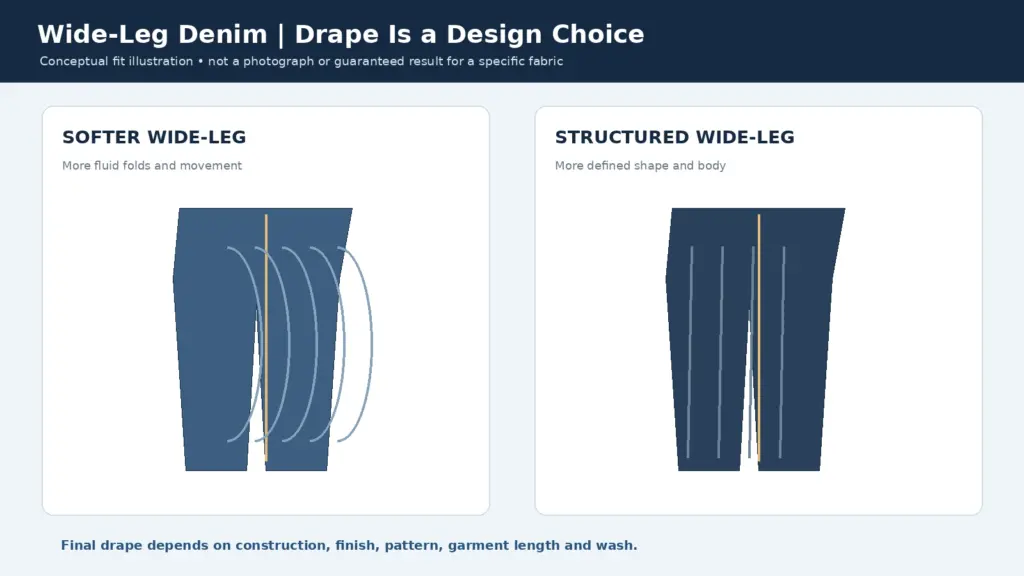
A fashion brand wants to develop a pair of wide-leg denim trousers. The design has a high waist, generous leg volume and soft folds that move naturally when the wearer walks.
The factory produces the first sample using firm cotton denim. The garment holds its shape, but the legs stand away from the body more than the designer wants.
The next question is whether lyocell denim drape would produce a more fluid silhouette.
For wide-leg trousers that need soft movement rather than a stiff, sculptural shape, lyocell denim fabric is worth sampling.
The decision is not just about choosing a different fiber. Buyers must consider fabric weight, bending stiffness, weave, finishing, leg-panel geometry, seam stability and washing performance.
Using ZLDENIM’s HW1210 8.5oz lyocell denim as a real example, this guide explains how to develop the right wide-leg silhouette while controlling production and cutting costs.
Why Lyocell Denim Drape Matters in Wide-Leg Pants
Wide-leg pants use a larger volume of fabric around the leg than slim or straight trousers.
That extra material creates folds, which become an important part of the finished silhouette.
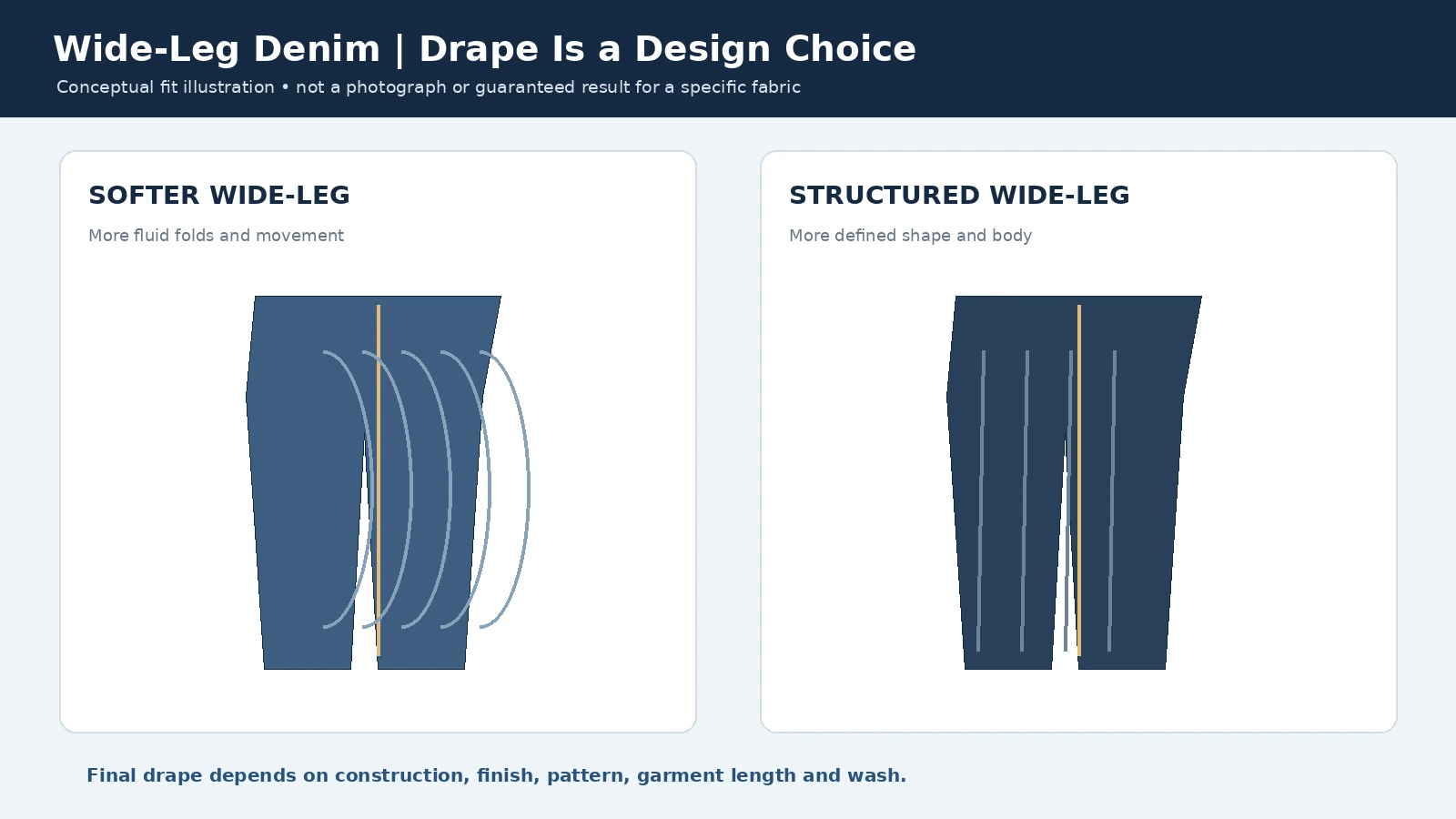
A firm fabric may produce wider, more architectural folds. A more fluid fabric may fall closer to the body and move with softer, narrower folds.
Neither is automatically better. The correct choice depends on the fashion design.
Soft, Flowing Wide-Leg Trousers
For a fluid style, buyers should prioritize the way the fabric bends, hangs and moves.
Lyocell denim can be a useful starting point because suitable constructions often have a softer hand and more flowing drape.
The final fabric still needs enough body to maintain the intended leg shape and waistband appearance.
Structured Wide-Leg Jeans
Some wide-leg jeans are designed to look substantial and sculptural.
These may benefit from a firmer rigid denim, particularly if the brand wants the garment to maintain a broad silhouette when worn.
In this case, selecting a softer fabric purely because it feels luxurious may produce the wrong effect.
Barrel-Leg vs Conventional Wide-Leg
A barrel-leg jean typically uses deliberate pattern shaping to create curved leg volume. A conventional wide-leg trouser may rely more on a broad straight or flared panel.
Lyocell denim can suit either concept, but the pattern maker must check how the actual fabric behaves.
An extremely fluid fabric may soften the sculptural effect of a barrel leg. For conventional flowing wide-leg pants, that softness may be desirable.
2. Is 8.5oz Lyocell Denim a Good Starting Weight?
An 8.5oz fabric weighs approximately 288–290 GSM.
This makes it lighter than many traditional 12–14oz jeans constructions, although the exact handfeel depends on yarn, weave and finishing.
For wide-leg trousers, 8.5oz is a useful weight to evaluate when the design needs fluid movement without abandoning the appearance of woven denim.
How Weight Affects the Garment
| Development Factor | Softer 8.5oz Direction | Firmer 12oz-Class Direction |
|---|---|---|
| Leg movement | Often more fluid | Often more structured |
| Fold appearance | Softer, flowing folds | More defined folds |
| Garment mass | Lower at comparable pattern area | Higher at comparable pattern area |
| Waistband appearance | May need additional structure | May hold a firmer shape |
| Pocket construction | Check local support and stability | Check seam bulk and shape |
| Best starting concept | Draped wide-leg trousers | Structured wide-leg jeans |
These are development directions. Two fabrics of the same weight may have different drapes, so evaluate physical samples before finalizing the pattern.
3. Real ZLDENIM Example: HW1210 8.5oz Lyocell Denim
ZLDENIM’s HW1210 is a suitable product to evaluate for fluid wide-leg trousers.
| Specification | HW1210 |
|---|---|
| Fabric | Lyocell Denim |
| Weight | 8.5oz / approximately 290 GSM |
| Composition | 100% lyocell |
| Recorded width | 170cm |
| Color | Deep Blue |
| Weave | 3/1 right-hand twill |
| Yarn character | Ring-slub construction |
| Suggested development | Wide-leg and relaxed trousers |
View HW1210 – 8.5oz Lyocell Denim
HW1210 offers a useful combination of denim appearance, moderate fabric weight and the potential for a softer, more fluid silhouette.
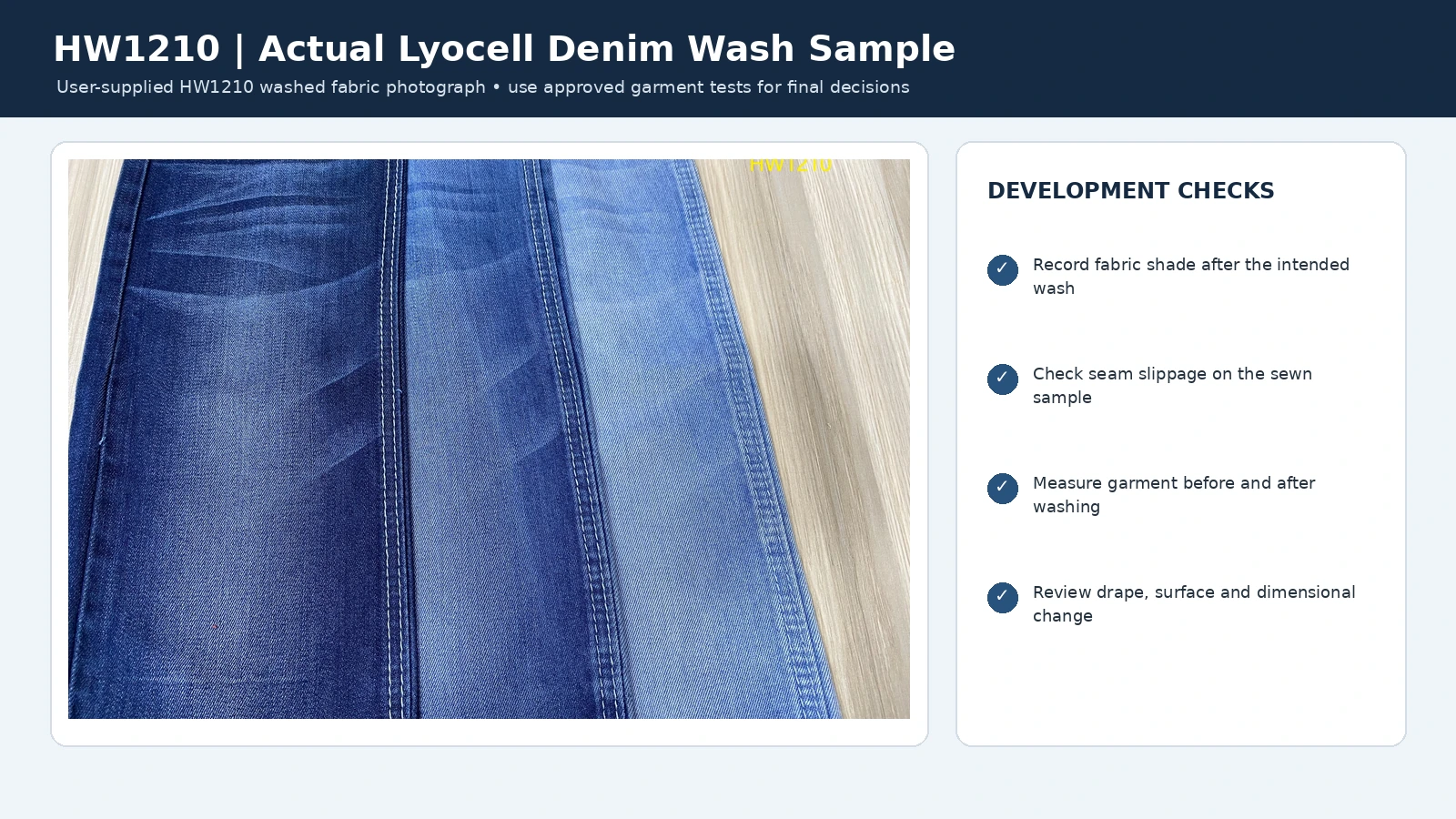
For development, first compare its original drape against the approved garment reference. Then sew a representative leg panel, wash it using the intended production recipe and review the finished shape.
How to Evaluate HW1210’s Drape
Use the actual fabric rather than relying only on a product photograph.
A practical process is to hang a sufficiently large sample panel vertically, allowing the fabric to settle without unnecessary tension.
Observe the fold size and how quickly the fabric falls back into position after movement. Photograph the sample under consistent conditions so the designer can compare it with other candidates.
For a more useful garment-level test, sew one leg or a complete pair of trousers using the proposed pattern.
Check the silhouette from the front, side and back while the model stands and walks.
This helps the buyer separate fabric-drape problems from pattern-shaping problems.
4. Pattern Design Matters as Much as Fabric Softness
The same fabric can produce very different wide-leg trousers depending on the pattern.
Consider the waist and hip fit, leg circumference, rise, inseam and side-seam shape.
A wider leg creates more fabric area, which changes the location and appearance of folds.
High-Waisted Wide-Leg Pants
A soft denim may provide attractive movement through the legs while requiring a more structured waistband.
The factory can evaluate a suitable waistband construction or interfacing during sampling.
The objective is to maintain the approved waist shape without making the garment excessively stiff.
Relaxed Utility-Inspired Wide-Leg Pants
For a style with large pockets or flap details, consider how the soft fabric handles added weight.
If a pocket pulls the leg panel downward, the designer may need to revise the pocket size, attachment position or local reinforcement.
Choose construction adjustments that preserve the garment’s desired drape.
Flowing Wide-Leg Pants
For a fluid silhouette, evaluate the hem as well as the upper leg.
A deep hem adds material and can change the way the bottom of the garment hangs.
Test the proposed hem construction before bulk cutting so the finished trousers maintain the intended movement.
5. Seam Slippage and Soft Denim: What Should the Factory Test?
Lyocell denim is often considered for its soft feel, but garment construction must still meet the loading requirements.
In woven fabrics, seam slippage occurs when fabric yarns move beside the stitch line under force.
A wide-leg trouser can appear relaxed through the leg yet still place considerable stress on the hip and seat seams during sitting.
Focus on the High-Stress Areas
For HW1210 trousers, begin with the seat seam, crotch, hip and side seams.
Prepare sewn samples using the intended seam allowance, needle, thread and stitch density. Compare the original construction with a suitable reinforced alternative if the first trial reveals excessive yarn movement.
A technical team can use ISO 13936-2 for seam-slippage assessment when the buyer’s quality requirements call for laboratory testing.
Test After the Planned Wash
Garment washing can change fabric handfeel and yarn interaction.
If the design uses enzyme washing or silicone softening, repeat the relevant seam checks after the treatment.
A seam that works well before washing should also meet the garment’s requirements in the final finished condition.
Reinforcement Without Losing Drape
Stay tape or local reinforcement may be useful at selected seams. However, reinforcement should be narrow and placed where it is needed.
A large stiff strip can change the garment’s appearance, especially in a flowing design.
Test the complete garment before approving the sewing method.
6. How Washing Affects Wide-Leg Shape and Length
Washing can change both the length and width of lyocell denim garments.
For wide-leg trousers, length changes affect where the hem falls and how the leg moves around the shoe.
Width changes can alter the volume and fold pattern.
The factory should develop the paper pattern using measurements from the actual planned wash rather than relying on an unwashed fitting alone.
A Practical Shrinkage Allowance Example
Suppose a sample trouser has a target finished inseam of 76cm, and the fabric develops 3% lengthwise shrinkage under the approved wash.
The theoretical pre-wash dimension is:
76cm ÷ (1 − 0.03) = 78.35cm
The 3% is an illustrative test result, not a published HW1210 value.
In garment production, the factory should verify the actual change at the relevant measurement points and adjust the pattern accordingly.
For wide-leg styles, also check the finished leg opening and knee width. The pattern and grade rules should preserve the intended silhouette across different garment sizes.
7. Why HW1210’s 170cm Width Matters to Cost
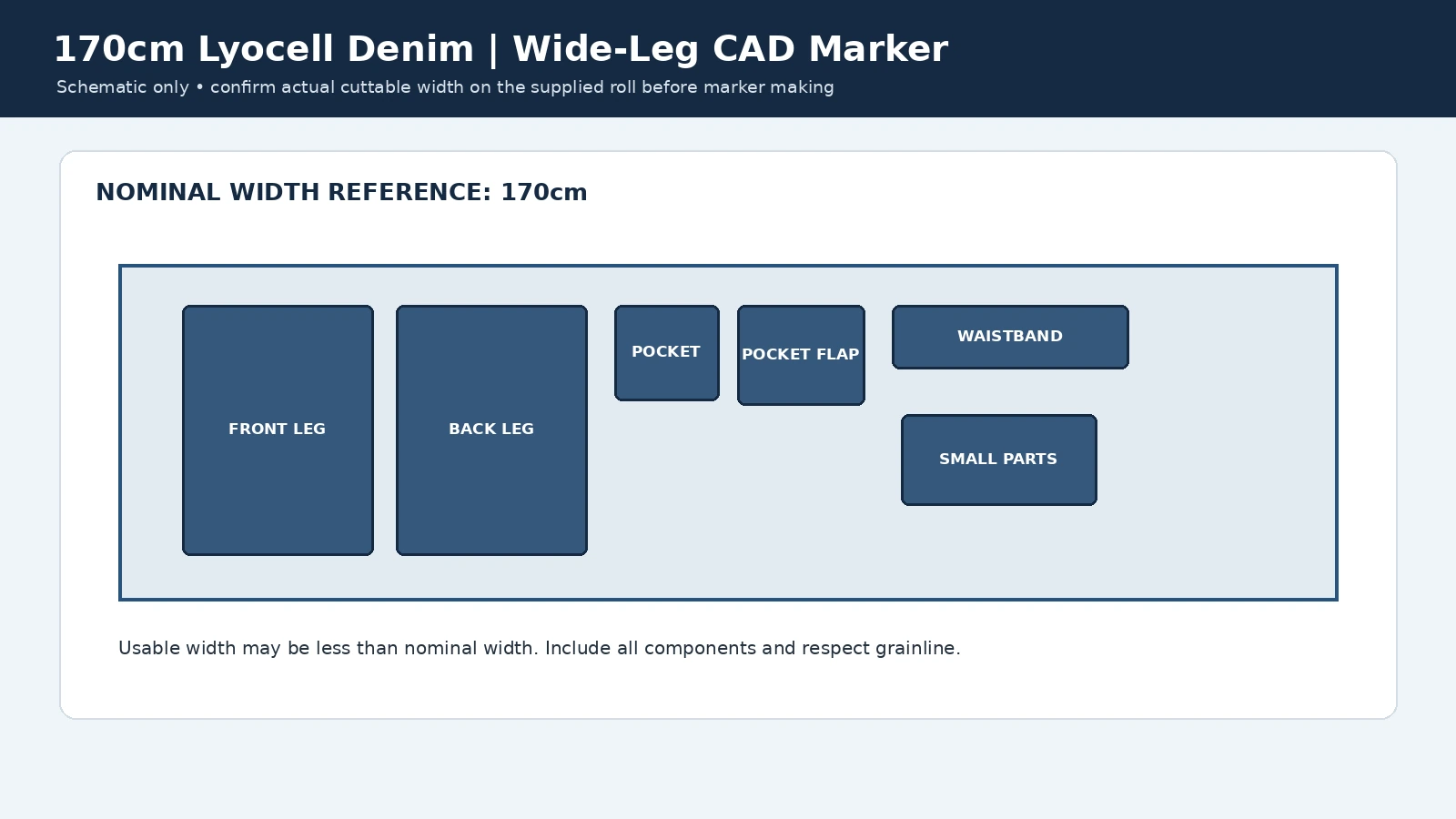
Wide-leg trousers use broad front and back leg panels.
These larger pieces can reduce the flexibility of the CAD cutting layout, especially when the available width is limited.
HW1210 has a recorded width of 170cm, but the marker should use the actual cuttable width measured for the proposed fabric.
A Simple Marker Comparison
Imagine a factory comparing two otherwise suitable fabrics for the same wide-leg pattern.
| Illustrative Costing Item | 170cm Nominal Fabric | 180cm Nominal Fabric |
|---|---|---|
| Example cuttable width | 166cm | 176cm |
| Example marker consumption | 1.48m/pair | 1.35m/pair |
| Hypothetical price per meter | $5.80 | $5.80 |
| Fabric cost per pair | $8.58 | $7.83 |
These values illustrate CAD costing. They are not actual HW1210 prices or measured marker results.
The wider fabric saves approximately $0.75 per pair in this hypothetical case.
But the advantage only exists if the wider fabric also meets the desired drape, appearance and garment quality.
A cheaper cutting marker is not a useful saving when the finished trousers fail the design brief.
How to Improve Marker Efficiency
Ask the cutting department to use the actual graded size ratio and respect the fabric grainline.
Do not rotate large leg panels against the required grain direction simply to improve the marker percentage.
If the pattern includes pleats, waistbands or pockets, include all those pieces in the cost calculation.
8. A Five-Step Production Approval Process
Before committing to bulk fabric, use a straightforward development sequence.
Step 1 — Define the silhouette. Decide whether the garment needs flowing folds, a structured leg or a combination of both.
Step 2 — Review the fabric. Compare HW1210 against the intended handfeel and surface appearance.
Step 3 — Sew the garment. Check drape, waistband structure, seam performance and hem behavior.
Step 4 — Wash and refit. Record dimensional changes and inspect the finished silhouette.
Step 5 — Calculate production cost. Use cuttable width, the graded CAD marker and the actual fabric quotation.
The final choice should satisfy appearance, manufacturing and cost requirements together.
9. What to Send Your Lyocell Denim Supplier
A detailed sourcing request allows the supplier to check the most relevant option.
We are developing women’s high-waisted wide-leg denim trousers with a soft, flowing silhouette.
We would like to evaluate HW1210 8.5oz lyocell denim in deep blue. Please advise current available lots, usable width, sample yardage and price per meter.
Our factory will test the intended garment wash, seat-seam stability and finished leg drape before bulk cutting.
Estimated quantity: [meters]. Destination: [country].
Send Your Wide-Leg Denim Inquiry
Frequently Asked Questions
Is lyocell denim good for wide-leg pants?
Yes. Suitable lyocell constructions can provide fluid drape and soft movement. The final result depends on the actual fabric and garment pattern.
Is 8.5oz denim too heavy for flowing trousers?
Not necessarily. An 8.5oz lyocell denim may create a fluid silhouette, depending on its yarn structure, weave and finishing.
Can HW1210 be used for structured wide-leg jeans?
It may be worth testing, but a firmer fabric could be more suitable when the design requires pronounced, sculptural folds.
Does lyocell denim require special sewing?
It requires sewing settings appropriate to the actual fabric and garment. Pay particular attention to stressed seams, needle selection and the planned wash.
How does 170cm width affect fabric consumption?
The pattern maker should calculate consumption using the cuttable width. Broad leg panels can make marker efficiency sensitive to relatively small width differences.
Should lyocell wide-leg pants be tested after washing?
Yes. A finished-garment wash trial helps determine the correct inseam allowance, leg width, drape and seam construction.
Source Lyocell Denim for Wide-Leg Pants
For flowing denim trousers, the right fabric should deliver attractive movement while maintaining a stable garment construction.
HW1210 offers an 8.5oz, 100% lyocell starting point for development.
Review HW1210 Lyocell Denim, or explore the ZLDENIM Lyocell Collection.
For broader fiber comparisons, see Lyocell Denim vs Cotton Denim.
To obtain sample information and a quotation, contact ZLDENIM Sourcing.