
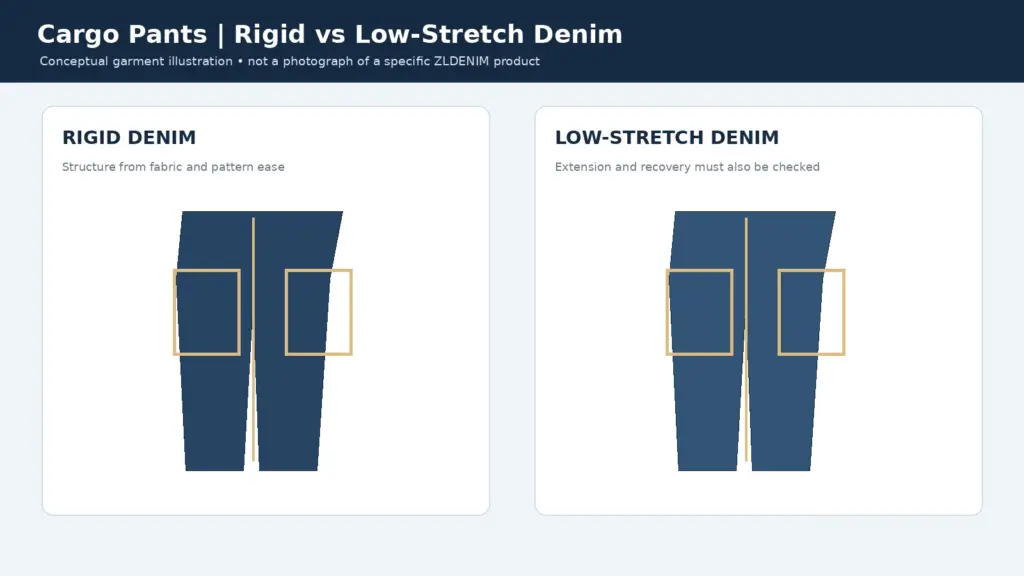
A clothing brand is developing denim cargo pants with large thigh pockets, a relaxed fit and a structured workwear appearance.
The designer wants the pockets to hold their shape. The fitting team wants comfortable movement, and the garment factory wants a material that will not create excessive sewing bulk.
Should the brand choose rigid denim or low-stretch denim?
The best denim fabric for cargo pants depends on whether the design needs maximum structure, additional movement or a balance of both.
Rigid and low-stretch constructions can both produce successful cargo pants. The difference becomes clearer when buyers evaluate the actual pocket design, garment fit, washing behavior and total fabric cost.
Using HW703, HW704 and C1744 from ZLDENIM, this guide explains how to make that decision before bulk production.
1. What Makes Cargo Pants Different from Ordinary Jeans?
Cargo pants usually contain more fabric components than conventional five-pocket jeans.
Large thigh pockets, pleats, flaps, reinforced corners and utility details can add both fabric consumption and concentrated stress.
A large pocket also affects the leg silhouette.
If the material is too soft for the intended design, the pocket may collapse or hang downward. If the fabric is excessively stiff, the added layers can create uncomfortable folds or bulky seams.
The right fabric must support the design while allowing the garment to move as intended.
Pocket Structure
Box-shaped cargo pockets generally need sufficient fabric body or suitable construction to maintain their appearance.
A softer fabric may be ideal for relaxed, flowing utility trousers, but a structured streetwear design may need a firmer material.
Movement
The hip, crotch and knee areas experience repeated bending and stretching during wear.
A relaxed pattern can provide much of the necessary ease. A closer-fitting utility style may benefit from modest additional fabric stretch.
Sewing Complexity
Cargo pants can have more overlapping fabric layers than ordinary jeans.
The sewing team should inspect the thickest intersections early, especially where pockets, side seams and flaps overlap.
2. Rigid vs Low-Stretch Denim: Which Is Better?
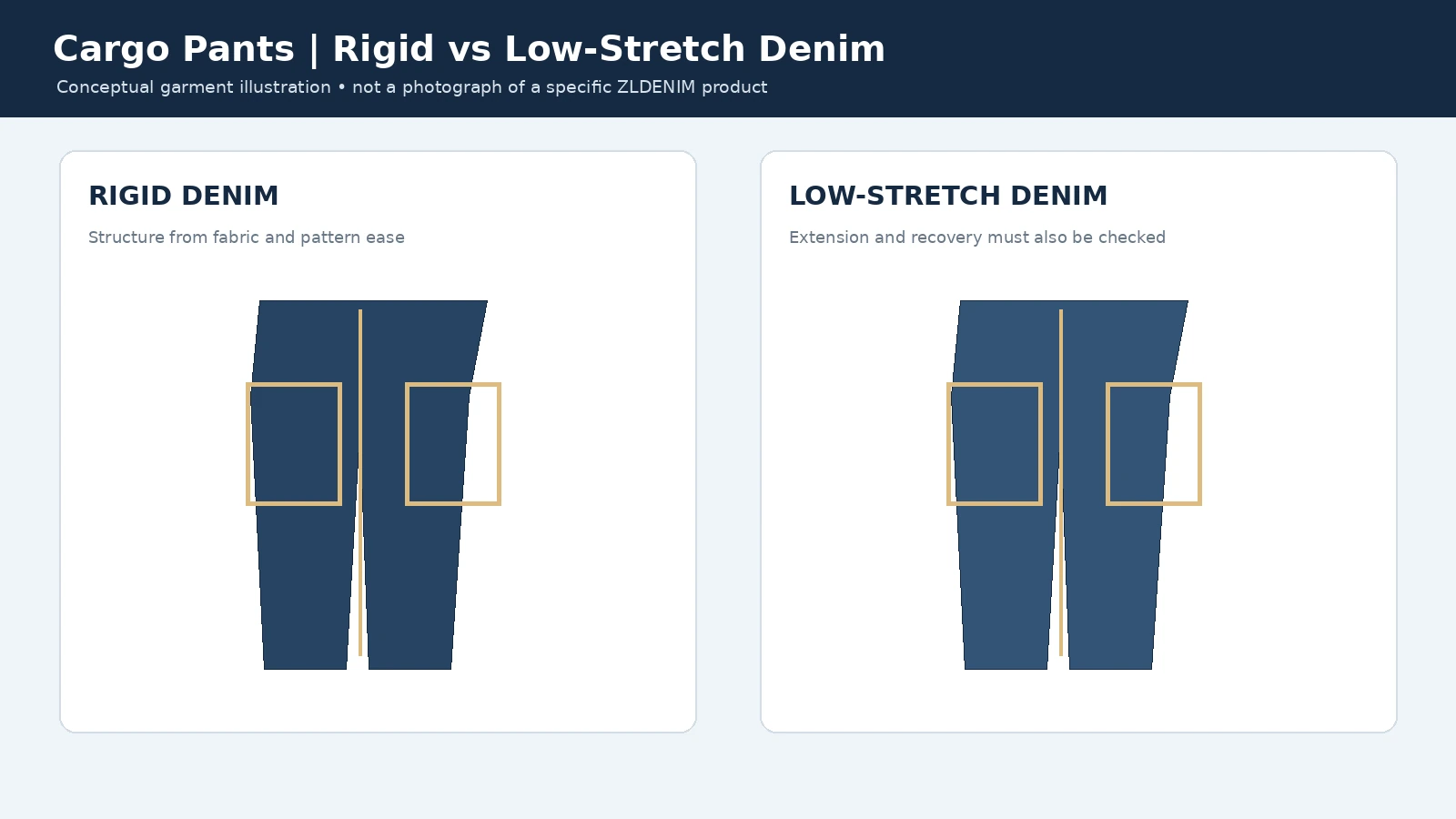
Rigid denim and low-stretch denim solve different garment-development problems.
| Buying Factor | Rigid Denim | Low-Stretch Denim |
|---|---|---|
| Main design direction | Defined structure | Structure with added flexibility |
| Movement | Relies mainly on pattern ease | Uses pattern ease plus fabric extension |
| Pocket shape | Can support a firm silhouette | Depends on fabric body and recovery |
| Knee and seat fit | Evaluate pattern and washed dimensions | Also evaluate stretch growth and recovery |
| Cutting process | Check width and shrinkage | Check width, relaxation and spreading tension |
| Suitable cargo styles | Relaxed workwear and structured streetwear | Everyday utility and closer-fitting cargo jeans |
Choose Rigid Denim When the Pattern Provides Enough Ease
For oversized and relaxed cargo pants, the garment may have sufficient room for sitting, walking and bending without engineered stretch.
In that situation, rigid denim is a useful starting point.
The fabric’s structure may also support pronounced folds, box-shaped pocket panels and a substantial workwear appearance.
Choose Low-Stretch Denim When the Fit Needs More Movement
Low-stretch denim can help when the cargo pants are relatively fitted around the waist, hips or thighs while retaining a relaxed leg silhouette.
The additional extension may improve comfort.
However, the factory should test fabric growth and recovery so that the garment maintains the intended appearance after movement.
A pocket attached to a stretch panel may behave differently from one attached to a rigid fabric, particularly under load.
3. Three Real ZLDENIM Fabrics to Compare
ZLDENIM offers three relevant fabric directions for cargo-pants development.
| Style | Main Specification | Development Direction |
|---|---|---|
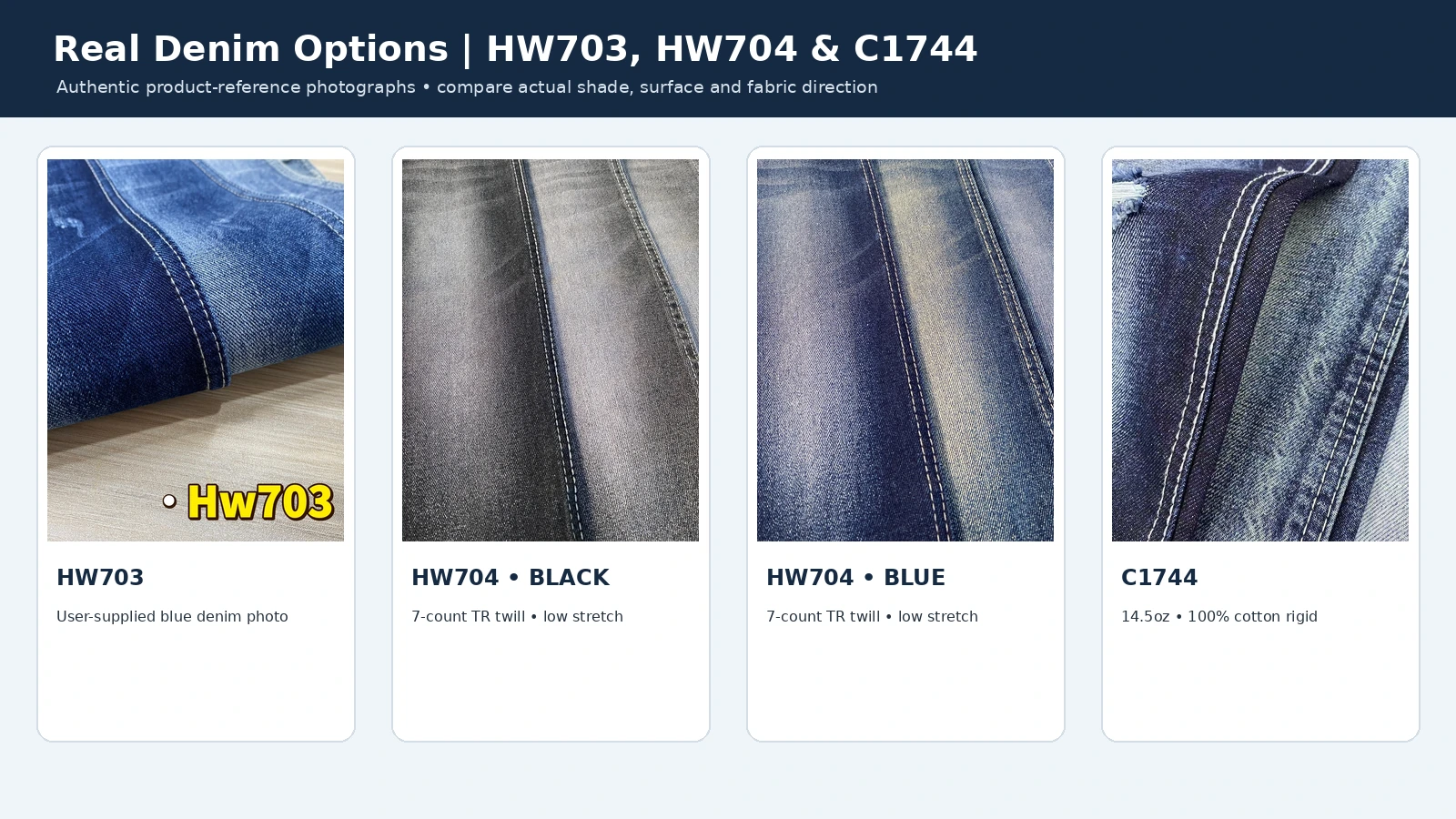
| HW703 | 13oz rigid, 80% cotton / 20% polyester, 180cm width | Structured everyday cargo pants |
| HW704 | 13oz low-stretch denim | Cargo pants needing modest added movement |
| C1744 | 14.5oz rigid, 100% cotton, 168–172cm width | Heavyweight heritage-style cargo pants |
HW703 — 13oz Open-End Rigid Denim
HW703 contains 80% cotton and 20% polyester, with a recorded weight of 13oz and width of 180cm.
Its rigid construction is worth evaluating for cargo pants that need a defined appearance without moving to a substantially heavier denim.
For a relaxed utility design, make a sample with the actual thigh-pocket dimensions and intended seam construction.
Then assess pocket stability, garment movement and washed appearance.
The cotton-polyester composition is useful as another construction option to compare with 100% cotton denim, particularly when the brand has specific dimensional or strength requirements.
HW704 — 13oz Low-Stretch Denim
HW704 is a 13oz low-stretch denim.
It offers an alternative to rigid HW703 for cargo pants that need modest additional flexibility while retaining a substantial denim appearance.
This can be useful for utility-inspired trousers with a relatively neat hip fit or designs that need easier movement when the wearer bends.
During sampling, compare the extension and recovery of HW704 with the actual rigid option. Check how the garment behaves around the seat, knees and pocket attachments after wearing and washing.
For the production costing stage, request the current lot’s usable width and create a CAD marker using that measurement.
C1744 — 14.5oz Extra-Dark Indigo Rigid Denim
C1744 is a 14.5oz, 100% cotton rigid denim in extra-dark indigo, with a recorded width range of 168–172cm.
It is worth sampling for heavyweight cargo jeans, structured streetwear and vintage-inspired utility trousers.
Its substantial construction can contribute to a strong visual appearance, but the factory should pay close attention to multilayer sewing.
A large pocket flap, side seam and reinforcement may create several layers at one stitch line.
Test those areas with the actual sewing equipment before committing to production.
4. Why Cargo Pockets Sag
Pocket sagging is influenced by more than fabric weight.
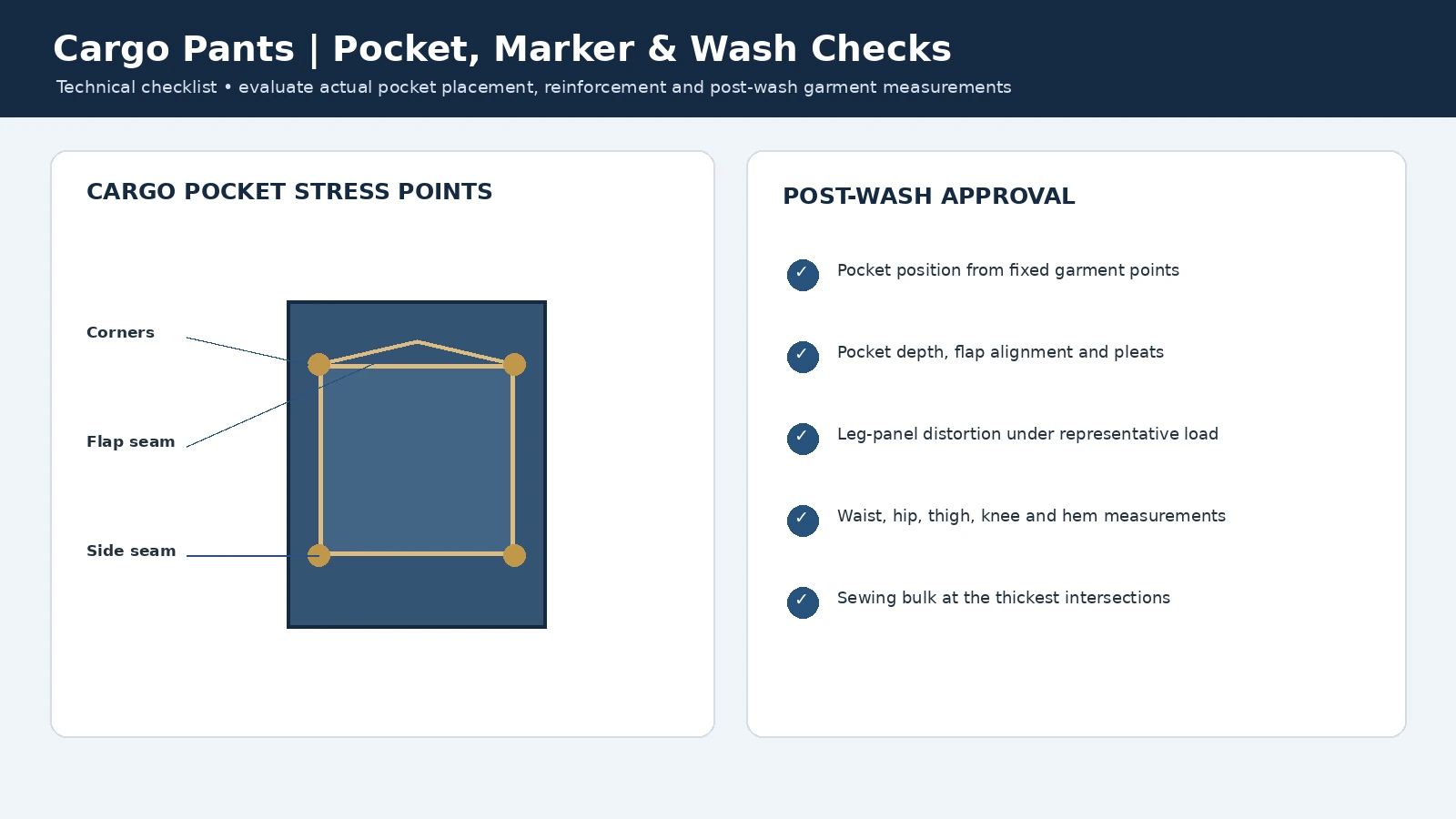
A large cargo pocket has its own dimensions, weight, pleats and attachment points. When objects are placed inside it, the load transfers to the leg panel through the pocket seams.
If the fabric is too flexible for a boxy design, the pocket may lose its intended shape.
If the attachment is poorly engineered, the corners may experience concentrated stress.
Test the Pocket Empty and Loaded
Make a sample garment and inspect the pocket without any contents.
Check whether the pleats and flap hold the approved shape.
Then insert a representative load suited to the product’s actual purpose. Observe how the pocket hangs and whether the surrounding leg panel distorts.
After removing the load, evaluate the pocket’s appearance again.
This test helps the designer distinguish a fabric-body problem from a pocket-pattern or reinforcement problem.
Pocket Corners Need Special Attention
High-stress pocket corners may benefit from bartacks or suitable reinforcement stitching.
Stay tape or additional fabric layers can be considered where appropriate.
However, additional layers can also increase sewing bulk, so the reinforcement should be developed together with the fabric and garment pattern.
5. Heavy Denim Can Create Sewing Problems
C1744 is considerably heavier than the 13oz options.
That makes sewing development especially important for complex cargo pants.
At the thickest intersections, the factory should review needle penetration, stitch formation, feeding consistency and seam appearance.
A sewing method that performs well on a single fabric layer may behave differently when several folded layers meet.
Key Areas to Test
- Cargo pocket corners and flaps
- Side seams beneath attached pockets
- Belt loops and waistband joins
- Crotch intersections
- Double-fold hems
- Reinforcement patches
For a heavyweight design, produce samples containing the maximum expected layer count.
The sewing team can then select suitable needles, thread, stitch density and seam-construction methods before bulk production.
6. Does Heavier Denim Mean Better Durability?
Cargo pants are often associated with durability, but the required performance should follow the intended use.
A fashion cargo pant and a utility trouser intended for demanding work may require very different testing.
A 14.5oz fabric has greater mass per unit area than a 13oz fabric, but that alone is not a complete measure of tear or abrasion performance.
What Buyers Should Evaluate
| Performance Area | Useful Development Check |
|---|---|
| Fabric tensile strength | Resistance to pulling force |
| Tear strength | Resistance to tear propagation |
| Abrasion | Behavior at knees, seat and pocket areas |
| Seam strength | Performance of sewn structural seams |
| Seam slippage | Yarn movement beside stitching |
| Pocket loading | Attachment and garment-panel response |
| Dimensional stability | Finished measurements after washing |
If the product is intended for workwear, define the required performance before approving bulk fabric.
This helps the supplier and factory select the right material and testing program.
7. How Width Changes Cargo-Pants Fabric Cost
Cargo pants usually require more pattern pieces than ordinary jeans because of the added pockets, flaps and reinforcement details.
Those components must all fit within the fabric’s usable width.
HW703 has a recorded width of 180cm. C1744 is narrower at 168–172cm.
The cutting department should calculate actual CAD marker consumption for each fabric rather than compare prices per meter alone.
Hypothetical Cost Example
| Costing Item | 180cm Fabric | 170cm Fabric |
|---|---|---|
| Example usable width | 176cm | 166cm |
| Hypothetical fabric price | $5.10/m | $5.40/m |
| Assumed cargo-pants marker | 1.55m | 1.70m |
| Fabric cost per garment | $7.91 | $9.18 |
These prices and marker results are illustrative, not current ZLDENIM quotations.
The second material costs more per garment in this example because of both the assumed meter price and the higher linear consumption.
The difference becomes significant across a larger production order.
Include Every Pocket Component
When comparing markers, ensure that the factory includes both main leg panels and all additional parts.
A CAD marker based on ordinary five-pocket jeans may underestimate the material required for cargo pants.
Also account for the fabric’s grainline, shade grouping, spreading losses and any unsuitable edge areas.
8. Wash Shrinkage and Pocket Placement
Garment washing affects both the overall size and the appearance of cargo pockets.
If the leg panels change dimension, the pocket may sit differently relative to the knee or side seam.
A softening treatment may also change how the pocket flap hangs.
For C1744, the supplier reference lists lengthwise and widthwise shrinkage values that can help the factory prepare its first test. The final pattern should be adjusted using measurements from the actual approved wash.
For HW703 and HW704, establish the intended wash conditions and measure representative garment samples.
What to Measure After Washing
Record the waist, hip, thigh, knee, inseam and hem dimensions.
Then measure pocket placement from defined garment reference points.
Check pocket depth, flap alignment, pleat appearance and the surrounding leg panel.
When the factory adjusts the base pattern or size grade, it should maintain the intended relationship between pockets and garment dimensions.
This prevents the larger sizes from receiving pockets positioned incorrectly relative to the leg.
9. A Practical Rigid vs Low-Stretch Approval Process
Start with one approved cargo-pants design.
Make representative samples using the selected rigid and low-stretch fabrics.
Evaluate pocket structure and garment movement before washing.
Then wash the garments under the intended production process and compare the finished results.
For low-stretch options, include growth and recovery checks.
For rigid options, focus on pattern ease, structure and sewn seam performance.
Finally, calculate the fabric cost per approved garment using the real cutting marker and actual quotation.
The best choice is the fabric that meets the design requirements while remaining practical for the factory to produce.
10. Request Cargo-Pants Denim from ZLDENIM
A sourcing inquiry should explain the intended garment, not just request the heaviest available denim.
We are developing relaxed denim cargo pants with large thigh pockets and a structured workwear appearance.
We would like to compare HW703 and C1744 rigid denim with HW704 low-stretch denim.
Please advise current available colors, sample options, usable widths, fabric quantities and quotation terms.
Our factory will evaluate pocket structure, sewing bulk, washed dimensions and CAD marker consumption before bulk approval.
Estimated quantity: [meters]. Destination: [country].
Send Your Cargo-Pants Fabric Requirement
Frequently Asked Questions
Is rigid denim better than low-stretch denim for cargo pants?
Rigid denim is often a useful starting point for structured, relaxed cargo pants. Low stretch may be preferable when the garment needs added flexibility around the hips or knees.
What weight denim works best for cargo pants?
For many everyday utility designs, 10–13oz is a useful sampling direction. Heavier constructions may suit structured streetwear and vintage workwear styles.
Does a large cargo pocket require heavyweight denim?
Not necessarily. Pocket shape depends on fabric body, pocket dimensions, reinforcement and attachment construction.
Is 14.5oz denim too heavy for cargo pants?
It can work for a heavyweight design. Test the garment’s comfort, pocket bulk and sewing method before production.
Does low-stretch denim prevent pocket sagging?
Not automatically. The factory should evaluate fabric growth, recovery and the actual pocket design.
How can buyers reduce fabric cost for cargo pants?
Use accurate cuttable widths and CAD markers that include all pocket pieces. Compare the resulting fabric cost per garment rather than only the price per meter.
Find Denim Fabric for Cargo Pants
A successful denim cargo pant needs the correct balance of fabric structure, comfort, pocket performance and manufacturing cost.
Compare HW703 Rigid Denim, HW704 Low-Stretch Denim and C1744 Heavy Cotton Rigid Denim.
You can also browse Cotton & Rigid Denim and Stretch Denim.
For samples, quantities and quotations, contact ZLDENIM Sourcing.