
A jeans brand is developing two styles: a classic straight-leg jean and a heavyweight relaxed jean. Both require 100% cotton rigid denim, but the designer is choosing between a 12oz fabric and a 14.5oz fabric.
At first, the decision appears straightforward. The heavier fabric should create a more substantial garment, while the lighter option should feel easier to wear.
But purchasing decisions are rarely that simple. A heavier denim may also be narrower, require a different cutting marker, create more bulk at the seams and change the finished cost per pair.
When comparing 12oz vs 14oz denim fabric, buyers should calculate the finished garment result—not just compare ounce weights.
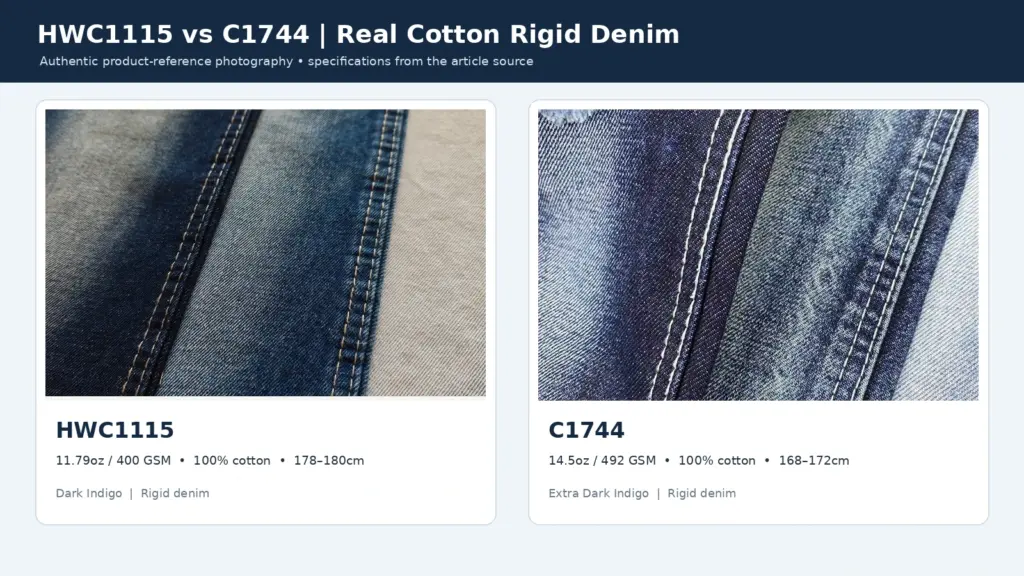
Using two actual ZLDENIM products, HWC1115 and C1744, this guide shows how to select rigid denim for straight-leg, relaxed and workwear-inspired jeans.
1. What Changes Between 12oz and 14.5oz Rigid Denim?
Denim weight is measured in ounces per square yard (oz/yd²) or grams per square meter (GSM). It describes how much the fabric weighs per unit area.
A heavier fabric generally adds more material mass to the garment. However, weight alone does not fully describe bending stiffness, surface texture or comfort.
Two rigid denims can have different handfeels because of their yarn count, weave density, yarn twist and finishing.
For jeans development, buyers should compare weight alongside fabric body, color, surface character and washed-garment behavior.
Around 12oz: Everyday Structure
A 12oz-class rigid denim is a useful starting point for classic straight-leg jeans, relaxed trousers and structured casual jeans.
It can provide a traditional denim appearance without the extra mass of a substantially heavier construction.
For a garment intended for everyday wear, this weight range may be easier to develop around the seat, knees, waistband and hems.
Around 14.5oz: A More Substantial Garment
A 14.5oz rigid denim is worth considering for heavyweight straight-leg jeans, vintage-inspired wide-leg styles and garments with a pronounced workwear character.
It adds fabric mass and can support a substantial visual appearance, depending on its construction and finish.
The factory should examine the resulting stiffness, seam bulk and movement after washing. A heavy fabric that looks impressive on a hanger still needs to work when the wearer sits and bends.
2. HWC1115 vs C1744: Real Fabric Comparison
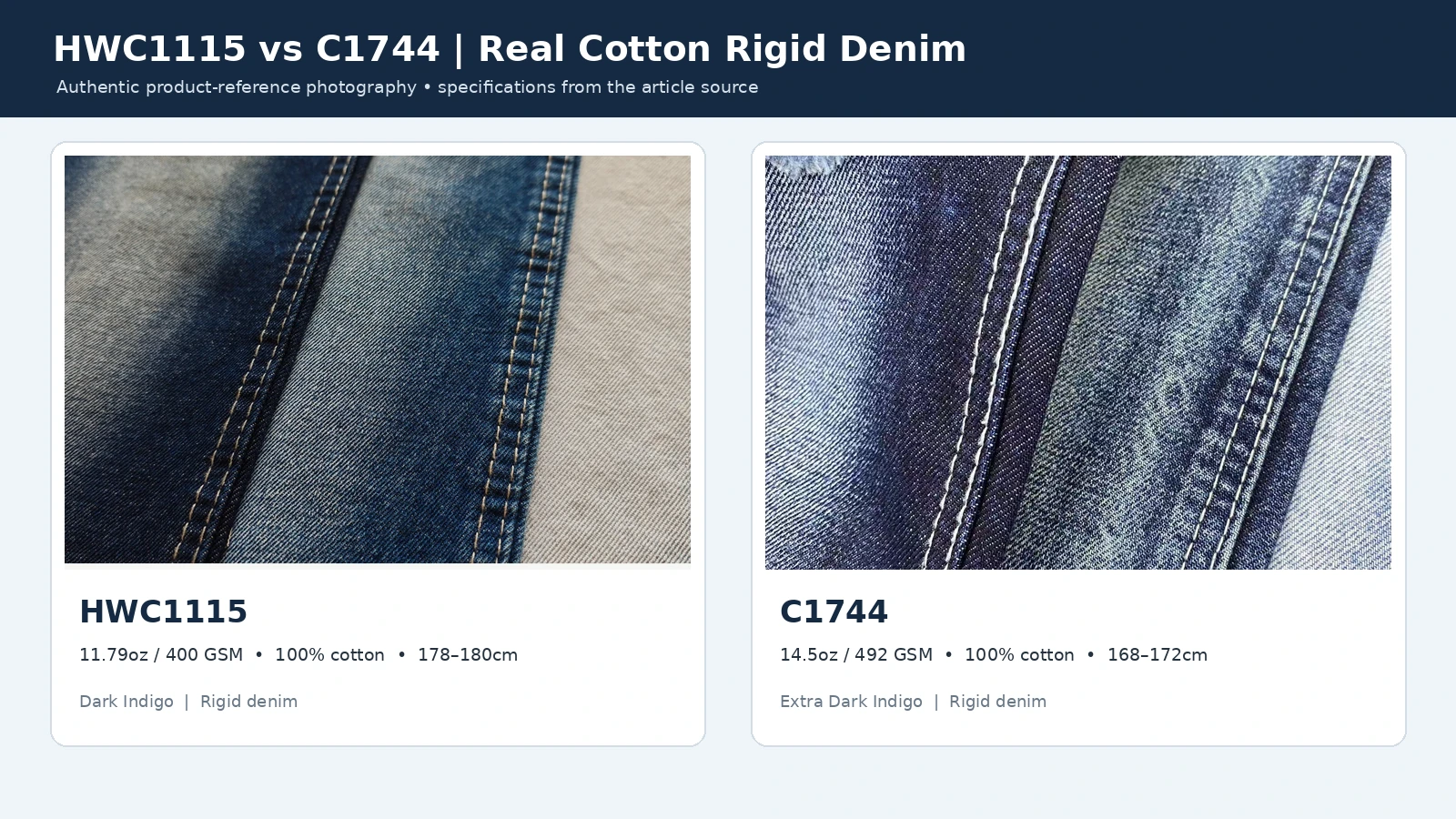
ZLDENIM offers two relevant 100% cotton rigid denim references.
| Specification | HWC1115 | C1744 |
|---|---|---|
| Weight | 11.79oz / 400 GSM | 14.5oz / 492 GSM |
| Composition | 100% cotton | 100% cotton |
| Stretch | Rigid | Rigid |
| Recorded width | 178–180cm | 168–172cm |
| Color | Dark Indigo | Extra Dark Indigo |
| Fabric structure | Clean 3/1 right-hand twill | Non-slub twill |
| Initial garment direction | Straight, relaxed and everyday jeans | Heavy straight, relaxed and heritage jeans |
| Key production check | Shape, cuttable width and washed fit | Marker yield, seam bulk and washed fit |
The weight difference is approximately 92 GSM. C1744 is also supplied in a narrower recorded width range.
These differences affect more than handfeel. They can change the cutting layout and the amount of fabric the factory needs to purchase for the same garment order.
HWC1115 — 12oz-Class Cotton Rigid Denim
View HWC1115 – 100% Cotton Rigid Denim
HWC1115 has a recorded finished weight of 400 GSM, approximately 11.79oz, and a width of 178–180cm. Its clean 3/1 right-hand twill and dark-indigo appearance make it a candidate for classic straight-leg and relaxed jeans.
For a brand developing an everyday five-pocket jean, begin by testing how the fabric holds its leg shape after the intended wash.
The cutting department can then make a CAD marker using the usable width of the actual supplied roll.
C1744 — 14.5oz Extra-Dark Indigo Rigid Denim
View C1744 – 14.5oz Extra Dark Indigo Cotton Denim
C1744 is a 14.5oz, approximately 492 GSM, 100% cotton rigid denim with a non-slub twill structure and an extra-dark indigo shade. Its recorded width is 168–172cm.
It is a useful candidate for heavier, structured straight-leg or relaxed jeans where the garment design calls for a substantial denim body.
When developing C1744, inspect the thickest seam intersections early, especially at the waistband, fly, belt loops and hems.
This helps the factory identify whether the approved sewing construction and machinery can handle the planned fabric layers.
3. Which Denim Weight Works for Different Jeans Fits?
Classic Straight-Leg Jeans
For a straight-leg jean with moderate ease, HWC1115 is a practical first sample.
Its 12oz-class weight provides a useful middle ground for traditional jeans development.
Use a washed sample garment to evaluate the line from hip to hem and the comfort around the seat and knee.
C1744 can also work, particularly if the brand wants a heavier, more structured appearance. The pattern may require additional attention to sitting comfort and fold bulk.
Relaxed and Wide-Leg Jeans
Both fabrics can work for relaxed cuts.
If the designer wants softer folds and more natural movement, begin with HWC1115. If the concept calls for heavier folds and a more pronounced vintage silhouette, compare C1744.
A wide leg is not automatically better in heavy denim. Its appearance depends on the relationship between pattern width, fabric stiffness and garment length.
Heavy Workwear-Inspired Jeans
For substantial utility-inspired jeans, C1744 is worth sampling first.
Its heavier construction can contribute to the intended visual character. The development team should then assess movement, seam bulk and the actual strength requirements.
For workwear applications, fabric strength and abrasion performance should be assessed through the relevant tests, rather than inferred from weight.
4. The Width Difference Can Change Your Fabric Cost
This is one of the most important purchasing considerations.
HWC1115 is recorded at 178–180cm, while C1744 is recorded at 168–172cm. That means the pattern maker may have a different amount of horizontal space for nesting garment pieces.
Fabric Cost per Pair = Price per Linear Meter × CAD Marker Consumption per Pair
The formula is simple, but the inputs matter.
A Hypothetical Cost Comparison
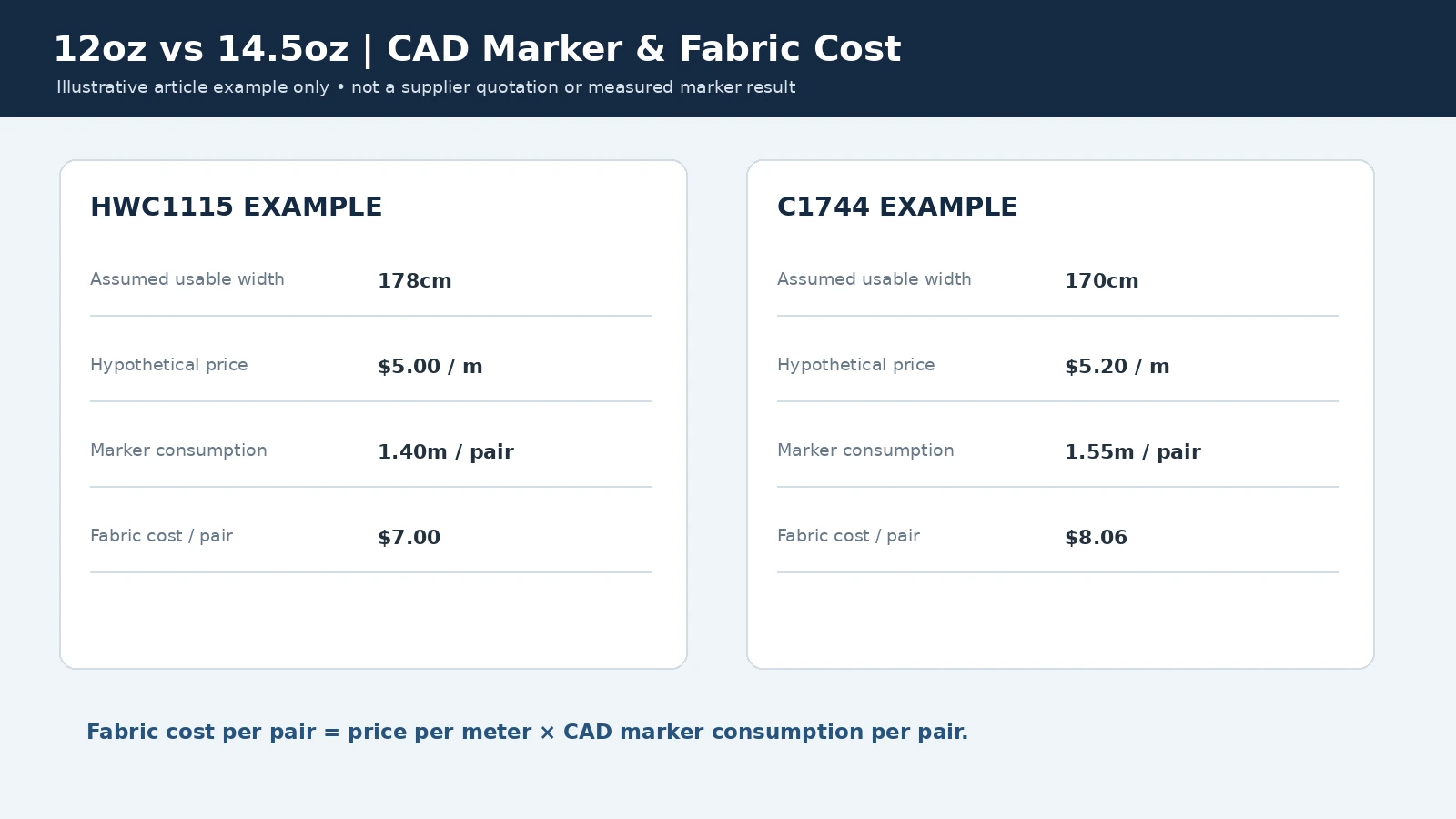
Assume the factory develops a jeans pattern and obtains the following illustrative results.
| Costing Item | HWC1115 Example | C1744 Example |
|---|---|---|
| Assumed usable width | 178cm | 170cm |
| Hypothetical price per meter | $5.00 | $5.20 |
| Hypothetical marker consumption per pair | 1.40m | 1.55m |
| Fabric cost per pair | $7.00 | $8.06 |
| Fabric cost for 1,000 pairs | $7,000 | $8,060 |
All prices and marker consumptions above are hypothetical. They are not ZLDENIM quotations or measured CAD results.
In this illustration, the heavier denim costs $1.06 more per pair. Across 1,000 pairs, the difference is $1,060 before considering sewing, washing and other production costs.
Part of the difference comes from the assumed meter price, and part comes from the cutting consumption.
This is why buyers should ask the factory to run separate CAD markers for the two actual fabrics.
How to Improve the Comparison
Use the same garment design, size ratio and cutting restrictions. Measure the actual cuttable width after excluding unsuitable edges, then calculate marker consumption separately.
The wider material may allow better nesting of front legs, back legs and smaller components, but the actual result depends on the pattern geometry.
Do not assume that a 10cm width difference produces a fixed percentage saving in every jeans style.
5. Heavy Denim Creates Different Sewing Challenges
A 14.5oz fabric introduces more mass into the garment and can create additional bulk where several layers overlap.
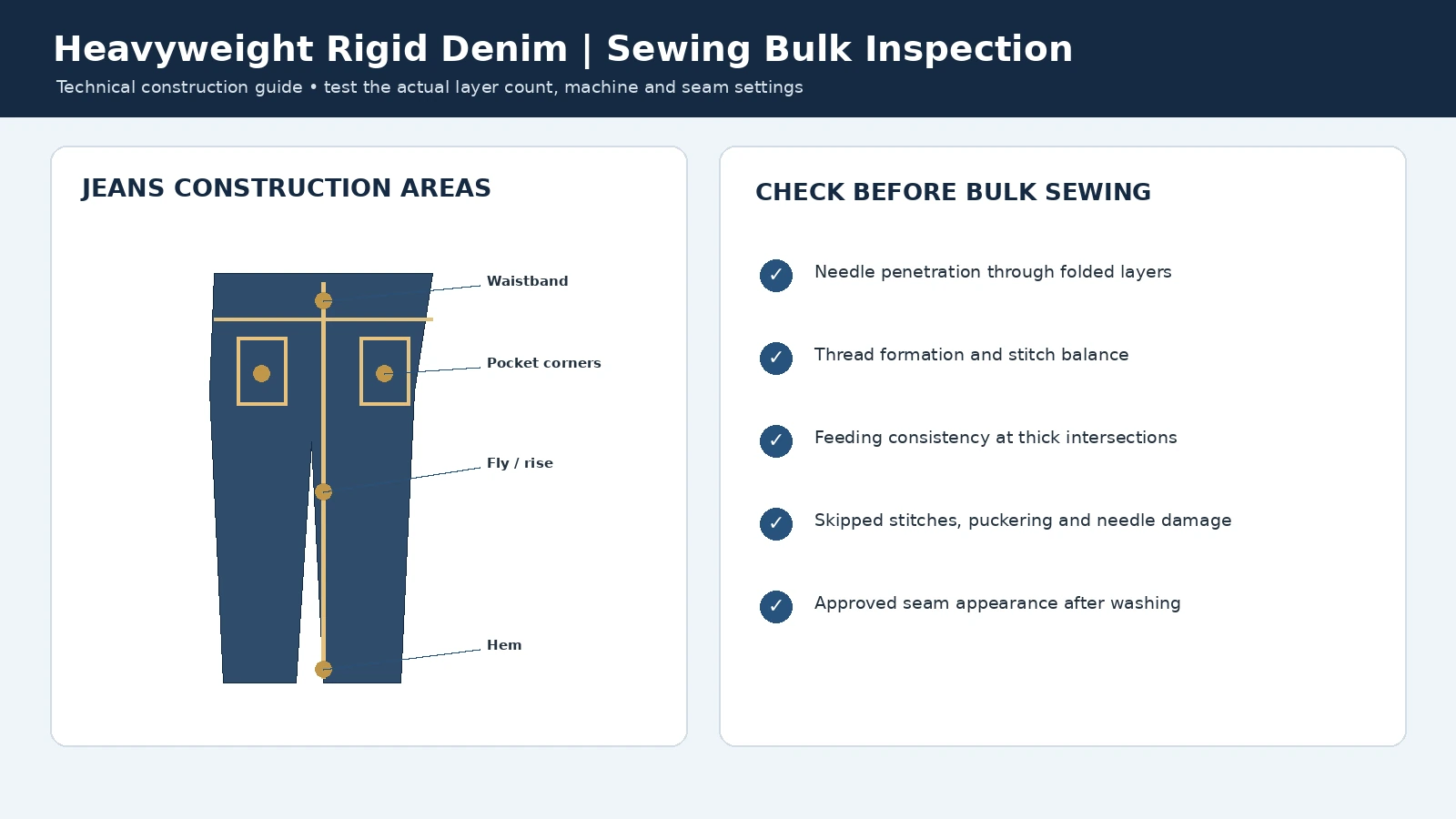
The cutting and sewing teams should examine these areas during sample development:
- Waistband joins and belt-loop attachments
- Fly construction and zipper area
- Pocket corners and yokes
- Inseam and outseam intersections
- Double-fold hems
For C1744, test the proposed needle, thread, stitch density and seam construction before bulk sewing. Check whether the machines feed multiple layers consistently and whether any needle damage or puckering appears.
HWC1115 also requires appropriate sewing settings, but its lighter construction may make some multilayer assemblies easier to manage.
The goal is to select a sewing process suited to the actual fabric rather than apply one machine setup to every rigid denim.
6. Shrinkage, Pattern Allowances and Washed Fit
Rigid denim changes dimensions during washing and relaxation. That can influence the waistband, leg length, hip and thigh measurements.
For HWC1115, the published reference lists approximately 3% warp and 3% weft shrinkage. C1744’s supplier reference lists 4% lengthwise and 2% widthwise shrinkage, each with a stated tolerance of ±2 percentage points.
These figures help plan the first test, while the intended garment wash determines the final approved pattern allowances.
A Practical Pattern Calculation
If a fabric contracts by 4% lengthwise under the approved test conditions, a panel expected to finish at 80cm would need a theoretical pre-wash length of:
80cm ÷ (1 − 0.04) = 83.33cm
This is a simplified dimensional calculation. Real garments also involve seam construction, measurement points, finishing and fitting requirements.
The factory should record pre-wash and post-wash garment measurements for each size, then adjust the base pattern and grade rules as necessary.
A shrinkage result from one fabric should not be applied automatically to the other.
7. How to Run a Two-Fabric Development Test
To decide between HWC1115 and C1744, develop two representative jeans samples using the intended pattern, wash and finishing direction.
First compare the original fabric body and the cutting marker. Next sew the garments and evaluate seam thickness and construction. Then wash both according to the approved process and check dimensions, drape and comfort.
The final purchasing decision should consider three things together: the desired silhouette, the factory’s production capability and the actual fabric cost per approved garment.
A fabric that offers the right appearance at a manageable production cost is more useful than one selected on ounce weight alone.
8. What Buyers Should Request from ZLDENIM
Send a short technical brief rather than simply asking for a 12oz or 14.5oz price.
We are developing men’s straight-leg and relaxed rigid jeans. We would like to compare HWC1115 and C1744 in 100% cotton.
Please provide available shades, current roll quantities, nominal and usable widths, sample options and price per meter.
Our factory will compare CAD marker consumption, washed garment dimensions and seam bulk before selecting the fabric for bulk production.
Target quantity: [meters]. Destination: [country].
Send Your Fabric Inquiry to ZLDENIM
Frequently Asked Questions
Is 14.5oz denim better than 12oz denim?
Not universally. The heavier fabric may better suit a substantial garment, while 12oz-class denim can be a stronger choice for everyday comfort and easier construction.
Does heavier denim always cost more per pair?
No. Price per meter and cutting consumption determine the base fabric cost. Compare actual quotations and CAD markers.
Is 12oz denim suitable for straight-leg jeans?
Yes. It is a useful starting weight for structured everyday straight-leg jeans.
Is 14.5oz denim suitable for wide-leg jeans?
Yes, particularly when the design calls for substantial body. Evaluate the finished drape, fold structure and comfort.
Which is better for workwear-inspired jeans?
Both may work. Choose according to the visual concept and test the actual strength, seam and abrasion requirements for the intended use.
Can the same pattern be used with both weights?
Use the same design brief, but recheck washed dimensions, ease, sewing bulk and pattern allowances for each fabric.
Compare Cotton Rigid Denim with ZLDENIM
The right rigid denim is the fabric that produces the intended jeans silhouette at an acceptable total production cost.
Start with HWC1115 if you want a clean, 12oz-class cotton rigid denim. Evaluate C1744 if the collection needs a heavier, extra-dark indigo construction.
Explore HWC1115 and C1744, or review the Cotton & Rigid Denim Collection.
For available rolls, samples and quotations, contact ZLDENIM Sourcing.