
You are developing a new jeans collection. The fabric sample looks suitable, but you are not ready to purchase thousands of meters. Perhaps you need enough for the first 50 or 100 garments. Maybe an independent clothing brand is testing a new color, or a garment factory needs a small quantity to complete an order.
Can you buy one or two denim fabric rolls from China?
Yes, buying denim fabric by the roll can be possible—but it depends on available stock, how the fabric is packed and the shipping arrangement. A fresh mill production order and an existing warehouse-stock purchase are different transactions. Understanding that difference is the first step to a practical small-volume import.
Buying Denim by the Roll: Can You Start with One Roll?
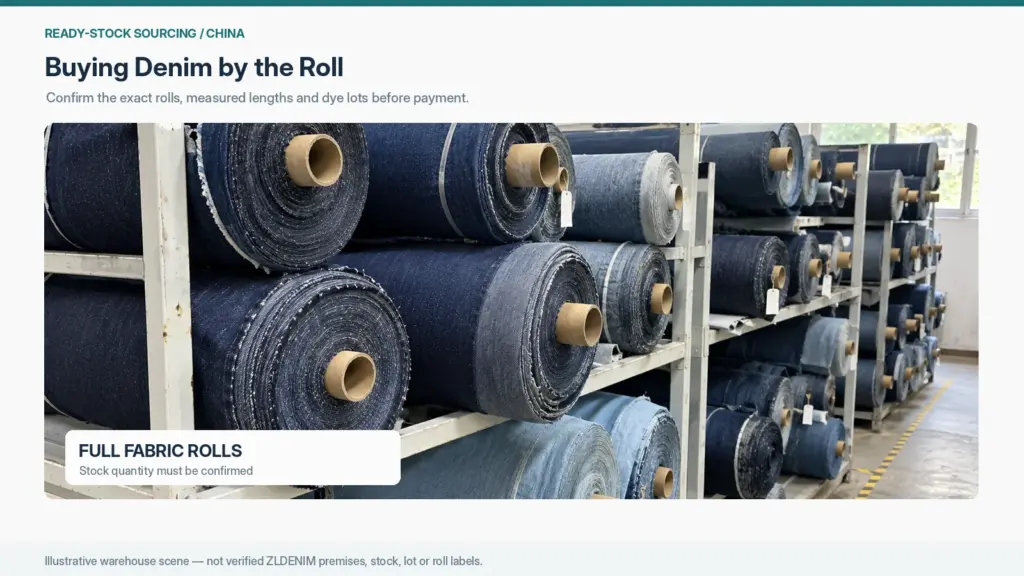
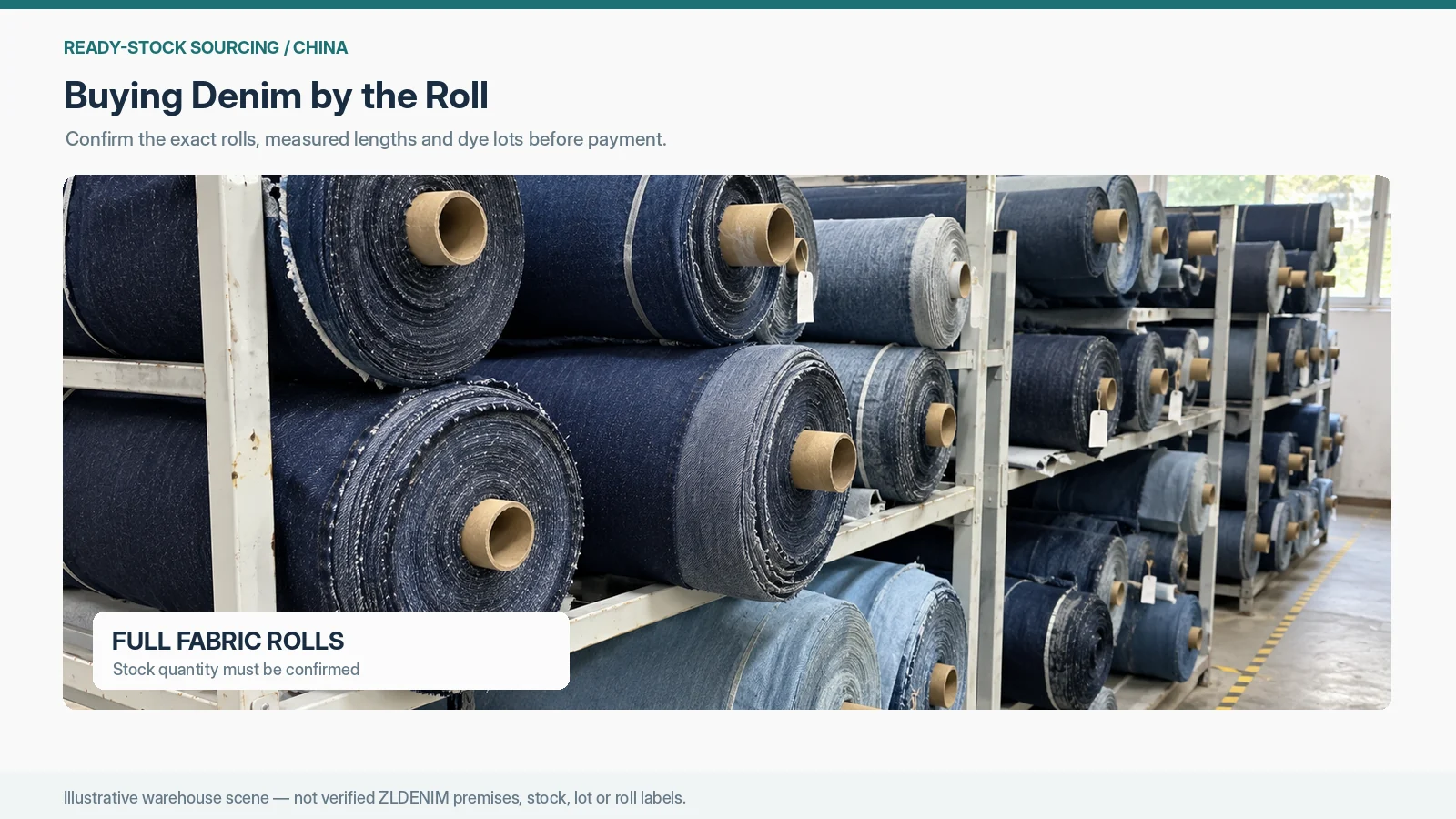
Denim is commonly wound onto rolls for storage and transportation. Each roll contains a measured length of fabric around a core. There is no universal length, width, gross weight or package size for every roll.
Is One Denim Roll Always 100 Yards?
No. About 100 yards is a useful illustrative size for some denim stock, but not a standard requirement. A hypothetical 100-yard roll contains 91.44 meters because 1 yard equals exactly 0.9144m. Another roll of the same fabric may have a different actual measured length.
The buyer should confirm whether pricing is by one complete roll, actual measured yards or actual measured meters. The order confirmation should also address short lengths, splices or other roll conditions when relevant. “One roll of blue denim” alone is not a complete purchase description.
2. Is There a Minimum Order Quantity?
MOQ depends on the supply model.
Ready-Stock Denim
Ready-stock material has already been produced and may be available through a warehouse or supplier network. It need not trigger a new weaving run for a small order, so an individual roll or a few rolls may be practical for some styles. However, availability is confirmed for the exact fabric, color, lot and quantity, not assumed from the online listing.
New Mill Production
A specially produced construction or color may require fresh yarn preparation, dyeing, weaving or finishing. That can create new-production minimums, development expense and lead time. Buyers should not expect the same practical quantity as an existing-stock purchase.
ZLDENIM’s Available-Stock Model
ZLDENIM works with ready-stock denim from available warehouses and its sourcing network. Available stock does not have a fixed new-production MOQ, but that does not mean every style is offered in arbitrary cut lengths. As a general business practice, full rolls are preferred, with cut sampling or other small quantities subject to the actual fabric and agreed terms.
The website is not a live stock ledger. Ask the team to confirm whether the selected fabric can be supplied as one complete roll, multiple rolls or an available sample quantity. See ZLDENIM Ready-Stock Denim. Buyers can also review HWC1115 12oz cotton rigid denim as a real catalog specification before asking about current rolls and lot availability.
3. How Much Fabric Do You Actually Need?
The cutting room should calculate expected consumption from the actual garment pattern and size ratio.
Required Fabric Length = Number of Garments × Approved Marker Consumption per Garment, plus the factory’s justified production allowances.
For example, suppose a factory plans 50 pairs of jeans at a hypothetical marker consumption of 1.40m per pair. The theoretical requirement is 70 meters. If an available roll contains 91.44 measured meters, it may provide enough base fabric. But the factory must still account for spreading losses, defects, shrinkage-related pattern allowances and required spare material.
A 150cm fabric and a 180cm fabric may produce different marker consumption. Do not assume that rolls with the same total length will cut the same number of jeans. Confirm usable width and the actual CAD marker; see the Denim Fabric Width Guide.
How Order Size Changes the Cost Structure
The same fabric can produce a very different landed cost when the order changes from one roll to five rolls or a larger multi-roll shipment. Compare the complete shipment, not only the quoted price per meter.
- One roll: documentation, origin handling, customs clearance and final delivery are spread across a small quantity. Courier, air freight or consolidation may be practical, but the roll’s packed weight and dimensions must be checked before choosing the route.
- Five rolls: fixed charges are distributed across more meters, but the buyer should still request the roll-by-roll length, dye-lot breakdown, gross weight and package dimensions. Five available rolls are not automatically one shade-compatible production lot.
- A larger multi-roll order: compare available stock, consolidated freight and a new-production quotation as separate options. The lowest ex-warehouse price is not necessarily the lowest cost after transport, inspection, financing and unusable material are included.
Landed Cost per Usable Meter = (Fabric + Packing + Origin Charges + Freight + Insurance + Destination Charges) ÷ Usable Meters Received
Before confirming the order, send the garment type, target construction, usable-width requirement, approved marker consumption, quantity, destination city and required delivery date. Ask the quotation to state the currency, pricing unit, validity period, payment terms, named delivery place and Incoterms rule and version. For available stock, also request the measured length of each proposed roll and the packed shipment details needed for a freight quotation.
4. Can You Request Samples Before Buying?
Yes. Sampling is an important part of international fabric purchasing. Photographs cannot reliably communicate all relevant handfeel, construction or garment-wash behavior.
Swatches and Sample Cards
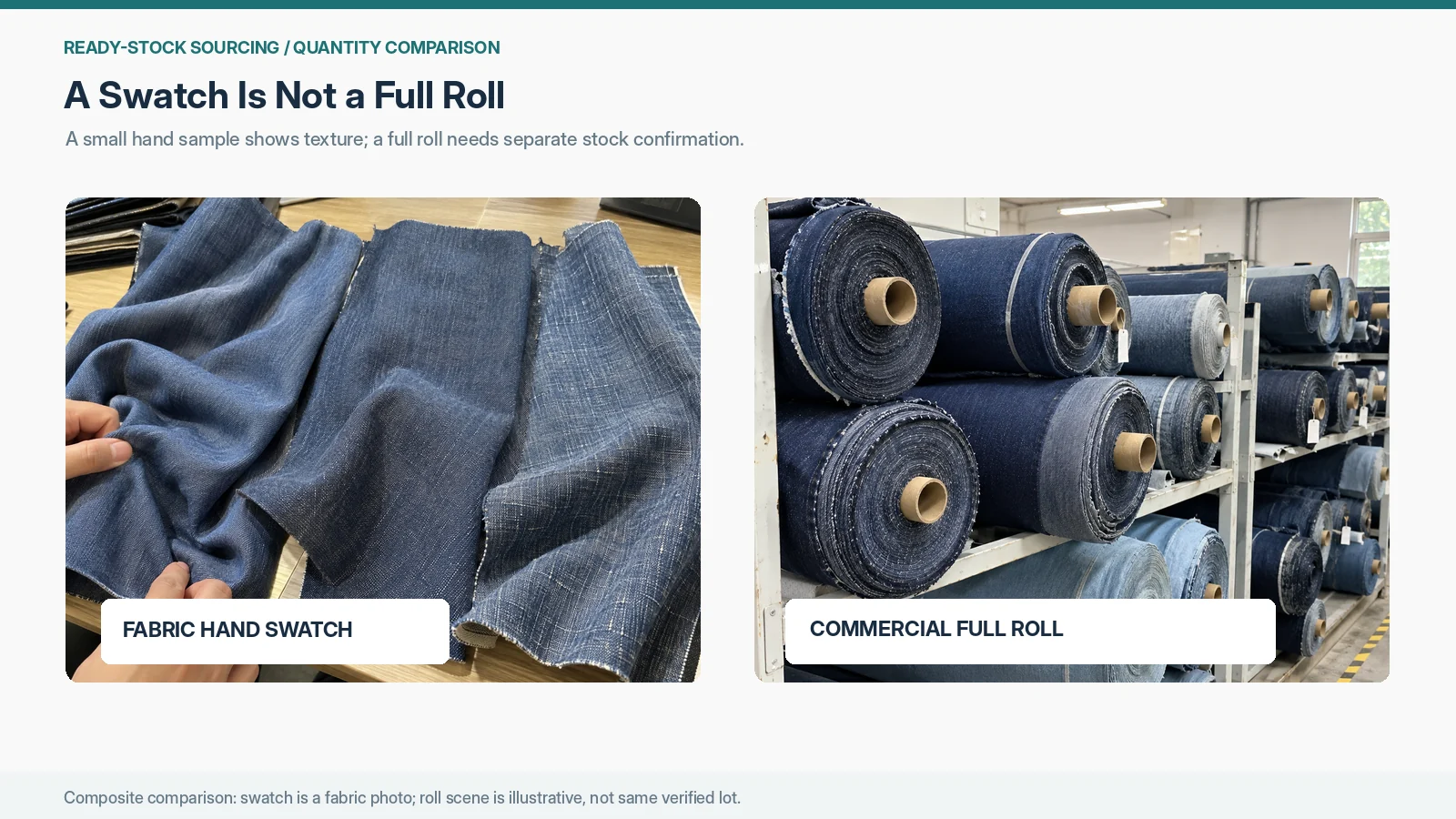
A small fabric swatch allows buyers to assess color, surface texture, construction and initial handfeel. It does not reliably represent every performance requirement or the full range of bulk roll variation.
Sample Yardage
Cutting, sewing, washing and fitting a garment may require more material than a small swatch. Tell the supplier whether you need a hanger sample, swatch, approximately one meter or enough yardage for a sample garment. The supplier can then confirm whether the selected stock can be sampled and under what terms.
ZLDENIM can check available swatches and sample yardage for selected products. Sampling charges, available amounts and courier charges must be confirmed for the actual inquiry. Review ZLDENIM Samples.
What Should the Sample Test Show?
For jeans, confirm composition and weight, shade, fabric surface, stretch and recovery where relevant, usable width, shrinkage and washed appearance. A rigid and a stretch fabric with similar colors may create different fits and need different pattern allowances.
5. Confirm the Actual Stock Lot Before Ordering
A product page describes a fabric option; it does not prove that a particular physical roll is currently reserved for you.
| Purchase item | What the buyer should confirm |
|---|---|
| Style reference | Exact supplier or internal fabric number |
| Color | Approved shade or reference swatch |
| Fiber composition | Cotton, polyester, lyocell or elastane percentage |
| Finished weight | GSM or oz/yd² and measurement basis |
| Width | Nominal width and minimum usable width |
| Roll count and lengths | Number of physical rolls and measured quantity of each |
| Lot traceability | Dye lot and roll numbers when available |
| Quality condition | Agreed inspection and acceptance requirements |
| Quantity and unit | Meters or yards to be invoiced |
Two rolls of the same style can still differ in shade, even within a related production batch. If the fabric will be washed, evaluate compatible shades where needed and keep roll identities through cutting. A matching fabric code alone is not proof that different rolls will produce identical garments.
6. How Are Denim Rolls Shipped Internationally?
The shipping method depends on roll count, packed weight, dimensions, destination and urgency. Freight can be a substantial part of a small purchase.
Option A: Courier or Air Freight
International courier or air service can suit samples or urgent small shipments, but a complete roll may be heavy or oversized. For illustration, a 100-yard roll of 373 GSM denim at a 1.70m full width contains about 58kg of fabric before packaging if those figures apply throughout the roll. Actual carrier charges can depend on actual or volumetric weight.
Do not estimate full-roll freight from a 0.5kg swatch-envelope price. Request a quotation using the packed gross weight and dimensions.
Option B: LCL Sea Freight
Less-than-container-load (LCL) service combines smaller shipments with other cargo. It can be worth evaluating when the order is too large for economical courier service but does not justify a full container. LCL may involve origin and destination handling, documentation, customs and onward-delivery costs. With one or two rolls, fixed charges can make the total expensive even when the quoted sea freight rate looks low.
Option C: Consolidation With Other Goods
If the buyer already imports fabric, trims or garments from China, combining the denim rolls with another shipment may reduce duplicated handling or freight charges. A nominated freight forwarder or consolidation warehouse in China may coordinate the receipt. All commercial, export and customs requirements still need to be met.
7. Should the Buyer Use a Freight Forwarder?
Both parties can help coordinate transport, but the importer should understand the agreed responsibilities.
If the buyer already has a China-based forwarder or consolidation address, the seller can discuss delivery to that nominated location under a suitable contract. This is often practical for a buyer combining purchases from several suppliers.
If the buyer has no forwarder, ask whether the seller can obtain a courier or freight estimate or recommend a suitable logistics route. A supplier should not promise a delivered price without the actual destination, gross weight, shipment details, customs responsibilities and delivery term.
Is FOB Suitable for One or Two Rolls?
FOB (Free On Board) under Incoterms 2020 is intended for appropriate sea and inland-waterway transport when the seller delivers the goods on board a vessel at the named port. It is not a generic synonym for “seller arranges shipping.” For delivery to a carrier or forwarder’s warehouse, FCA (Free Carrier) may better describe the transaction. If seller-arranged carriage is required, CPT, CIP or DAP might be considered depending on agreed responsibilities.
Always name the delivery place, the Incoterms rule and version. FOB does not automatically include international freight, import duty or last-mile delivery. For small imports, compare the total landed cost, not only the ex-warehouse or port quotation.
8. What Documents Might Be Required?
Documents depend on destination and shipping method. Typical items can include commercial invoice, packing list, transport document or waybill and customs information. Additional documentation depends on the importer’s country and rules.
A useful roll packing list identifies style, color, roll count, measured quantity, gross weight and package dimensions. Include relevant roll and dye-lot references where available. Confirm destination-specific requirements with the buyer’s customs broker or freight forwarder before dispatch.
9. What to Check Before Payment
A clear proforma invoice or order confirmation should cover the exact fabric and shade, actual physical rolls, invoice unit, price, stock availability, sampling and quality terms, named delivery term, freight responsibility and agreed payment process.
Avoid paying against an informal statement that only says “one roll denim.” Verify seller identity and the receiving company’s payment details through agreed business channels. If the original swatch and bulk lot differ, establish what constitutes approval and how discrepancies will be handled before the order ships.
10. A Practical First Roll Order With ZLDENIM
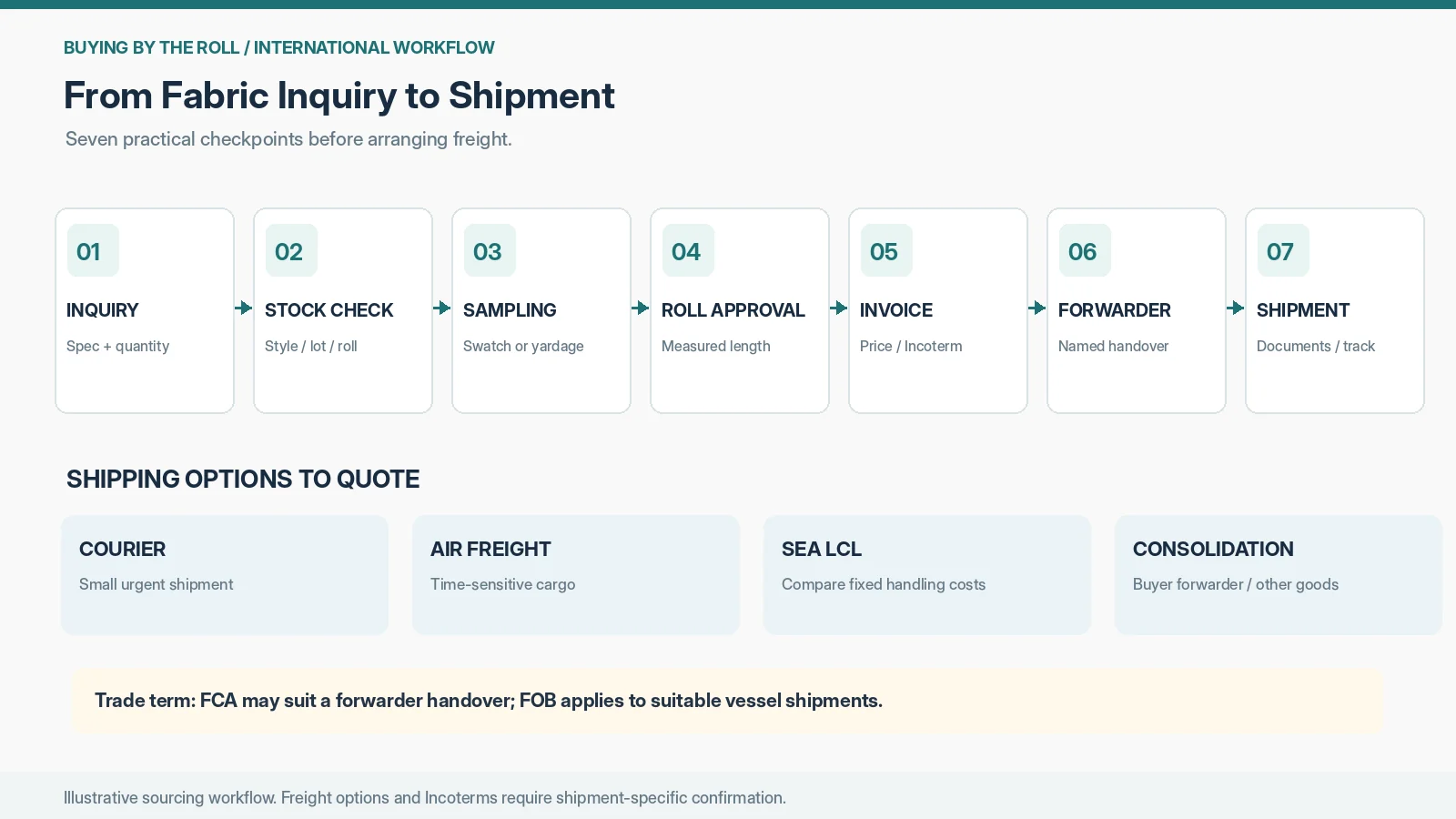
Imagine a clothing brand needs one or two rolls of 11–12oz dark-indigo denim for straight-leg jeans. A practical sequence is:
- Send your requirements: weight, color, composition, stretch level, quantity, destination and garment use.
- Check stock: ZLDENIM identifies suitable options from available warehouses or sourcing partners.
- Review samples: approve available swatches or sample yardage for the garment project.
- Confirm exact rolls: verify lengths, lots, usable width and measured quantity.
- Agree on shipping: discuss the buyer’s forwarder or suitable freight estimate and named delivery term.
- Confirm the order: approve the invoice, payment terms and required documentation before dispatch.
This avoids treating the online fabric catalog as guaranteed live inventory.
Example Email to Request One or Two Rolls
Hello, we are a clothing brand developing straight-leg jeans and would like to buy one or two rolls of denim fabric from China. Our target is 11–12oz dark indigo, rigid or low stretch, with a medium-firm hand. Please confirm current styles, actual roll lengths, composition, usable width and price per meter or yard. We would also like swatches or sample yardage before placing the roll order. Our destination is [city and country]; we can discuss delivery to our nominated forwarder in China if appropriate. Please advise on current stock, terms and shipping arrangements.
A reference garment photograph or fabric swatch can help identify a more suitable construction.
Frequently Asked Questions
Can I buy just one roll of denim fabric from China?
For some available-stock products, yes. Confirm the exact style, quantity and terms with the supplier.
How many meters are in one denim roll?
There is no universal length. A hypothetical 100-yard roll equals 91.44m, but real roll lengths vary.
Can I buy denim without a large mill MOQ?
Existing stock may support small orders without starting new production. Custom mill manufacturing may have different minimums.
Can I request samples before a roll purchase?
Yes, subject to sample availability and the supplier’s confirmed terms. Explain whether you need swatches or material for sewing and washing.
Is it economical to ship only one roll internationally?
It depends on packed weight, dimensions, destination, carrier and customs costs. Compare courier, LCL and consolidation by total landed cost.
Is FOB appropriate for one or two rolls?
FOB can be suitable for a qualifying vessel-based delivery. For goods handed to a carrier or forwarder before loading, FCA or another appropriate term often fits better.
Are all ZLDENIM catalog fabrics immediately in stock?
No. The online catalog is not real-time inventory. Current quantities and lot details are confirmed for each enquiry.
Buy Denim Fabric by the Roll With ZLDENIM
Buying by the roll can support garment development, smaller production programs and replenishment. Confirm the exact material, roll lengths, stock lot and delivery arrangement before payment.
Browse the ZLDENIM Fabric Catalog, read about Ready-Stock Denim, request Samples, or send a request through ZLDENIM Sourcing. We can help check suitable options and practical shipping arrangements. Current quantities, sample terms, prices and transport arrangements are confirmed individually.
Pingback: Ready-Stock Denim Fabric: Benefits & Buying Checks